

Executive Overview
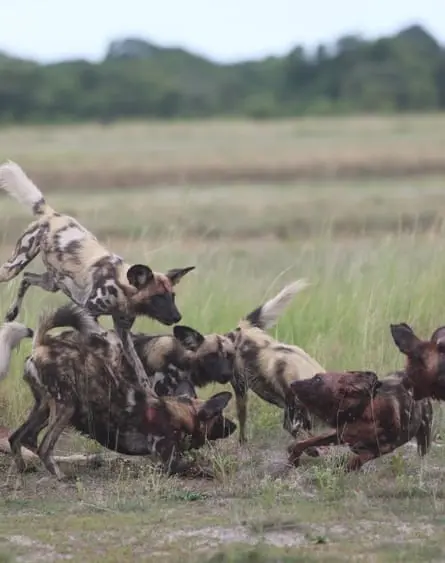
In the wild, coming of age is rarely a gentle transition. For the endangered African wild dog (Lycaon pictus), maturity demands a perilous leap into the unknown known as "dispersal." When young adults outgrow their natal packs, they are pushed out to seek new territories, find unrelated mates, and establish entirely new dynasties. Yet, the journey undertaken last year by three brothers in Zambia transcends the typical boundaries of wildlife biology.
Traversing an astonishing cumulative distance of more than 2,500 miles (4,100 kilometers) over an eight-month span, these three male African wild dogs shattered the record for the longest single-mammal dispersal journey ever recorded on the African continent. Their epic odyssey—stretching from the lush grasslands of Kafue National Park in western Zambia to the rugged terrain of the Luangwa Valley in the east—took them through a gauntlet of human infrastructure, speeding traffic, stealthy bushmeat snares, and heavily populated agricultural regions.
Published in the journal Ecology by researchers from the Zambian Carnivore Programme (ZCP), this incredible trek provides both a breathtaking narrative of survival and a stark scientific warning. As human development increasingly fractures and fragments African ecosystems, the survival of apex predators hinges precariously on the existence of invisible, fragile ecological corridors. These three brothers have proven that nature’s ancient pathways still function, but conservationists warn that without urgent international protection, these corridors may soon close forever.
Detailed Chronology: An Eight-Month Odyssey Across Zambia
The saga began in the western expanses of Kafue National Park, one of Africa’s premier conservation areas. Here, a pack of African wild dogs raised a litter that included a trio of brothers and a parallel group of sisters. As the natural lifecycle progressed, tensions within the pack dictated that the young adults must part ways. In search of a future, the siblings left their natal home, stepping into a landscape that has been profoundly altered by human hands.
The Launch and the Copper-Belt Encounter
Setting out toward the east, the brothers and their sisters initially moved through the mosaic of protected lands and buffer zones. However, dispersal is fraught with hazards, and the siblings soon separated as they navigated the complexities of unfamiliar terrain.
Two months into their journey, fate intervened. Deep within Zambia’s heavily industrialized and populated Copperbelt mining region—an area fraught with sensory overstimulation, human settlements, and vehicular traffic—the paths of the brothers and sisters crossed once more. In a poignant, fleeting reunion, the two groups spent a full day together.
For social carnivores, such encounters carry immense biological weight. Because African wild dogs strictly avoid inbreeding, related animals cannot form a new pack together. Having reconnected only to realize their shared lineage, the brothers and sisters parted ways permanently. Tragically, this would be the last chapter for some of the sisters. Two members of the female group perished shortly after, likely succumbing to the invisible, deadly wire snares set by illegal bushmeat hunters.

Navigating the Human-Dominated Matrix
Left to themselves, the brothers pressed onward, embarking on a grueling zig-zag route across central and eastern Zambia. A straight line from their origin in Kafue to their final destination in the Luangwa Valley spans roughly 340 miles (546 kilometers). Yet, due to the myriad detours forced upon them by human settlements, fenced agricultural plots, major roads, and geographic barriers, the cumulative distance they covered ballooned to an unprecedented 2,500-plus miles.
To put this feat into perspective, their migration is roughly equivalent to walking the entire length of Chile on foot, and stretches far beyond the celebrated, multi-species wildebeest and zebra migrations across the Serengeti. They successfully dodged oncoming traffic on roaring highways, slipped past hunters utilizing wire snares, and eluded hostile reactions from rural communities unaccustomed to sharing space with dangerous carnivores.
After eight arduous months of ceaseless travel, the brothers finally crossed into the Luangwa Valley. Here, amidst a thriving sanctuary of savannah and riverine forest, they found their new haven, successfully completing the longest recorded mammal dispersal in African history.
Supporting Context & Metrics: The Biology and Crisis of African Wild Dogs
To understand the magnitude of the brothers’ journey, one must examine the precarious status of the African wild dog. Once roaming across much of sub-Saharan Africa in massive numbers, the species has suffered catastrophic declines over the past century. Today, they are classified as Endangered on the International Union for Conservation of Nature (IUCN) Red List.
Grim Statistics of Survival
- Global Population: Estimates indicate that only about 6,600 adult African wild dogs remain in the wild.
- Fragmentation: These survivors are fractured into roughly 39 distinct, isolated populations scattered across the continent.
- Previous Record: The prior continental record for a single dispersal journey stood at 2,418 miles, set in 2012 by wild dogs traveling between Loliondo in northern Tanzania’s Ngorongoro district and Tsavo West National Park in southern Kenya.
- Primary Threats: The species faces an array of anthropogenic pressures, including habitat loss due to agricultural expansion, infectious diseases transmitted by domestic dogs, road collisions, retaliatory killings by livestock farmers, and indiscriminate bushmeat snares.
The Necessity of "Dispersal"
Dispersal is not merely a lifestyle choice for wild dogs; it is an evolutionary imperative. Unlike lions or spotted hyenas, where females remain in their natal pride and males disperse, both male and female wild dogs leave their birth packs once they reach sexual maturity (typically around 12 to 18 months of age).
This biological drive prevents inbreeding and ensures genetic diversity across disparate populations. However, for dispersal to be successful, young dogs must be able to traverse the matrix of land between national parks. When these intermediate spaces are choked off by fences, industrial developments, and sprawling towns, dispersal becomes a death sentence.
Official Statements and Scientific Insights
The tracking of these animals was made possible through the tireless work of field researchers utilizing advanced telemetry and GPS collars. Their findings, documented in the journal Ecology, have provided conservationists with invaluable data regarding modern wildlife movement.
Dr. Matt Becker, chief executive of the Zambian Carnivore Programme (ZCP), emphasized the dual nature of the discovery:
"These extraordinary journeys show that natural connections between Africa’s wildlife strongholds still exist. But they also reveal how difficult and dangerous those journeys have become. Rather than relying solely on fenced protected areas, these findings reinforce the value of investing in connected landscapes. The dogs are showing us that connectivity still works; now we need to do more to protect and strengthen it."
The implications of this study stretch far beyond the borders of Zambia. Dr. Nyambe Nyambe, director of the Kavango-Zambezi Transfrontier Conservation Area (KAZA TFCA) secretariat—a massive conservation initiative spanning five southern African nations—noted that large mammals rely heavily on trans-boundary cooperation:
"These long-term studies provide key evidence that connectivity between large landscapes is still there. If we conserve and continue to improve these connections—spanning the range of national parks, community areas, nations, and regions—a lot of species like wild dogs can make the rest happen."
Conservation scientists draw direct parallels between the plight of African wild dogs and other megafauna, such as African savannah elephants. Ancient elephant migration routes are increasingly obstructed by human infrastructure, leading to escalated human-wildlife conflict. Both species highlight a fundamental truth of 21st-century conservation: protected parks alone are ecological islands. Without functional bridges between these islands, species will inevitably succumb to inbreeding depression and local extinctions.
Future Outlook: Protecting Africa’s Ecological Corridors
The story of the three Zambian brothers is ultimately a tale of resilience. It proves that even in an era defined by the Anthropocene—where human activity reshapes the planet—nature retains a stubborn, indomitable will to endure. Yet, conservationists caution against romanticizing the dogs’ survival into a guarantee for the future.
Strategic Shifts in Conservation
- Landscape-Level Planning: Traditional conservation has focused on drawing hard boundaries around national parks. Experts argue that funding and policy must now pivot toward "permeable landscapes"—zones where human communities and wildlife can safely coexist.
- Anti-Poaching and Snare Removal: Because snares set for bushmeat pose an indiscriminate threat to endangered predators (as tragically experienced by the brothers’ sisters), intensified community-led anti-poaching patrols are paramount.
- Corridor Legislation: Governments within transfrontier areas like KAZA must legally designate and protect migration corridors, preventing large-scale industrial projects or fencing from severing these vital arteries.
- Local Community Integration: True conservation cannot succeed without the buy-in of local populations. Programs that mitigate livestock losses, promote eco-tourism, and educate communities on the ecological value of apex predators are essential to reducing retaliatory killings.
As the three brothers settle into their new lives in the Luangwa Valley, having secured a territory and prospective mates, they serve as ambassadors for a fragile wild world. Their 2,500-mile journey is a testament to what is possible when the wild is given just enough room to breathe. Whether future generations of African wild dogs will be granted that same space remains the defining challenge for the continent’s conservation community.



