

Executive Overview
In the global effort to mitigate climate change, municipal organic waste diversion has emerged as one of the most accessible, high-impact strategies available. On paper, the infrastructure is expanding at an unprecedented rate. According to the latest national data, millions of households now have access to curbside organics collection. Yet, a glaring gap remains between access and participation. While municipal trucks roll through neighborhoods to collect "green bins," a significant percentage of those bins sit empty, clean, and unused at the side of the garage.
The primary barrier to composting is not a lack of environmental awareness or civic duty. Instead, it is a deeply human, sensory obstacle: the "yuck factor." When households attempt to separate food waste, they are quickly confronted with a slurry of decomposing organic matter, foul odors, flies, maggots, and the recurring, unpleasant chore of hosing out a putrid plastic cart.
This investigative report examines the structural and psychological bottlenecks plaguing municipal green bin programs. By analyzing waste metrics, historical policy shifts, and the thermodynamic realities of organic decay, we explore why traditional diversion methods fail—and how a simple, human-centered engineering intervention developed by Canadian startup BagEZ is quietly solving the behavioral friction point that has stymied municipal waste managers for decades.
Detailed Chronology: The Evolution of Waste Diversion and the Friction of "Wet" Waste
To understand why modern organic waste collection programs struggle, one must examine the history of municipal recycling programs.
[1970s–1980s] ----------------> [1990s–2000s] ----------------> [2010s–Present]
Dry Recycling Revolution        Single-Stream Scaling           The Organics Mandate
(Paper, Glass, Aluminum)        (High volume, high friction)    (Wet waste, high "yuck factor")
The Dry Recycling Era (1970s–1990s)
Modern curbside waste separation began in earnest in the late 20th century with the introduction of dry recycling bins for paper, glass, and aluminum. These materials were clean, stable, and could sit in a kitchen utility closet for weeks without degrading. The behavioral shift required was minimal: citizens merely had to sort inert materials into different containers.
The Single-Stream Scale-Up (2000s)
To increase participation, municipalities transitioned to "single-stream" recycling, allowing residents to throw all recyclables into a single large bin. While this increased volume, it also introduced contamination issues. However, the materials remained fundamentally dry and manageable.
The Organics Mandate (2010s–Present)
As landfills neared capacity and the climate impacts of methane emissions became undeniable, cities realized that the next frontier in waste diversion was organic material. Unlike paper or glass, organic waste is "wet." It consists of food scraps, yard trimmings, and grease-soaked paper.

When municipalities rolled out green bins, they applied the same design framework used for dry recycling: large, heavy-duty plastic carts designed to be wheeled to the curb. However, they overlooked a fundamental aspect of human behavior. When left in a sealed plastic container, wet food scraps undergo rapid anaerobic decomposition. Within days, this process produces a highly concentrated, foul-smelling liquid known as leachate, which coats the interior of the bin, attracts flies, and creates an ideal breeding ground for maggots.
For many residents, the environmental benefits of composting were quickly outweighed by the unpleasant reality of maintaining the bin. Without a clean, convenient way to manage this waste, participation rates plummeted, leaving cities with expensive collection routes but low diversion yields.
Supporting Context & Metrics: The Scale of the Waste Crisis
The environmental and financial costs of empty green bins are immense. To understand the scale of this issue, we must look at the underlying data.
The Methane Emergency
According to the U.S. Environmental Protection Agency (EPA), food waste is the single most common material found in municipal landfills, accounting for approximately 24 percent of municipal solid waste.
Landfill Composition (U.S. Municipal Solid Waste)
┌─────────────────────────────────────────┐
│ Food Waste (24%)                        │ ───► Accounts for 58% of
├─────────────────────────────────────────┤      fugitive methane emissions
│ Paper & Cardboard (20%)                 │      from landfills.
├─────────────────────────────────────────┤
│ Plastics (12%)                          │
├─────────────────────────────────────────┤
│ Other Waste (44%)                       │
└─────────────────────────────────────────┘
When organic matter is buried in a landfill, it is deprived of oxygen. This anaerobic environment forces microbes to break down the waste into methane ($CH_4$), a greenhouse gas with a warming potential 28 to 36 times greater than carbon dioxide over a 100-year timescale. The EPA estimates that food waste in landfills is responsible for 58 percent of all fugitive methane emissions released into the atmosphere from these facilities.
The Access vs. Participation Gap
The infrastructure to capture this waste is growing. The 2023 nationwide survey by BioCycle reported that 14.9 million U.S. households had access to curbside food waste collection—a 49 percent increase from the 10 million households reported just two years prior.
| Metric | 2021 | 2023 | Growth (%) |
|---|---|---|---|
| U.S. Households with Organics Access | 10.0M | 14.9M | +49% |
| Average Curbside Participation Rate | Variable | <30% (low-performing areas) | — |
However, access does not equal participation. While progressive cities like San Francisco and Toronto report high participation rates due to mandatory ordinances and pay-as-you-throw pricing, many suburbs and mid-sized cities report participation rates well below 30 percent.

The Volumetric Mismatch
Data reveals a significant mismatch between the physical size of curbside bins and the actual amount of waste produced by households. The MITRE-Gallup study—the largest survey of U.S. household food waste to date—tracked nearly 10,000 households and determined that the average family produces 6.2 cups of edible food waste per week (increasing to 8.8 cups when including inedible parts like peels, bones, and coffee grounds).
$$textAverage Weekly Household Food Waste approx 8.8 text cups approx 0.55 text gallons$$
Most municipal curbside organic carts range from 13 to 64 gallons in capacity. This means the average household’s weekly food waste occupies only a tiny fraction of the bin’s volume. When loose scraps are thrown into these oversized bins, they roll around, break open, and coat the expansive plastic walls with residue, maximizing the surface area of decay while utilizing less than 5% of the bin’s physical capacity.
Industry Perspectives: The Limits of Public Subsidies
Waste management professionals and municipal policy analysts have long struggled to find a sustainable solution to the green bin cleanliness problem.
Lessons from the Essex County Trial
In 2023–2024, the Essex County Council in the United Kingdom launched a comprehensive, year-long Food Recycling Project targeting more than 375,000 households. The initiative was designed to test whether removing friction could boost diversion rates.
Each household received:
- An educational leaflet detailing what materials were accepted.
- An instructional sticker placed directly on their general waste bin.
- A free roll of compostable plastic liners.
The results were immediate. Food recycling tonnage rose by an average of 21 percent against a control group within the first three months—more than doubling the council’s initial 10 percent target.

Essex County Food Recycling Project Results (First 3 Months)
┌──────────────────────────────────────────────┐
│ Council Target: +10% Tonnage                 │
├──────────────────────────────────────────────┤
│ Actual Performance: +21% Tonnage             │ ██████████████████████████████
└──────────────────────────────────────────────┘
The trial proved that when residents have a reliable way to line their bins and contain the mess, they are far more likely to participate. However, the project also highlighted a major challenge: cost. Providing free, high-quality compostable liners to hundreds of thousands of households is an expensive ongoing subsidy that most municipal budgets cannot sustain long-term.
The Operational Challenge for Haulers
For waste collection companies, loose food waste presents an operational challenge. When liquid waste pools at the bottom of bins, it can freeze during cold northern winters, causing the waste to stick to the cart even when tipped by automated mechanical arms. In the summer, these wet bins attract rodents and pests, leading to resident complaints and driver safety concerns.
"We see a direct correlation between bin cleanliness and program compliance," notes one municipal waste coordinator. "If a resident’s bin becomes a breeding ground for flies, they will quietly put their food waste back into the black trash cart, where it is bagged and hidden. To keep participation high, we have to help residents keep their bins clean without blowing our budget on free bags."
The Engineering of a Solution: How BagEZ Re-Engineers the Curbside Bin
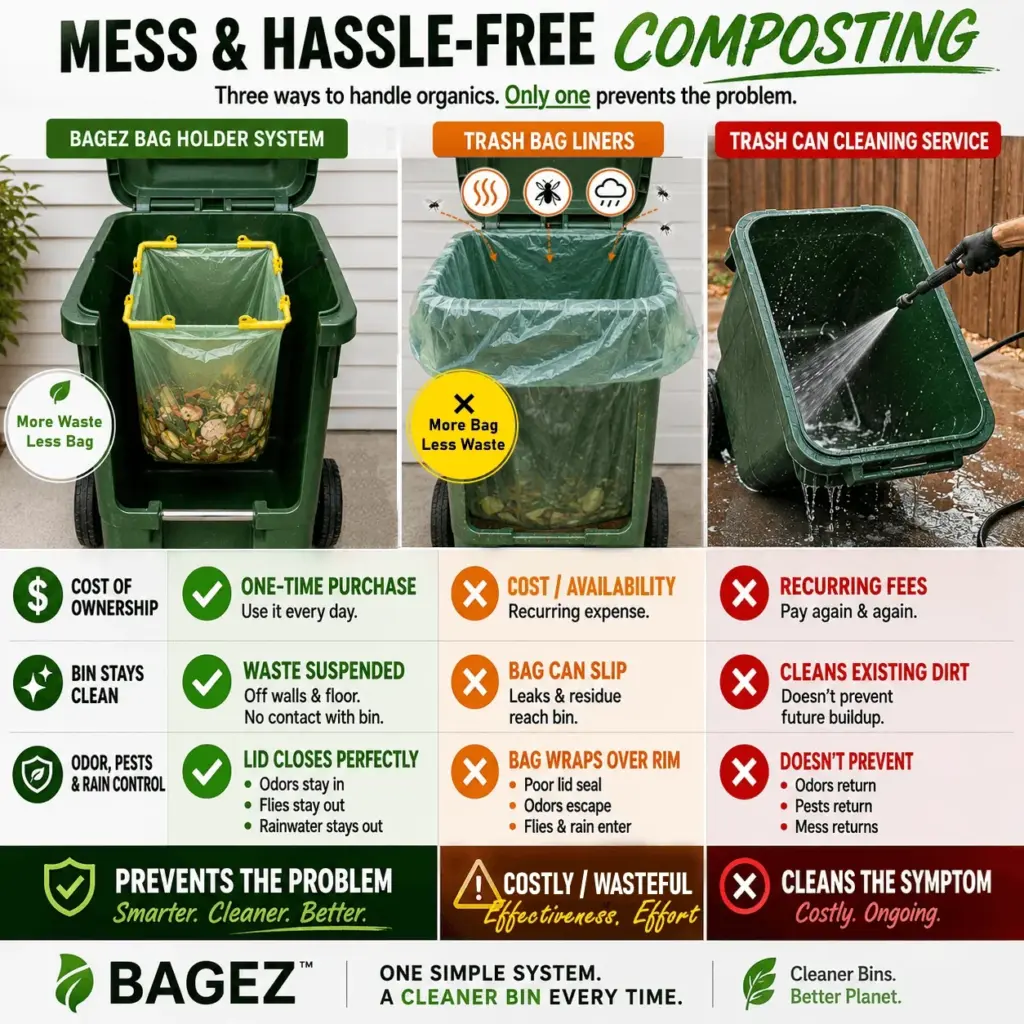
To address the issues of bin cleanliness, odor, and cost, Canadian entrepreneur Sean Rana founded BagEZ. Rather than relying on expensive, single-use, full-sized cart liners or costly third-party bin-washing services, Rana approached the problem through the lens of human-centered industrial design.
Traditional Bin Setup (Wet, Anaerobic)     BagEZ Suspended Setup (Dry, Aerobic)
┌───────────────────────────────────────┐   ┌───────────────────────────────────────┐
│  [Closed Lid]                         │   │  [Closed Lid]                         │
│  Loose waste sits on bottom           │   │  Steel Frame holding bag suspended     │
│  No airflow -> Anaerobic decay        │   │  Airflow around bag -> Evaporation    │
│  Leachate pools, creates odor/maggots │   │  No contact with walls -> Dry bin     │
└───────────────────────────────────────┘   └───────────────────────────────────────┘
The Physics of Suspension and Airflow
The core innovation of BagEZ is a high-tensile, corrosion-resistant folding steel frame equipped with heavy-duty engineered clips. The frame rests securely on the rim of any standard curbside cart (from 13 up to 64 gallons), suspending a standard-sized trash or compostable bag inside the cart.
This suspension design fundamentally alters the environment inside the bin:
- Eliminating the Contact Zone: Because the bag is suspended, it never touches the bottom or sides of the plastic cart.
- Promoting Evaporation: Decomposing food scraps naturally release moisture. In a standard bin, this moisture condenses on the plastic walls and pools at the bottom. With BagEZ, air circulates freely around all sides of the suspended bag, allowing condensation on the bag’s exterior to evaporate rather than pool.
- Maintaining a Dry Environment: By keeping the interior of the cart dry, BagEZ removes the moisture required for fly larvae (maggots) to survive and prevents the buildup of sticky, smelly residue.
Volume Optimization and Cost Reduction
By suspending the bag, BagEZ allows households to use smaller, more affordable bags that match their actual waste output. Instead of buying expensive, oversized 30- to 64-gallon compostable liners to fit their municipal cart, residents can use standard 13-gallon bags.

This offers several practical benefits:
- Cost Efficiency: Standard 13-gallon compostable bags cost a fraction of the price of heavy-duty, full-cart liners, saving households money over the course of a year.
- Maximized Utility of Odor Control: In a small, confined bag, simple odor remedies like a sprinkle of baking soda are highly effective. In contrast, spreading baking soda across the bottom of a giant, empty 64-gallon bin does little to neutralize odors.
- Pest Deterrence: By keeping waste contained and dry, odor is significantly reduced. Households can also easily attach small peppermint or clove sachets to the exterior of the frame, masking food odors and deterring raccoons, rodents, and other pests.
Future Outlook: The Path to Zero-Waste Cities
As cities push toward aggressive zero-waste and decarbonization targets by 2030 and 2050, organic waste diversion will remain a top priority. However, building compost facilities and buying hybrid collection trucks is only half the battle. The success of these programs ultimately depends on the individual resident standing in their kitchen, deciding which bin to use.
      [Municipal Infrastructure]  <─── The Critical Link ───>  [Household Behavior]
      - Compost Facilities             (Friction Reduction)    - No "Yuck" Factor
      - Collection Trucks              - Easy, clean bins      - High participation
      - Policy Mandates                - Low ongoing cost      - Sustained habit
To achieve high participation rates, municipalities must move away from purely educational campaigns and address the physical friction of waste separation. The success of the Essex County trial demonstrated that residents will compost if the process is clean and convenient.
Innovative, low-cost tools like BagEZ bridge the gap between municipal infrastructure and human behavior. By transforming a messy, unpleasant chore into a clean, simple habit, these solutions help ensure that green bins are actually used. In the long run, the fight against landfill methane emissions won’t just be won with major policy shifts—it will be won by making it easier for everyday households to do the right thing.



