

Executive Overview
The United States is currently experiencing a historic boom in its energy storage market. Driven by an urgent need to stabilize an aging electrical grid, maximize reliability, and accelerate the transition toward a low-carbon economy, battery storage has become the linchpin of modern American energy policy. These giant, grid-scale batteries store excess electricity generated by intermittent renewable sources—primarily wind and solar—discharging it when the sun sets or the wind stops blowing.
Yet, this green energy revolution rests upon a foundational paradox: it has been built largely on the back of inexpensive, highly efficient Chinese battery technology.
For years, Washington has viewed this reliance not as an economic opportunity, but as a profound national security vulnerability. This tension reached a boiling point with a sweeping executive order from the Trump administration, declaring a national emergency and effectively banning Chinese batteries from being integrated into grid-scale energy storage systems across the United States.
The move marks an escalation in a multi-year, bipartisan economic strategy designed to decouple the American clean energy supply chain from Beijing. Through a combination of aggressive tariffs, restrictive tax credits tied to geographic sourcing, and now outright bans on critical infrastructure, the federal government is attempting to force the rapid maturation of a domestic manufacturing base.
However, this industrial policy pivot comes with a steep price tag. Industry analysts warn that the sudden exclusion of Chinese technology threatens to stall ongoing clean energy deployments, drive up electricity costs for consumers, and potentially threaten the stability of the grid it aims to protect. As developers scramble to decode the regulatory fallout, the broader question remains: How much economic pain and climate delay are nations willing to endure in the pursuit of technological self-reliance?
Detailed Chronology: A Multi-Year Campaign Against Supply Chain Dependency
To understand the gravity of the recent executive order, it is necessary to trace the systematic escalation of US trade and industrial policies targeting China’s dominance in the energy storage sector.
The 2022 Inflation Reduction Act and Sourcing Restrictions
The modern push for supply chain decoupling began in earnest with the passage of the landmark Inflation Reduction Act (IRA) in August 2022. While designed to inject trillions of dollars into domestic clean energy development through tax incentives, the legislation introduced stringent guardrails.
The IRA tied lucrative tax credits directly to where battery components were manufactured and assembled, and where critical minerals—such as lithium, cobalt, and nickel—were mined, processed, or recycled. Projects that relied heavily on foreign entities of concern, chiefly China, found themselves disqualified from these financial incentives. The goal was clear: use the carrot of federal funding to compel manufacturers to onshore or nearshore their supply chains.
The 2025 Regulatory Overhaul and 2026 Thresholds
As the clean energy landscape evolved, so did the regulatory framework. In 2025, the framework governing these tax credits underwent a significant makeover to close loopholes and accelerate domestic production timelines.
Under the updated legislation, the rules became even more uncompromising. Beginning in 2026, a staggering 55% of the total cost of materials used in new energy storage projects must originate from outside China and other restricted nations. Failure to meet this threshold strips the project of its eligibility for federal tax credits, rendering many otherwise viable commercial proposals economically unfeasible.
The Section 301 Tariff Escalation
Simultaneously, the federal government utilized trade enforcement mechanisms to tilt the playing field against foreign imports. Under Section 301, import tariffs on Chinese lithium-ion batteries—which had previously lingered at a modest 7.5%—were aggressively increased to 25% in January. This financial penalty was intended to bridge the cost gap between cheap imports and nascent domestic alternatives, though it immediately squeezed profit margins for project developers.
The August 2026 National Emergency Executive Order
Despite tariffs and tax penalties, the influx of Chinese battery technology continued to power the majority of American grid storage expansion due to its unbeatable cost and scale. Frustrated by the slow pace of complete decoupling, the Trump administration took its most drastic measure yet in late August 2026.
Citing imminent threats to critical infrastructure, the White House issued an executive order declaring a national emergency. The directive explicitly bans the installation of "any foreign-produced bulk-power system electric equipment" deemed a national security risk. It targets battery energy storage systems (BESS) alongside critical accompanying components such as inverters and transformers.
By framing the issue through the lens of national security rather than mere trade protectionism, the administration effectively bypassed traditional legislative channels, catching the energy industry completely off guard.
Supporting Context & Metrics: The Scale of Dominance and Disruption
The friction between US policy and Chinese manufacturing stems from an undeniable economic reality: China commands an overwhelming lead in the global clean energy supply chain. Through decades of strategic state support, heavy investment in research and development, and the cultivation of an unmatched industrial ecosystem, China is the undisputed powerhouse of solar panels, electric vehicles, and grid-scale batteries.
The Economic Divide
Today, lithium-ion batteries manufactured domestically in the United States remain significantly more expensive than their Chinese counterparts. Even alternative international suppliers, such as South Korea, cannot match the low production costs achieved by Chinese mega-factories.
When developers are forced to pivot away from Chinese cells, the economic repercussions are immediate. Projects face higher capital expenditures, which inevitably translate to higher costs for utilities and, ultimately, ratepayers.
Near-Term Market Volatility
The immediate aftermath of the August 2026 executive order has been characterized by acute market uncertainty. According to analysis from energy consultancy BloombergNEF, the deployment of grid-connected storage projects is expected to slow considerably in the near term. Developers are currently caught in a holding pattern, pausing construction as they await detailed guidance from the Department of Energy, which is expected by the end of the year.
Depending on how strictly the new rules are interpreted, project developers may be forced to find alternative cell suppliers overnight.
"Worst case, those projects could get canceled," warns Isshu Kikuma, an energy storage analyst at BloombergNEF.
Furthermore, a literal interpretation of the executive order technically applies even to existing energy storage plants already operating on the grid. While industry experts consider it highly unlikely that operational facilities will be forcefully shut down—given that the vast majority rely on Chinese hardware—the mere ambiguity of the mandate has rattled investors and project financiers.
Official Statements and Industry Reactions
The suddenness and severity of the executive order have drawn mixed reactions from trade associations, market analysts, and energy developers, highlighting a deep anxiety over the health of the domestic energy transition.
"An outright ban was a bit of a surprise, and it does create a bit of concern for domestic players in the US," notes Shan Tomouk, energy storage and energy lead at Benchmark Mineral Intelligence. While domestic manufacturers stand to benefit long-term from the elimination of foreign competition, the abrupt disruption of current supply chains threatens to choke off the very components needed to keep pace with soaring electricity demand.
Developers argue that punishing the industry before domestic manufacturing capacity is fully online creates an impossible bottleneck. Without a soft landing or an adequate grace period, companies caught midway through multi-million-dollar installations face crippling financial liabilities.
Conversely, defenders of the executive order maintain that incremental measures like tariffs and tax credits have proven too weak to break the gravitational pull of cheap Chinese technology. From this perspective, a hard shock to the system is the only way to jolt domestic industries into aggressive action, preventing the US from trading one form of energy dependence—fossil fuels—for another tied to a geopolitical rival.
Future Outlook: The Road to 2030 and Beyond
Looking past the immediate turmoil, the long-term trajectory suggests that the United States will eventually possess the domestic manufacturing capacity to meet its own energy storage demands.
Current projections from energy analysts indicate that the US could scale up its domestic production capacity sufficiently by around 2030. However, industry observers urge caution: historical bottlenecks, workforce shortages, and the complexities of scaling advanced chemical manufacturing mean that some new factories may face delays in ramping up to full operational capability. Consequently, true supply-demand equilibrium using entirely non-restricted sources may not materialize until well into the 2030s.
An Ironic Lifeline: The Slowing EV Market
Interestingly, an unexpected economic shift is currently providing a lifeline to the grid storage sector. The recent cooling of the electric vehicle (EV) market has left several major automotive battery factories with excess capacity.
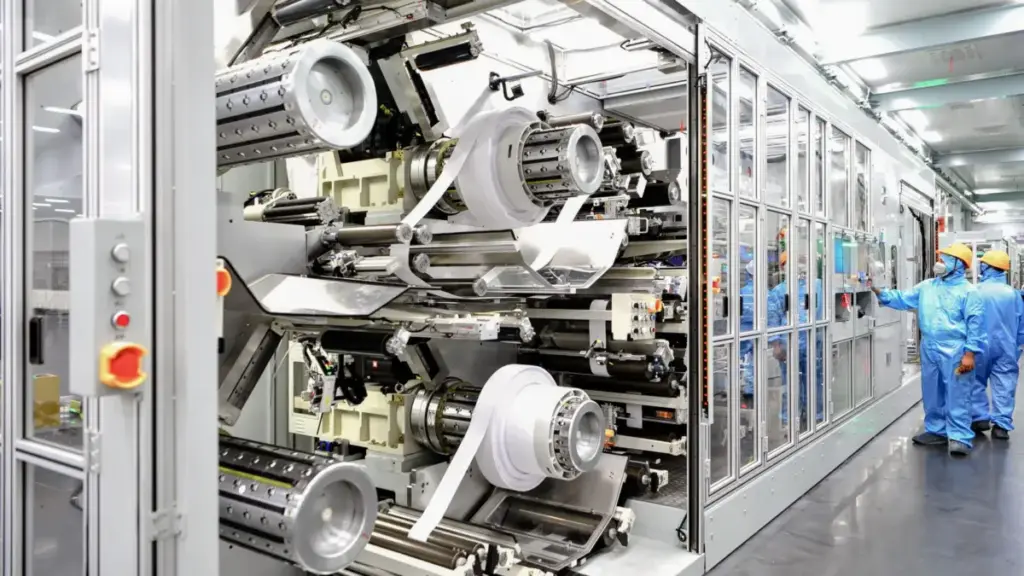
Facilities originally constructed by major automotive and battery conglomerates—including LG Energy Solutions, Samsung SDI, Ford, and SK On—are currently in the process of retooling their assembly lines. Instead of producing cells exclusively for passenger electric vehicles, these plants are pivoting to manufacture larger format cells optimized for stationary grid storage systems. This industrial pivot is expected to accelerate the availability of domestic storage components over the next 24 months.
A Global Dilemma
Ultimately, the US dilemma over battery supply chains is a microcosm of a much larger global challenge. As nations worldwide grapple with the existential threat of climate change, they must balance two competing imperatives:
- The Urgent Need for Speed and Affordability: Deploying cheap, readily available clean energy technology immediately to slash carbon emissions and stabilize escalating energy costs.
- The Imperative of Economic and National Security: Mitigating the systemic risks of relying on a single, potentially adversarial superpower for the critical infrastructure of the 21st century.
As the United States navigates this delicate political and economic tightrope, the coming months will test whether American industrial policy can successfully build a homegrown clean energy economy without derailing the very climate progress it seeks to protect.



