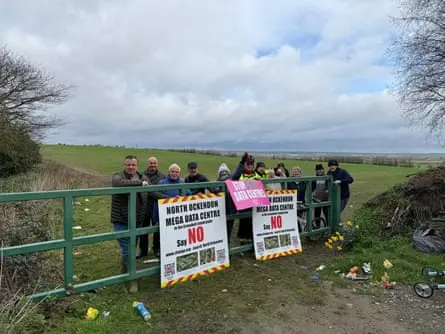
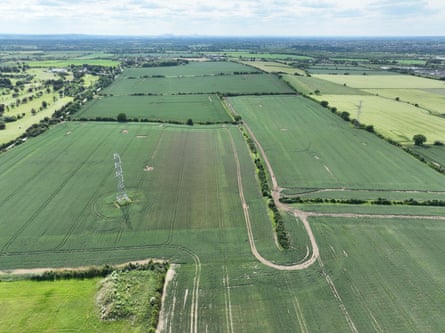
The rapid, unyielding expansion of artificial intelligence and cloud computing has precipitated an invisible environmental reckoning across the United Kingdom. Nowhere is this tension more palpable than in North Ockendon, an outer London green belt community bracing for what could become one of the largest data centers in Europe.
Proposed by developer Digital Reef, the East Havering Data Centre Campus (EHDCC) is a colossal £14.7bn infrastructure project designed to fuel the computational demands of the AI revolution. Yet, according to planning documents reviewed by The Guardian, the staggering scale of the development comes with an unprecedented environmental price tag. The facility is projected to emit more than 1 million tonnes of carbon dioxide equivalent ($textCO_2texte$) annually once fully operational—a figure that outstrips any other data center proposal disclosed in the UK to date.
Over its projected 60-year lifespan, the EHDCC is anticipated to pump more than 72 million tonnes of $textCO_2texte$ into the atmosphere. To put this into perspective, its annual operational emissions alone equal the carbon footprint of roughly 27,000 transatlantic flights from London to New York. Furthermore, by 2038, the campus’s cumulative operational emissions are projected to consume nearly 20 times the entire carbon budget of the host borough of Havering, and almost 1% of the entire United Kingdom’s carbon budget.
As tech giants and venture capitalists race to build out the infrastructure necessary to power machine learning, LLMs, and hyperscale cloud storage, Britain is facing a formidable systemic dilemma. The central question is no longer merely technological or economic; it is fundamentally existential: How can the UK reconcile its explosive appetite for AI infrastructure with its legally binding climate targets and an already strained national power grid?
Detailed Chronology: From Concept to Public Backlash
The trajectory of the EHDCC project highlights the friction between fast-moving national economic strategies and localized environmental governance.
The Genesis of the Proposal: Digital Reef formulated plans for the massive campus spanning 218 hectares of green belt land in North Ockendon, positioning it as a "unique opportunity to create a sustainable datacentre campus of the future." The site was deliberately selected for its proximity to major energy transmission corridors in outer London, despite sitting on crop-producing farmland.
The Critical Infrastructure Designation (2024): In a pivotal regulatory shift, the UK government designated data centers as "critical national infrastructure" (CNI) in 2024, placing server farms on legally equivalent footing with water utilities, energy networks, and emergency services. This opened the door for streamlined development paths.
Planning Law Amendments (January 2025): The regulatory landscape shifted dramatically in January 2025 when planning legislation was amended. This change allowed data center developers to apply as Nationally Significant Infrastructure Projects (NSIPs), granting them mechanisms to bypass traditional local authority planning procedures and seek approval directly from central government bodies.
The First Consultation Phase (April 2025): Digital Reef opened its initial round of public consultation regarding the EHDCC project, drawing intense scrutiny and immediate pushback from environmental advocates, local agricultural groups, and residents.
Government Policy Stagnation (Late 2025): Despite promising a specialized National Policy Statement for the data center sector via the now-disbanded Department for Science, Innovation and Technology (DSIT), the government delayed publishing the framework, leaving a regulatory vacuum.
Current Status and Next Steps: Following the close of the initial consultation in April, Digital Reef is revising its proposal. A subsequent public consultation incorporating feedback and design adjustments is scheduled for release in the autumn. Meanwhile, local authorities like Havering Council find themselves navigating complex jurisdictional boundaries as the project looms over their local planning mandates.
Supporting Context & Metrics: The Anatomy of a Megaproject
To truly grasp the environmental footprint of the East Havering Data Centre Campus, one must examine the raw metrics of energy consumption, land conversion, and grid engineering.
1. Astronomical Energy Demands
According to data from the Office of Gas and Electricity Markets (Ofgem), the average UK household consumes approximately 2,500 kWh of electricity per year. Digital Reef’s own planning documentation reveals that at a "likely" 50% operational load, the EHDCC campus will consume a staggering 2.65 billion kWh of electricity annually. This equates to the total energy demand of more than 1 million UK households—effectively powering a city the size of Birmingham entirely for data storage and server cooling.
2. Grid Strain and Infrastructure Upgrades
Powering this colossus requires a radical overhaul of local transmission architecture. The campus is slated to be powered primarily by a massive 600MVA connection to the National Grid via the nearby Warley substation. Because existing infrastructure is wholly inadequate for this magnitude of draw, developers have mapped out major engineering upgrades. These include:
The construction of a brand-new 400kV National Grid substation.
A supplementary 132kV UK Power Networks facility situated on adjacent land.
A targeted full-connection delivery date of 2033.
This local grid expansion mirrors a national trend. Neso, Britain’s independent energy system operator, has warned Parliament that data center developers have collectively requested a phenomenal 72.8GW of electricity connections by 2039. This figure represents a nearly 60% increase over the UK’s total peak power demand from the previous year, highlighting an impending supply crunch driven almost exclusively by hyperscale and AI infrastructure.
3. Green Belt Destruction and Biodiversity Loss
Spanning 218 hectares, the EHDCC footprint consumes expansive swaths of protected green belt land. Local agricultural stakeholders and conservation groups have pointed out that the site consists primarily of productive crop-producing farmland—a troubling land-use trade-off at a time when global supply chain security and domestic food production face mounting geopolitical and climatic pressures.
Official Statements & Stakeholder Perspectives
The clash over the EHDCC has galvanized a broad coalition of critics, ranging from tech-justice advocates to local preservationists, while exposing deep divisions over corporate responsibility and regulatory oversight.
The Tech-Justice Critique
Donald Campbell, advocacy director at the tech-justice nonprofit Foxglove, did not mince words when evaluating the project’s disclosures:
"The EHDCC’s projected emissions are staggering. It’s a big threat to the ability to decarbonise in the UK. It’s also going to be a big drain on important resources that are needed by homes and other businesses."
Campbell argued that the financial model underpinning these builds is fundamentally inequitable. Because data centers ultimately serve the wealthiest technology conglomerates in the world, the public and the environment should not be forced to bear the systemic social and environmental costs. He contends that developers must be legally mandated to construct dedicated, off-grid renewable generation and battery storage facilities rather than simply tapping into a public grid already straining under electrification pressures:
"That’s the only way of really ensuring that it’s not going to add to carbon emissions. They shouldn’t just plug into the grid and drain the power that everyone else needs."
Local Resistance
The North Ockendon Residents Association condemned the project as an environmental catastrophe. In a statement to researchers, a group spokesperson remarked:
"It’s a massacre of green belt land. It’s crop-producing farmland, in an age when we are threatened by security, it’s the loss of wildlife habitats, and there’s the pollution cost, which everyone seems to brush under the carpet."
Local Government and Corporate Silence
Navigating the planning bureaucracy has proven equally controversial. Councillor Keith Prince, Reform UK leader of Havering Council, noted that because formal determinations regarding the EHDCC remain within the purview of the local planning authority framework, it would be legally "wrong" to offer a definitive stance until the statutory review concludes.
Meanwhile, Digital Reef has maintained a rigid corporate silence, declining to respond to media requests for comment regarding its emissions trajectory or proposed green belt offsets.
Future Outlook: Offsets, Obligations, and the Path Forward
As the autumn public consultation approaches, the EHDCC proposal serves as a stress-test for Britain’s green transition policies.
Within its planning dossier, Digital Reef acknowledges that the project "does not align with a science-based 1.5C compatible trajectory and achieving net zero by 2050." To account for unavoidable carbon shortfalls, the developer has proposed utilizing a cash-in-lieu mechanism, estimating a £77.6m payment into Havering Borough’s carbon offset fund.
However, climate scientists and advocacy groups remain deeply skeptical of financial offset strategies, arguing that local carbon credit funds cannot physically capture or neutralize the million-plus tonnes of annual emissions pumped directly into the atmosphere by the facility.
Government projections indicate that while data centers accounted for roughly 2.5% of the UK’s electricity consumption in early 2025, that figure is anticipated to quadruple by 2030. Without immediate, binding interventions—such as mandatory renewable energy co-location, strict efficiency standards, and a comprehensive National Policy Statement that prioritizes ecological preservation over unbridled tech expansion—projects like the East Havering Data Centre Campus risk locking the United Kingdom into decades of high-carbon lock-in.
For North Ockendon and the broader British public, the coming months will determine whether the computational infrastructure of tomorrow can be built without sacrificing the livability of today.