By Benito Müller, Anju Sharma, Jen Allan, Matthias Roesti, and Luis Gomez-Echeverri
Executive Overview
Every November, a familiar global ritual unfolds. Tens of thousands of delegates—presidents, prime ministers, seasoned diplomats, corporate chief executives, indigenous leaders, activists, journalists, celebrities, and fossil fuel lobbyists—board long-haul flights to converge on a single host city. For two frenetic weeks, the venue transforms into a sprawling, hyper-caffeinated city-within-a-city, driven by a shared, urgent conviction: everyone with a stake in the planet’s future must physically be in the room.
However, beneath the high-stakes headlines and theatrical late-night plenary sessions lies a quiet institutional crisis. What began in the mid-1990s as a lean diplomatic forum dedicated to technical carbon accounting and treaty negotiation has evolved into an overwhelming, multi-ring circus. The sheer scale of the modern United Nations Climate Change Conferences (Conferences of the Parties, or COPs) has begun to undermine their original core objective: negotiating actionable, legally binding agreements to curb global warming.
A critical question is being raised by senior climate policy scholars and veteran observers: Has the institutional Fear of Missing Out (FOMO) become one of the single greatest obstacles to effective international climate cooperation?
According to structural analysis conducted by the European Capacity Building Initiative (ecbi), the exponential growth of COP attendance is not merely an optical issue; it is a structural vulnerability. While proposals to streamline, downsize, or refactor these annual summits are frequently met with fierce pushback over concerns of exclusion, evidence suggests that uncontrolled scale creates diplomatic gridlock, marginalizes vulnerable nations, and dilutes the political focus required to deliver on climate finance and emissions reductions.
+-------------------------------------------------------------------------+
|                      COP ATTENDANCE EXPANSION TREND                     |
|                                                                         |
|  100,000 +-------------------------------------------------- [COP28] --+
|          |                                                    |         |
|   75,000 +----------------------------------------------------+         |
|          |                                           [COP26]  |         |
|   50,000 +----------------------------------------------+     |         |
|          |                                              |     |         |
|   25,000 +------------------------------ [COP15]        |     |         |
|          |                     [COP3]      |            |     |         |
|        0 +-- [COP1 (1995)] ------+---------+------------+-----+---------+
|              Berlin 1995     Kyoto 1997 Copenhagen 2009 Glasgow 2021 Dubai 2023
+-------------------------------------------------------------------------+
Detailed Chronology: The Anatomy of an Institutional Explosion
To understand how climate summits reached their current tipping point, one must trace the historical trajectory of the United Nations Framework Convention on Climate Change (UNFCCC) negotiating process over the past three decades.
       1995              1997               2009               2015              2023
---------+-----------------+------------------+------------------+-----------------+-------->
       COP1              COP3              COP15              COP21             COP28
     (Berlin)          (Kyoto)         (Copenhagen)          (Paris)           (Dubai)
 ~4,000 Delegates  ~10,000 Delegates ~27,000 Delegates  ~36,000 Delegates ~85,000+ Delegates
The Foundational Era (1995–1997)
When governments first convened for COP1 in Berlin in 1995, international climate diplomacy was an obscure field occupied primarily by environmental ministers, legal technicians, atmospheric scientists, and a handful of dedicated non-governmental organizations (NGOs). Attendance was measured in the low thousands.
By 1997, when delegates gathered in Japan to draft the Kyoto Protocol—the world’s first treaty establishing legally binding emissions reduction targets for industrialized nations—the stakes had risen significantly. Yet, even with intense global media scrutiny, COP3 hosted fewer than 10,000 total participants. Negotiations were intimate enough that lead negotiators could gather in small, working-group rooms to debate text line by line.
The Copenhagen Turning Point (2009)
The geopolitical footprint of the climate crisis expanded dramatically at COP15 in Copenhagen. Billed as the moment world leaders would seal a post-Kyoto global treaty, the conference attracted roughly 27,000 participants.
Copenhagen exposed the operational limitations of the UNFCCC framework. The venue was paralyzed by logistical bottlenecks, accredited civil society representatives were turned away at the gates due to overcapacity, and negotiations broke down into chaos. The resulting Copenhagen Accord was merely "noted" rather than formally adopted, exposing how chaotic logistics and unwieldy crowd dynamics could compromise high-stakes diplomacy.
The Paris Breakthrough and Post-Treaty Spikes (2015–present)
The adoption of the Paris Agreement at COP21 in 2015 established a dynamic architecture based on Nationally Determined Contributions (NDCs). Over 36,000 people attended the Paris summit.
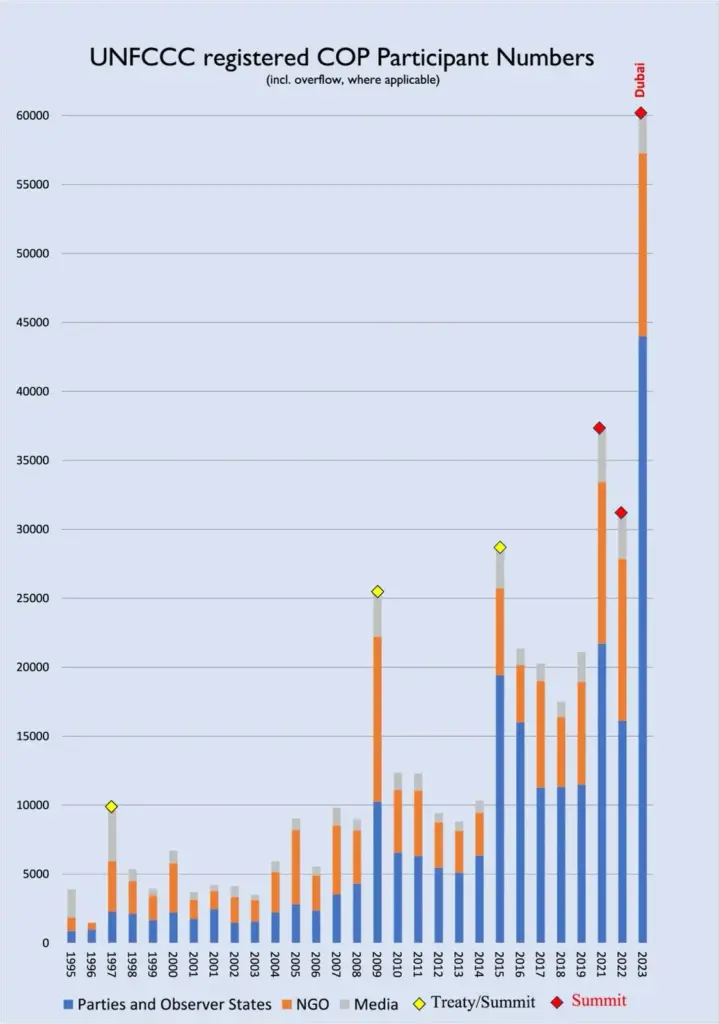
However, ecbi’s analysis reveals a recurring post-treaty phenomenon: following every major breakthrough treaty COP, attendance at subsequent COPs approximately doubled.
- Post-Kyoto Growth: Attendance jumped in the late 1990s as implementation rules were negotiated.
- Post-Paris Escalation: The adoption of the Paris Rulebook transformed COPs from diplomatic summits into global trade shows, sustainability expos, and networking hubs.
By the time COP26 took place in Glasgow in 2021, attendance topped 38,000 despite global pandemic restrictions. A year later at COP27 in Sharm El-Sheikh, numbers breached 49,000.
The trend reached its peak at COP28 in Dubai in 2023, where registrations soared past an unprecedented 85,000 accredited badges (with some estimates reaching 100,000 including local day-pass attendees). The summit occupied a venue spanning several square kilometers, featuring corporate pavilions, elaborate media zones, and thousands of side events completely divorced from the core diplomatic negotiations.
Supporting Context & Metrics
The quantitative transformation of the COP process reflects underlying shifts in who attends these conferences, who pays for them, and how political power is exerted.
1. The Doubling Phenomenon and ecbi Data
The study Quo Vadis COP?, published by the European Capacity Building Initiative (ecbi), systematically documents the growth patterns of global climate conferences. The data demonstrates that participation growth is non-linear and heavily influenced by major treaty milestones.
| Event | Year | City | Key Outcome / Benchmark | Approximate Total Attendance |
|---|---|---|---|---|
| COP1 | 1995 | Berlin, Germany | Establishment of the Berlin Mandate | ~4,000 |
| COP3 | 1997 | Kyoto, Japan | Adoption of Kyoto Protocol | ~9,500 |
| COP15 | 2009 | Copenhagen, Denmark | Copenhagen Accord (High-level breakdown) | ~27,000 |
| COP21 | 2015 | Paris, France | Adoption of the Paris Agreement | ~36,000 |
| COP26 | 2021 | Glasgow, United Kingdom | Glasgow Climate Pact / Completion of Rulebook | ~38,000 |
| COP27 | 2022 | Sharm El-Sheikh, Egypt | Loss and Damage Fund Established | ~49,000 |
| COP28 | 2023 | Dubai, United Arab Emirates | First Global Stocktake / Transition away from fossil fuels | ~85,000+ |
PARTICIPATION DISTRIBUTION AT MODERN COPs (Conceptual Estimate)

  [██████████] Official National Delegates & Lead Negotiators (15%)
  [████████████████████] Civil Society, Indigenous & Youth Groups (25%)
  [████████████████████████████████] Corporate, Industry & Commercial Entities (40%)
  [████████████████] Media, Technical Staff & Observers (20%)
2. The Asymmetry of Access and Presence
While defender organizations argue that large numbers reflect democratic interest and civil society inclusion, metric analysis reveals a severe imbalance in representation:
- Lobbying Coalitions: At COP28, analysis of the UNFCCC attendee database revealed that over 2,400 individuals affiliated with the fossil fuel sector were granted accreditation—outnumbering official delegates from almost every vulnerable nation combined.
- Small State Disadvantage: Developing countries and Small Island Developing States (SIDS), such as Tuvalu, Vanuatu, or Palau, often field small delegations consisting of 5 to 10 negotiators. These negotiators must cover dozens of parallel negotiating tracks, technical working groups, and contact groups running simultaneously around the clock. Conversely, rich nations and large corporate lobbies field hundreds of specialized delegates.
- Financial Strain on Host Nations: Hosting 80,000+ people requires immense security budgets, specialized infrastructure, massive venue construction, and thousands of high-priced hotel rooms. This financial burden restricts the pool of developing nations capable of hosting future COPs, effectively concentrating host privileges among wealthier or energy-rich nations.
+-------------------------------------------------------------------------------+
|                       DELEGATION SIZE DISPARITY (COP28)                       |
|                                                                               |
|  Small Island Developing State (Avg) : [██] 5-10 Negotiators                  |
|  G20 Industrialized Nation (Avg)     : [████████████████████] 150-500+         |
|  Fossil Fuel Industry Affiliates     : [████████████████████████████████] 2,400+|
+-------------------------------------------------------------------------------+
Official Statements & Scholar Perspectives
The core authors of the ecbi paper—Benito Müller, Anju Sharma, Jen Allan, Matthias Roesti, and Luis Gomez-Echeverri—alongside other veteran multilateral governance scholars, have outlined the structural dangers posed by this unchecked growth.
On the Illusion of Inclusivity vs. Practical Negotiating Space
Writing on behalf of ecbi, Oxford scholar Benito Müller highlights the paradox of size:
"The fear of missing out—FOMO—has become a self-reinforcing engine driving climate conferences into logistically unmanageable territory. Everyone feels they must be in the room, not necessarily because they are contributing to the legal text, but because the event has become the global center stage for climate politics. The result is that the actual business of negotiating treaties is swallowed up by the circus surrounding it."
Anju Sharma, a Senior Associate at the International Institute for Environment and Development (IIED) and co-author of the ecbi assessment, points out how large numbers actively harm vulnerable nations:
"We must carefully distinguish between true democratic inclusion and numerical inflation. When a COP balloons to 80,000 people, it does not mean the voices of vulnerable communities are 80 times louder. In fact, their voices are easily drowned out by corporate PR machines and massive trade delegations. Smaller, focused negotiating settings historically afforded developing nations a far more level playing field."
On the Operational Breakdown of Negotiating Mechanics
Jen Allan, a Senior Lecturer in International Relations and long-time observer for the Earth Negotiations Bulletin (ENB), emphasizes the administrative burden placed on host secretariats and negotiating teams:
"The core mandate of the UNFCCC is to prevent dangerous anthropogenic interference with the climate system through international law and policy. When lead negotiators spend hours simply navigating through massive commercial expos and security checkpoints designed for 80,000 people, the process loses its essential focus. High-level political optics are eclipsing technical legal progress."
Co-author Luis Gomez-Echeverri, Emeritus Research Fellow at the International Institute for Applied Systems Analysis (IIASA), notes:
"The current model places an unbearable burden on host cities in the Global South. By turning the annual COP into a world’s fair, we are virtually guaranteeing that only very wealthy states can afford to host them. That is a fundamental governance failure for a regime based on equity."
Future Outlook: Reforming the UNFCCC Architecture
To safeguard the future of global climate governance, institutional analysts and policy experts argue that structural reforms must be implemented before the COP model collapses under its own weight. Several core proposals are currently gaining traction among UN member states and policy institutes.
+-------------------------------------------------------------------------------+
|                        PROPOSED TWO-TRACK UNFCCC MODEL                        |
|                                                                               |
|   +---------------------------------+   +---------------------------------+   |
|   |         TRACK A: NEGOTIATIONS   |   |        TRACK B: CLIMATE ACTION  |   |
|   |          "The Blue Zone"        |   |           "Global Action Hub"   |   |
|   +---------------------------------+   +---------------------------------+   |
|   | • Lean, delegate-only focus     |   | • Decentralized, regional expos |   |
|   | • Capped national delegations   |   | • Business & NGO showcases      |   |
|   | • High efficiency, lower cost   |   | • Year-round virtual networking |   |
|   +---------------------------------+   +---------------------------------+   |
+-------------------------------------------------------------------------------+
1. Decoupling the "Negotiation Track" from the "Action Expo"
The primary reform strategy involves formally splitting the annual COP into two distinct events:
- The Diplomatic Negotiating Session: A focused, streamlined gathering restricted strictly to national negotiating teams, accredited civil society observers, and essential international press. This session would focus entirely on legal text, technical implementation, and compliance mechanisms.
- The Global Climate Action Hub / Expo: A separate, parallel or biennial summit designed for corporate announcements, non-state action, technological displays, regional multi-stakeholder partnerships, and civil society mobilization.
2. Imposing Strict Delegation Caps
To curb diplomatic bloat and reduce asymmetry between wealthy and developing states, proposal authors suggest capping national delegation sizes:
- Balanced Allocation: A standard cap (e.g., maximum 30 to 50 delegates per state party) would immediately streamline logistical requirements and re-balance access between rich and poor nations.
- Lobbyist Regulation: Restricting badges issued to corporate entities and trade associations under party delegations, ensuring transparency in observer credentials.
3. Institutionalizing Regional Pre-COPs
Rather than relying exclusively on one massive global summit each November, the UNFCCC could shift greater analytical weight onto existing Regional Climate Weeks:
- Regional Consensus Building: Developing common positions at regional summits (Latin America, Africa, Asia-Pacific, Small Island States) prior to the global gathering would allow lead negotiators to enter the annual conference with consolidated mandates.
- Lowering Carbon Footprints: Regionalizing discussions significantly cuts down on long-haul aviation emissions associated with thousands of delegates traveling to a single site every 12 months.
4. Harnessing Hybrid and Virtual Diplomatic Tools
The logistical lessons learned during the COVID-19 pandemic demonstrated that technical, non-politicized negotiations can effectively occur via hybrid channels throughout the year.
By shifting routine line-item reviews, draft text consultations, and technical reporting to secure virtual environments, the physical annual COP could be shortened significantly, reducing host expenses and preventing negotiator exhaustion.
Conclusion
The annual UN Climate Change Conference remains an indispensable pillar of international diplomacy—the only global forum where vulnerable small island states sit as legal equals alongside the world’s largest superpowers and carbon emitters.
However, as the research by Benito Müller, Anju Sharma, Jen Allan, Matthias Roesti, and Luis Gomez-Echeverri makes clear, allowing climate summits to be driven by "FOMO" threatens to transform a crucial treaty body into an unwieldy global spectacle.
Reclaiming the integrity of the COP process requires a willingness to make uncomfortable choices: scaling down physical participation, setting clear boundaries for corporate involvement, and returning the core focus to where it belongs—delivering fast, equitable, and enforceable climate action before time runs out.