

Executive Overview
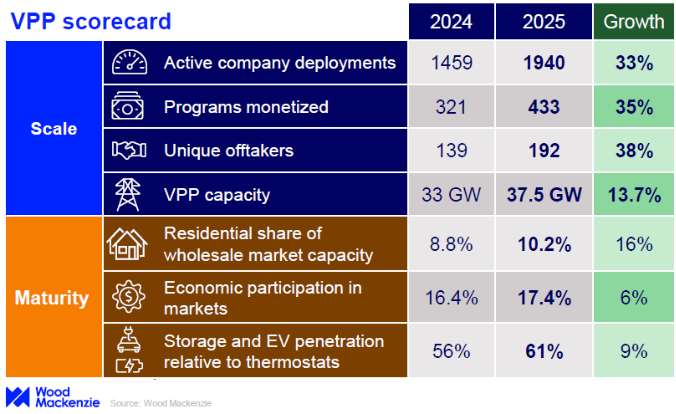
The United States energy grid is undergoing a quiet, decentralized revolution. According to a landmark industry analysis—the 2025 North America Virtual Power Plant Market report published by Wood Mackenzie—the US virtual power plant (VPP) landscape has surged to an impressive 37.5 gigawatts (GW) of behind-the-meter flexible capacity now online.
At its core, a Virtual Power Plant is not a monolithic physical power station with smokestacks or sprawling turbine halls. Instead, it is an advanced, software-orchestrated network of small-scale, distributed energy resources (DERs). By seamlessly aggregating residential solar panel systems, domestic battery storage units, electric vehicles (EVs), and smart thermostats into a unified, digitally managed ecosystem, VPPs give utilities and grid operators unprecedented flexibility. When electricity demand spikes during extreme weather events or grid emergencies, these distributed assets can be instantaneously tapped to stabilize the system. For the everyday consumer participating in these programs, the trade-off is clear: enhanced grid reliability and financial compensation for contributing resources.
However, beneath the headline-grabbing capacity figures lies a complex narrative of rapid expansion outstripping regulatory frameworks. While market activity—measured by company deployments, unique buyers, and utility-led programs—has grown by over 33% year-over-year, total system capacity has crawled upward at a much slower pace of just under 14%. Industry experts attribute this divergence to strict utility program caps, complicated capacity accreditation reforms, and lingering institutional barriers.
As the country grapples with an unprecedented surge in electricity demand driven by energy-intensive data centers and industrial electrification, VPPs are moving from the periphery of energy policy to the absolute center of national grid modernization strategy.
Detailed Chronology & Market Evolution
To understand where the VPP market stands today, it is essential to trace how a concept once viewed as an experimental demand-response tool blossomed into a multibillion-dollar asset class.
The Early Days: Smart Thermostats and Simple Curtailment
For well over a decade, the concept of distributed flexibility was synonymous with "demand response." Utility programs largely relied on direct-load control switches attached to residential air conditioners or simple smart thermostat networks (such as Google Nest or ecobee). During peak summer afternoons, utilities would signal these devices to nudge temperature settings upward by a few degrees, collectively shedding megawatts of load to prevent blackouts. While effective, these early iterations were largely one-way streets: utilities shed load, but consumers received nominal, if any, direct financial incentives, and the technology could not inject power back into the grid.

The Battery Storage Boom and the Rise of Two-Way Power
The paradigm shifted dramatically with the commercialization of residential lithium-ion battery storage, anchored by products like the Tesla Powerwall, and the mainstream adoption of electric vehicles. Suddenly, homes were no longer just passive consumers of electricity; they were micro-generation and storage nodes.
As hardware costs fell and state-level incentives—such as California’s Self-Generation Incentive Program (SGIP)—matured, homeowners began pairing solar installations with domestic storage. Software aggregators recognized an opportunity. Companies emerged to pool these batteries, allowing them to discharge stored energy back into wholesale markets during high-priced, high-demand intervals. This evolution transformed VPPs from simple load-shedding mechanisms into dynamic, two-way power delivery systems capable of providing frequency regulation, spinning reserves, and peak shaving.
Regulatory Milestones and Roadblocks
A critical inflection point for the broader industry was the Federal Energy Regulatory Commission’s (FERC) Order 2222, issued in late 2020. Designed to dismantle barriers preventing distributed energy resources from competing in regional wholesale electricity markets, Order 2222 required grid operators to create market rules allowing VPP aggregators to participate directly alongside traditional fossil fuel and utility-scale renewable power plants.
However, implementation has been notoriously sluggish. As Wood Mackenzie’s latest findings indicate, many wholesale market experts now view Order 2222 as a missed opportunity that fell short of delivering sweeping, frictionless market access. Today, the sector is defined by a tense interplay between forward-thinking software aggregators, cautious traditional utilities, and evolving state-level regulatory battles over data access, rate bases, and market sovereignty.
Supporting Context & Metrics: Unpacking the 2025 Data
A granular examination of the 2025 North America Virtual Power Plant Market report reveals vital structural shifts within the industry, highlighting both structural maturation and persistent friction points.
Breadth Versus Depth: The Growth Paradox
The most striking metric in the Wood Mackenzie report is the disparity between market expansion and physical capacity growth. While the number of active company deployments, unique offtakers (buyers), and utility program offerings all surged by more than 33% over the past year, total online capacity expanded by a modest 14%.
+-----------------------------------+-----------------------+
| Metric Category                   | Annual Growth Rate    |
+-----------------------------------+-----------------------+
| Company Deployments               | > 33%                 |
| Unique Offtakers (Buyers)         | > 33%                 |
| Utility & Market Programs         | > 33%                 |
| Total Disclosed VPP Capacity      | < 14%                 |
+-----------------------------------+-----------------------+
Ben Hertz-Shargel, global head of grid edge at Wood Mackenzie, notes that this decoupling is not accidental. "Utility program caps, capacity accreditation reforms, and market barriers have prevented capacity from growing as fast as market activity," he explains. In essence, while the infrastructure of the VPP economy—software platforms, aggregator partnerships, and customer acquisition funnels—is scaling exponentially, regulatory bottlenecks and conservative utility constraints are keeping the floodgates partially closed.
The Residential Resurgence
Historically, commercial and industrial (C&I) customers dominated VPP capacity due to the sheer scale of their facilities and ease of aggregation. However, residential customers are steadily capturing market share, increasing their representation in wholesale market capacity from 8.8% in 2024 to 10.2% in 2025.
This democratization of energy participation is being driven by hardware diversification. While smart thermostats still maintain a foundational presence, deployments incorporating advanced battery storage and electric vehicles now account for 61% of the volume seen in thermostat-only programs. The integration of EVs—particularly via vehicle-to-home (V2H) and vehicle-to-grid (V2G) technologies—represents the next massive frontier for residential capacity.
Despite these gains, everyday consumers still face significant hurdles. The most stubborn roadblock is data access. Bureaucratic friction and legacy utility data-sharing systems often make it unnecessarily difficult for third-party aggregators to onboard new customers and settle market transactions efficiently.
Geographic Hotspots and the Data Center Paradox
Geographically, the VPP market is heavily concentrated. California, Texas, New York, and Massachusetts account for a remarkable 37% of all VPP deployments nationwide. These states benefit from aggressive decarbonization mandates, high retail electricity rates, and frequent grid stress events that make VPP economics highly favorable.
In wholesale markets, the PJM Interconnection (managing the grid across 13 states and Washington, DC) and ERCOT (the isolated Texas grid) boast the highest disclosed VPP offtake capacity. Interestingly, both PJM and ERCOT are epicenters for massive new electricity loads driven by the explosive growth of artificial intelligence data centers.

Rather than viewing data centers solely as a threat to grid stability, industry leaders see an alignment of challenges and solutions. "While data centers are the source of new load, there’s an enormous opportunity to tap VPPs as the new source of grid flexibility," points out Hertz-Shargel. By utilizing decentralized VPP fleets to absorb renewable intermittency and buffer local grid stress, utilities can help feed power-hungry data infrastructure without relying entirely on carbon-heavy peaker plants.
The Rise of Independent Distributed Power Producers
A new commercial paradigm is also taking shape. The top 25 VPP offtakers each procured more than 100 megawatts this year, with over half of all market participants expanding their active deployments by at least 30%. This commercial velocity is fueling the emergence of the "independent distributed power producer" (IDPP) business model.
Under this framework, specialized companies leverage predictable revenue streams from grid services (such as frequency regulation) and energy arbitrage (storing cheap solar power during the day and discharging it during peak pricing hours) to finance third-party-owned residential storage fleets for electricity retailers. This model abstracts away the upfront capital cost for homeowners, accelerating adoption rates.
Official Statements & Industry Perspectives
The rapid evolution of VPPs has ignited fierce debate among utility executives, independent aggregators, and policy analysts regarding who should control and own distributed energy resources.
The Battle Over Distributed Capacity Procurement
A major point of contention centers on how traditional utilities integrate DERs. Many utility companies favor the Distributed Capacity Procurement model, wherein utilities directly incorporate customer-sited assets into their regulated rate bases.
However, this approach faces fierce opposition from VPP aggregators and independent software providers. Critics argue that allowing utilities to monopolize DER management through rate-basing stifles competition, locks out private capital, and ultimately disadvantages consumers.

"This model is seen as limiting access of private capital and aggregators from the DER market, rather than leveraging customer and third-party-owned resources," notes Ben Hertz-Shargel.
Alternative Models: The Power of Utility-Leased Storage
Countering the narrative that all utility involvement is restrictive, successful hybrid models exist that prove state-regulated utilities and distributed assets can cooperate effectively. A prime example is Green Mountain Power’s (GMP) Lease Energy Storage program in Vermont.
Under initiatives like GMP’s program, utilities can lease residential hardware—such as Tesla Powerwalls—directly to customers for modest monthly fees (around $55 a month), while retaining dispatch rights during peak grid events. Programs structured this way have frequently outpaced purely voluntary, "bring-your-own-device" (BYOD) models in adoption speed and reliability, offering a blueprint for how regulated utilities can build robust VPP fleets with high customer satisfaction.
Future Outlook: The Road Ahead for US VPPs
As the United States looks toward the remainder of the decade, the trajectory of the virtual power plant market points toward inevitable, if sometimes turbulent, expansion.
Several critical factors will dictate whether VPPs can scale rapidly enough to meet the nation’s dual challenges of surging electricity demand and aggressive climate targets:
- Regulatory Modernization: Regulators at both the federal (FERC) and state Public Utilities Commission (PUC) levels must streamline data access protocols and reform capacity accreditation rules. Without transparent, standardized access to customer energy data, the friction of onboarding new VPP participants will continue to cap market potential.
- EV Integration and V2G Standards: As millions of electric vehicles hit US roads, the standardization of vehicle-to-grid protocols will be paramount. Unlocking the massive battery capacity sitting idle in parked EVs could single-handedly double or triple available VPP capacity overnight.
- Macroeconomic and Policy Tailwinds: With federal tax incentives—such as the investment tax credits for standalone energy storage established under landmark climate legislation—providing crucial early-stage financial support, private capital is pouring into the sector. The maturation of independent distributed power producer financing models will likely lower adoption barriers for everyday households.
The days of relying exclusively on massive, centralized fossil fuel power plants to keep the lights on are numbered. Virtual power plants have crossed the threshold from theoretical concept to a proven, 37.5-gigawatt operational reality. By transforming millions of homes into active participants in the energy economy, VPPs offer a resilient, flexible, and consumer-empowered path forward for the modern American electrical grid.



