

Executive Overview
For generations, the post-harvest agricultural landscape was defined by a specific, transitory feature: the stubble field. These amber expanses of short, leftover cereal straws served as a seasonal commons, offering a fleeting window for rural walkers to shortcut across the countryside before the heavy autumn and winter ploughing routines began. More importantly, they acted as critical ecological resting grounds.
Today, however, the traditional stubble field is undergoing a profound metamorphosis. Driven by shifts in climate pressures, economic imperatives, and an escalating awareness of soil degradation, modern farming practices are radically altering how land is managed between harvests. While stubble fields may technically linger longer into the season due to reduced tillage, not all post-harvest acres are created equal.
A stark divide has emerged across rural Britain and international agricultural belts alike. On one side of the fence lie sterile, herbicide-managed expanses tailored strictly for high-yield efficiency; on the other, pioneering regenerative farms are transforming the post-harvest lull into vibrant, living ecosystems. This journalistic investigation explores the evolving science of soil management, the historical baggage of post-harvest practices, and the vanguard of farmers turning the humble stubble field into a frontline defense for environmental restoration.
Detailed Chronology: From Stubble Burning to the "Five-Minute Fallow"
To understand the modern agricultural landscape, one must trace the timeline of how farmers have treated post-harvest residue over the past century.
The Mid-20th Century: The Era of Biological Abundance
One hundred years ago, agricultural pacing was dictated by natural limitations and heavy machinery constraints. Following the summer harvest, stubble fields were typically left untouched well into midwinter. These fields were far from barren; they were rich tapestries of native weeds, ground-nesting birds, and overwintering insects. This prolonged exposure served a dual purpose: it provided vital foraging grounds for local wildlife, and it allowed the natural freeze-thaw cycles of winter frosts to break down hard soil clods naturally, preparing a rough seedbed for the spring.
The Late 20th Century: The Scourge of Stubble Burning and the 1993 Ban
As post-war farming shifted toward industrial scale and chemical dependency, speed and weed suppression became paramount. Throughout the 1970s and 1980s, post-harvest stubble burning became a widespread, highly controversial practice. Farmers routinely set fire to thousands of acres of residual straw to incinerate pernicious weeds, clear fields rapidly, and control pests.
However, the practice came at an astronomical ecological cost. Stubble burning sterilised the upper layers of the soil, killed beneficial microorganisms, incinerated ground wildlife, and blanketed rural communities in acrid smoke while contributing significantly to air pollution. Public outcry and mounting environmental evidence eventually forced regulatory action. By 1993, long after many forward-thinking farmers had already abandoned the practice due to its destructive nature, stubble burning was officially banned in the United Kingdom.
The Turn of the Millennium: Minimal Tillage and the Bare-Earth Problem
Following the ban, farmers pivoted toward non-inversion tillage and direct-drilling techniques. Beneath Cleve Hill Down, for instance, a common modern sight is a tractor drilling winter wheat directly into the bare seedbed between old straw lines. Regularly treated with broad-spectrum herbicides to eliminate green growth, these fields resemble a pale-gold spread of machine-knitted tweed.
While this prevents the soil degradation associated with deep ploughing, it creates a new vulnerability. Fields left as bare, chemically managed stubble are highly susceptible to wind and water erosion. Having been baked hard by increasingly intense summer heatwaves, these lifeless surfaces offer zero nutritional or structural value to wildlife, effectively turning farm soil into a temporary industrial platform.
The Contemporary Era: The Regenerative Revolution
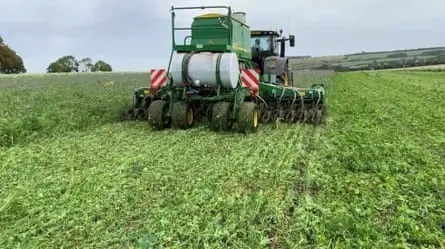
Today, a new philosophy is taking root on select farms. At Wexcombe Farm, managed by the Hosier family, the traditional post-harvest window is being reimagined entirely. Rather than leaving fields bare or spraying them into submission, farmers practicing regenerative agriculture are introducing complex polyculture cover crops directly into the stubble while the final wheat harvest is still underway.
George Hosier describes this innovation delightfully as a "five-minute fallow field." Within moments of the combine harvester completing its run, seeds for a diverse mix of cover crops are drilled directly into the ground. These fields are rapidly transforming the concept of post-harvest management across the globe.
Supporting Context & Metrics: The Science of Soil Health
The shift away from bare stubble fields is underpinned by mounting scientific data regarding soil biology, carbon sequestration, and hydrological resilience.
The Hidden Crisis Beneath Our Feet
According to agricultural scientists and environmental bodies, conventional intensive farming has depleted global topsoils at an alarming rate. Traditional ploughing exposes organic matter to oxygen, accelerating the oxidation of carbon and releasing vast quantities of carbon dioxide into the atmosphere. Furthermore, bare soil subjected to torrential autumn rains suffers from structural collapse, leading to severe nutrient runoff into local water systems.

Cover Crops as Ecological Engines
The deployment of multi-species cover crops—such as those utilized at Wexcombe Farm—reverses this degradation through several biological mechanisms:
- Diverse Root Systems: A mix of fodder radish, phacelia, buckwheat, clover, and vetches creates varied root depths. Deep taproots (like radish) break up compacted subsoil layers without mechanical intervention, while fine root networks (like phacelia and buckwheat) bind soil particles together, resisting erosion.
- Nitrogen Fixation: Legumes such as clover and vetches form symbiotic relationships with rhizobia bacteria, capturing atmospheric nitrogen and converting it into natural soil fertilizer, thereby reducing the need for synthetic chemical inputs.
- Microbial Stimulation: Living roots continuously exude carbon-rich compounds (exudates) that feed beneficial mycorrhizal fungi and bacteria, re-establishing a complex, living soil food web.
Quantitative Environmental Impacts
| Agricultural Practice | Carbon Impact | Soil Erosion Risk | Biodiversity Index | Water Retention |
|---|---|---|---|---|
| Traditional Stubble Burning (Pre-1993) | Extremely High Emissions | Very High | Near Zero | Poor (Crusted surface) |
| Conventional Bare Stubble (Chemical Spray) | Moderate Emissions | High | Low | Moderate |
| Regenerative Cover-Cropped Stubble | Carbon Sinking / Net Negative | Minimal | High | Excellent (Spongy matrix) |
Official Statements and Expert Perspectives
The transition from sterile stubble management to regenerative post-harvest cropping has garnered significant attention from agronomists, policy-makers, and farming unions.
Dr. Aris Thorne, a leading soil ecologist at the Agricultural Research Institute, highlights the paradigm shift:
"For decades, modern agronomy treated soil as an inert chemical medium—a mere sponge to hold up plants and deliver synthetic NPK fertilizers. We are now realizing that soil is a living biological organ. Leaving post-harvest fields completely bare or chemically dead is akin to starving an animal between meals. Practices like those seen at Wexcombe prove that the post-harvest period can be our most productive window for biological carbon pumping."
Representing the farming community, George Hosier emphasizes the practical viability of regenerative methods over purely theoretical conservation:
"People often assume that farming for nature means sacrificing yield or financial viability. What we’ve found with our ‘five-minute fallow’ approach is that the opposite is true. By introducing a diverse cover crop immediately after the combine leaves, we are protecting our soil from baking sun and winter washouts, feeding our outdoor-living livestock through the leaner months, and setting up our spring barley for a healthier start. It’s an investment in the farm’s future capital—the soil itself."
Environmental regulators have also begun integrating these insights into subsidy frameworks, shifting financial incentives away from mere land ownership toward tangible improvements in soil organic matter and biodiversity net gain.
Future Outlook: The Next Horizon in Arable Management
As the agricultural sector faces the dual pressures of climate volatility and tightening environmental regulations, the future of the post-harvest stubble field hangs in the balance.
Climate Adaptation and Extreme Weather
With changing weather patterns bringing prolonged summer droughts punctuated by sudden, violent downpours, bare stubble fields represent an unacceptable risk for farm businesses. Unprotected soil washes away rapidly, taking thousands of pounds of applied fertilizers with it. The widespread adoption of living cover crops is expected to transition from an avant-garde farming technique to an essential risk-mitigation strategy across temperate and semi-arid agricultural zones.
Integration of Livestock and Arable Farming
Historically, mixed farming—where livestock and crop production were intimately integrated—was standard practice. Industrialization heavily segregated these sectors, leading to specialized, monocultural arable farms that imported fertility in bags and tanks. The resurgence of multi-species cover crops is bridging this divide once more. As demonstrated by Wexcombe’s outdoor-living cows grazing on lush radish and clover over winter, the integration of livestock into the arable rotation fertilizes the soil naturally through manure while trampling organic residue to build humus.
Policy and Market Pressures
Consumer demand for sustainably produced food is reshaping supply chains. Major food manufacturers and supermarkets are under increasing scrutiny regarding their Scope 3 greenhouse gas emissions, much of which originates from farm-level soil management. Consequently, grain buyers and agricultural processors are beginning to reward farmers who demonstrate active carbon sequestration and soil regeneration during the post-harvest phase.
Conclusion
The nostalgic image of the silent, amber stubble field—flickering dew against the legs of an autumn rambler—is evolving. While the romanticism of the temporary rural commons may be shifting, a deeper, more profound beauty is taking its place. Where once there was only dead straw and chemical silence, the modern regenerative farm is proving that the end of a harvest is not an ending at all, but rather the vital, vibrant beginning of the next agricultural cycle.



