

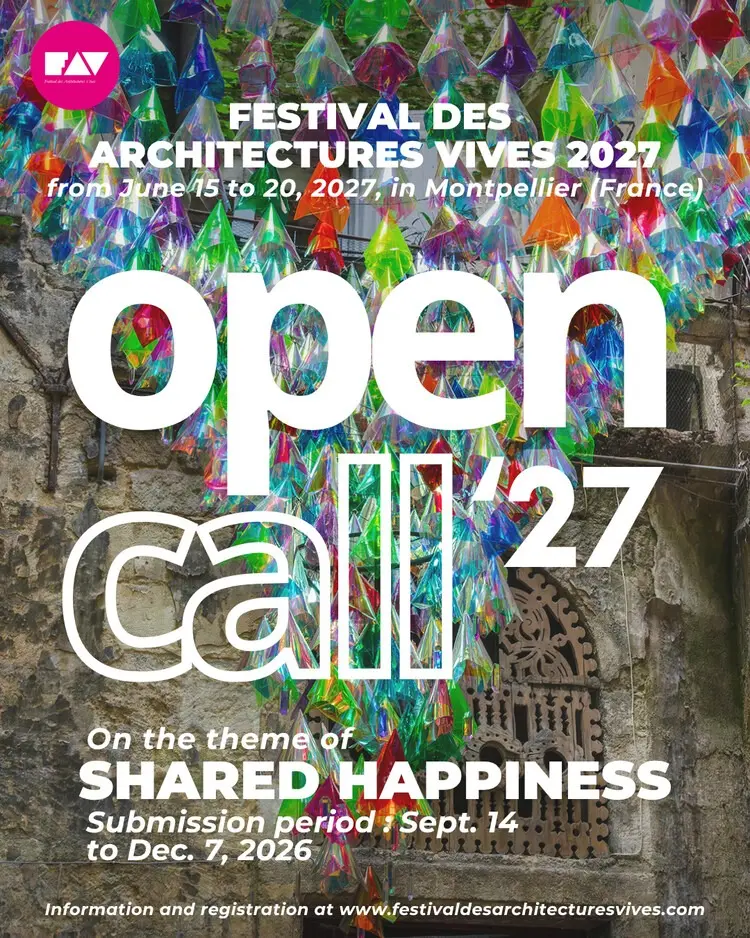
MONTPELLIER, FRANCE — In the historic heart of Southern France, where medieval stone meets the avant-garde imagination of a new generation of designers, the stage is set for a landmark celebration of spatial intervention. The Festival des Architectures Vives (FAV) has officially announced the launch of its global call for applications for its 21st consecutive edition. Scheduled to take place in Montpellier from June 15 to June 20, 2027, this year’s festival introduces a deeply resonant, emotionally charged conceptual framework: "Shared Happiness" (Le Bonheur Partagé).
Emerging as one of Europe’s most dynamic incubators for experimental architecture, urban intervention, and landscape design, FAV 2027 invites young architects, urban planners, landscape architects, and multidisciplinary creators from across the globe to reimagine the hidden urban jewels of Montpellier. Centered around the grand, private courtyards (hôtels particuliers) of the city’s historic district—spaces normally shielded from the public eye—the festival challenges participants to construct ephemeral architectural installations that bridge the gap between historical heritage and contemporary socio-spatial dialogue.
With the submission window open until December 7, 2026, the architectural community has a finite, highly anticipated opportunity to pitch interventions that interrogate what collective joy, communal well-being, and spatial harmony mean in an increasingly fragmented modern world.
Executive Overview: A Milestone 21st Edition
Entering its third decade of operation, the Festival des Architectures Vives has evolved far beyond a local showcase; it is now an international institution that acts as a vital bridge between theoretical experimentation and tangible built reality. Over the past twenty years, FAV has provided an essential launchpad for hundreds of emerging designers, offering them rare creative autonomy to construct full-scale, site-specific installations in environments steeped in architectural pedigree.
The 2027 edition arrives at a critical juncture in contemporary urbanism. As cities worldwide grapple with the compounding pressures of post-pandemic social recovery, ecological anxiety, and the rapid digitization of public life, the psychological and physical dimensions of urban space are undergoing intense scrutiny. By selecting "Shared Happiness" as the guiding motif for 2027, the festival’s curators are pivoting away from dystopian urban critiques—so often prevalent in contemporary design discourse—and toward a radical exploration of joy, generosity, and collective emotional resonance as architectural drivers.
+-------------------------------------------------------------------------+
|                       FAV 2027: KEY METRICS & DATES                     |
+-------------------------------------------------------------------------+
| Event Milestones:                                                       |
| • Call for Applications Launch : September 22, 2026                     |
| • Application Deadline         : December 7, 2026                       |
| • Festival Dates               : June 15 – June 20, 2027                |
| • Location                     : Montpellier, France                    |
| • Target Audience              : Young architects, landscape            |
|                                  architects, urban planners, & creatives|
| • Primary Venue Type           : Historic private courtyards            |
|                                  (hôtels particuliers)                  |
+-------------------------------------------------------------------------+
Young professionals chosen for the festival will not merely exhibit drawings or digital renderings; they will receive logistical, financial, and institutional backing to fabricate their designs within centuries-old stone courtyards. This direct confrontation between contemporary materiality—often utilizing sustainable, recycled, or technologically advanced components—and classical French architecture guarantees a sensory-rich experience for the tens of thousands of visitors who descend upon Montpellier each June.
Detailed Chronology: The Journey to June 2027
To understand the weight of the 2027 call for applications, one must examine the rigorous, carefully calibrated timeline that governs the Festival des Architectures Vives. The path from the initial conceptual brief to the grand opening in the sun-drenched alleys of Montpellier is a multi-month journey defined by rigorous peer review, structural safety evaluations, and hands-on fabrication.
Phase 1: The Launch and Open Call (September – December 2026)
The unveiling of the festival theme on September 22, 2026, marks the official commencement of the cycle. Over the ensuing ten weeks, multidisciplinary teams from around the world form partnerships, pool resources, and develop comprehensive design proposals responding to the "Shared Happiness" brief.
Applicants must account for a multitude of constraints:
- Site Adaptability: Designs must be modular or easily assembled without damaging the protected historic masonry of the hôtels particuliers.
- Materiality: Emphasis is placed on circular economy principles, recyclability, and low carbon footprints.
- Weather Resistance: Installations must withstand the Mediterranean sun, potential summer winds, and continuous public interaction.
- Ephemeral Nature: The structures must be completely reversible, leaving no trace upon the historic fabric once the festival concludes.
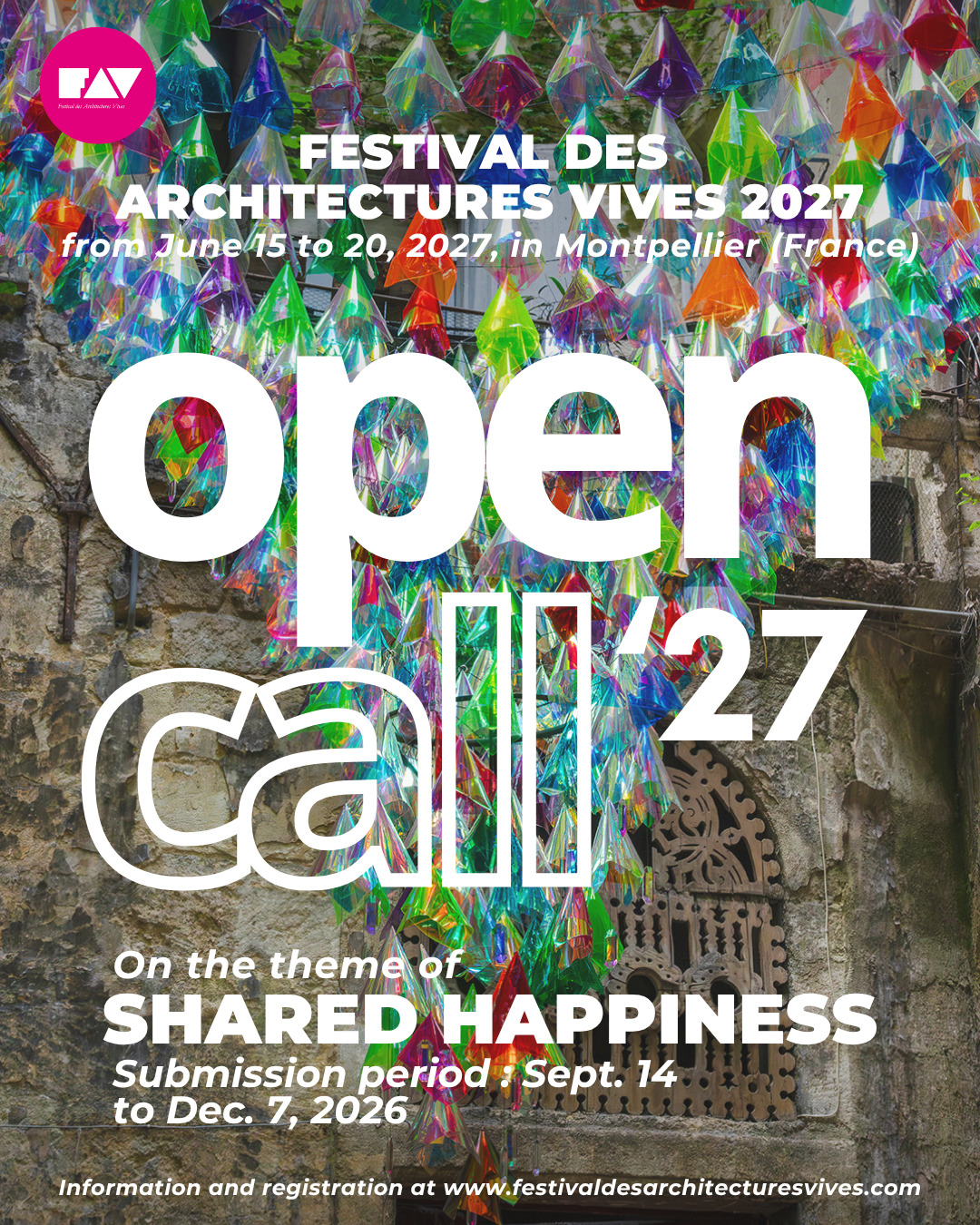
The application portal closes decisively at midnight on December 7, 2026. Following this, an expert jury composed of esteemed architects, architectural critics, cultural figures, and municipal representatives convenes to review the submissions.
Phase 2: Selection, Refinement, and Engineering (January – March 2027)
By early winter, the finalist teams are notified. This triggers a period of intense collaboration between the selected designers and FAV’s technical directors. During this phase, structural engineers and local authorities evaluate the winning proposals for public safety, crowd flow dynamics, and material compliance. Designers refine their blueprints, source sustainable materials—frequently relying on local suppliers in the Occitanie region—and prepare for the logistics of pre-fabrication.
Phase 3: On-Site Construction and Fabrication (June 10 – June 14, 2027)
The week preceding the festival is a hive of frantic, highly collaborative activity. Selected teams descend upon Montpellier to execute their visions over a breathless, highly compressed build window. Working side-by-side in the courtyards, architects test structural joints, calibrate lighting elements, and integrate acoustic or interactive features. This intense build period has historically fostered a vibrant community spirit among the participants, turning temporary workshops into impromptu laboratories of architectural exchange.
Phase 4: The Festival and Public Exhibition (June 15 – June 20, 2027)
Doors open to the public on June 15, transforming Montpellier into an open-air museum of spatial experimentation. Over six days, citizens, tourists, and international design critics navigate a curated urban trail, utilizing digital maps and physical guides to discover installations tucked away behind heavy wooden street-front portals.
The event culminates in the awarding of several prizes, including the Jury Prize and the Public Choice Award, before the installations are carefully dismantled, recycling materials wherever possible to honor the festival’s commitment to ecological stewardship.
Supporting Context & Metrics: The Anatomy of an Urban Catalyst
To fully appreciate the significance of the Festival des Architectures Vives in Montpellier, one must look closely at the socio-cultural and economic ecosystem that supports it. Over its 20-year history, FAV has documented consistent growth across several key performance indicators, cementing its status as a premier European cultural event.
The Urban Canvas: Montpellier’s Hôtels Particuliers
Montpellier is unique among French regional capitals for its exceptionally preserved medieval and early modern urban core (known locally as l’Écusson). Within this dense labyrinth of narrow streets lie dozens of private mansions constructed during the 17th and 18th centuries by wealthy merchants, nobles, and regional nobility.
+-------------------------------------------------------------------------+
|                  THE ARCHITECTURAL DIALECTIC OF FAV                     |
+-------------------------------------------------------------------------+
|                                                                         |
|   [ 17th / 18th Century Stone ]  <--->  [ 21st Century Ephemeral Tech ] |
|   • Massive, permanent stone            • Lightweight, modular systems  |
|   • Classical symmetry                  • Fluid, algorithmic geometry   |
|   • Private, exclusive heritage         • Public, democratized access   |
|                                                                         |
|   SYNTHESIS: A temporary spatial dialogue provoking new emotional       |
|              and physical understandings of urban interiors.            |
|                                                                         |
+-------------------------------------------------------------------------+
These buildings are architectural masterpieces in their own right, characterized by:
- Monumental Staircases: Grand stone ascents wrapping around open wells.
- Carved Stone Facades: Intricate baroque and classical detailing.
- Enclosed Courtyards: Intimate, acoustic spaces traditionally used for carriage turnarounds and private receptions.
By opening these private thresholds to the general public, FAV performs a dual function: it democratizes elite architectural heritage while providing contemporary designers with a high-contrast backdrop that tests the limits of their creativity. An installation that appears striking in a white-cube gallery takes on entirely new dimensions when juxtaposed against centuries-old patinated limestone.
Economic and Cultural Impact
Independent cultural impact assessments conducted over the past decade highlight the multifaceted value of FAV to the Occitanie region:
- Footfall and Attendance: The festival regularly attracts upwards of 40,000 to 50,000 visitors over its six-day run, drawing architecture enthusiasts from across France, Europe, and further abroad.
- International Reach: Participants hail from more than 15 to 20 different countries annually, transforming Montpellier into a global melting pot of emerging design talent.
- Media Amplification: FAV consistently secures coverage in leading international architecture and design publications, reinforcing Montpellier’s reputation as a progressive, design-forward metropolis.
- Alumni Success: Numerous architects who cut their teeth building temporary installations at FAV have gone on to establish internationally acclaimed practices, validating the festival’s role as a career-launching platform.
Official Statements and Curatorial Vision: Decoding "Shared Happiness"
The intellectual backbone of the 21st edition rests on its thematic anchor: "Shared Happiness" (Le Bonheur Partagé). In an era dominated by discussions of urban loneliness, climate crisis, and hyper-individualized digital consumption, the curators have deliberately chosen a concept that sounds deceptively simple yet carries profound spatial implications.
In their curatorial manifesto released alongside the call for applications, the festival organizers elaborate on the necessity of this theme:
"Architecture has always been tasked with sheltering the body, but its higher calling is to elevate the human spirit. In an urban landscape increasingly dictated by utilitarian efficiency, security fencing, and commercial transactionalism, where is the space for collective joy? How can physical form, light, texture, and volume actively induce a sense of shared well-being among strangers?
For FAV 2027, we challenge the new generation of creators to step beyond critique and propose spatial solutions for happiness. We are not looking for naivety, but for sophisticated, tactile, and immersive environments that provoke smiles, spark shared conversations, and foster an immediate sense of communal belonging within the rigid stone framework of Montpellier’s historical courtyards."
This curatorial stance pushes designers to move past purely cerebral or formalistic architectural exercises. To address "Shared Happiness," an installation must engage the human senses directly. Whether through kinetic structures that respond to collective touch, acoustic pavilions that harmonize ambient sound into soothing auditory landscapes, or optical interventions that refract the piercing Mediterranean sunlight into playful, shifting chromatic fields, the successful proposals will be those that translate an emotional state into physical reality.
Furthermore, the emphasis on the word Shared underscores a vital social dimension. Happiness in the urban realm cannot be an isolated, solipsistic experience; it requires relational architecture—spaces that encourage pause, interaction, eye contact, and collective dwelling among people who have never met before.
Future Outlook: The Evolution of Ephemeral Architecture
As the architecture and design professions continue to adapt to a rapidly changing world, the relevance of temporary, experimental festivals like FAV has never been more pronounced. Traditional architectural procurement models—often bogged down by multi-year planning approvals, rigid regulatory frameworks, and conservative financial backing—frequently struggle to innovate at the speed demanded by contemporary ecological and social shifts.
Ephemeral architecture acts as the R&D (Research and Development) laboratory for the built environment. Because these installations are temporary and built on a modest scale, they permit risks that would be economically or logistically prohibitive in permanent construction. Designers can test novel bio-based materials (such as mycelium composites, recycled textiles, and rammed earth blocks), experiment with advanced parametric geometries, and study human behavioral responses to radical spatial configurations in real-time.
+-------------------------------------------------------------------------+
|                  FAV AS AN URBAN R&D LABORATORY                         |
+-------------------------------------------------------------------------+
|  [ Ideation & Call ] ---> [ Material Experimentation ] ---> [ Real-Time ] |
|                           (Bio-plastics, textiles)         (Crowd Study)|
|                                                                         |
|  [ Permanent Adaptation ] <--- [ Post-Occupancy Data ] <--- [ Assembly ]|
|  (Informing future cities)                                              |
+-------------------------------------------------------------------------+
Looking toward June 2027, the Festival des Architectures Vives stands poised to once again push the boundaries of what architecture can achieve in a matter of days. For young practitioners watching from architecture schools and emerging studios worldwide, the call for applications is more than just a competition brief—it is an invitation to leave an indelible mark on a historic city, to engage in a high-stakes dialogue with the past, and to redefine how spatial design can cultivate joy in the 21st century.
How to Apply
Eligible candidates—including young architects, landscape architects, urban planners, and allied spatial creators—are invited to review the complete submission guidelines, site dossiers, and technical constraints on the official Festival des Architectures Vives platform.
- Submission Deadline: December 7, 2026
- Festival Dates: June 15 – June 20, 2027
- Location: Montpellier, France
As the winter months unfold and drafting tables light up across the globe, the architectural world watches Montpellier, anticipating how the next generation will answer the call to build a architecture of shared happiness.



