Executive Overview
On August 14, a catastrophic highway collision in central Brazil claimed the lives of seven Indigenous Guarani individuals, including two children and a prominent, internationally respected community leader. The victims, all hailing from the Kalipety village within the Tenondé Porã Indigenous Territory in São Paulo state, were traveling to visit relatives and share traditional seeds when their vehicle was struck by a detached grain cargo trailer.
The tragedy has sent profound shockwaves through Brazil’s Indigenous communities and environmental advocacy networks. Among the deceased was Karaí Tiago Honório dos Santos, a visionary executive coordinator of the Guarani Yvyrupa Commission and the Guarani Inter-Village Committee. Tiago was widely recognized for his fierce, innovative advocacy, notably engineering a landmark 2019 shareholder activist campaign against one of Brazil’s largest railway operators that secured millions in environmental and community reparations.
Beyond the immediate devastation of losing three generations of a single family and vital community pillars—including educators, council members, and cultural preservationists—the incident highlights the precarious safety conditions faced by Indigenous travelers on Brazil’s heavily commercialized roadways. Compounding the community’s grief, the driver of the truck allegedly fled the scene, leaving authorities with mounting questions regarding regulatory compliance, industrial transport safety, and the broader vulnerabilities of Indigenous populations navigating a modernizing, resource-extractive Brazilian landscape.
Detailed Chronology of the Crash and Immediate Aftermath
The Collision
The fatal accident occurred on August 14 in central Brazil, under circumstances that point heavily to industrial negligence in freight transport. According to a formal police report reviewed by investigative outlets, a heavy cargo trailer loaded with corn broke loose from the semi-truck pulling it.
A local fisherman who witnessed the horrific event described the separation to law enforcement, stating that the massive, corn-filled trailer detached unexpectedly and smashed "violently" into the passenger car carrying the seven Guarani travelers. The kinetic force of the impact was catastrophic, rupturing fuel lines and instantly triggering an intense fire that engulfed both vehicles.
The Scene and the Hit-and-Run
The ferocity of the blaze made immediate rescue efforts impossible and incinerated the vehicles, complicating the initial recovery and identification of the victims. According to the eyewitness testimony provided to police, the driver of the transport truck failed to stop, rendering aid, or report the accident. Instead, the driver fled the scene, leaving the burning wreckage and the bodies of the victims behind. This alleged hit-and-run has intensified public outrage, prompting demands for a thorough manhunt and rigorous investigation into the trucking company’s safety standards, cargo weight limits, and vehicle maintenance protocols.
Identification of the Victims
While official forensic identification procedures took time due to the severity of the thermal destruction, community members and family quickly confirmed the identities of all seven souls lost in the wreckage:
- Karaí Tiago Honório dos Santos (34), executive coordinator and prominent rights defender.
- Kerexu Laudiceia Benites (31), Tiago’s wife, community leader, and local educator.
- Jaxuka Luna Benites Santos (7), their young daughter.
- Tadeu Hiago Werá Mirim Benites dos Santos (14), their teenage son.
- Kerexu Cleonice Honório dos Santos (42), Tiago’s older sister and council member.
- Ileo Benites (32), community member.
- Genilson Euzébio Karay Mirim (30), community member.
The loss represents a devastating blow to the Kalipety village, wiping out key leadership figures, educators, and cultural torchbearers in a single, brutal moment.
Supporting Context & Metrics: The Legacy of Karaí Tiago and the Kalipety Village
A Journey Interrupted: Seed Exchange and Cultural Tradition
To fully understand the gravity of the trip, one must look at the cultural practices of the Guarani. Anthropologist Tatiane Klein, a close friend and professional colleague of Karaí Tiago for over a decade, noted the tragic irony of the accident.
“[Tiago’s] journey was interrupted in such a brutal way, and what a sad coincidence that [it was] by a truck loaded with corn,” Klein shared in a phone interview. “They were going to Mato Grosso do Sul to visit relatives and exchange traditional seeds that they cultivate in the Kalipety [Guarani village].”
Seed-saving and inter-community exchange are fundamental to Guarani agrobiodiversity and food sovereignty. These trips are not merely social visits; they are sacred acts of ecological preservation, ensuring that indigenous crop varieties adapted to regional microclimates survive across generations.
Innovative Activism: The Rumo Railway Campaign
Karaí Tiago was much more than a local voice; he was a strategic tactician who mastered the mechanisms of corporate accountability to defend indigenous rights. His defining moment of public notoriety came in 2019, when he spearheaded a brilliant, unconventional corporate activist campaign against Rumo, Brazil’s largest railway operator.
Rumo’s expansive freight railway project cut aggressively across 13 distinct Indigenous villages spanning five separate Indigenous territories, threatening local ecosystems, water sources, and traditional livelihoods. Rather than relying solely on conventional protests, Tiago mobilized Guarani communities to purchase six shares of Rumo stock, valued at just 17 Brazilian reais each (approximately $3 USD at the time).

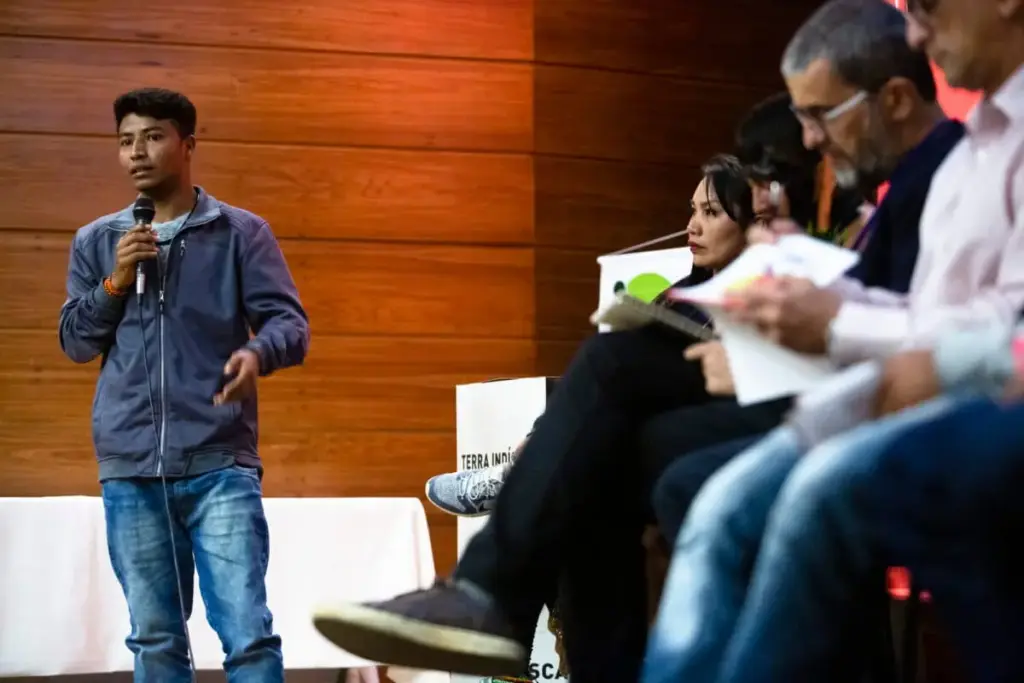
By acquiring these shares, the Guarani gained legal standing as corporate stakeholders. This micro-investment granted them direct entry into Rumo’s annual shareholder meeting. Standing before top executives and institutional investors, Tiago and his delegation publicly confronted the company, shaming corporate leadership for failing to honor commitments regarding environmental safeguards and Indigenous protections.
The Landmark Settlement
The pressure yielded historic results. Within a year of the shareholder confrontation, the Guarani committee successfully negotiated and signed a binding agreement with Rumo. The settlement secured comprehensive environmental mitigation programs and financial compensation valued at 68 million reais (roughly $13 million USD), setting a groundbreaking legal and tactical precedent for Indigenous resistance against corporate encroachment in Latin America.
Pillars of the Community: Cleonice and Laudiceia
The losses extend far beyond Tiago’s individual accomplishments. His sister, Kerexu Cleonice Honório dos Santos, was an institutional cornerstone, serving on the Indigenous territory’s collective leadership council and emerging as a driving force within the broader Guarani women’s movement.
Meanwhile, his wife, Kerexu Laudiceia Benites, dedicated her life to education and the transmission of ancestral wisdom. Working as a teacher within the Kalipety village, Laudiceia was instrumental in reinvigorating traditional knowledge regarding native medicine, botany, and ethnopharmacology—knowledge critical to the community’s self-sufficiency and cultural identity.
Official Statements and Community Reaction
The immediate aftermath of the tragedy has been defined by a heavy, enveloping grief. When international environmental and investigative media outlets such as Mongabay reached out to the wider Guarani leadership for formal commentary, representatives declined immediate interviews, explaining that the communities were in deep mourning and not yet emotionally prepared to speak publicly about the devastating loss.
However, tributes have poured in from human rights organizations, socio-environmental research institutes, and academic allies across Brazil.
- The Guarani Yvyrupa Commission released internal notices mourning the loss of their coordinator, highlighting his unwavering dedication to territorial demarcation and ecological restoration.
- The Instituto Socioambiental (ISA) published commemorative tributes, emphasizing that while the physical presence of leaders like Tiago, Cleonice, and Laudiceia has been abruptly cut short, their institutional blueprints, legal victories, and defense strategies remain embedded in the fabric of the struggle.
- Civil Rights Advocates have pointed out the bitter symbolism of the tragedy: Indigenous defenders who successfully challenged industrial grain transport giants on corporate floors were ultimately struck down on the highway by the very industrial freight machine that characterizes modern agribusiness expansion in Brazil.
Future Outlook: Safety, Accountability, and the Survival of Guarani Autonomy
As the Tenondé Porã Indigenous Territory buries its dead, several critical questions loom over the investigation and the future trajectory of Indigenous advocacy in the region.
1. The Search for Legal Accountability
The immediate priority for legal teams and civil rights monitors is tracking down the driver who fled the scene and holding the transport company fully accountable. The failure to secure the grain cargo trailer points to severe potential violations of transit safety laws, overloading regulations, and mechanical maintenance standards. Indigenous rights groups are demanding that federal prosecutors step in to ensure the hit-and-run is investigated with maximum transparency and urgency, preventing the case from stalling in local bureaucratic channels.
2. Infrastructure Hazards for Indigenous Communities
The crash throws a harsh spotlight on the systemic dangers posed by high-speed, heavy-load freight corridors that bisect or run adjacent to Indigenous territories throughout Brazil. As agribusiness production scales up to feed global export markets, rural highways see exponential increases in heavy truck traffic. Infrastructure planning rarely accounts for the safety of vulnerable rural and Indigenous populations who must navigate these roads, raising urgent demands for traffic calming measures, speed enforcement, and dedicated pedestrian and community crossings near reserves.
3. Succession and the Resilience of Guarani Leadership
Perhaps the deepest anxiety within the Kalipety village concerns leadership succession. Figures of Karaí Tiago’s caliber—who successfully bridge traditional ancestral knowledge with sophisticated, modern legal and corporate strategies—are rare and difficult to replace.
Yet, those who worked closely with him emphasize that his leadership style was profoundly collaborative rather than centralized. Tatiane Klein noted that Tiago was intentional about "pushing others to speak and training younger leaders." This deliberate mentorship model ensures that the political consciousness, strategic acumen, and ecological vision he cultivated will continue to guide the next generation of Guarani defenders.
4. Continuing the Fight for Land and Environment
The legal precedents set by the Kalipety village—such as the Rumo railway shareholder action—proved that Indigenous communities can effectively fight corporate neglect using the tools of the modern capitalist system. As the community heals from this unspeakable trauma, their underlying struggle for territorial autonomy, environmental defense, and cultural survival remains steadfast. The road ahead is perilous, but the legacy etched by Tiago, Cleonice, Laudiceia, and their family members provides an enduring light for the battles yet to come.