As the Biodiversity Heritage Library (BHL) marks its momentous 20th anniversary, institutions worldwide are looking back at the foundational literature that forged our modern understanding of the natural world. Among the most profound contributions to this global digital repository are the rare archival materials and foundational texts provided by the University of Illinois Urbana-Champaign Library. At the center of these historical treasures are the life works of two nineteenth-century biological pioneers: Stephen Alfred Forbes and Charles Robertson.
Though operating in different yet complementary niches of the natural sciences—Forbes mastering aquatic ecology, ichthyology, and entomology, and Robertson establishing the bedrock of pollination ecology through his decades-long study of bees and flowering plants—both men shared an obsessive dedication to empirical observation. Their meticulous records, published volumes, and specimen logs did much more than catalog the biodiversity of the American Midwest at the turn of the 20th century. Today, in an era marked by rapid environmental shifts and alarming rates of species decline, their historical datasets have transformed into irreplaceable baseline metrics for contemporary climate and ecological research. This article explores the extraordinary lives of Forbes and Robertson, examining how their archival legacy continues to bridge the gap between historical field naturalism and modern data-driven ecological conservation.
Detailed Chronology: The Parallel Lives of Scientific Visionaries
The parallel trajectories of Stephen A. Forbes and Charles Robertson span an era when American science was rapidly shifting from amateur natural history to rigorous, institutionalized empirical research.
Stephen A. Forbes: Architect of Aquatic and Environmental Science (1844–1930)
Born on May 29, 1844, Stephen Alfred Forbes emerged as one of the most versatile and influential natural scientists of his generation. His early academic career at the University of Illinois Urbana-Champaign established him as a premier professor of zoology and entomology. Forbes possessed a remarkably holistic vision of nature, rejecting the notion that organisms could be studied in isolation from their environments. His sweeping research inquiries examined insects, crustaceans, fishes, and birds, mapping out the complex webs of interaction that bind ecosystems together.
1886: Forbes’s international reputation was solidified when he was awarded the prestigious first-class medal of the Société d’Acclimation de France for his groundbreaking scientific publications.
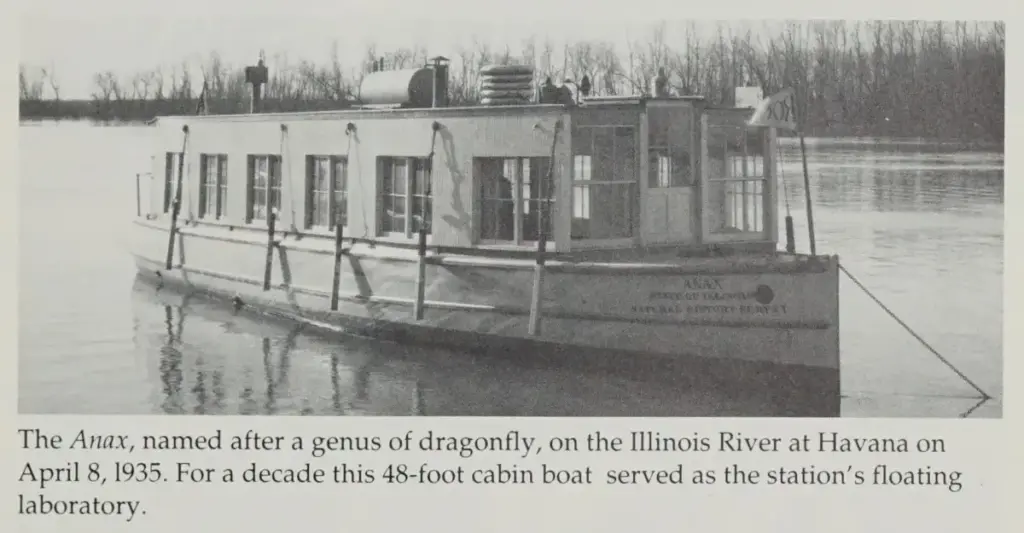
1894: Recognizing the need for continuous, localized aquatic research, Forbes established the pioneering Forbes Biological Station on the Illinois River in Havana, Illinois. Two years later, in 1896, he directed the construction of an innovative 48-foot floating biological laboratory at the site.
1908: Forbes published The Fishes of Illinois, a monumental work documenting over 150 fish species represented by more than 200,000 specimens gathered across all 102 counties of the state. Richly illustrated with color paintings by artists Lydia M. (Hart) Green and Charlotte M. Pinkerton and paired with detailed distribution maps, the text became an instant classic in aquatic biodiversity.
1917: Appointed as the director of the Natural History Survey Division, Forbes held the post until his death on March 13, 1930, in Urbana, Illinois, leaving behind a legacy that fundamentally shaped the Illinois Natural History Survey (INHS).
Charles Robertson: The Unsung Master of Plant-Pollinator Networks (1858–1935)
Thirteen years junior to Forbes, Charles Robertson was born on June 12, 1858, in Carlinville, Illinois. He pursued his early education at Blackburn College in his hometown before refining his expertise in botany and zoology at Harvard University. Eventually returning to Blackburn College, he served as a professor of biology and Greek.
Unlike many of his university-bound contemporaries, Robertson chose a localized, intensely focused path of field research. For more than twenty years, he systematically documented every insect visit to the flowering plants within and immediately surrounding Carlinville.
The Carlinville Survey: Robertson ultimately recorded 1,429 pollinating insect species—ranging from flies and beetles to butterflies and bees—interacting with 456 distinct plant species.
1928: He synthesized decades of painstaking field notes into his seminal volume, Flowers and Insects. This publication remains one of the most comprehensive single-locality studies of plant-pollinator interactions ever completed.
1935: Demonstrating a lifelong passion that never waned, Robertson was actively collecting insect specimens in Florida only a few months before his death on June 1, 1935, in Carlinville.
Supporting Context & Metrics: The Quantitative Value of Historical Archives
The true brilliance of both Forbes and Robertson lies not merely in the books they published during their lifetimes, but in the granular, quantitative data embedded within their surviving collection logs, correspondence, and field ledgers—data that modern scientists are leveraging in unprecedented ways.
Quantifying the Past: By the Numbers
Metric Category
Stephen A. Forbes / INHS Legacy
Charles Robertson Archive
Primary Geographic Focus
Statewide (All 102 Illinois Counties)
Carlinville, Illinois, and surrounding regions
Key Specimen Volume
200,000+ fish specimens cataloged in landmark studies
1,429 pollinating insect species documented
Associated Flora Studied
Broad aquatic & terrestrial ecosystems
456 specific plant species
Primary Archival Repositories
University of Illinois Urbana-Champaign Library & BHL
University Archives (UIUC) & BHL Collections
The Modern Utility of Century-Old Data
While 19th-century field notebooks were once viewed as dusty relics of an analog past, contemporary data science has recast them as goldmines for biodiversity conservation. Robertson’s specimen collection logs—which record specific specimen numbers, scientific names, sexes, precise collection dates, localities, and host plants—have served as an irreplaceable baseline for evaluating modern environmental degradation.
In a landmark investigation published in Ecology & Society, researcher John Marlin (an affiliate of the Illinois Sustainable Technology Center and the INHS) utilized Robertson’s historic logs to measure species decline in Carlinville over a century. By comparing Robertson’s historic observations with modern field surveys, scientists were able to quantify exact shifts in the local ecosystem, tracking the selective extinction and survival of specialized bee and floral networks.
Furthermore, a quantitative analysis published in the Data Science Journal further emphasized the wealth of knowledge captured within Robertson’s preserved correspondence, reprints, five ledgers, and dedicated bee-research data books. Housed within the University Archives at the University of Illinois Urbana-Champaign and made globally accessible via the Biodiversity Heritage Library, these texts prove that historical archives are dynamic, living assets in the fight against biodiversity loss.
Official Statements and Archival Recognition
The enduring impact of Forbes and Robertson on the scientific community and the state of Illinois is immortalized not only in their publications, but in the glowing tributes paid by their academic peers. Upon Forbes’s passing, the University Senate put forth an official resolution capturing the essence of his character and professional magnitude:
"The Senate knew him as Professor of Zoology and Entomology and Dean of the College of Science; it admired his sagacity and patience as chairman of its Committee on Educational Policy; its members loved him for his simplicity, sincerity and broad human interests. The University and the State are immeasurably indebted to him as one of their most useful and eminent laborers for the common good."
The ripple effects of Forbes’s institutional vision are similarly felt today across the network of field stations operated by the Illinois Natural History Survey. From the Frank C. Bellrose Waterfowl Research Center at the historic Forbes Biological Station in Havana—which continues to drive wetland and marsh bird conservation policy—to the Great Rivers, Illinois River, Kaskaskia, Lake Michigan, Ridge Lake, and Sam Parr biological stations, his framework for continuous, localized field research endures.
Reflecting on the mission of the Biodiversity Heritage Library during its 20-year milestone, digital archiving initiatives emphasize the crucial bridge built between human narratives and hard data. BHL serves as a unique repository where the official scientific record (preserved in peer-reviewed monographs and illustrated folios) converges with the intimate human experience of discovery (revealed through handwritten logs, personal correspondence, and field journals).
Future Outlook: Connecting Historical Discoveries to Contemporary Conservation
As ecological systems face unprecedented pressures from habitat fragmentation, climate change, and invasive species, the work initiated by Stephen A. Forbes and Charles Robertson is more critical than ever. We cannot effectively manage what we do not understand, and we cannot measure ecological change without a reliable baseline.
The integration of rare archival materials from the University of Illinois Urbana-Champaign into the Biodiversity Heritage Library ensures that these foundational datasets remain free, open, and accessible to researchers, educators, historians, and citizen scientists across the globe. By digitizing hand-painted fish illustrations, century-old specimen ledgers, and fragile field notes, BHL acts as a time machine for the environmental sciences.
Looking forward, the ongoing digitization and data-mining of collections like those of Forbes and Robertson pave the way for advanced predictive ecological modeling. As data scientists and conservation biologists continue to parse the granular details of Robertson’s bee ledgers or map the historical aquatic distributions recorded by Forbes, they are proving that yesterday’s natural history is tomorrow’s conservation blueprint.
Through the continued preservation efforts of institutions like the Biodiversity Heritage Library—supported by public advocacy and philanthropic contributions—the invaluable labor of these 19th-century pioneers will continue to illuminate the path toward a sustainable, biodiverse future.