For nearly two centuries, the Papers and Proceedings of the Royal Society of Van Diemen’s Land—later known as the Papers and Proceedings of the Royal Society of Tasmania—has served as an intellectual anchor for the southernmost reaches of the British Empire and, later, an independent Australia. Established in 1843, the Royal Society of Tasmania holds the distinction of being the oldest Royal Society outside of the United Kingdom. Its foundational journal, launched with its inaugural volume in 1849, did far more than record the administrative triumphs of a fledgling British penal colony; it captured the rapid, often volatile transformation of a unique island ecosystem.
As part of the global celebration for BHL at 20: Treasures from the Biodiversity Heritage Library, this foundational scientific publication is receiving renewed international attention. Thanks to modern open-access digital infrastructure, researchers, historians, and conservationists can now explore more than 175 years of continuous scientific publication through the Biodiversity Heritage Library (BHL).
Volume One of the Papers and Proceedings, published in three installments between 1849 and 1851, provides a vivid, multi-faceted look at colonial enterprise. From meticulously cataloged weather tables and reports on nascent coal mining to groundbreaking natural history accounts by global luminaries like John Gould and John Edward Gray, the journal offers a complex window into the past. Yet, it is also a text shadowed by the realities of colonization—reflecting Eurocentric privileges while omitting Indigenous voices. Today, modern editors and researchers are actively confronting these historical gaps through truth-telling initiatives, bridging nineteenth-century natural science with contemporary ecological stewardship and historical accountability.
Detailed Chronology: The Genesis of a Scientific Institution
The Birth of a Colony’s Scientific Consciousness
In the early decades of the nineteenth century, the British colonial outpost of Van Diemen’s Land (as Tasmania was historically named) was rapidly evolving from a remote penal settlement into a permanent, enterprising community. Settlers, naturalists, and administrators alike recognized an urgent need to systematically record and understand the landscapes, climates, and resources of their new home.
To address this intellectual vacuum, the Royal Society of Van Diemen’s Land was established in 1843 under the patronage of the colonial governor, Sir John Franklin, and his visionary circle. Six years later, in 1849, the Society published the first volume of its Papers and Proceedings. This landmark publication established a tradition of scientific inquiry that has weathered political upheavals, economic depressions, and technological revolutions.
[1843] Royal Society of Van Diemen’s Land Established
  │
  ├── [1849-1851] Publication of Volume 1 (Papers and Proceedings)
  │     ├── Comprehensive meteorological and demographic data
  │     └── Groundbreaking natural history (Gray, Gould, M'Coy)
  │
  ├── [Late 19th Century] Foundation of TMAG and Botanical Gardens
  │
  ├── [2021] Formal Apology to Tasmanian Aboriginal People issued by the Society
  │
  └── [Present Day] Full global open-access digitization via BHL at 20
Volume One: Data, Industry, and Natural Wonders
The nearly 50 opening pages of Volume One set a rigorous administrative and empirical tone. They featured exhaustive meteorological charts, population demographics, and economic surveys tracking the colony’s agricultural yields, manufacturing capabilities, and early coal exploration efforts.
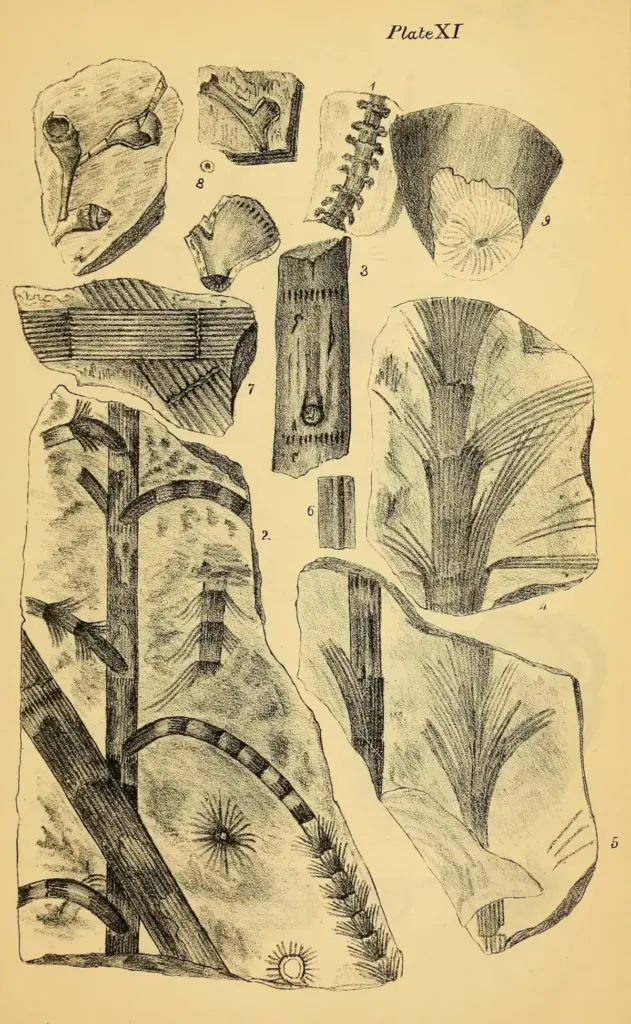
Simultaneously, the natural sciences section read like a nineteenth-century "Who’s Who" of natural history. Contributions from luminaries such as Frederick M‘Coy unraveled the mysteries of ancient fossil zoology and botany, while global zoological authorities synthesized field observations from across the island.
However, the most revealing insights into the rapidly shifting Tasmanian environment are often found in the routine, seemingly casual meeting minutes recorded by the Society’s members:
The Record-Breaking Blue Gum: In 1849, a Mr. Hull reported an astonishing Eucalyptus specimen located six miles outside Hobart Town. Measuring an immense 28 yards (25.6 meters) in circumference and scaling an estimated 330 feet (100.5 meters) in height, the tree exemplified the staggering scale of Tasmania’s original old-growth forests.
Curiosities and Zoological Discoveries: Mr. Champ presented a small spotted fish preserved in spirits featuring four leg-like appendages with finger-like tips, while Mr. Milligan triumphantly announced the safe arrival of two live thylacines shipped to London the previous year.
Indigenous Ecological Knowledge: Members examined specimens of "native bread" (Mylitta sp.), a subterranean fungus historically harvested and consumed by Tasmanian Aboriginal people. Observers noted that when grated and prepared into a pudding with milk, the fungus was "very palatable."
Rare Botany: A sample of white resin from the Oyster Bay pine was documented. Sourced from a tree with an exceptionally narrow geographic distribution, the timber was prized for local building and carpentry. Today, the South Esk Pine Nature Reserve protects one of the last remaining native stands of this endangered conifer.
While nineteenth-century naturalists cataloged native species with meticulous care, their publications also inadvertently documented the genesis of some of Tasmania’s most pressing contemporary ecological challenges.
The Pet That Became a Predator
Among the most historically significant papers in the early volumes is an account by renowned naturalist Ronald Campbell Gunn. Gunn detailed how the "flying squirrel"—better known today as the sugar glider (Petaurus breviceps)—became naturalized in Tasmania. Originally imported as a household pet during the 1830s, the small marsupials escaped captivity and rapidly established self-sustaining wild populations.
At the time, few colonial observers could have anticipated that this pocket-sized introduction would evolve into an acute ecological threat. Today, the descendants of those escaped pets prey heavily on the nesting females, eggs, and chicks of Tasmania’s critically endangered swift parrot (Lathamus discolor), accelerating the bird’s trajectory toward extinction.
The Trout Controversy
Equally consequential was a paper authored by Captain Charles Stanley, which evaluated the practicalities of introducing brown and rainbow trout into Tasmania’s native freshwater river systems. Stanley’s advocacy for acclimatization bore fruit when live fish ova were successfully transported to the Salmon Ponds at New Norfolk. The subsequent release of these exotic fish permanently altered aquatic food webs, introducing a formidable apex predator that disrupted native endemic fish populations forever.
Beyond Science: Institutions, Archives, and Critical Reflection
The Papers and Proceedings were never merely repositories for biological and geological treatises. They also functioned as institutional ledger books, documenting the inner workings of the Royal Society itself—including office-bearers, financial statements, book acquisitions, and artifact donations.
The Foundation of Tasmanian Cultural Institutions
The individuals steering the early Society were among the most prominent and influential figures in the colony. Their weekly and monthly meetings regularly attracted generous donations of rare books, fine art, geological specimens, and anthropological artifacts.
These accumulated donations formed the cornerstone collections of several world-class cultural institutions that thrive today, including:
The Royal Tasmanian Botanical Gardens
The Tasmanian Museum and Art Gallery (TMAG)
The Royal Society of Tasmania Art and Library Collections
The journal serves as an irreplaceable historical witness, chronicling not only the birth of these institutions but also the political debates, administrative struggles, and civic ambitions that brought them into existence.
Confronting Colonial Blindspots
Modern historians and contemporary editors approach these historic texts with a dual lens of appreciation and critical analysis. Produced entirely by colonial administrators and settlers, the early journals inherently reflect the privileges, biases, and worldview of the British Empire. Consequently, they largely omit Indigenous Tasmanian voices and gloss over the profound injustices inflicted upon the island’s original custodians.
Dr. Sally Bryant AM, a leading Tasmanian wildlife scientist, Honorary Editor of the journal, and recipient of Honorary Life Membership in the Society, notes that these omissions and ideological biases make the historical record both compelling and occasionally uncomfortable to engage with. Recognizing these historical shortcomings has become a vital component of the Society’s modern evolution.
Official Statements and Contemporary Perspectives
Reflecting on the enduring legacy of the publication, contemporary leadership emphasizes that the journal must evolve to address historical reckonings while maintaining its scientific rigor.
"Within forty years of British settlement, Van Diemen’s Land was no longer merely a colonial outpost at the edge of the world. It had grown into an increasingly connected, resourceful, and enterprising community pursuing scientific knowledge, economic opportunity, and civic benefit. The Papers and Proceedings chronicle that remarkable transformation."
— Dr. Sally Bryant AM, Honorary Editor, Royal Society of Tasmania
Modern volumes of the Papers and Proceedings have actively expanded their editorial scope to include social history, cultural reconciliation, and environmental ethics. In a landmark step toward historical accountability, the Royal Society of Tasmania issued a formal Apology to Tasmanian Aboriginal People in 2021. Furthermore, the Society’s annual Tasmanian Aboriginal Lecture series and subsequent journal publications have integrated Indigenous perspectives and truth-telling into the core of the institution’s academic mission.
Future Outlook: Digital Preservation and Artificial Intelligence
As the Biodiversity Heritage Library (BHL) celebrates its 20th anniversary, the complete run of the Papers and Proceedings of the Royal Society of Tasmania stands as one of its most prized open-access collections.
Through BHL’s global digital repository, researchers worldwide can access over 175 years of continuous scientific literature. Crucially, the digitization of these fragile paper volumes allows modern researchers to apply advanced computational tools, natural language processing, and artificial intelligence to historical texts. These technologies unlock ecological patterns, phenological shifts, and historical distribution data that manual reading alone might easily overlook.
In an era increasingly dominated by fleeting digital media and automated algorithms, the Papers and Proceedings remains a profound testament to intellectual resilience. It is far more than a digitized relic on a screen; it is an active, evolving window into the environments, cultures, and sociopolitical forces that continue to shape the unique island of Tasmania.
To explore the complete, freely accessible historical archives of the Royal Society of Tasmania, visit the Biodiversity Heritage Library (BHL).