

Executive Overview
An investigation by Carbon Brief has revealed that extreme heatwaves across the United Kingdom forced NHS hospitals to cancel more than 1,000 surgical procedures during May and June. The record-breaking temperatures—amplified by global climate change—exposed severe structural vulnerabilities in healthcare infrastructure, driving ambient temperatures inside operating theatres past safe operational thresholds and forcing clinicians to halt routine, urgent, and emergency medical care.
Data obtained through Freedom of Information (FOI) requests submitted to 140 NHS trusts and health boards shows that at least 1,110 operations were cancelled across 17 peak heatwave days. The disrupted procedures spanned a wide array of specialties, ranging from elective hip and knee replacements to complex cardiac operations, skin cancer excisions, and ophthalmic procedures. Most critically, the data confirmed that at least 10 life-threatening emergency operations were cancelled due to theatre overheating, while 18 surgeries had to be abruptly abandoned mid-procedure as environmental controls failed.
Because many NHS trusts do not systematically track heat-related cancellations, medical experts emphasize that the 1,110 figure represents a conservative baseline. The findings paint a picture of a national surgical apparatus unequipped for recurring extreme weather events, compounding existing NHS backlog pressures, staffing shortages, and acute bed shortages.
Detailed Chronology and Methodological Findings
The FOI Investigation Framework
The investigation centered on two distinct periods of extreme weather during which the UK Health Security Agency (UKHSA) issued "Amber" and "Red" heat-health alerts across England, alongside corresponding official weather warnings in Wales:
- Period 1: May 22 to May 28
- Period 2: June 18 to June 27
To evaluate the operational impact of these thermal events, Carbon Brief submitted targeted FOI requests to 140 NHS trusts and health boards in England and Wales responsible for acute care facilities equipped with operating theatres. Non-surgical institutions, including mental health trusts and community trusts, were excluded from the inquiry.

| Category of Response | Number of Trusts / Health Boards | Operational Implications |
|---|---|---|
| Disclosed Heat-Related Cancellations | 59 | Recorded 1,110 total heatwave cancellations across the 17-day period. |
| Responded Without Specific Heat Tracking | 63 | Cited lack of centralized data coding for heat, or categorized incidents under generic terms like "equipment failure." |
| Non-Responsive Prior to Publication | 19 | Failed to provide data within the statutory timeframe. |
Among the 59 health bodies providing full surgical cancellation datasets, approximately 7% of all recorded procedure cancellations during the designated heatwave windows were directly attributed to excessive heat and humidity inside hospital facilities.
       [140 NHS Trusts Contacted]
                   │
    ┌──────────────┼──────────────┐
    ▼              ▼              ▼
59 Disclosed   63 Lacked      19 Non-
Heat Data      Heat Tracking  Responsive
 (1,110 Ops)    Systems
Geographic Concentration of Cancellations
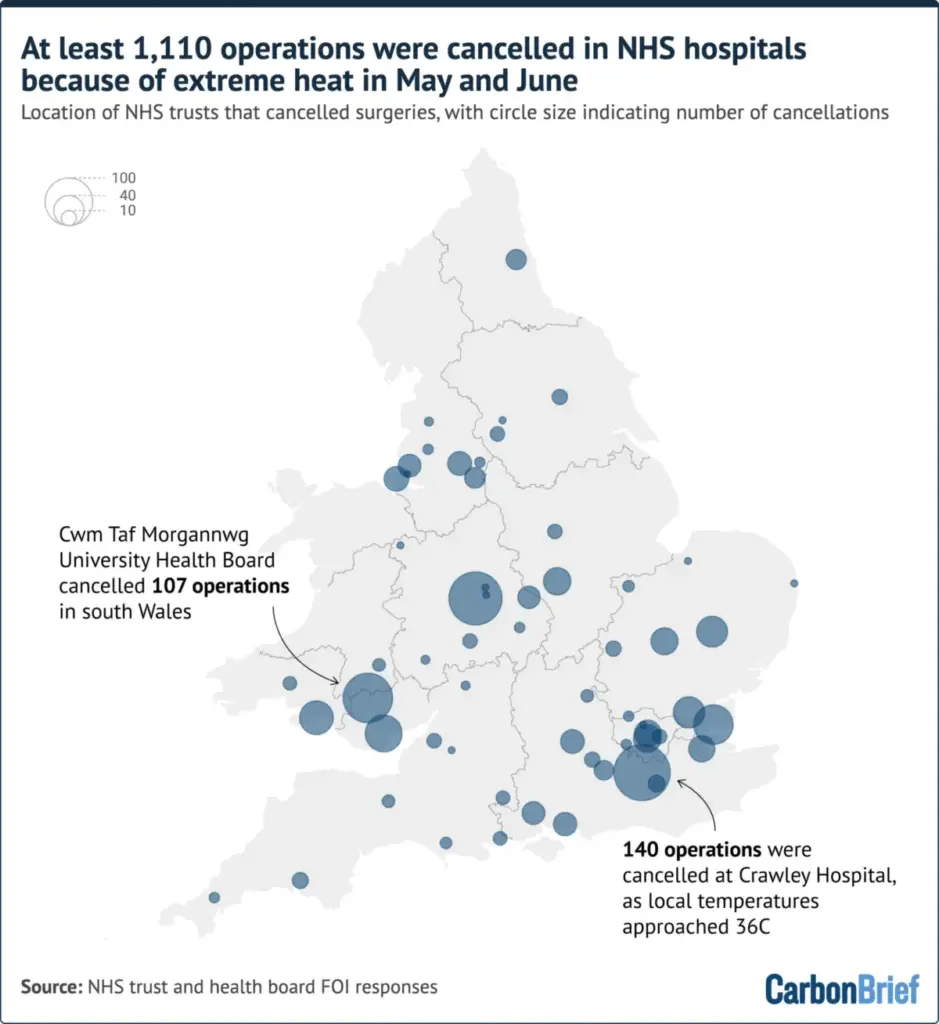
Surgeries were cancelled across England and Wales, with the highest concentration occurring in southern regions where ambient temperatures reached record highs.
+-----------------------------------------------------------------------+
| GEOGRAPHIC HOTSPOTS FOR HEATWAVE SURGICAL CANCELATIONS               |
+-----------------------------------------------------------------------+
| 1. Crawley Hospital (Surrey & Sussex Trust)  [140 Cancellations]     |
|    - Local temperatures approached 36°C in June.                      |
|                                                                       |
| 2. Cwm Taf Morgannwg University Health Board [107 Cancellations]     |
|    - Widespread disruption across South Wales facilities.             |
|                                                                       |
| 3. Regional Hotspot Hubs:                                            |
|    - South Essex                                                      |
|    - Dudley (West Midlands)                                           |
|    - Greater London Municipal Area                                    |
+-----------------------------------------------------------------------+
Surrey and Sussex Healthcare NHS Trust registered the single highest localized total, reporting 140 cancelled operations—all concentrated within the surgical unit at Crawley Hospital. Local weather stations recorded temperatures approaching 36°C near Gatwick during the June heatwave, overwhelming internal climate control systems.
In South Wales, Cwm Taf Morgannwg University Health Board reported 107 heatwave cancellations, while significant clusters of procedure deferrals were confirmed across South Essex, Dudley in the West Midlands, and multiple acute care sites across Greater London.
Supporting Context and Key Metrics
Surgical Specialties Disrupted
Data detailing specific procedure categories disclosed by reporting trusts covers 596 individual cancellations. The breakdown shows that high-volume elective specialties faced the vast majority of deferrals:

Distribution of Disclosed Cancellations by Specialty (Sample Size: 596)

Orthopaedic Surgeries (Hip/Knee Replacements) █ 167
Ophthalmic (Eye) Surgeries                     ████████ (High Volume)
Gynaecological & Urological Procedures         ████████ (High Volume)
Cardiology / Cardiac Procedures                █ 8
Dermatological Oncology (Skin Cancer)         █ 7
Emergency Operations                           █ 10
Mid-Operation Abandonments █ 18- Orthopaedic Surgery: Accounting for 167 cancellations, orthopaedic procedures were the single most impacted category. Complex joint replacements require ultra-clean airflow environments and thermal-sensitive sterile materials, making them extremely vulnerable to microclimate shifts in the operating room.
- Ophthalmology, Gynaecology, and Urology: High procedure volumes in these specialties resulted in widespread cancellations, directly adding to regional elective care backlogs.
- Oncology and Cardiology: At least eight specialized cardiac procedures and seven skin cancer removal operations were deferred due to unsafe theatre conditions.
The Emergency and Mid-Procedure Toll
While the majority of deferred operations were classified as elective—scheduled in advance for non-immediate life-threatening conditions—the investigation revealed that acute emergency care was also compromised.
At least 10 emergency surgical procedures intended to treat immediately life-threatening conditions had to be cancelled or transferred due to uncontrollable environmental conditions in theatres.
Even more disruptive were 18 instances where surgical teams commenced operations but were forced to abandon procedures midway through. These abandonments occurred when theatre temperatures rose unexpectedly, HVAC cooling systems tripped out, or condensation compromised the sterile field while patients were undergoing active surgery.
Clinical Mechanics and Engineering Systems Breakdown
HVAC Failures and Pathogen Controls
Operating theatres rely on highly complex, specialized Heating, Ventilation, and Air Conditioning (HVAC) engineering to maintain sterile environments. Explaining the failure points, NHS anaesthetist Dr. Ed Robinson noted that surgical suites operate as tightly regulated, positive-pressure environments.
                    AIRFLOW & STERILITY MECHANICS

    [Outdoor Ambient Temp Exceeds Design Limits (>35°C)]
                           │
                           ▼
          [HVAC Cooling & Humidity Control Fails]
                           │
             ┌─────────────┴─────────────┐
             ▼                           ▼
  [Loss of Positive Pressure]     [Surge in Relative Humidity]
             │                           │
             ▼                           ▼
  [Airborne Pathogens & Fumes    [Microbial Condensation Forms
   Enter Clinical Space]          on Surgical Implements]
             │                           │
             └─────────────┬─────────────┘
                           ▼
              [PATIENT INFECTION RISK RISES]
                           │
                           ▼
             [MANDATORY SURGICAL CANCELLATION]
Operating theatre ventilation systems dilute airborne contaminants and purge medical fumes and waste anaesthetic gases. Laminar air displacement systems direct clean air downward over the patient, forcing ambient air outward into adjacent non-clinical corridors to keep pathogens away from open wounds.

When ambient outdoor temperatures surpass the engineering thresholds of older hospital cooling towers, these climate systems fail. Loss of temperature regulation causes relative humidity inside the theatre to spike. Tim Lane, a urological surgeon and President of the Royal College of Surgeons of England (RCS England), noted that elevated humidity creates a critical infection risk: excess moisture condenses onto surgical trays, sterile drapes, and stainless-steel instruments, creating pathways for bacterial contamination.
Physical Stress on Staff and Material Degradation
Overheating in operating suites creates dual risks, threatening both medical equipment function and clinical performance:
- Staff Thermal Stress: Surgical teams frequently operate in heavy Personal Protective Equipment (PPE). In orthopaedic cases, staff wear dense lead aprons to protect against continuous intraoperative X-ray radiation. Under elevated ambient heat, clinicians face thermal exhaustion and reduced concentration, making prolonged surgical intervention unsafe.
- Material and Chemical Instability: Critical surgical supplies have narrow thermal tolerances. For instance, specialized polymethyl methacrylate (bone cement) used to anchor prostheses during hip and knee replacements cures unpredictably under heat. High room temperatures cause the compound to set too quickly, preventing proper seating of the implant and risking surgical failure.
Official Statements and Expert Insights
The investigation drew commentary from surgical leaders, health researchers, and government figures, who emphasized the systemic threat posed by thermal disruption.
"Behind all of these statistics… are real people who have probably already been waiting a long time."
— Dr. Dmitri Nepogodiev, Public Health Researcher, University of Birmingham
Dr. Nepogodiev stressed that while hospitals prioritize urgent, life-threatening cases during climate disruptions, elective cancellations inflict profound emotional distress and physical deterioration on patients awaiting joint replacements or cancer interventions.

Richard Egan, an endocrine surgeon and National Clinical Director within NHS Wales, highlighted the compound strain on health system capacity:
"That’s a significant impact on waiting lists… For every week that patients are waiting on a waiting list, their condition could get worse and deteriorate."
— Richard Egan, National Clinical Director, NHS Wales
Responding to widespread hospital strain during summer heatwaves, Health Secretary Yvette Cooper stated that the government and NHS leadership must fundamentally change their operational approach:
"The NHS has to make sure we are preparing for summer pressures now in the same way we prepare for winter."
— Yvette Cooper, Health Secretary
Tim Lane, President of RCS England, pointed out that front-line adaptation has reached its operational limits without long-term capital backing:

"NHS staff work incredibly hard to adapt, often reorganising services and finding practical solutions to keep care running, but resilience alone cannot compensate indefinitely for outdated infrastructure or sustainability."
— Tim Lane, President, Royal College of Surgeons of England
Future Outlook and Strategic Adaptation
Infrastructure Deficits and Long-Term Adaptation Plans
The disruption observed during the May–June heatwaves reflects systemic vulnerabilities across the NHS estate. A study following the 2022 heatwaves revealed that ambient temperatures could not be controlled in approximately 40% of NHS operating theatres, underscoring years of chronic underinvestment in capital infrastructure. Many NHS buildings in England were constructed decades ago, long before modern climate projections accounted for frequent summer extremes.
       CHRONOLOGY OF NHS HEAT ADAPTATION & POLICY FRAMEWORK

   2022          2026 FOI            2026 POLICY         2035 TARGET
┌────────┐     ┌───────────┐       ┌─────────────┐     ┌─────────────┐
│ 40% of │     │ 1,110+    │       │ £32M Resil. │     │ CCC Mandate │
│ Theatres│────>│ Heat      │──────>│ Funding     │────>│ Safe Temp   │
│ Uncool-│     │ Operations│       │ Allocated   │     │ Compliance  │
│ able   │     │ Cancelled │       │ (from £1.5B)│     │ NHS Estate  │
└────────┘     └───────────┘       └─────────────┘     └─────────────┘
The Climate Change Committee (CCC), an independent advisory body, has explicitly recommended that all UK healthcare infrastructure implement retrofits to maintain safe internal working temperatures by 2035. Concurrently, the UK Government’s Third National Adaptation Programme (NAP3) mandates that NHS England incorporate heat mitigation and resilient cooling designs into all future hospital construction.
Capital Allocation and System Readiness
Following summer climate disruptions, the UK Government announced a targeted £32 million allocation drawn from a broader £1.5 billion healthcare infrastructure spend. This ring-fenced capital is earmarked for immediate engineering upgrades, focusing on:
- Replacing legacy chiller plants and cooling towers with high-capacity units.
- Installing redundant ventilation systems in high-risk acute surgical suites.
- Upgrading thermal insulation and solar shading across aging ward blocks and theatre suites.
While these investments represent a step toward climate resilience, health policy experts emphasize that physical infrastructure upgrade programs must proceed alongside improved data collection. Standardizing how heatwave disruptions are logged across all NHS trusts will be critical to identifying vulnerable facilities before heat events occur. Without systemic structural upgrades, seasonal heat pressures threaten to become a recurring summer crisis for the UK’s healthcare system.



