

Executive Overview
For generations, the rhythm of life along Vietnam’s central coast has been dictated by the tides, the hum of heavy diesel engines, and the bountiful promise of the South China Sea. Yet, for veteran mariners like Vo Huu Viet—a fisherman with more than thirty years on the water in Quang Ngai province—the current era is defined by an unprecedented convergence of economic and geopolitical crises.
When global diesel prices hit historic highs in March, driven by escalating conflicts in the Middle East, Viet did something he had rarely done in three decades: he kept his aging, wood-hulled vessel tied to the dock. “The catch is simply not enough to make up for the labor of four men,” Viet reflects, standing on the deck of his family’s livelihood.

Viet’s decision was far from isolated. Across Vietnam’s vital coastal ports, thousands of commercial fishing boats remained idle for months as soaring fuel prices rendered sea-bound voyages economically unviable. The crisis extended far beyond diesel pumps; the price spike rippled through every sector of the maritime economy, inflating the costs of essential supplies from block ice to onboard provisions.
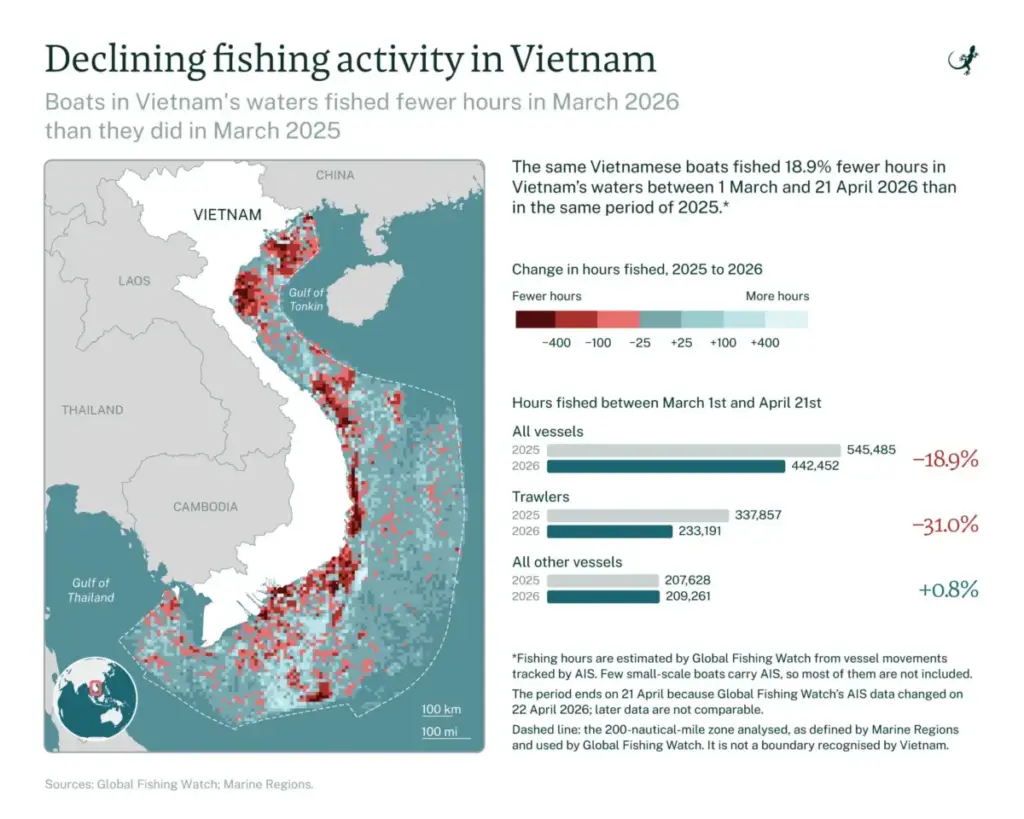
According to vessel-tracking data from the nonprofit platform Global Fishing Watch, overall fishing activity in Vietnamese waters plummeted by 18.9% between March 1 and April 21 compared to the same period in the previous year. For energy-intensive trawlers, the contraction was even more severe, dropping by 31%.

Today, Vietnam’s fishing fleet—traditionally celebrated as the iconic “blue boats” of the nation’s maritime identity—is trapped in a complex web of compounding pressures. Fishers face depleted marine stocks driven by decades of overfishing and climate change, stringent regulatory oversight sparked by a lingering European Union "yellow card," and the encroaching presence of heavily subsidized Chinese maritime forces in contested waters. As Hanoi attempts to balance its dual mandates of asserting territorial sovereignty and reforming its multi-billion-dollar seafood export industry, vulnerable working-class fishers are left to absorb the staggering human and economic toll.
Detailed Chronology of a Maritime Crisis
The multifaceted crisis gripping Vietnam’s fisheries sector is not a sudden anomaly; rather, it is the culmination of regulatory flashpoints, geopolitical escalations, and global economic shocks unfolding over the past decade.

The 2017 Regulatory Turning Point
The foundational shift in modern Vietnamese fisheries management occurred in October 2017, when the European Commission (EC) issued Vietnam a formal "yellow card." The warning served as an indictment of the country’s lax oversight regarding illegal, unreported, and unregulated (IUU) fishing. At the time of the ruling, the EC cited severe legal and structural deficiencies: Vietnam’s domestic fisheries laws did not effectively govern vessels operating outside national jurisdiction, catch logbooks were virtually non-existent, and statutory penalties were far too weak to deter illicit harvesting.
Out of an estimated 33,000 vessels operating within Vietnam’s exclusive economic zone (EEZ), only about 10% carried functional vessel monitoring systems (VMS), and none were legally mandated to keep them switched on continuously. The economic fallout was immediate. In 2017, the European Union had surpassed the United States as the single largest importer of Vietnamese seafood, generating $1.4 billion in trade—a 22% year-on-year increase. By 2019, under the shadow of the yellow card, those exports nosedived by 12%, resulting in immediate losses of more than $183.5 million.

Legislative Overhauls and the Securitization of Fisheries
In response to Brussels’ warnings, Hanoi moved swiftly to overhaul its legal framework. Weeks after the yellow card was issued, the Vietnamese National Assembly passed a landmark Fisheries Law incorporating European recommendations. This was followed in 2019 by Decree 42, which introduced punitive fines ranging from 800 million to 1 billion Vietnamese dong (approximately $35,000 to $43,700) for unlicensed fishing in foreign waters—a sum that frequently exceeds the total catch value of an extended commercial voyage.
While these measures demonstrated Vietnam’s commitment to compliance, fisheries analysts argue that the implementation strategy heavily favored heavy-handed enforcement over ecological restoration. Carolyn Gruber, a fisheries expert at the Washington, D.C.-based Stimson Center, describes the approach as a process of "securitization." Rather than investing heavily in community-led marine conservation or comprehensive stock management, state resources were funneled into military-style monitoring and enforcement actions.

For ordinary fishers, this translated into an omnipresent digital panopticon. GPS trackers, radar units, and communication antennas became mandatory fixtures atop vessels. “We cannot fish outside Vietnam’s waters anymore. The machine knows everything,” says Xanh, a fisherman in his 50s from the coastal village of Tinh Ky. “They fine harshly. If they catch you doing that, they put you in jail.”
The 2026 Fuel Price Shock and Fleet Paralysis
The most recent acute phase of the crisis unfolded in early 2026. Following the outbreak of conflict in Iran in late February, global oil markets experienced a violent upward spiral. By March, domestic diesel prices in Vietnam reached an all-time high of approximately 43,000 dong per liter—roughly $6.20 per gallon—nearly doubling the baseline costs of recent years.

For an "island-protecting" voyage bound for the disputed Paracel archipelago, a mid-sized to large vessel typically requires two to three weeks at sea and burns up to 5,000 liters (1,320 gallons) of fuel alone. At March prices, fuel costs eclipsed $8,200. Factor in the expenses for bait, crew provisions, maintenance, and basic wages, and a single voyage required gross earnings of at least $27,000 merely to break even. Confronted with these prohibitive operating thresholds, thousands of captains chose to keep their vessels anchored, plunging maritime communities into sudden financial distress.
Supporting Context and Metrics: Economics, Ecology, and Geopolitics
Understanding the plight of Vietnam’s fishing communities requires examining the stark statistical realities governing the nation’s maritime sector.

+--------------------------------------------------------------------------+
|                 VIETNAM’S FISHERIES SECTOR AT A GLANCE                   |
+----------------------------------+---------------------------------------+
| Metric                           | Data Point / Context                  |
+----------------------------------+---------------------------------------+
| Fleet Growth (2013-2023)         | Expanded 3.5x (from 4M to 14.4M HP)   |
| Catch Growth (2013-2023)         | Grew less than 1.7x                   |
| March 2026 Diesel Peak           | 43,000 VND/liter (~$6.20/gallon)      |
| Q2 2026 Activity Drop (Overall)  | Down 18.9% year-on-year               |
| Q2 2026 Activity Drop (Trawlers) | Down 31.0% year-on-year               |
| Estimated Yellow Card Cost       | ~23% reduction in EU seafood exports  |
| Projected Red Card Penalty       | Potential $500 million loss           |
+----------------------------------+---------------------------------------+
Overcapacity and the "Tragedy of the Commons"
Over the past decade, Vietnam’s commercial fishing fleet underwent aggressive, unchecked expansion. Between 2013 and 2023, the total engine capacity of the national fleet surged more than 3.5 times, growing from just over 4 million combined horsepower to more than 14.4 million horsepower. Over the exact same timeframe, however, total marine fish catches grew by a factor of less than 1.7.
This widening divergence between fleet capacity and actual yields points to a classic "tragedy of the commons." Decades of unsustainable bottom-trawling, combined with illegal fishing practices and the compounding effects of climate change—such as rising sea surface temperatures and altered oceanic circulation patterns—have severely depleted coastal and offshore fish stocks. Pushed to the brink by diminished nearshore yields, fishers were historically encouraged by state policies to venture further into deeper, more hazardous waters.

The Geopolitical Double Duty of the Fleet
The South China Sea is one of the world’s most fiercely contested geopolitical flashpoints, with regional governments locked in overlapping territorial disputes over rich fisheries and hydrocarbon reserves. China remains the most assertive claimant, leveraging its expansive "nine-dash line" to assert jurisdiction over roughly 90% of the sea. Beijing backs these expansive claims through aggressive island-building, militarization, and the continuous deployment of a state-backed coast guard and maritime militia.
According to Harrison Prétat, deputy director of the Center for Strategic and International Studies’ (CSIS) Asia Maritime Transparency Initiative, Chinese vessels systematically patrol inside the nine-dash line, intercepting foreign vessels and aggressively maneuvering to expel them.

Faced with this external pressure, Vietnam utilizes its commercial fishing fleet to perform an unofficial dual function: harvesting seafood while simultaneously staking physical territorial claims. While Vietnam maintains a formal maritime militia established under a 2009 law—comprising an estimated 8,000 vessels, or roughly 1.22% of the country’s maritime labor force—the vast majority of frontline presence is sustained through ordinary commercial operators.
Through a state subsidy program initiated in 2010, the government provides financial assistance for fuel, insurance, and navigation equipment to encourage boats to operate in contested, remote waters near archipelagos like the Paracels. Fishers colloquially refer to these subsidized voyages as "island protecting."

Yet, the scale of state support highlights a glaring disparity in regional power dynamics. While the largest Vietnamese fishing vessels qualify for a maximum fuel subsidy of roughly $3,810 for a month-long voyage, equivalent Chinese state subsidies can match that figure for a single day of operation. When global fuel prices spike, the financial burden placed on Vietnamese and Philippine operators disproportionately hampers their ability to maintain a presence at sea, a strategic outcome that analysts note heavily favors Beijing’s long-term calculus.
Official Statements and Institutional Perspectives
The institutional responses to Vietnam’s fisheries crisis reflect deep systemic policy contradictions between economic ambition, geopolitical necessity, and international compliance.
- The European Commission (Brussels): A spokesperson for the European Commission emphasized in an email correspondence that Brussels continues to collaborate closely with Vietnamese authorities to refine national fisheries control policies. However, the commission maintains that the yellow card will remain in place until absolute structural compliance is demonstrated. Research indicates that a yellow card operates as a non-tariff barrier equivalent to a 5% tariff rate, while an escalation to a "red card"—an outright import ban on marine fish—would devastate the industry, with government officials warning of potential losses exceeding $500 million.
- Vietnamese Central Government (Hanoi): Removing the yellow card to protect and expand Vietnam’s $11.34-billion seafood export industry remains a top-tier national priority across successive administrative cycles. Simultaneously, Hanoi is attempting to rein in overcapacity. In 2024, the government approved a sweeping conservation plan aiming to reduce the national fishing fleet to 83,600 vessels by 2030, mandating that coastal provinces cut their registered vessel counts by at least 12% compared to 2020 baselines.
- Civil Society and Think Tanks: Analysts such as Carolyn Gruber of the Stimson Center warn that government spending remains skewed toward policing rather than ecological renewal. "It’s more of what we would call securitization," Gruber notes, describing how fisheries management has been subordinated to military enforcement. Similarly, Harrison Prétat of CSIS highlights that resource extraction in the South China Sea has effectively been weaponized as a proxy for territorial acquisition, leaving shared fish stocks vulnerable to total collapse.
- Frontline Fishers (Quang Ngai & Tinh Ky): For local mariners caught between bureaucratic crackdowns and foreign intimidation, policy pronouncements carry little weight against daily survival. Speaking anonymously at the Tinh Ky port, one fisherman captured the prevailing sentiment regarding increased oversight: “Coast guard and fisheries officers check everything, at the port, again at the river gate, and out in the sea. Sometimes they check the boat, then demand a million dong for ‘beer money.’”
Future Outlook: Navigating an Uncertain Horizon
As Vietnam looks toward its 2030 targets for fleet reduction and sustainability reform, the immediate future for artisanal fishing communities appears precarious. Small-scale vessel owners, such as Vo Huu Viet, are primary targets for phased decommissioning and livelihood transition programs promoted by provincial authorities. Yet, for mariners whose identities and generational knowledge are entirely tethered to the sea, alternative employment remains scarce and economically unappealing.
The systemic pressures are mounting. Climate change continues to alter marine ecosystems, driving fish stocks further away from depleted coastal shelves. Geopolitical friction in the South China Sea shows no signs of abating; confrontations with foreign coast guards and maritime militias—ranging from aggressive water-cannon barrages to direct boardings and property confiscation—remain an ever-present occupational hazard.

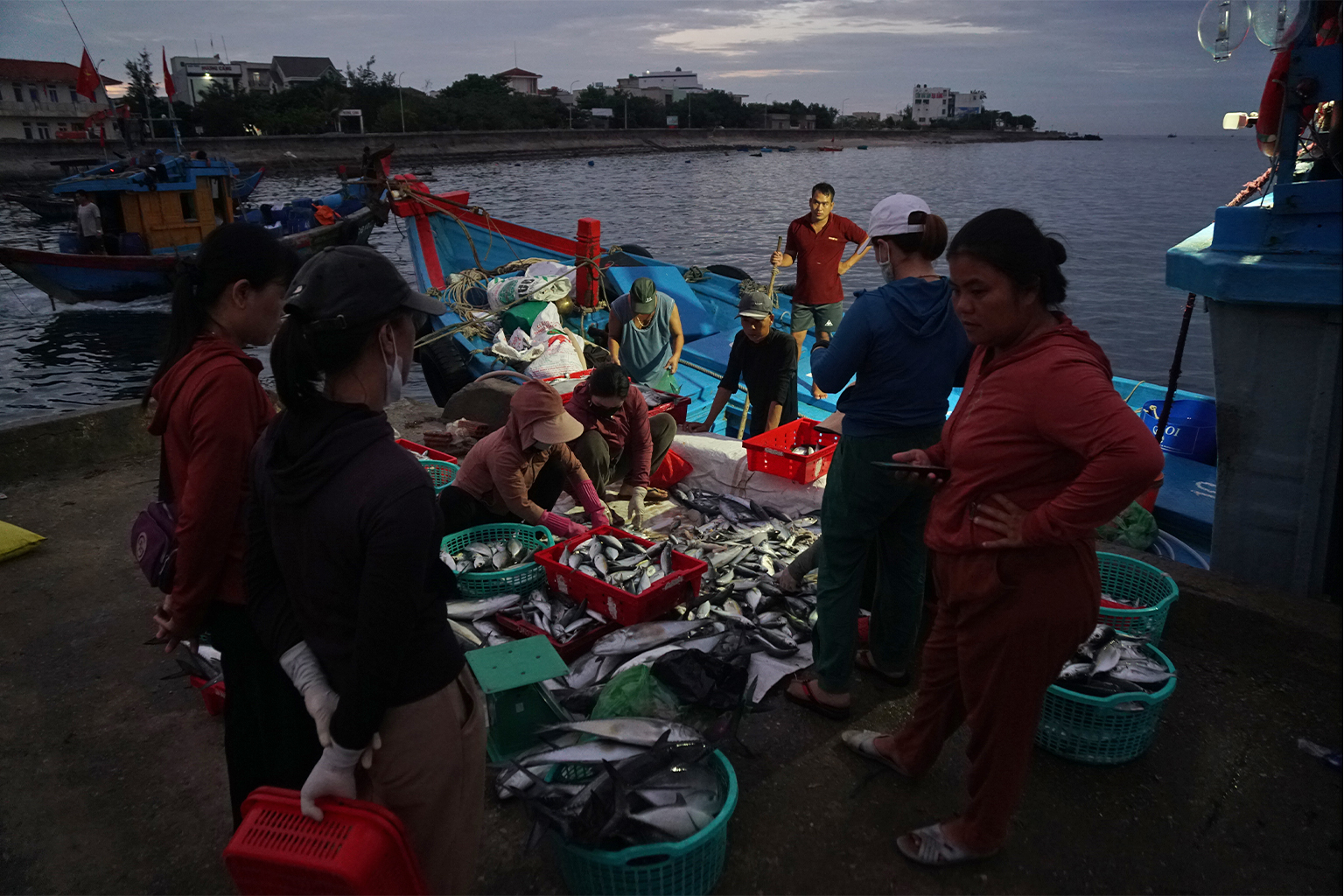
As dusk fell over the Quang Ngai coastline following a rare refueling stop, Viet and his three crewmen cast off their moorings once more. Their upcoming four-day voyage would yield an expected total profit of just 3 to 4 million dong—roughly $115 to $153—to be divided among the four families. Squeezed relentlessly between soaring operational overhead, aggressive foreign encroachment, and an exhausted marine ecosystem, Vietnam’s traditional fishers continue to navigate treacherous waters with diminishing margins for survival.



