Executive Overview
The Washington Utilities and Transportation Commission (UTC)—the state agency tasked with regulating solid waste haulers—has initiated a critical rulemaking process to rewrite definitions surrounding Material Recovery Facility (MRF) residuals. This regulatory overhaul follows a high-stakes legal battle between the UTC and waste management firm DTG Enterprises (doing business as DTG Recycle), which was originally facing a staggering $3.4 million penalty for allegedly operating without a required solid waste certificate.
While that multimillion-dollar penalty has since been dropped as part of a formal settlement agreement, the core dispute has exposed glaring ambiguities in Washington’s environmental and transportation statutes. At the heart of the controversy is a fundamental legal gray area: How should state regulators treat "residual solid waste"—the unavoidable byproducts of recycling and sorting operations—when it is transported from an MRF to a disposal site?
Major waste industry players, including Waste Connections, Waste Management (WM) of Washington, and the Washington Refuse and Recycling Association (WRRA), have intervened in the UTC’s CR-101 rulemaking process. These industry leaders argue that current state regulations are outdated, having been drafted decades before modern MRFs became commonplace. They are pushing for explicit exemptions for MRF residuals, aligning these facilities with existing exemptions granted to traditional transfer stations.
Simultaneously, the Washington Department of Ecology is running a parallel rulemaking process focused on organics management, source separation, and MRF operations under recently enacted state laws, creating a complex web of overlapping regulatory updates. For DTG, the timing of these legal shifts coincides with a massive corporate restructuring, including a buyout by its founder and subsequent asset sales, even as the UTC launches new investigative inquiries into the company’s operations.
Detailed Chronology: From a $3.4 Million Penalty to Regulatory Reform
The friction between Washington regulators and the private waste sector crystallized when the UTC cracked down on DTG Enterprises, setting off a chain of events that has reverberated across the state’s waste management landscape.
The Allegations and the $3.4 Million Fine
The conflict began when the UTC filed a formal complaint against DTG. The state agency alleged that during a period when the company lacked the requisite solid waste certificate, it transferred 3,389 loads of "residual solid waste" from its MRF facilities to various solid waste facilities in Snohomish County. Under Washington state law, entities engaging in the commercial transportation of solid waste must hold a valid solid waste certificate issued by the UTC.
Citing the sheer volume of unauthorized hauls, the UTC levied a proposed penalty of $3.4 million against DTG. The fine sent shockwaves through the state’s recycling sector, immediately drawing criticism from industry advocates who viewed the penalty as draconian and fundamentally disconnected from the realities of modern materials recovery.
The Settlement and the CR-101 Rulemaking Trigger
Rather than heading toward a protracted and potentially damaging courtroom battle, DTG and the UTC reached a settlement agreement. Under the terms of the resolution, the $3.4 million penalty was formally scrapped.
Crucially, however, the settlement required the UTC to initiate a formal rulemaking process—specifically utilizing a CR-101 notice—to better define how MRF residuals should be classified and treated under the agency’s regulatory scope. Both the UTC and DTG acknowledged that clarifying these rules would ultimately benefit the broader waste industry by eliminating legal ambiguities that had persisted for years.
Public Comments and the Upcoming October Workshop
The launch of the CR-101 rulemaking process opened a public comment period that officially closed on August 7. During this window, the UTC received detailed submissions from the state’s major waste operators, industry associations, and legal counsel.
With the comment period concluded, the UTC is preparing to host a comprehensive rulemaking workshop later in October. This session will serve as a critical forum for stakeholders to debate proposed language changes, evaluate exemption criteria, and attempt to harmonize UTC regulations with newer state environmental laws.
DTG’s Corporate Restructuring and New UTC Scrutiny
Compounding the regulatory drama, DTG has undergone significant structural transformations over the past several months. In February, Macquarie Asset Management sold DTG Recycle back to its original founder, Dan Guimont. Following the buyout, the company engaged in a series of asset divestitures, including the sale of four material recovery facilities to MCS Recycle. As a result of these strategic shifts, DTG no longer operates any MRFs directly.
Despite these changes, the UTC’s oversight of the company has not waned. The agency recently opened a fresh document investigation into DTG’s business dealings. This new inquiry continues to probe whether DTG transported solid waste without the proper certificates, demanding extensive data regarding recent asset sales, operational timelines, and corporate structures.
Supporting Context & Metrics: The Mechanics of MRF Residuals
To understand the urgency behind the UTC’s rulemaking process, one must examine the operational reality of Material Recovery Facilities and the legal frameworks governing Washington’s waste stream.
The Inevitable Byproduct of Recycling
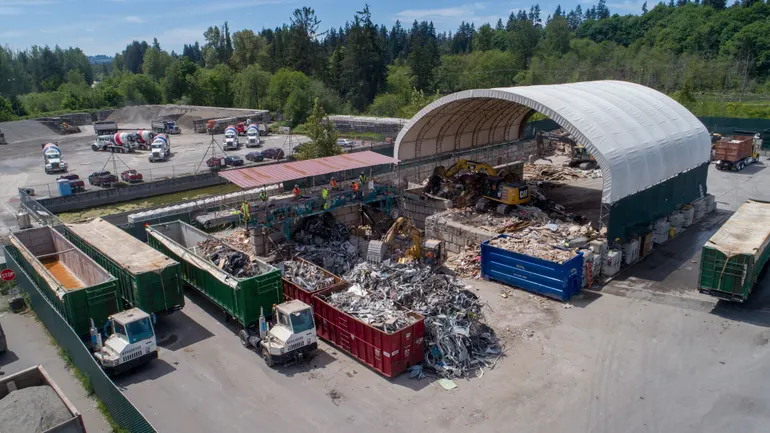
Modern MRFs are industrial facilities designed to intake mixed recyclables, separate them using a combination of manual labor and advanced optical sorting technologies, and bundle marketable commodities like paper, cardboard, plastics, and metals. However, no sorting process is 100% efficient. Consumers frequently place non-recyclable items—such as food-soiled packaging, textiles, hazardous materials, and general trash—into recycling bins.
These contaminants ultimately become "MRF residuals": unrecoverable waste that must be hauled away from the recovery facility and sent to landfills or waste-to-energy plants. Industry representatives emphasize that the generation of residuals is an inescapable physical reality of recycling operations, not an intentional attempt to bypass hauling regulations.
The Ambiguity of "Incidental" Transport and "Occasional" Hauling
Under current Washington regulations (specifically WAC 480-70-011), certain collection and hauling operations are exempt from UTC certification requirements. This includes entities that "occasionally transport to a disposal site, but whose primary business is not the collection of solid waste." Furthermore, exemptions exist for companies that transport solid waste "purely as an incidental adjunct to some other established private business."
DTG and other operators argued that these statutory definitions are hopelessly vague. Specifically:
- What constitutes "occasional" transport? For a high-volume MRF processing thousands of tons of materials daily, hauling away residual waste is a continuous, routine necessity. Does "routine" disqualify a company from the "occasional" exemption?
- Is waste disposal an "incidental adjunct"? DTG maintained that its primary business is recycling and recovery, and the subsequent disposal of residuals is merely a byproduct of that core function rather than a revenue-generating hauling service.
Because the statutes were written decades before modern MRFs became the backbone of municipal waste diversion, they failed to anticipate the logistical challenges of moving residual waste from a recovery plant to a final disposal facility.
Parallel Rulemaking and the New EPR Law
The UTC’s regulatory updates do not exist in a vacuum. The Washington Department of Ecology is simultaneously executing a parallel rulemaking process focusing on organics management, source separation contamination, and Material Recovery Facility operating standards.
Furthermore, these agency actions intersect with Washington’s landmark extended producer responsibility (EPR) for packaging law, which passed in 2025. This sweeping legislation introduces rigorous tracking, reporting, and transparency requirements for MRF residuals and their final disposal locations. Industry associations argue that the Department of Ecology’s EPR framework is the appropriate and sufficient mechanism for monitoring waste processing transparency, making heavy-handed UTC hauling penalties redundant and counterproductive.
Official Statements and Industry Perspectives
The stakeholders involved in the UTC rulemaking process have staked out clear, forceful positions. Major waste operators and trade groups are united in their demand for modernization and regulatory clarity.
Waste Connections: Highlighting the Reality of Recycling
In its official comments submitted to the UTC, Waste Connections emphasized the fundamental unfairness of penalizing companies for managing processing byproducts:
"Residuals are an unavoidable byproduct of legitimate recycling and recovery operations. The existence of residuals does not indicate that a load was improperly transported as recyclable material."
The company asserted that applying traditional solid waste hauling penalties to recycling facilities creates a chilling effect on the state’s recycling infrastructure, discouraging private investment in green technology out of fear of unexpected legal liability.
WRRA: Correcting Historical Oversight
The Washington Refuse and Recycling Association (WRRA)—which represents major industry players including Republic Services and Recology—submitted extensive commentary advocating for explicit exemptions for MRF residuals. WRRA pointed out that when the state’s foundational waste transportation statutes were enacted, modern MRFs were virtually nonexistent.
"This history should correct any notion that the legislature intentionally omitted MRFs from the statute," WRRA stated in its regulatory filing.
The association further argued that creating an explicit exemption for MRF residuals would merely mirror the existing, well-established exemptions already granted to municipal and private transfer stations. WRRA also highlighted the regulatory redundancy of the UTC’s involvement given the implementation of the 2025 EPR packaging law:
"This significant new legislation should be the primary means for regulators to bring greater transparency to waste processing."
DTG Recycle: Pushing for Definitional Clarity
Throughout the dispute, DTG maintained that the state’s punitive approach was fundamentally flawed due to reasonable disagreements over statutory interpretation. In its comments to the UTC, the company stressed that hauling residuals was never intended to be a commercial revenue stream, but rather an administrative necessity inherent to its primary role as a recycler.
DTG urged the commission to use the CR-101 process to clearly define terms like "incidental" and "occasional," ensuring that legitimate recycling operators have legal certainty when managing the outflow of non-recyclable materials from their sorting floors.
Future Outlook: What Lies Ahead for Washington’s Waste Industry
As the Washington Utilities and Transportation Commission prepares for its pivotal rulemaking workshop in October, the stakes for the state’s environmental and waste management sectors could not be higher.
Resolving the Regulatory Crossroads
The outcome of this rulemaking process will determine whether Washington can successfully bridge the gap between legacy transportation laws and modern recycling demands. If the UTC adopts the recommendations put forward by WRRA, Waste Connections, Waste Management, and DTG, MRF residuals will be formally recognized as exempt byproducts. Such a decision would provide immediate legal shelter to material recovery facilities, shielding them from predatory fines and resolving years of legal ambiguity.
Conversely, if the UTC maintains a rigid interpretation of solid waste certificates, private recyclers may face heightened operational compliance costs, complex bureaucratic hurdles, and the constant threat of enforcement actions. This friction could ultimately disincentivize private investment in recycling infrastructure within the state, undercutting Washington’s broader climate and sustainability goals.
The Broader Intersection of State Agencies
Beyond the UTC, the interaction between the commission’s transportation rules and the Department of Ecology’s environmental mandates will dictate the future regulatory climate. As the state rolls out its extended producer responsibility framework for packaging, regulators will have unprecedented visibility into waste tracking and disposal metrics. Industry leaders are hopeful that this overlapping oversight will force state agencies to coordinate their efforts, streamlining compliance for businesses that operate at the intersection of logistics, recycling, and environmental stewardship.
For DTG Enterprises, the path forward involves navigating both the ongoing UTC document investigation into its past asset sales and the evolving legal definitions that will shape the future of the state’s secondary materials market. As the October workshop approaches, all eyes in Washington’s waste management sector will be locked on Olympia, waiting to see whether regulators will modernize their rulebooks to reflect the realities of 21st-century recycling.