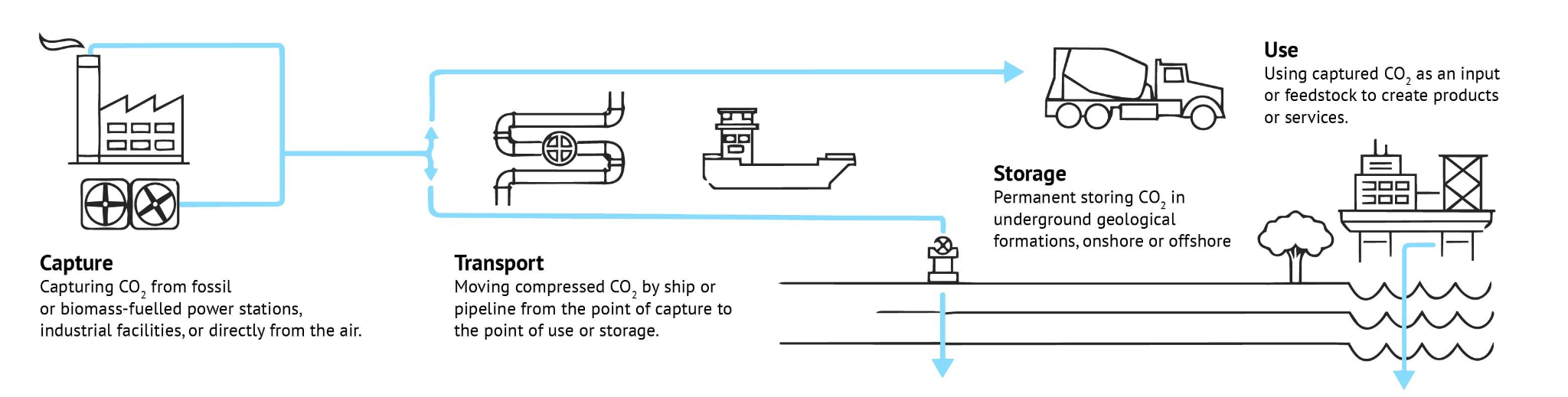
As nations navigate the narrow corridor toward limiting global warming to 1.5°C, Carbon Capture and Storage (CCS) has emerged as one of the most contested battlegrounds in international climate policy. Underpinning the net-zero strategies of major economies—from the United Kingdom to the United States and across the European Union—CCS promises to intercept carbon dioxide emissions at the source, preventing them from escaping into the atmosphere and permanently locking them into deep geological formations.
To its proponents, including the Intergovernmental Panel on Climate Change (IPCC) and the International Energy Agency (IEA), CCS is an indispensable tool. It is widely framed as the sole technically viable pathway for decarbonizing "hard-to-abate" heavy industries, such as cement, steel, and chemical manufacturing, where chemical process emissions cannot be eliminated through electrification alone.
However, an array of climate scientists, economists, and advocacy groups offer a starkly different diagnosis. They argue that CCS is an exorbitant, historically underperforming technology that serves as a tactical lifeline for the fossil fuel industry. Critics contend that by promising future carbon mitigation, CCS justifies the continued extraction of coal, oil, and gas, diverting precious public subsidies away from proven clean energy solutions like wind, solar, and grid-scale storage.
+-------------------------------------------------------------------------------+
|                        GLOBAL CCS BALANCE SHEET (2026)                        |
+------------------------------------+------------------------------------------+
| Total Global Fossil CO2 Emissions  | 38,100,000,000 tonnes / year             |
| Total CO2 Captured & Stored        |     62,500,000 tonnes / year (< 0.2%)     |
| Fraction Used for Fossil Extraction| ~75% (Enhanced Oil Recovery)             |
| Active Commercial Projects         | 75 operational worldwide                 |
+------------------------------------+------------------------------------------+
With governments committing tens of billions of dollars to scale national CCS industries—exemplified by the UK’s £21.7 billion multi-decade industrial cluster strategy—the technology stands at a critical juncture. The core debate is no longer merely about technical feasibility, but whether CCS represents a vital bridge to a net-zero future or a dangerous distraction from the imperative to phase out fossil fuels entirely.
Detailed Chronology: From Enhanced Oil Recovery to Climate Savior
The technical foundations of carbon capture were not forged in response to global warming, but rather within the commercial operations of the 20th-century oil industry.
1970s                 1977              2005             2015            Present (2026)
  |---------------------|-----------------|----------------|-------------------|
First Commercial      Marchetti proposes  IPCC releases    Paris Agreement   75 facilities;
Capture deployed for  ocean CO2 injection Special Report   refocuses CCS on  shift to industry
Enhanced Oil Recovery to mitigate climate  identifying 3    net-zero, industrial & blue hydrogen
in North America.     change.             pilot projects.  decarbonization.  clusters.
1. The Industrial Origins (1970s–1990s)
Carbon capture technology was first deployed commercially in North America during the early 1970s. Its initial purpose was strictly commercial: Enhanced Oil Recovery (EOR). Fossil fuel operators captured carbon dioxide produced as a naturally occurring byproduct during natural gas processing and injected it into mature, depleted oil fields. This process pressurized underground reservoirs, decreasing oil viscosity and enabling operators to extract previously unrecoverable crude. The gas was captured not to protect the atmosphere, but to unlock additional hydrocarbon reserves.
2. Academic Genesis and Ocean Storage Proposals (1976–1977)
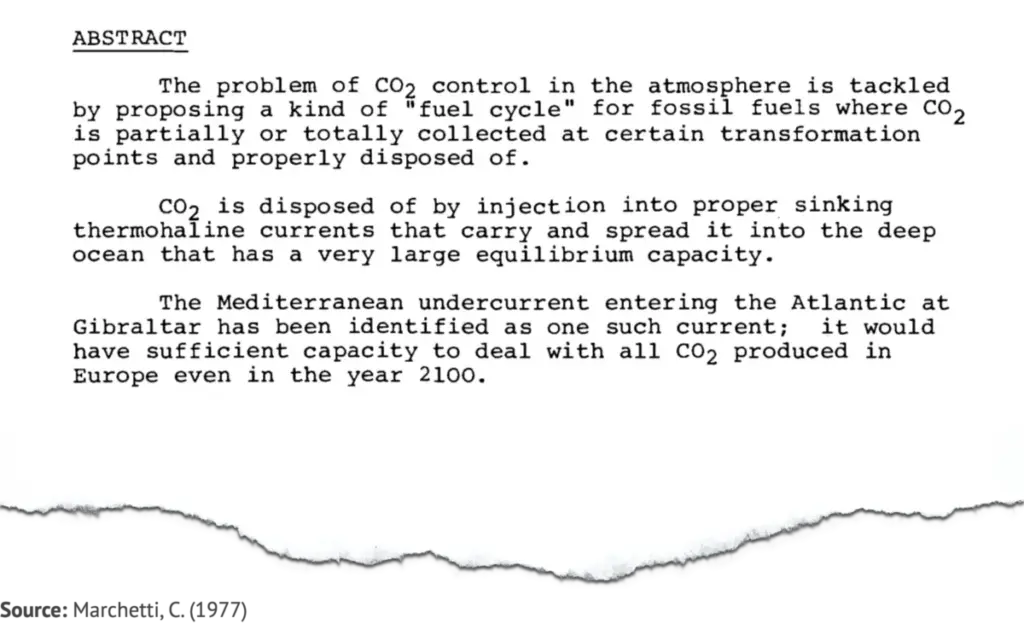
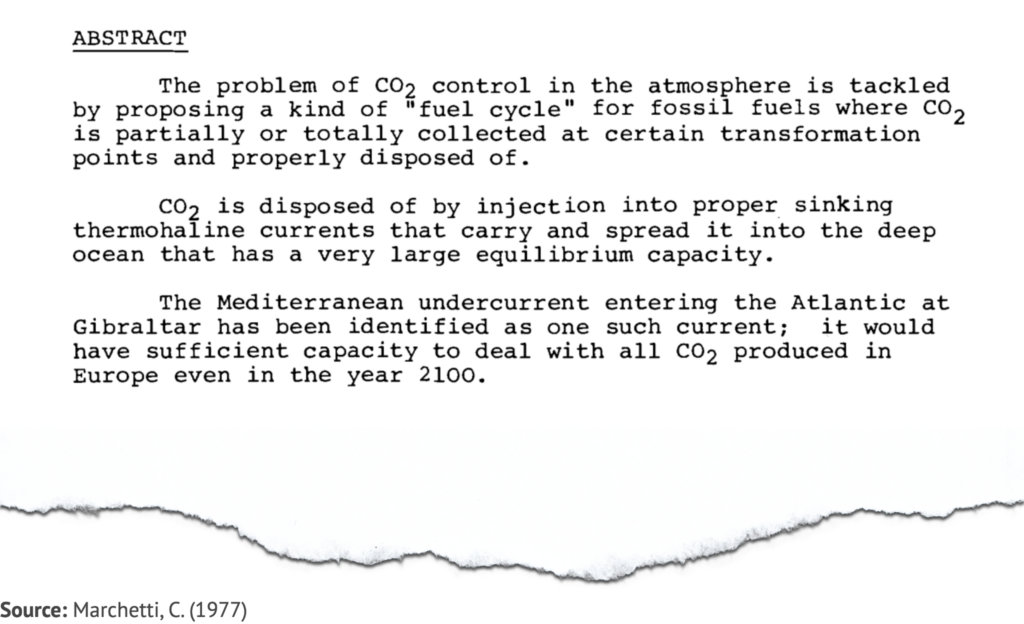
The theoretical transition of carbon capture from an oil extraction technique to a climate mitigation measure first appeared in academic literature in the late 1970s. Italian physicist Cesare Marchetti authored a foundational 1977 paper proposing a system to collect CO2 from concentrated fossil fuel transformation points and inject it into deep ocean currents, such as the Mediterranean thermohaline current passing through Gibraltar, using the oceans as an equilibrium sink.
3. The Power Sector Pivot and Coal Expectations (2000s)
By the early 2000s, escalating climate concerns led policymakers in Europe and North America to reimagine CCS as a solution for power generation. The IPCC published a pivotal Special Report on Carbon Dioxide Capture and Storage in 2005, identifying just three active, small-scale permanent storage projects worldwide. Throughout this decade, governments poured millions into pilot programs designed to equip coal-fired power plants with post-combustion capture technologies.
This initial wave largely collapsed. Plummeting deployment costs for renewable energy sources—primarily solar photovoltaics and onshore wind—rapidly undermined the economic case for high-capex coal power plants equipped with CCS. Today, out of thousands of power plants globally, only seven operational coal-CCS facilities remain worldwide (five in China, one in the US, and one in Canada).
4. The Post-Paris Resurgence (2015–Present)
The adoption of the Paris Agreement in 2015 and the subsequent wave of national net-zero commitments fundamentally revived political interest in CCS. Integrated Assessment Models (IAMs) used by global institutions revealed that reaching net-zero greenhouse gas emissions by mid-century without carbon removal or industrial point-source capture would require unprecedented reductions in global energy demand. Consequently, governments pivoted from attempting to save coal power to targeting industrial process emissions and backing "blue" hydrogen—producing hydrogen from natural gas coupled with carbon capture.
Supporting Context & Metrics: The Reality of Global Deployment
Despite decades of policy discussion, the empirical reality of CCS deployment reveals a vast divergence between political ambition and real-world capacity.
The Scale Gap
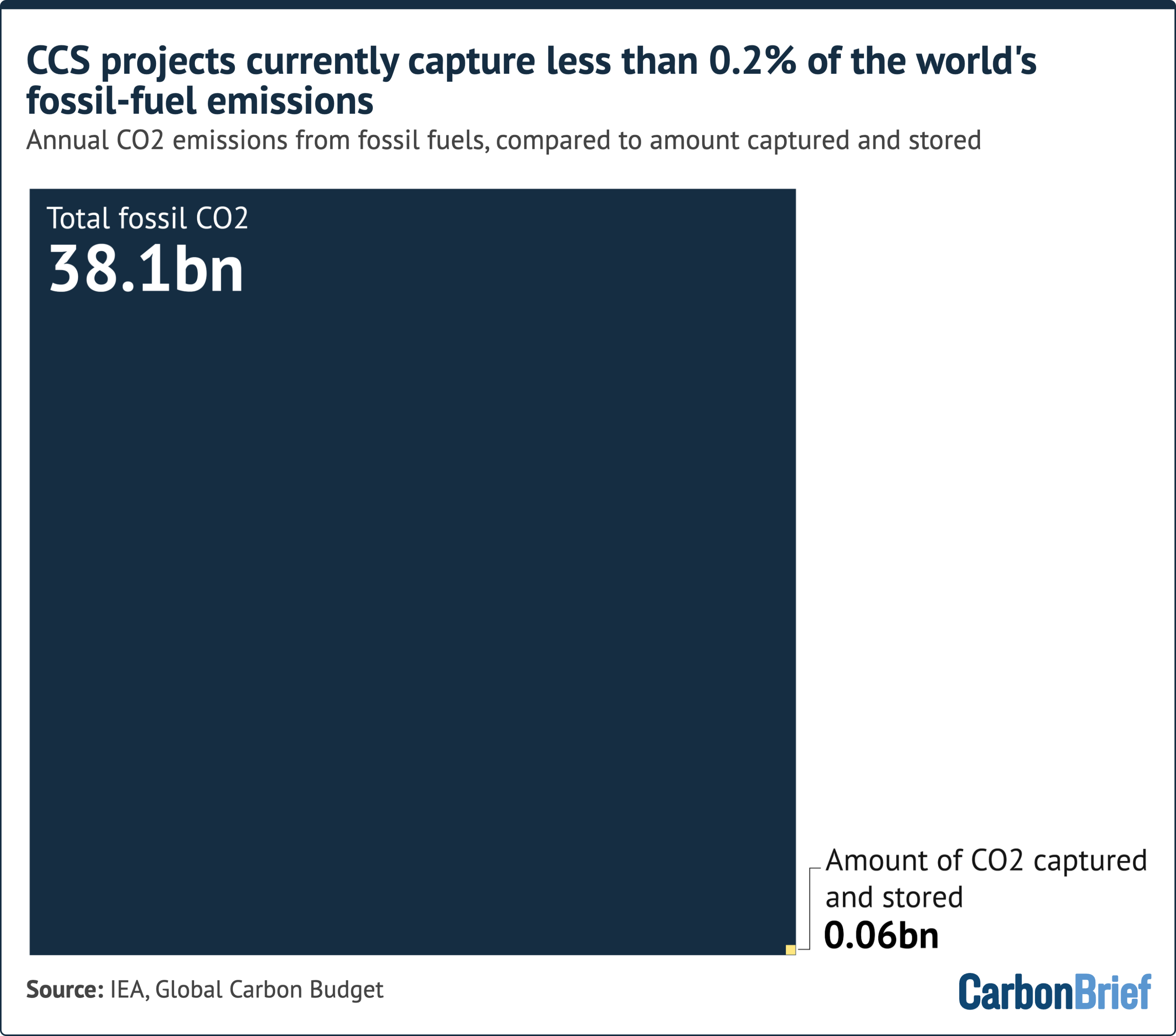
According to data compiled by the International Energy Agency (IEA), as of early 2026, there are 75 operational commercial CCS facilities globally. Combined, these plants capture approximately 62.5 million tonnes of CO2 (MtCO2) per year—an amount roughly equivalent to the annual greenhouse gas output of Ecuador.
GLOBAL FOSSIL EMISSIONS VS. CAPTURED CO2 (2026)
================================================================================
Total Annual Fossil CO2 Emissions:  [||||||||||||||||||||||||||||||||||||||||||] 38.1 Gt
Total CO2 Captured Annually:        [|] 0.0625 Gt (< 0.2%)
================================================================================
When set against the global baseline of fossil fuel CO2 emissions—which stands at approximately 38.1 billion tonnes (GtCO2) per year—existing CCS operations capture less than 0.2% of global fossil emissions.
Sectoral Distribution and End-Use
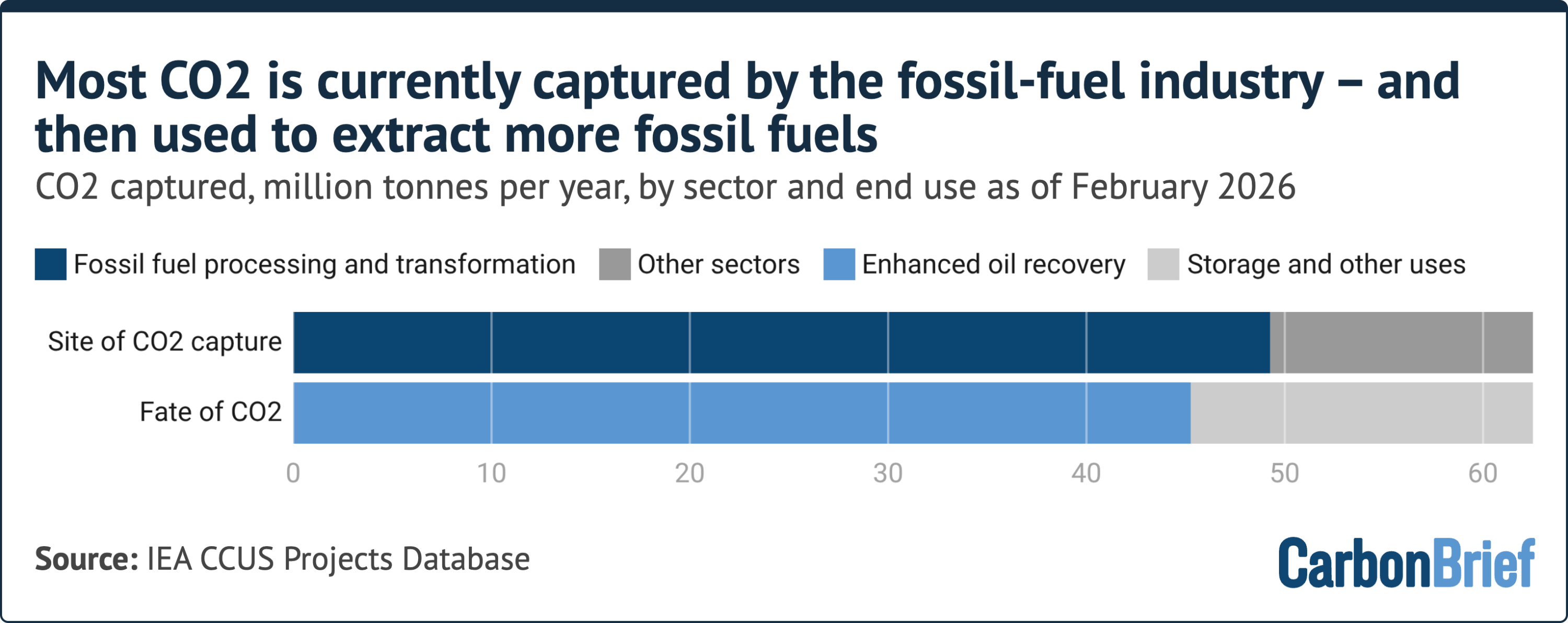
The overwhelming majority of existing capture capacity remains directly tied to fossil fuel processing. Approximately 49 MtCO2 of the current 62.5 MtCO2 annual global total originates from natural gas processing plants, where CO2 must be stripped from raw methane to meet commercial pipeline standards.
Furthermore, approximately 45 MtCO2 of all captured carbon globally—nearly three-quarters of the operational total—is utilized for Enhanced Oil Recovery. Rather than providing isolated geological sequestration, most operational CCS infrastructure today functions as an input for the extraction of additional oil and gas.
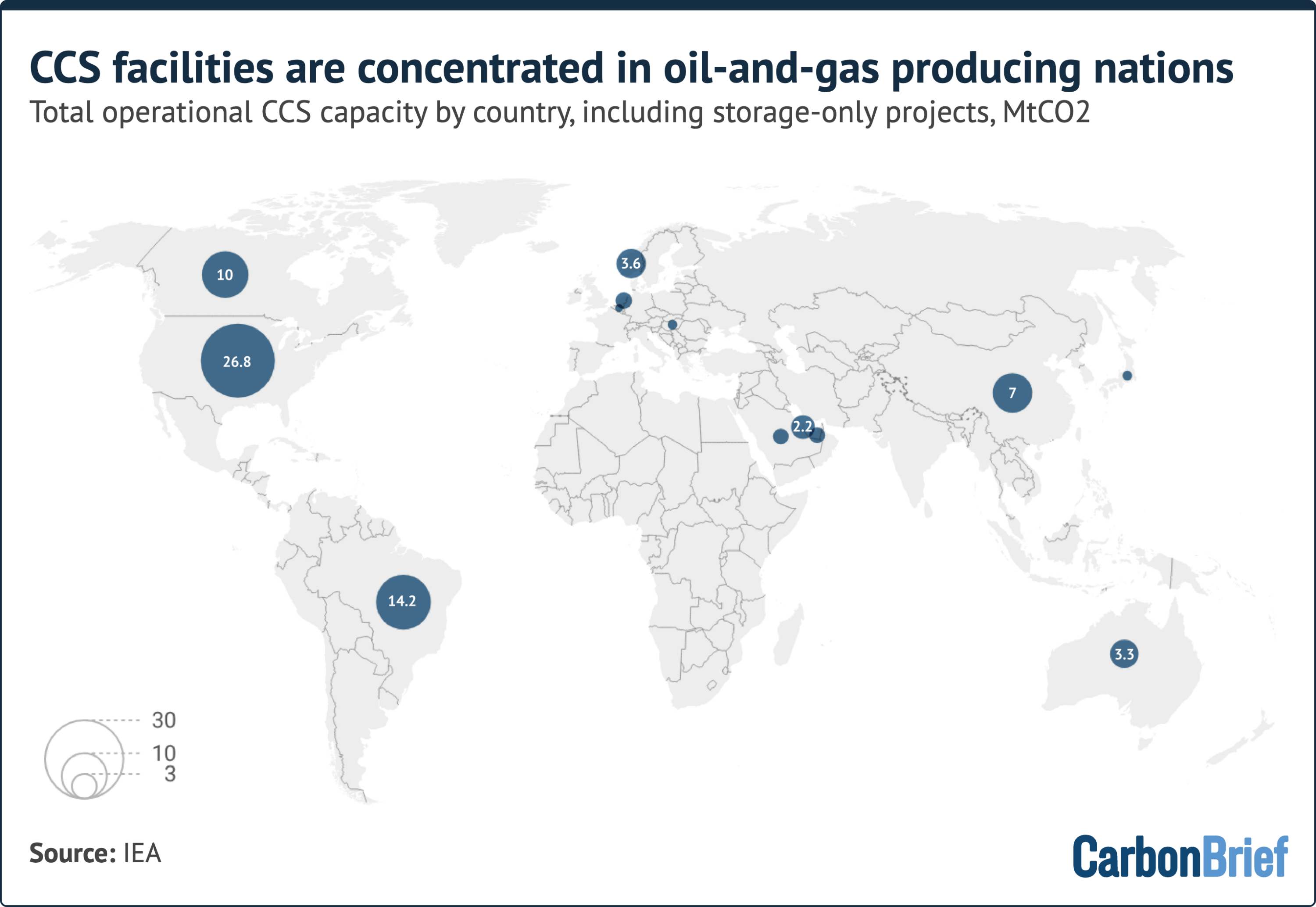
Operational facilities are concentrated heavily within major fossil-fuel-producing nations:
United States: 26.8 MtCO2/year capacity
Brazil: 14.2 MtCO2/year capacity
Canada: 10.0 MtCO2/year capacity
China: 7.0 MtCO2/year capacity
Norway, Qatar, and Gulf States: Remaining baseline capacity
Real-World Capture Efficiency vs. Regulatory Targets
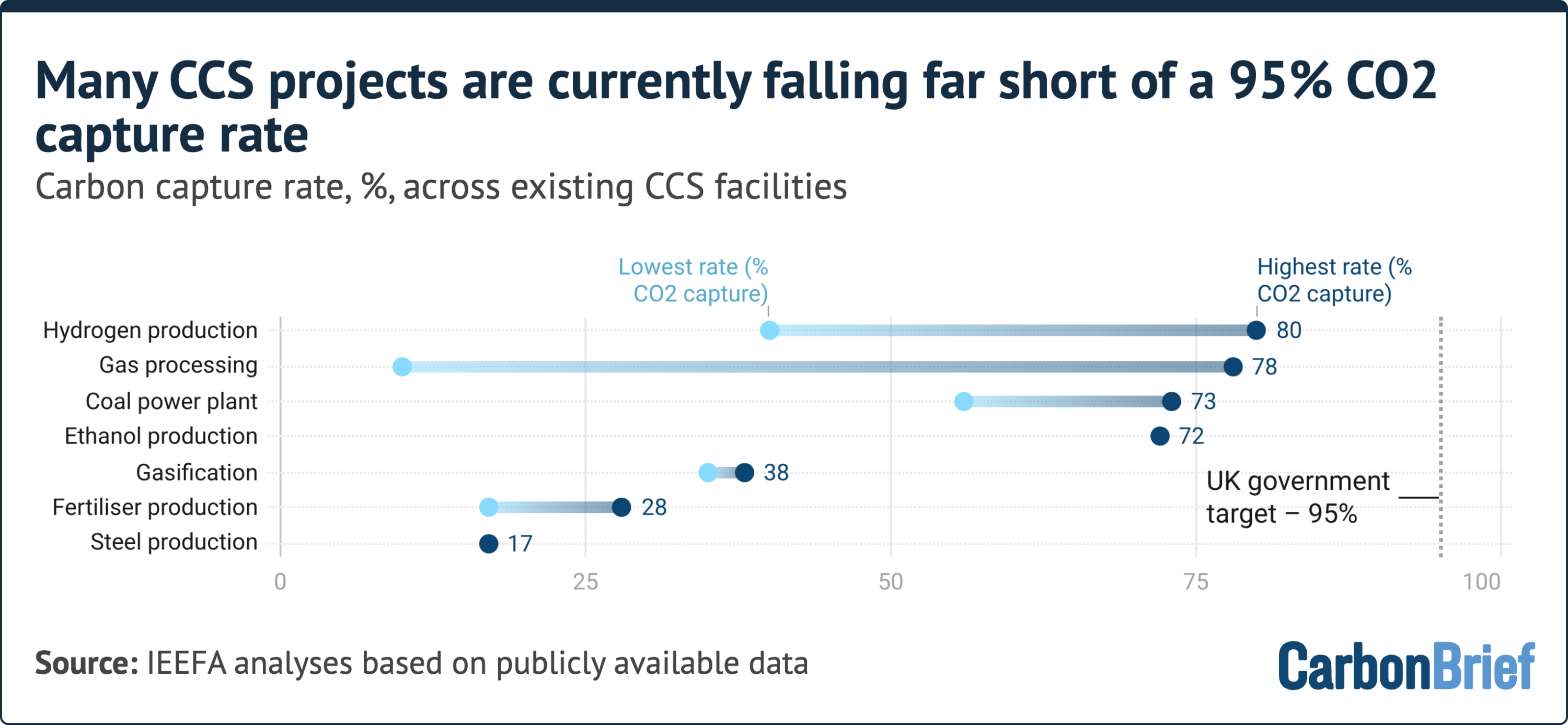
While UK regulatory guidance and international benchmarks specify target capture rates of 95% for new post-combustion installations, real-world evaluations demonstrate chronic underperformance.
Analysis conducted by the Institute for Energy Economics and Financial Analysis (IEEFA) across prominent global facilities shows actual long-term carbon capture rates falling well below design capacity:
Steel Production (Emirates Steel, UAE): ~17% capture rate
Hydrogen Production (Quest / Air Liquide, North America): 60%–80% capture rates
Power Sector (Boundary Dam, Canada & Petra Nova, US): Periodically impacted by technical outages, capturing far below nominal design targets
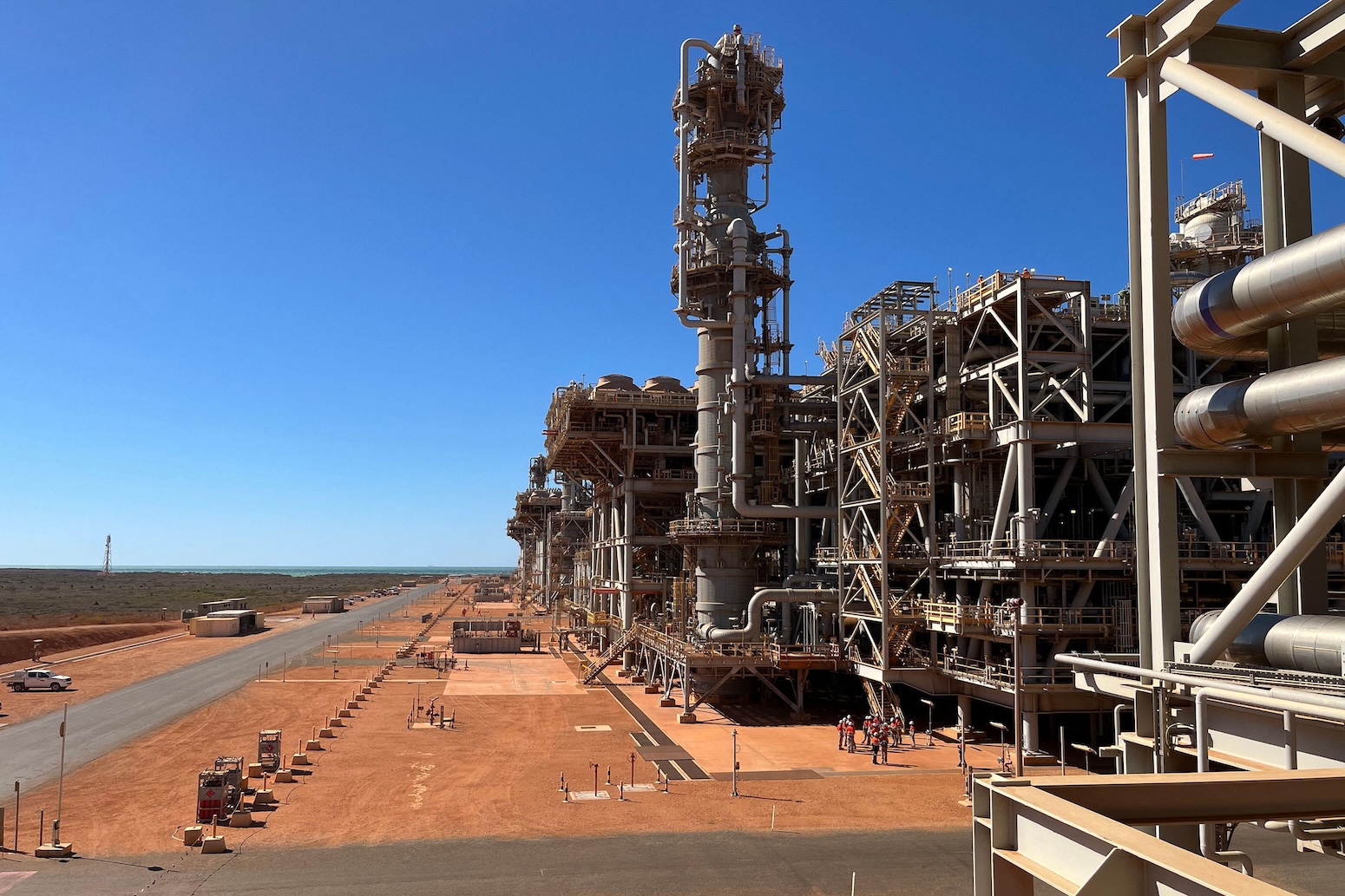
Gas Processing (Gorgon, Australia): Long plagued by sand contamination and equipment degradation, underperforming its regulatory storage obligations by millions of tonnes.
DESIGN VS. ACTUAL REAL-WORLD CAPTURE RATES
Target Rate (UK Guidelines): [========================================] 95%
Hydrogen Production (Quest): [==============================--------] 70-80%
Coal Power (Boundary Dam):   [=========================-------------] 60-65%
Steel Production (Emirates): [========------------------------------] 17%
Official Statements & Expert Analysis
The debate surrounding CCS features contrasting perspectives from climate modellers, energy economists, environmental law experts, and industry advocacy bodies.
The Institutional Case for CCS
The Intergovernmental Panel on Climate Change (IPCC):
In its Sixth Assessment Report (AR6), Working Group III emphasizes that point-source capture is an essential component of deep decarbonization:
"CCS is a critical mitigation option for primary energy and industrial applications… CCS will be required to mitigate remaining CO2 in industrial sectors such as cement, lime, and chemicals, where process-related emissions are inherently difficult to eliminate."
The International Energy Agency (IEA):
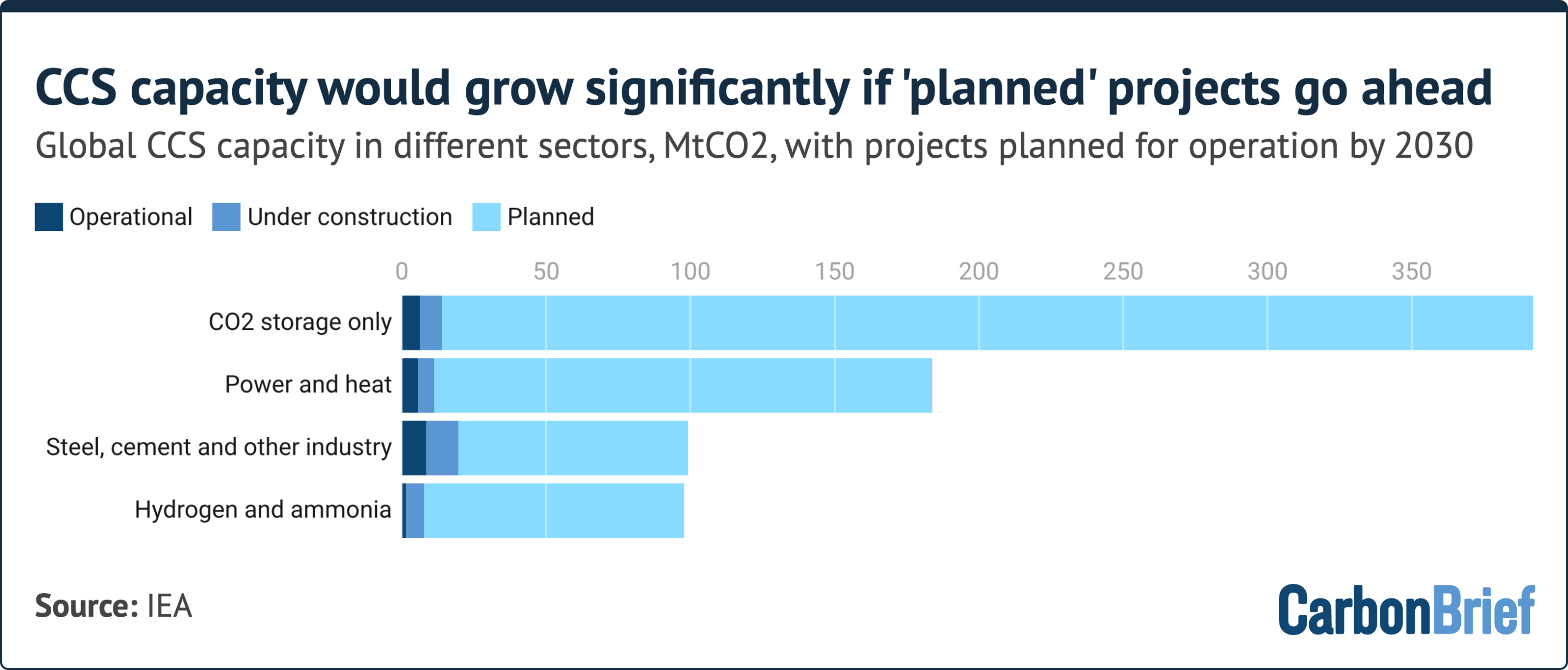
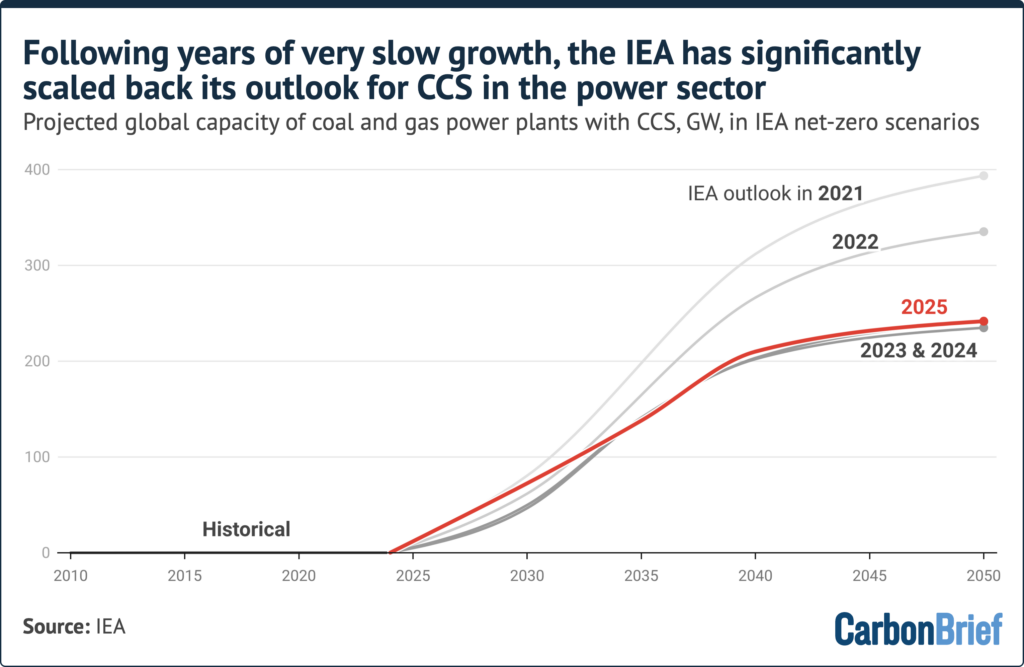
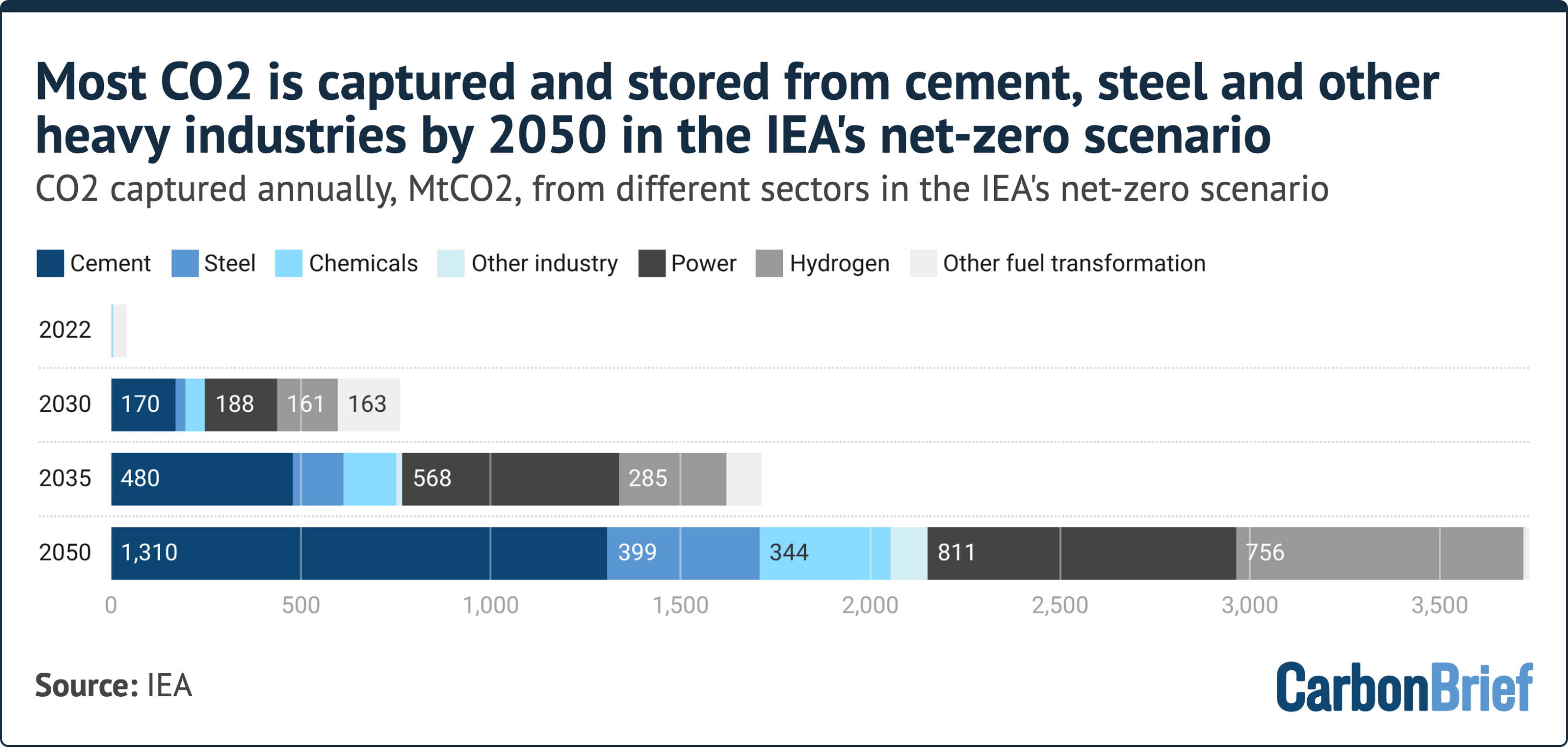
In its updated Net Zero Roadmap, the IEA asserts that reaching net-zero emissions globally by 2050 without carbon capture is practically impossible. The agency’s modeling mandates a scale-up from 62.5 MtCO2 today to 1.7 billion tonnes (1,700 MtCO2) captured annually by 2035—a nearly 30-fold expansion in less than a decade.
Dr. Jennifer Roberts, Deputy Director of the UK Carbon Capture and Storage Research Centre (UKCCSRC):
Speaking to Carbon Brief on the role of modeling in climate planning, Dr. Roberts noted:
"From an IPCC climate modelling perspective, reaching net-zero without CCS is far more expensive, disruptive and potentially out of reach… CCS is critical for net-zero, but is intrinsically tied with an industry sector that is climate polluting and historically anti-climate lobbying. Oil and gas companies can evidence a track record in multi-million or billion-dollar subsurface engineering projects."
Prof. Stuart Haszeldine, University of Edinburgh:
Addressing the pragmatic realities of transitional electricity networks:
"If we’re going to burn gas, then we should be fitting CCS on that. Otherwise we’re just going to say it’s OK for us to burn lots of gas and carry on emitting."
          INSTITUTIONAL PERSPECTIVES ON CARBON CAPTURE
+-----------------------------------------------------------------+
| PROPONENTS / MODELLERS         | CRITICS / ECONOMISTS           |
+--------------------------------+--------------------------------+
| • Essential for cement/lime    | • Historically underperforms   |
| • Reduces overall system cost  | • $1Tn/yr more expensive than   |
|   in Integrated Assessment     |   low-CCS pathways (Oxford)    |
|   Models                       | • High risk of upstream        |
| • Enables dispatchable gas for |   methane leakage              |
|   grid balancing               | • Extends fossil fuel lock-in  |
+--------------------------------+--------------------------------+
The Critical Counter-Analysis
University of Oxford (Smith School of Enterprise and the Environment):
A comprehensive 2023 working paper evaluating energy transition pathways discovered significant economic penalties associated with high-CCS dependence:
"A low-CCS pathway to net-zero emissions would cost roughly $1 trillion less per year than a high-CCS pathway… No evidence is found for technological learning or associated cost reductions in the historical development of carbon capture technology, in stark contrast to solar, wind, and battery storage."
Center for International Environmental Law (CIEL):
In a direct critique of climate scenario modeling reliant on unbuilt capture capacity, CIEL stated:
"Abated fossil fuels only exist in models. Relying on massive deployments of CCS to justify continued hydrocarbon exploitation represents a dangerous distraction and a false climate solution."
Andrew Reid, Energy Finance Analyst at IEEFA:
Reid questions the allocation of capital to power-sector gas capture over heavy manufacturing:
"Is there really any point in trying to decarbonize fossil fuels, which comes with significant technical, timing and additional cost risk? As for cement and chemicals, again, there are alternatives, but these are nascent and expensive. CCS may be a solution here and if investment is going to be made in any area, it most likely should be these."
Future Outlook & Strategic Imperatives: The UK Case Study & Global Horizon
Case Study: The United Kingdom’s £21.7 Billion Strategy
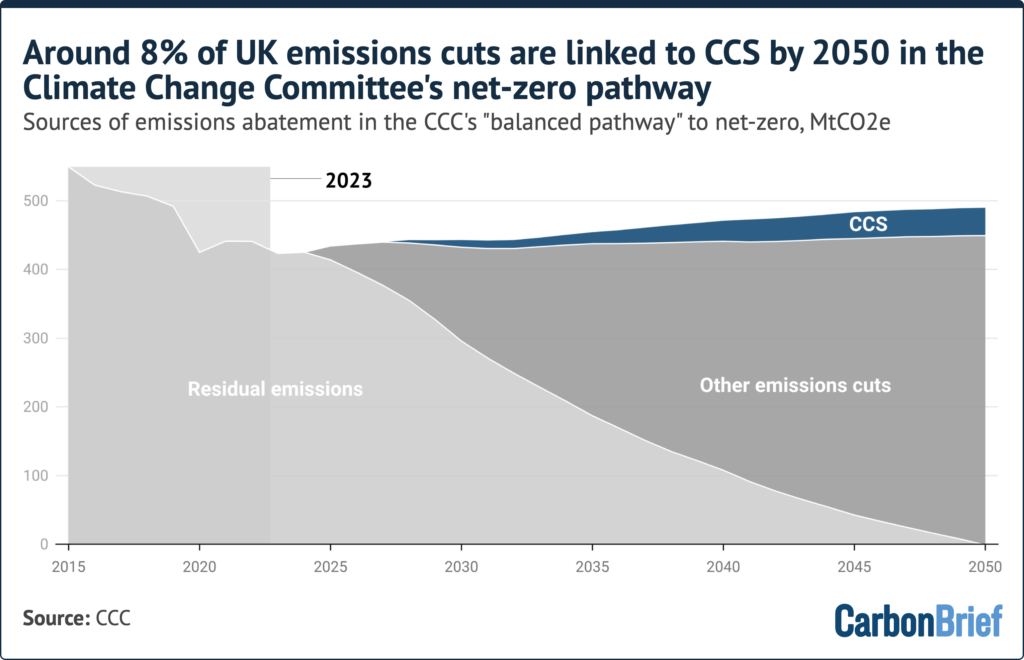
The UK government has positioned CCS at the center of its national Net Zero Strategy, committing up to £21.7 billion in public and consumer-funded support over a 25-year horizon. The strategy centers on creating geographically concentrated industrial "clusters" that connect carbon-intensive emitters to offshore storage networks beneath the North Sea.
                  THE UK INDUSTRIAL CLUSTER TIMELINE
+-------------------------------------------------------------------+
| TRACK 1 (Late 2020s)                                              |
|  - East Coast Cluster (Teesside & Humber)                         |
|  - HyNet North West (North West England & North Wales)            |
|  - Offshore Storage: Depleted North Sea gas fields & aquifers     |
+-------------------------------------------------------------------+
| TRACK 2 (Target ~2030)                                            |
|  - Acorn Cluster (North East Scotland)                            |
|  - Viking Cluster (Humber Region)                                 |
+-------------------------------------------------------------------+
Policy Commitments and Cluster Architecture
Track 1 Clusters (Late 2020s Deployment): The East Coast Cluster (Teesside and the Humber) and HyNet (North West England and North Wales).
Track 2 Clusters (Targeting ~2030): The Acorn project in Aberdeenshire and the Viking project in Lincolnshire.
Scope: These projects encompass natural gas power generation equipped with post-combustion capture (e.g., Net Zero Teesside), blue hydrogen production facilities, and industrial capture connections. Captured CO2 is slated for pipeline transport into offshore saline aquifers and depleted subsea gas reservoirs.
Challenges, Legal Battles, and Sectoral Allocation
The UK’s strategy faces growing scrutiny from regulatory bodies and legal challenges from environmental groups:
Funding Structure: Approximately three-quarters of the £21.7 billion commitment will be funded through levies passed directly to consumer energy bills rather than drawn entirely from central government revenues, raising equity concerns during an ongoing cost-of-living crisis.
Upstream Methane Risks: Legal challenges brought against major cluster developments, such as the Net Zero Teesside power project, argue that lifecycle emissions calculations ignore upstream methane leaks. Carbon Tracker analysis indicates that if gas-CCS facilities rely on imported liquefied natural gas (LNG) with high upstream leakage rates, overall lifecycle emissions cuts could drop from a projected 75% down to just 25% relative to unabated plants.
Misalignment with High-Priority Emitters: A 2025 report by the UK House of Commons Public Accounts Committee highlighted structural flaws in the UK cluster model, warning that the current framework fails to guarantee that financial subsidies reach the sectors that need them most—such as cement and lime—while prioritizing gas power and blue hydrogen. Demonstrating this volatility, energy major BP withdrew from a flagship blue hydrogen project on Teesside in late 2025, redirecting site development toward data center infrastructure.
                       THE CCS PRIORITIZATION LADDER
  +-------------------------------------------------------------------+
  | HIGHEST CLIMATE VALUE (Irreplaceable)                              |
  |  • Cement & Lime Production (Chemical process emissions)          |
  |  • Heavy Industrial Processing / Refining                         |
  +-------------------------------------------------------------------+
  | MEDIUM CLIMATE VALUE (Conditional / Transitional)                 |
  |  • Chemical Intermediates & Waste-to-Energy                       |
  |  • Dedicated Carbon Removal (BECCS / DACCS)                       |
  +-------------------------------------------------------------------+
  | LOWEST CLIMATE VALUE (High Risk / Renewable Alternatives Exist)   |
  |  • Power Generation (Gas / Coal Peakload)                         |
  |  • Blue Hydrogen Production (Extends natural gas dependency)      |
  |  • Enhanced Oil Recovery (EOR)                                    |
  +-------------------------------------------------------------------+
Global Strategic Imperatives
As international policy evolves, experts emphasize three primary imperatives for governments attempting to deploy carbon capture effectively:
Adopting a Strict "CCS Ladder" Framework: Policy support and public subsidies must prioritize non-electrifiable process emissions (cement, lime, waste management) over power generation, where wind, solar, and battery storage offer significantly lower cost-per-tonne abatement pathways.
Enforcing Stringent Regulatory Capture Thresholds: Governments must mandate minimum real-world operational capture rates of 95%+ and penalize shortfalls, preventing underperforming infrastructure from acting as a proxy for unabated fossil fuel operations.
Addressing Lifecycle and Upstream Emissions: For blue hydrogen and gas-CCS projects to deliver net climate benefits, strict, audited caps on upstream methane leakage (<0.2% across supply chains) must be legally tied to operating permits.
Without rigorous regulatory limits, carbon capture risks remaining an expensive, highly subsidized technology that extends fossil fuel dependence rather than accelerating the structural transition toward a decarbonized global economy.