Executive Overview
Healthy soil has long been hailed as the cornerstone of regenerative organic agriculture, providing the biological foundation necessary to grow nutrient-dense crops while sequestering carbon and restoring ecosystems. Yet, terrestrial topsoil covers less than one-third of our blue planet. Water—spanning vast oceans, seas, and estuaries—fills the remainder of the globe’s surface area. Historically, humanity looked to these aquatic expanses for sustenance long before the advent of modern crop cultivation. Today, as climate pressures mount, industrial farming practices stretch resources thin, and wild fisheries collapse under the weight of overfishing, the global food system faces a pivotal crossroad.
In response to this existential challenge, the renowned Rodale Institute has forged a groundbreaking research partnership with GreenWave, a pioneering organization dedicated to regenerative aquaculture. This collaboration is designed to explore how ocean-based food production can directly supply valuable, sustainable resources to land-based farmers. By investigating the efficacy of marine-derived biostimulants—specifically kelp—as a natural amendment for organic soils, the two institutions are building a bridge between terrestrial and aquatic agriculture.
The initiative seeks to validate scientifically what coastal communities have known for centuries: that the ocean holds the key to revitalizing depleted soils without relying on synthetic, fossil-fuel-derived fertilizers. As researchers launch rigorous field trials and greenhouse experiments slated for completion in 2027, this alliance promises to redefine the boundaries of sustainable food systems, uniting land and sea farmers under a single regenerative banner.
Detailed Chronology: From Industrial Overreach to Regenerative Innovation
The Industrialization of the Sea
To understand the necessity of the Rodale-GreenWave partnership, one must examine the trajectory of modern seafood production. For decades, wild fish and seafood stocks have dwindled due to a compounding matrix of overfishing, habitat destruction, and climate change.
Bren Smith, a native of Newfoundland, Canada, experienced this crisis firsthand. Beginning his fishing career at age 14 on the treacherous waters of the Georges Bank and Grand Banks targeting tuna and lobster, Smith watched the wild fishing industry buckle in the 1990s. Seeking a sustainable alternative that could provide "blue jobs" and economic security for coastal communities, he transitioned into finfish aquaculture.
However, Smith quickly realized that industrial aquaculture was repeating all the ecological mistakes of land-based farming. Commercial fish farming had evolved into a resource-intensive, environmentally degrading enterprise characterized by the excessive application of artificial nutrients, prophylactic antibiotics, and pesticides. Furthermore, these operations caused severe localized water pollution, landscape degradation, and the disruption of fragile marine ecosystems.
Reinventing Aquaculture: The GreenWave Model
Driven by the failures of conventional fish farming, Smith envisioned a radically different approach: cultivating species that do not require artificial feed, do not swim away, and naturally feed on existing waterborne nutrients. This vision birthed GreenWave and its innovative vertical underwater farming model.
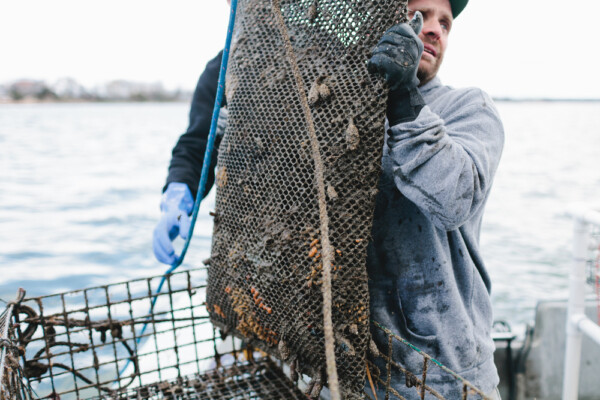
Designed to withstand severe weather, GreenWave’s farming infrastructure features hurricane-proof anchors at its perimeters and floating horizontal ropes stretching across the water’s surface. From a shore-bound perspective, these operations have a virtually invisible footprint.
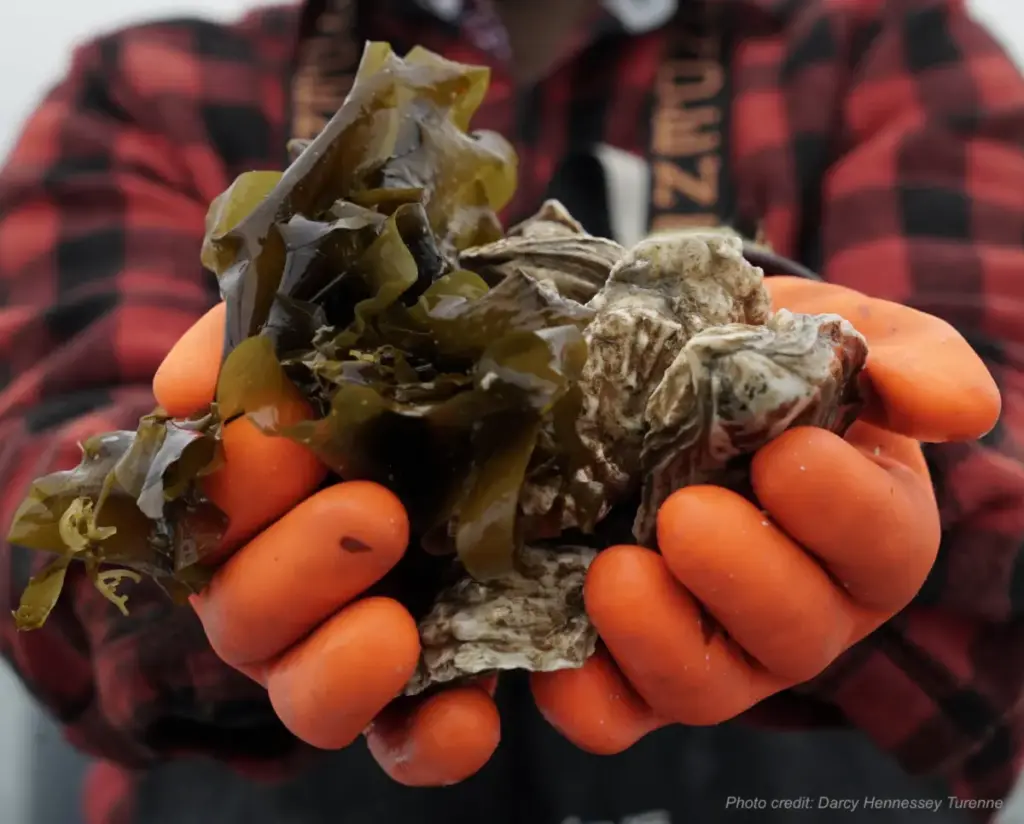
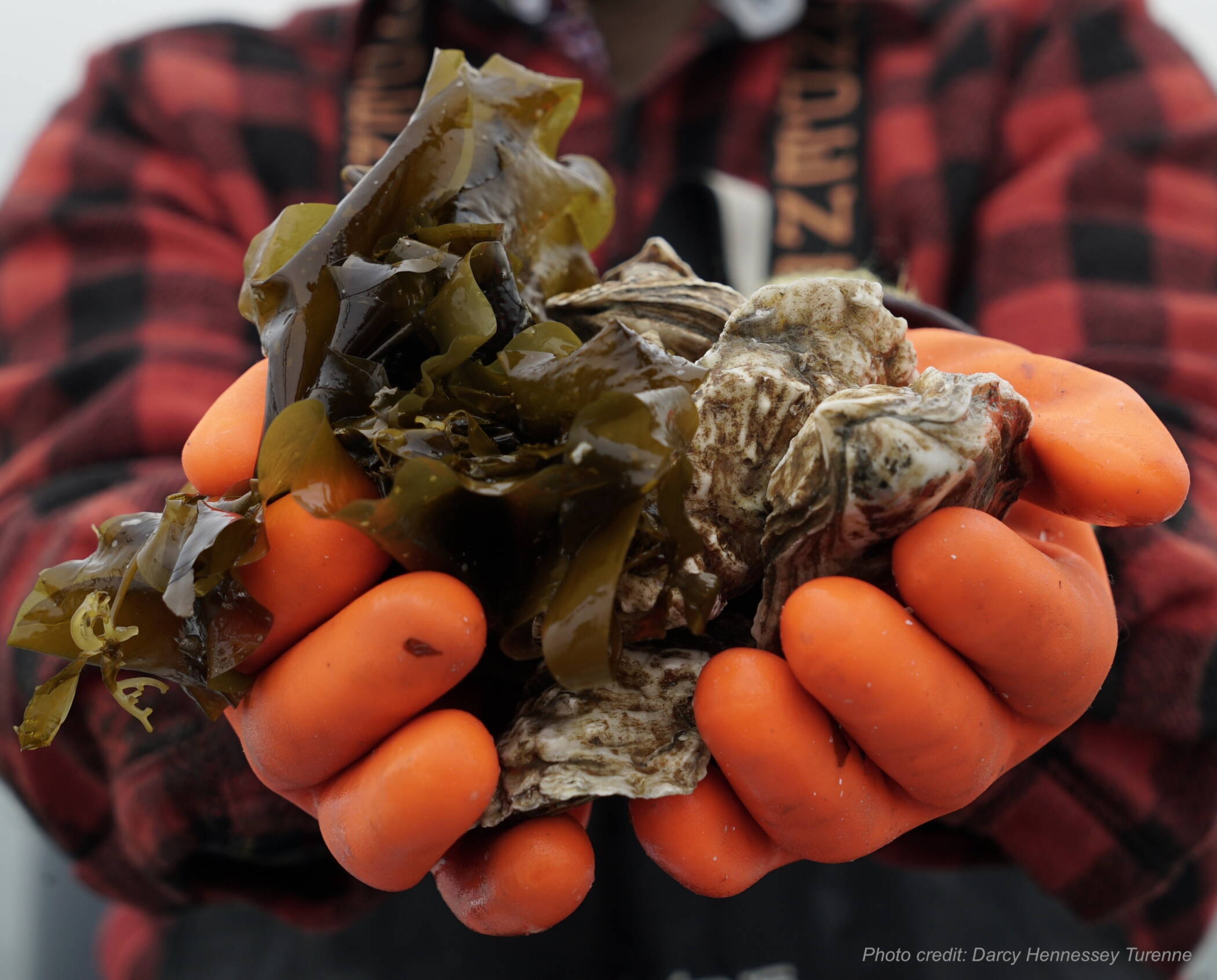
The vertical design maximizes space utilization. Kelp and other varieties of seaweed cascade downward from the surface ropes, growing alongside scallops suspended in hanging nets and mussels housed in mesh socks. Anchoring the system at the benthic base are oysters protected in cages and clams burrowed in the sandy sediment. Crucially, the shellfish are filter feeders, consuming naturally abundant microorganisms such as phytoplankton and algae. This multi-trophic design cleans the surrounding water while yielding dense crops of high-protein shellfish and mineral-rich kelp.
Supporting Context & Metrics: The Mechanics of a Zero-Input Food System
The statistics underpinning GreenWave’s aquaculture model challenge the resource-heavy paradigms of conventional agriculture. According to a 2024 report from the USDA Economic Research Service, the average American consumes roughly 20 pounds of fish and shellfish annually. Meanwhile, data from the National Oceanic and Atmospheric Administration (NOAA) indicates that more than 50 percent of the global seafood supply is now raised on water-based farms.
As global populations surge, the pressure on food networks intensifies. Bren Smith notes this macro-trend plainly: "Our food system is being pushed out to sea. We’re going to be eating more food from the sea, and the wild supply will not support us. With Rodale Institute, we are building a healthier food supply and connecting land and ocean farmers through regenerative practices."
The operational yield of GreenWave’s vertical farms is staggering. A single acre of regenerative ocean farm can produce an astonishing 250,000 shellfish and 25 tons of marine greens every five months. Most importantly, this output constitutes a zero-input food system: it requires zero fresh water, zero synthetic fertilizers, zero artificial feed, and zero arable land.
The Symbiotic Ecology of Ocean Farms
The biological dynamics within these underwater farms create a powerful, self-sustaining loop:
- Carbon Sequestration & Oxygenation: Seaweeds like kelp actively absorb dissolved carbon dioxide from the water column while releasing vital oxygen. This process combats localized acidification—a direct consequence of rising global ocean temperatures—creating a chemical environment where bivalves can successfully build and maintain robust, protective shells.
- Light Penetration: As filter-feeding shellfish consume excess particulate matter and phytoplankton, water clarity improves. This enhanced clarity allows greater penetration of sunlight, which in turn stimulates accelerated kelp growth.
Official Statements & Scientific Investigation: The Soil-Sea Connection
Bridging Coastal Resources and Terrestrial Soils
Long before the invention of synthetic, fossil-fuel-based fertilizers, coastal farming communities routinely harvested seaweed to amend and enrich their agricultural soils. As Smith points out, "Whenever coastal communities needed nutrients for their crops, they’ve gone to the sea—that is, until fossil-fuel fertilizers came along."
Because synthetic chemical inputs fail to build true, living soil health, certified organic land farmers reject them entirely. Instead, they rely on organic amendments. Natural marine resources like kelp offer a wealth of trace minerals and bioactive compounds capable of revitalizing crop vigor and soil biology simultaneously.
Dr. Andrew Smith, Chief Scientific Officer at the Rodale Institute, emphasizes the biological value of marine amendments: "We have long known that products harvested from the sea have the power to promote plant growth and plant health. Kelp acts as a ‘biostimulant’ that activates the beneficial microbes in soil, improves nutrient uptake by crops, and protects plants from stress such as drought."
Inside Rodale Institute’s 2027 Research Trial
To quantify these benefits and establish empirical data for organic producers, Rodale Institute scientists have embarked on a comprehensive, multi-year research initiative. Led by soil scientist Dr. Dinesh Panday, the research team is conducting a rigorous two-year field trial and a one-year greenhouse experiment.
The study is evaluating the impact of GreenWave-sourced kelp biostimulants on the nutritional profile of specialty crops—specifically lettuce and bell peppers—as well as its broader contribution to soil microbiome health. To establish a baseline of comparison, the kelp treatments are being measured against biochar, a widely accepted organic soil amendment. Researchers are applying kelp at varying application rates across isolated plots, as well as testing combinatorial plots where kelp and biochar are applied together.
"Kelp has many trace minerals that support healthy plant growth," explains Dr. Dinesh Panday. "We are studying its value for specialty crops in regenerative organic systems." Final results and peer-reviewed data from this study are expected to be published in 2027.
Reflecting on the synergy of the partnership, GreenWave’s Bren Smith adds: "We need credible science to evaluate kelp’s benefits and find out how to get the most from it. We knew we had to have a technically sophisticated partner to dig deep into this. When we were meeting with the research team at Rodale Institute, I knew we were talking farmer to farmer, that we are working toward the same goals."
Future Outlook: Empowering a New Generation of Climate Farmers
The collaboration between the Rodale Institute and GreenWave extends far beyond laboratory assays and field plots; it represents a scalable socioeconomic blueprint for coastal and rural communities alike.
Through its open-source methodology, GreenWave provides aspiring aquafarmers with a comprehensive toolkit to establish their own regenerative ocean farming operations. The economic barrier to entry is intentionally low: according to the organization’s open-source training model, "anybody with 20 acres, a boat, and $30,000" can acquire the technical knowledge and infrastructure needed to launch a viable farm.
Since establishing its regional training program in 2017, GreenWave has successfully educated and supported over 8,500 ocean farmers, nursery operators, and eco-entrepreneurs. The ultimate objective is to foster community-owned and community-operated cooperatives in coastal regions where commercial fishing has historically served as the primary economic engine.
"We’re no longer pillagers hunting the last fish," Bren Smith states emphatically. "We are a new generation of climate farmers who have joined the fight to restore our planet."
Ultimately, this partnership underscores a unified vision for a truly regenerative food system. While GreenWave pioneers the frontier of zero-input ocean agriculture, the Rodale Institute continues its decades-long mission of supporting the next wave of soil-based organic stewards.
For consumers navigating dietary choices, sustainable seafood guides—such as the Monterey Bay Aquarium Seafood Watch program and its "Super Green List"—highlight nutrient-dense options like mussels, clams, oysters, and kelp that carry minimal ecological footprints. As producers on land and sea align their practices to share and protect our planet’s shared natural resources, the Rodale-GreenWave alliance points the way toward a resilient, deeply integrated future for human nourishment and planetary health.