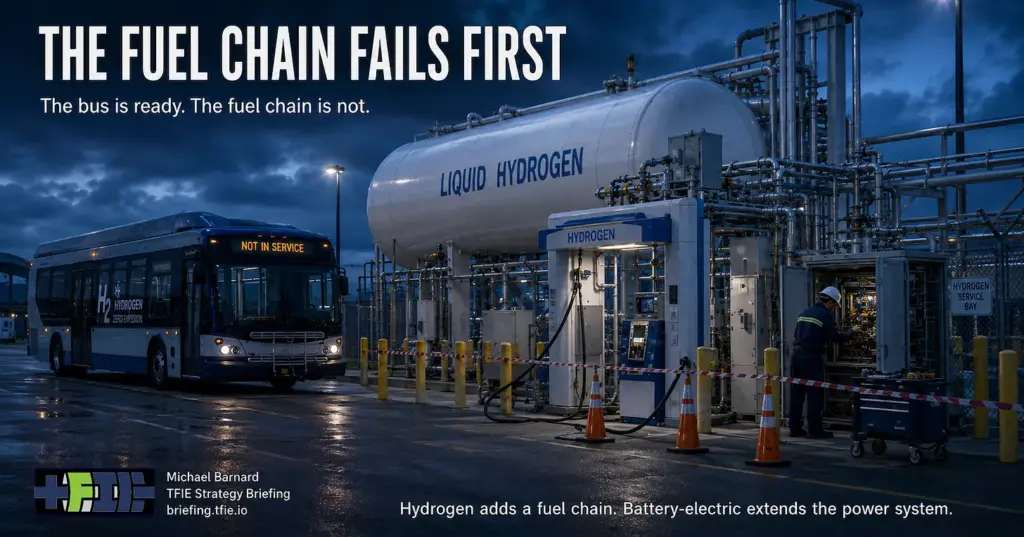
The transition to zero-emission public transit is often framed as a straightforward mechanical choice between propulsion technologies. Yet, the struggles faced by agencies like the Orange County Transportation Authority (OCTA) reveal a stark operational reality: a hydrogen fuel-cell bus is only as viable as the fragile, highly complex supply chain that feeds it.
While battery-electric transit leverages a ubiquitous, pre-existing electrical grid, hydrogen transit demands the creation and maintenance of a specialized, parallel energy-delivery network. For OCTA, this technological reality check has manifested as a staggering $27.6 million infrastructure investment earmarked for its Garden Grove facility—pushing the agency’s cumulative refueling expenditure past the $100 million threshold. This fresh capital injection comes on the heels of a failed commercial agreement with Air Products, which dismantled the agency’s primary hydrogen station in Santa Ana.
The fallout was immediate and catastrophic for fleet reliability. OCTA’s small contingent of ten fuel-cell buses experienced a nearly 95% drop in mileage between 2024 and 2025. Paradoxically, rather than pivoting to its more reliable, cost-effective, and operationally seamless battery-electric fleet—which incurred zero deployment losses due to infrastructure downtime—OCTA doubled down on its hydrogen expansion. This case study underscores a growing friction in municipal transit procurement: the tendency for subsidy-supported fleets to lock agencies into compounding sunk costs, raising vital questions about the long-term economic logic of hydrogen-powered public transport.
Detailed Chronology of a Fuel Crisis
To understand how a transit agency can find itself spending tens of millions of dollars to rescue a stalled bus fleet, one must examine the timeline of OCTA’s hydrogen initiative. The trajectory from early adoption to systemic breakdown highlights the profound risks of relying on volatile commercial hydrogen supply chains.
2020: The Promising Debut in Santa Ana
OCTA inaugurated a flagship hydrogen fueling station at its Santa Ana base, designed with sufficient capacity to support roughly 40 to 50 fuel-cell buses per day. At the time, the project was hailed as a progressive step toward decarbonization, aligning with California’s aggressive clean-transport mandates. The agency introduced ten hydrogen fuel-cell buses into its rotation, anticipating a smooth scaling process toward a broader fleet of 50 vehicles.
January 2026: The Infrastructure Collapse
The structural vulnerability of OCTA’s hydrogen strategy was exposed when negotiations between the agency and its commercial hydrogen partner, Air Products, broke down. Unable to reach a new commercial agreement covering the leased liquid-hydrogen equipment, Air Products took definitive action: it removed the central storage tank and vaporizers from the Santa Ana base.
The timing could not have been worse. The ten fuel-cell buses still had years of productive service life ahead of them, but they were suddenly left without a functioning depot fuel system.
2024–2025: The Operational Freefall
The downstream effects of the Santa Ana station’s decommissioning crippled day-to-day operations. Lacking an on-site fueling pathway, OCTA was forced to rely on makeshift workarounds, including off-site commercial stations and temporary mobile fueling units.
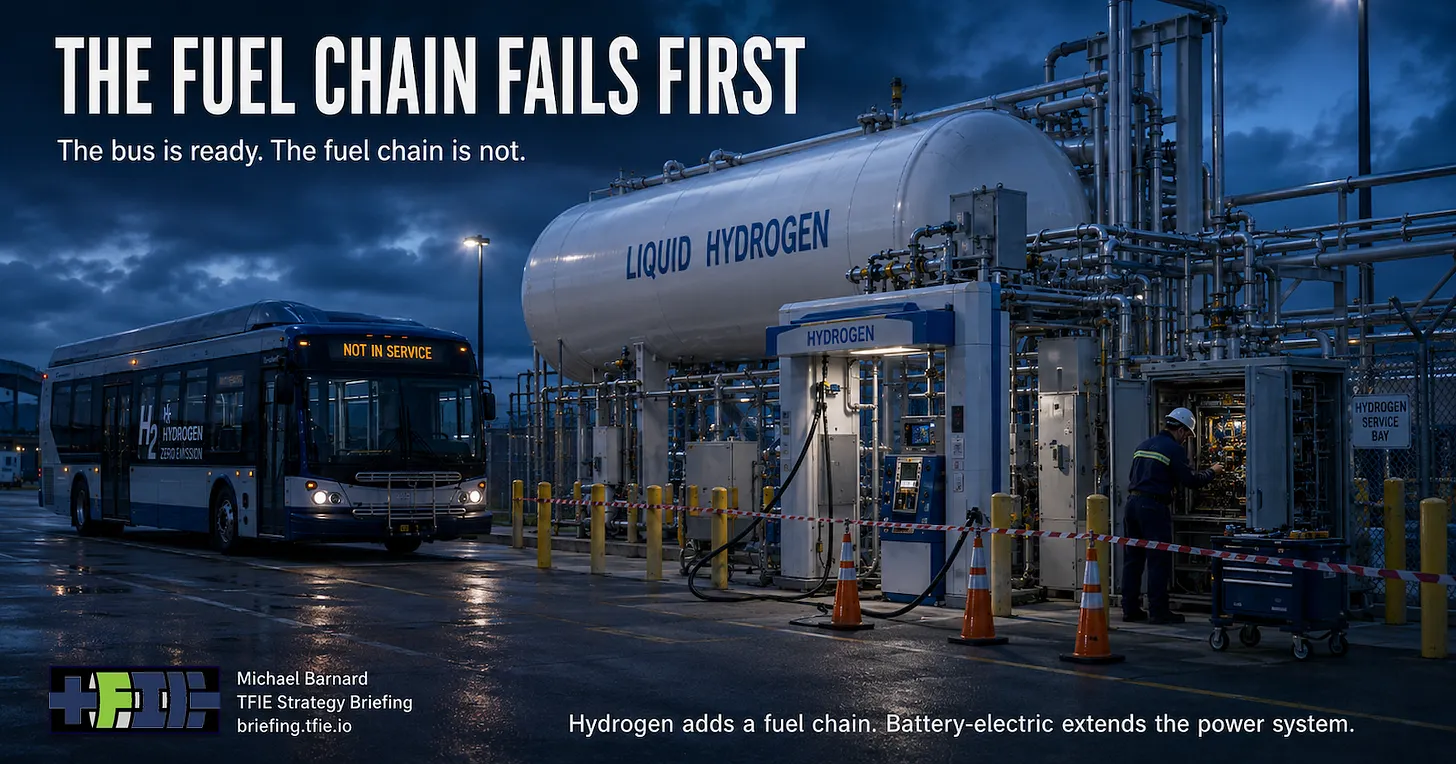
The impact on vehicle utilization was swift and severe:
- 2024: OCTA’s ten fuel-cell buses accumulated a respectable 270,462 miles.
- 2025: Mileage plummeted to just 14,232 miles—a staggering 95% collapse in operational output.
The Garden Grove Pivot
Rather than re-evaluating the long-term feasibility of hydrogen in light of these catastrophic supply bottlenecks, OCTA leadership approved a $27.6 million contract for a new hydrogen infrastructure project in Garden Grove. This latest funding package is designed to support the expansion of the fuel-cell fleet toward 50 buses, bringing total refueling infrastructure expenditures past the $100 million mark.
Supporting Context & Metrics: Hydrogen vs. Battery-Electric
A unique advantage of examining OCTA’s fleet management is the agency’s simultaneous deployment of both battery-electric buses (BEBs) and hydrogen fuel-cell electric buses (FCEBs). This side-by-side deployment provides a rare, real-world comparative dataset free from hypothetical modeling bias.
The Reliability Gap
While OCTA’s hydrogen program suffered from near-total operational paralysis due to the loss of its fueling infrastructure, its battery-electric fleet experienced no such existential crises. Throughout the periods of hydrogen fuel deprivation, OCTA reported zero lost bus deployments attributable to unavailable charging infrastructure.
Capital Expenditure and Infrastructure Complexity
The financial disparity between the two technologies highlights the hidden burdens of hydrogen systems:
- Battery-Electric Infrastructure: OCTA’s charging infrastructure required an investment of approximately $6 million. While BEBs present distinct localized challenges—most notably the need for heavy depot power grid upgrades—they build upon an electrical grid that already powers buildings, industrial sites, and regional vehicles.
- Hydrogen Infrastructure: Hydrogen demands an intricate, multi-tiered chain encompassing production, compression or liquefaction, specialized over-the-road transport, cryogenic or high-pressure storage, and precise nozzle dispensing. A failure at any single link in this chain renders the bus fleet entirely useless, regardless of the mechanical health of the vehicles themselves.
[Hydrogen Value Chain Risk Points]
Production ➔ Compression/Liquefaction ➔ Transport ➔ Depot Storage ➔ Dispensing ➔ Bus Propulsion
   (Any failure point = 100% Fleet Inoperability)
Furthermore, the $27.6 million Garden Grove award is not merely for a "station." It bundles site design and construction with facility modifications, long-term hydrogen supply contracts, operations, maintenance, and initial training periods. Because a transit agency cannot easily source raw hydrogen on the open market with the same plug-and-play simplicity as electricity, it must bind itself to complex, long-term vendor agreements.
Official Statements and Industry Perspectives
The structural vulnerabilities exposed by OCTA’s trials have sparked intense debate within clean-transport and procurement circles.
Industry analysts point out that the fundamental oversight in hydrogen fleet procurement is treating the bus as a standalone asset rather than the terminal end of an industrial supply chain. As procurement specialists note, “An agency considering hydrogen needs a credible answer for how affordable, genuinely low-carbon fuel will reach the depot for the full 12- to 15-year service life of the buses.”

Critics of California’s persistent "hydrogen fever" argue that municipal agencies often fall into a sunk-cost trap. When initial capital investments are heavily subsidized by state or federal grants, agencies are incentivized to rescue failing projects with more public funds rather than admitting strategic miscalculation.
A notable parallel exists in international markets, such as Aberdeen, Scotland, where municipal authorities chose a pragmatic exit strategy when faced with unsustainable hydrogen complexities: they wrote off their existing hydrogen bus fleets, cancelled pending orders, and transitioned fully to battery-electric platforms. By contrast, agencies bound by regional mandates or institutional momentum continue to throw good money after bad, prioritizing ideological adherence over spreadsheet-driven competence.
Clean-energy analysts emphasize that a fuel-cell bus can be in pristine mechanical condition, yet remain completely stranded if the delicate chemistry of the supply chain is disrupted. For public transit—where schedule reliability and taxpayer ROI are paramount—this high fragility index presents an increasingly difficult justification.
Future Outlook: The Crossroads of Municipal Transit
As OCTA moves forward with its Garden Grove infrastructure project and aims for a 50-bus hydrogen fleet, the broader transit sector watches with cautious skepticism. The lessons drawn from Orange County offer vital takeaways for municipal planners across the globe.
1. The Total Cost of Ownership Reality Check
Initial grant funding often masks the long-term operational and supply-chain vulnerabilities of hydrogen. As maintenance, specialized labor, and fuel-supply contracts compound over a 15-year lifecycle, the true cost of hydrogen transit routinely eclipses early projections. Agencies must weigh these compounding expenditures against the comparatively streamlined scaling of depot-based battery-electric charging.
2. Grid Integration vs. Dual-System Maintenance
The future of zero-emission transit will likely favor systems that minimize logistical failure points. While electric bus depots require sophisticated smart-charging software and utility coordination, they plug directly into the backbone of modern civilization: the electrical grid. Hydrogen, conversely, forces a transit agency to operate as an auxiliary energy-delivery and chemical-handling enterprise.
3. A Critical Re-evaluation of Procurement Criteria
Moving past the mid-2020s, public transit procurement boards are facing heightened financial scrutiny. The OCTA case serves as a cautionary tale: a rush toward technological diversification must not override rigorous supply-chain due diligence. If hydrogen transit is to carve out a permanent niche alongside battery-electric networks, providers must offer foolproof redundancy, price stability at the nozzle, and unbreakable continuity of supply. Until then, transit agencies gambling on hydrogen may find themselves paying millions just to keep their wheels turning.