A landmark study published in Nature Climate Change reveals that the general public operates under significant misperceptions regarding how their peers view and act upon climate change. Led by Dr. Kevin Tiede and a team of researchers from the Institute for Planetary Health Behaviour at the University of Erfurt, the research demonstrates a widespread "perception gap": while people systematically underestimate the public’s underlying support for climate policies, they simultaneously overestimate the extent to which others take concrete, real-world action.
Based on a series of rigorous surveys involving more than 5,000 respondents across Germany and the United States between 2024 and 2025, the study fundamentally challenges long-held assumptions in climate communication. For years, social scientists and policymakers have posited that simply correcting misperceptions—informing the public that their peers widely support climate action—would serve as a low-cost, highly effective catalyst for driving individual engagement. However, the findings indicate that information provision alone fails to bridge the massive gap between stated intentions and verifiable behavior.
The empirical data highlights a stark discrepancy between what people say they are willing to do and what they actually execute when given the opportunity. For example, while 37% of survey participants expressed a willingness to donate 1% of their household income to an environmental organization, only 4% actually made the donation when presented with an immediate opportunity to do so. Furthermore, the study illustrates that cognitive mechanics, such as "regression to the mean," cause people to pull their estimations of peer behavior toward an average midpoint—underestimating broad support for popular policies while overestimating support for fringe or restrictive measures.
Rather than focusing efforts on correcting baseline misperceptions or attempting to convert climate skeptics, the authors and independent experts contend that future strategies must address the structural barriers that hinder actual behavior. To turn widespread public endorsement into tangible climate mitigation, decision-makers must prioritize fairness, convenience, targeted subsidies, and clear policy co-benefits.
Detailed Chronology
To move beyond traditional research that relies purely on self-reported attitudes, the researchers constructed a multi-stage empirical framework across 2024 and 2025. The investigation evaluated over 5,000 participants split across five distinct experimental surveys in Germany and the United States—two major economies ranked among the world’s top ten carbon dioxide emitters.
       [2024–2025 RESEARCH TIMELINE & EXPERIMENTAL FLOW]

  Survey 1: Baseline Financial Commitment
  ├─ Measured Stated Willingness (37% willing to donate 1% income to WWF)
  ├─ Measured Real-World Behavior (4% actually donated)
  └─ Evaluated Peer Predictions (Predicted: 34% willing, 23% actual)
       │
  Survey 2: Civic & Legal Action
  ├─ Presented Greenpeace Constitutional Complaint against German Govt
  ├─ Tested Stated Willingness to join/donate as claimants
  └─ Evaluated Peer Predictions of legal participation
       │
  Survey 3: Labor Effort & Policy Perception Baseline
  ├─ Conducted "Work for Environmental Protection" task (pages completed -> WWF funds)
  ├─ Evaluated support across 8 individual behaviors and policy measures
  └─ Identified "Regression to the Mean" cognitive estimation bias
       │
  Surveys 4 & 5: Social Norm Information Interventions
  ├─ Group A (Action Norm): Informed that 4% actually donated
  ├─ Group B (Attitude Norm): Informed that 68% were willing to contribute
  └─ Group C (Control): Provided no contextual peer information
  └─ Result: Willingness rose in Group B, but actual donations remained unchanged across all groups
Survey 1: Baseline Financial Commitment
The initial survey tested the relationship between hypothetical willingness and real financial commitment. Participants were asked if they would be willing to donate 1% of their household income to the World Wide Fund for Nature (WWF) and were subsequently given an immediate opportunity to execute the donation. Researchers then prompted respondents to predict the percentage of their peers who agreed in principle and the percentage who followed through with an actual monetary contribution.
Survey 2: Civic and Legal Action
The second experiment moved from charitable giving to institutional and legal activism. Participants were introduced to a real-world constitutional complaint against the German government, led by Greenpeace, demanding more stringent national climate policies. Respondents evaluated their willingness to sign on as official claimants or contribute financially to the legal challenge, after which they were given the actual option to do so. Follow-up questions required participants to forecast peer participation and financial support rates.
Survey 3: Labor Effort, Personal Choices, and Policy Support
The third survey evaluated physical effort, personal habits, and broader policy preferences. Participants were invited to complete an online "work for environmental protection task," in which completing digital pages directly triggered institutional donations to WWF. The researchers measured actual output against peer predictions. Additionally, respondents rated their personal support for eight specific climate policies alongside their individual environmental habits, while estimating the corresponding support and behavior rates of the general public.
Surveys 4 and 5: Social Norm Information Interventions
The final two surveys were designed as controlled trials to test whether correcting perception gaps actively alters human behavior. Participants were divided into three experimental arms:
Group A (Action Norm): Explicitly informed that only 4% of prior participants had actually donated 1% of their household income to WWF.
Group B (Attitude Norm): Explicitly informed that 68% of prior participants expressed a willingness to contribute.
Group C (Control Group): Provided no prior information regarding peer behavior or attitudes.
Following these disclosures, all participants reported their willingness to support WWF, discuss climate change, or sign petitions, and were subsequently provided an immediate opportunity to make an actual donation.
Supporting Context & Metrics
The quantitative findings from the study reveal a persistent disparity between public perception, verbal intention, and verifiable climate action.
Metric / Experiment Category
Measured Real-World Value
Average Public Prediction
Key Phenomenon Identified
Survey 1: WWF Income Donation (Stated Willingness)
37% willing to contribute
34% estimated willing
Slight underestimation of peer willingness
Survey 1: WWF Income Donation (Actual Action)
4% actually donated
23% estimated actual donors
Substantial overestimation of peer action
Survey 3: High-Support Policies & Common Habits
High public support / high adoption
Significantly lower than actual
Underestimation due to regression to mean
Survey 3: Restrictive Policies & Uncommon Choices
Low public support / low adoption
Significantly higher than actual
Overestimation due to regression to mean
Surveys 4 & 5: Exposure to 68% Willingness Norm
Increased stated willingness
N/A
Boosted intent, zero effect on actual donations
Surveys 4 & 5: Exposure to 4% Action Norm
No change in willingness
N/A
Failed to alter engagement or actual donations
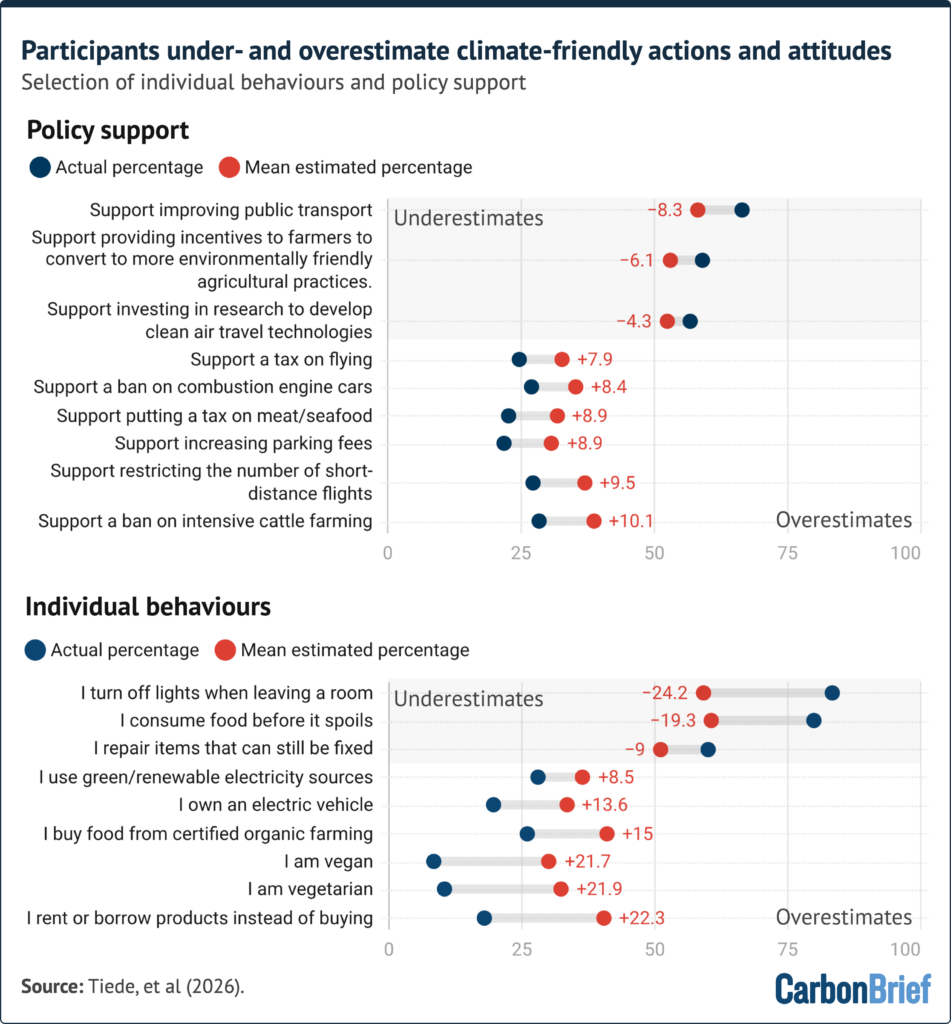
                [POLICY SUPPORT & BEHAVIOR PERCEPTION GAP]
  High Public Support Measures ───► [Actual: High] ──(Underestimated)──► [Peer Estimate: Medium]
  Low Public Support Measures  ───► [Actual: Low]  ──(Overestimated)───► [Peer Estimate: Medium]

  *Outcome: Human cognitive processing drives estimations toward the center ("Regression to the Mean").
Cognitive Mechanics Behind Misestimation
Data from Survey 3 demonstrated that the perception gap is driven in part by general cognitive processes inherent to human estimation over large population sets, rather than localized bias or political ignorance alone. When plotting actual public support (measured by policy preferences and personal habits) against predicted public support, a clear statistical pattern emerged:
Regression to the Mean: When actual public endorsement for a climate policy or habit was high, respondents consistently underestimated peer support. Conversely, when actual support for restrictive or unpopular measures was low, respondents consistently overestimated peer support.
Individual Context Effects: A respondent’s personal background systematically altered these estimations. Individuals who frequently engaged in climate discussions, regularly consumed climate-focused news, or were already involved in climate action predicted higher climate support across the board compared to less engaged peers.
Limits of Social Norm Interventions
Surveys 4 and 5 proved that providing accurate social information alters verbal attitudes without necessarily triggering real-world actions. While informing respondents that 68% of their peers were willing to donate successfully increased their own expressed willingness to contribute, it led to no measurable increase in actual monetary donations compared to the control group. Conversely, disclosing that only 4% had actually donated did not suppress stated intentions to sign petitions or discuss climate change, but similarly failed to impact actual financial contributions.
Official Statements
The study’s release prompted significant commentary from primary researchers and independent experts in social psychology and climate communications, offering critical context regarding cognitive mechanisms, normative behavior, and methodological limitations.
Lead Researcher Insights
Dr. Kevin Tiede, scientific managing director of the Institute for Planetary Health Behaviour at the University of Erfurt and lead author of the study, emphasized that misestimations are rooted in basic human cognitive bounds rather than systemic malice:
"The perception gap is not due to ignorance or bias, but because people are just not good at making good estimations."
Commenting on the practical limitations of social norm interventions, Dr. Tiede noted:
"Just telling people how many people support climate action is likely not enough to really change something… [However] direct comparability between people saying they would donate and actually donating is limited. Giving people more time to answer and autonomy over where to donate might result in more people taking action."
Addressing the broader theoretical framework, Dr. Tiede explained that while the findings confirm the presence of "pluralistic ignorance"—a phenomenon where individuals wrongly assume their private beliefs differ from the majority—the dynamics surrounding climate change are highly complex:
"The vast majority of people around the world support climate action, but people considerably underestimate the extent of this support."
Strategic and Theoretical Perspectives
Prof. Madalina Vlasceanu, an assistant professor at Stanford University’s Doerr School of Sustainability who was not involved in the study, highlighted the operational complexities of converting climate awareness into action. She observed that simple messaging is rarely sufficient to disrupt ingrained habits:
"It may take multiple and repeated attempts at effective communication, or for people to directly experience the norm that climate change is widely supported, rather than simply being told."
Prof. Vlasceanu further noted that public visibility plays a key role in shaping peer behavior:
"Observable behaviors, such as identity signaling—which could involve anything from protesting to vegetarianism—might have more of an impact on encouraging climate action among peers than private behaviors like donations."
Commending the research for refining academic understanding, she added that the study serves as a "great addition to the literature" because it disproves previous assumptions that correcting perception gaps directly drives action, noting that the findings have "sparked several new hypotheses that her lab is now working on."
Methodological Caveats
Prof. Mauro Bertolotti, associate professor of social psychology at the Università Cattolica del Sacro Cuore, offered a cautious assessment of the findings. While acknowledging that the "attitude-behaviour gap" is a recognized phenomenon in psychological literature, he raised questions regarding the ecological validity of experimental donation tasks:
"I am skeptical of simplified and abstract measures. Experiment environments often come with assumptions and expectations that are different from real life. As a result, they might not replicate the process people go through when choosing to make a donation to an environmental cause."
Future Outlook
The findings of this study signal a necessary pivot for policymakers, non-governmental organizations, and climate communicators. Historically, significant resources have been directed toward myth-busting, public education campaigns, and attempting to convert climate skeptics by highlighting broad peer consensus. However, the evidence demonstrates that public consensus already exists, and merely reiterating its existence does not translate into individual behavioral change.
To effectively bridge the attitude-behaviour gap, future strategies must shift from persuasion to enablement:
Targeting the Willing Majority: Rather than focusing communications on stubborn climate skeptics, public campaigns should focus on the majority of citizens who already support climate action, providing them with clear pathways to move from abstract agreement to verifiable action.
Reducing Structural and Practical Friction: High expressed willingness often fails to manifest as action due to logistical friction, immediate financial costs, or decision fatigue. Implementing structural interventions—such as direct subsidies, streamlined administrative procedures, and policy conveniences—can lower the threshold for personal action.
Ensuring Policy Fairness and Transparency: For climate policies to maintain broad public backing and encourage active participation, frameworks must be designed with equity at their core. Highlighting the fairness and tangible local co-benefits of environmental regulations builds visible, sustained public engagement.
Expanding Global Research Contexts: Because this research focused primarily on Germany and the United States, scholars emphasize the need to replicate these behavioral and perceptual studies across wider geographic and cultural regions—particularly within the Global South—where social norms, trust in institutions, and economic realities significantly alter how public attitudes translate into climate action.