Executive Overview
One hundred years after the principles of High Modernism first radically disrupted classical spatial design, the foundational concepts conceived by visionaries like Le Corbusier continue to quietly dictate the rhythm of the built environment. Among these, the promenade architecturale—the choreographed architectural walk—stands out as one of the most enduringly potent tools in the designer’s arsenal. Originally forged as an answer to the mechanical and temporal realities of the early 20th-century machine age, the promenade was never merely about getting from point A to point B. Rather, it was an explicit strategy to bind time, motion, and perception into a cohesive spatial sequence.
In Le Corbusier’s masterpieces, such as the seminal 1929 Villa Savoye in Poissy, France, the visitor is drawn along a carefully calculated upward trajectory. Moving through the transparent ground-level pilotis, up through ramps that defy static floor-plate zoning, and out onto the sprawling, sky-framed expanses of the roof garden, the occupant’s body becomes an active participant in an unfolding cinematic narrative.

Today, this modernist methodology has transcended its dogmatic roots. Far from remaining confined to the white-stucco boxes of the heroic era, the promenade architecturale has evolved into a flexible, multidisciplinary strategy. In the 21st century, it informs the layout of sprawling residential compounds by firms like Studio MK27 and Jacobsen Arquitetura, organizes the dizzying spatial vortexes of OMA’s cultural icons, and defines the urban-scaled topologies of contemporary museums and public parks. This article explores the historical genesis of the architectural promenade, tracks its evolution across diverse typologies, evaluates its modern-day manifestations, and projects its future in an era increasingly dominated by digital immersion.
Detailed Chronology: From the Machine Age to the Digital Era
To understand why the promenade architecturale remains a vital reference point for contemporary architects, one must trace its development through distinct historical epochs—from theoretical abstraction to universal urban application.

1. The Genesis: Modernist Orthodoxy and the Machine Age (1920s–1950s)
The concept was baptized in an era obsessed with velocity, manufacturing, and industrial progress. Influenced by the moving image of cinema and the assembly lines of the industrial revolution, Le Corbusier argued that architecture could not be truly understood from a single, static vantage point. In his foundational writings, he posited that a building is revealed through movement.
At the Villa Savoye, this philosophy materialized physically. The automobile entered beneath the building’s curved glass perimeter, mimicking the modern obsession with transit, before the pedestrian journey commenced via a central ramp. The journey was intentionally paced: views were framed like cinematic shots, unfolding through horizontal ribbon windows that edited the surrounding landscape. The ultimate crescendo of this spatial sequence was the roof garden—a domestic nature reserve elevated above the mundane earth. This mechanical yet poetic choreography became the blueprint for modernist functionalism, prioritizing human kinetics over rigid symmetrical axiality.

2. The Post-War Reinterpretation and Brutalist Expansions (1960s–1980s)
As modernism matured and fractured into brutalism and late-modern expressions, architects began to scale up the promenade. No longer restricted to private villas, the concept was adapted for civic centers, university campuses, and massive public complexes.
During this period, designers manipulated scale to evoke awe. Spatial sequences were stretched across cavernous concrete atriums, interlocking mezzanines, and monumental staircases. Architects like Lina Bo Bardi in Brazil integrated the promenade directly into the public life of the city, utilizing elevated pathways and open-air plazas to blur the boundaries between institution and street. The promenade became democratic; it was no longer just about framing individual contemplation, but about orchestrating collective human movement and social interaction.

3. The Contemporary Renaissance: Multi-Typology Integration (1990s–Present)
In the 21st century, the promenade architecturale has undergone a profound democratization and digitization. Contemporary practices no longer view the concept through a dogmatic modernist lens; instead, they treat it as an adaptable interface between human psychology, environmental sustainability, and complex programing.
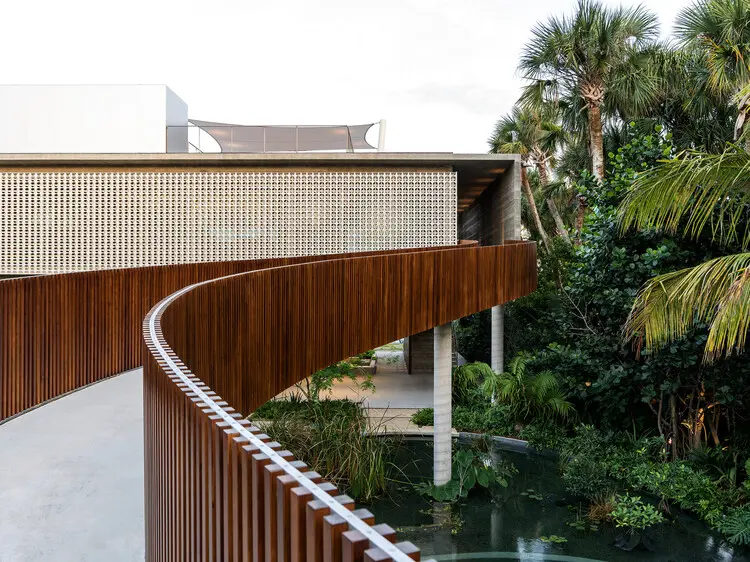
In residential architecture—exemplified by works from Brazil’s Studio MK27 (such as the Canal House) and Jacobsen Arquitetura—the promenade connects hyper-local domestic spaces with tropical vegetation, dissolving boundaries between indoor and outdoor microclimates. In public and cultural institutions, firms like OMA (with the Casa da Música in Porto) and FR-EE (with the Soumaya Museum) twist, fold, and elevate the promenade into sculptural, continuous surfaces. Here, the visitor’s path is no longer a simple linear or ramped progression, but a dynamic loop that redefines how we consume art, sound, and civic space.

Supporting Context & Metrics: The Anatomy of Spatial Movement
To quantify the enduring relevance of the architectural promenade, contemporary design theory examines how spatial sequencing impacts human psychology, wayfinding, and spatial efficiency. Modern architectural research underscores several core metrics and psychological responses tied directly to intentional spatial choreography:
- Cognitive Mapping and Wayfinding: Studies in environmental psychology indicate that buildings utilizing a clear, sequential promenade reduce spatial disorientation by up to 42% compared to labyrinthine, corridor-heavy layouts. By providing visual anchors at the conclusion of each linear or looping segment, users intuitively construct a mental map of the building.
- Physiological Well-being: Residential projects that incorporate an extended architectural journey—such as moving from a low-ceilinged, compressed entryway into an expansive, double-height living pavilion—have been shown to elicit measurable drops in cortisol levels among occupants, capitalizing on the psychological impact of spatial expansion and compression (compression and release).
- Typological Versatility: While initially engineered for single-family residences and exhibition pavilions, contemporary architectural database metrics show the promenade applied across diverse programmatic typologies:
- Cultural Institutions (Museums/Performance Halls): ~35% of recent high-profile competition entries utilize continuous helical or ramping promenades to eliminate hierarchical dead-ends.
- Residential Architecture: ~28% of luxury and mid-tier custom homes utilize choreographed arrival sequences to transition guests from public streetscapes to private sanctuaries.
- Public Parks and Urban Landscapes: ~37% of modern landscape architecture projects integrate elevated walkways and multi-tiered paths to manage high-density foot traffic while maximizing ecological exposure.
[Streetscape / Arrival]
       │
       ▼ (Spatial Compression)
[Threshold / Entryway]
       │
       ▼ (Kinetic Direction / Framing)
[The Promenade: Ramps, Bridges, or Interlocking Voids]
       │
       ▼ (Climax / Visual Release)
[Terminal Vista: Roof Garden, Panorama, or Central Atrium]
Official Perspectives and Critical Discourse
The enduring vitality of the promenade architecturale is frequently debated by leading theorists, preservationists, and contemporary practitioners who grapple with how physical movement must adapt to modern sensibilities.

On the Evolution of the Threshold:
Architectural historians note that while Le Corbusier’s promenade was deeply ocularcentric—focused heavily on what the eye encountered along a fixed path—contemporary versions are multisensory. Modern architects deliberately engage acoustics, tactile material transitions, and thermal shifts along the route. As noted in recent architectural criticism, a contemporary promenade is less about a static director framing a picture, and more about immersing the body in an ecological continuum.
The Critique of Linear Control:
Critics of rigid promenades argue that modern life demands agency rather than prescribed direction. In response, contemporary designers have evolved the classical linear ramp into non-linear, multi-directional loops. By offering multiple choices at every junction, firms like OMA empower the user to curate their own promenade architecturale, transforming a top-down modernist script into an open-ended contemporary dialogue.

Future Outlook: The Promenade in the Age of Digital and Hybrid Spaces
As we look toward the horizon of architectural design, the promenade architecturale faces a fascinating transformation. The rise of hybrid working models, smart-city integration, and immersive digital environments forces architects to rethink what constitutes a "journey" through space.
1. Phygital and Augmented Promenades
With the integration of augmented reality (AR) and location-aware building systems, the physical path can now be layered with responsive digital narratives. Cultural institutions are already experimenting with architectural promenades where physical movement triggers acoustic soundscapes, historical projections, or interactive data visualizations embedded within the concrete, glass, and steel fabric of the building.

2. Ecological Continuity and Slow Architecture
In an era of climate urgency, the architectural walk is increasingly being leveraged as an environmental pedagogical tool. Future promenades will prioritize biophilic design—guiding occupants through micro-climatic zones, natural ventilation corridors, and urban agricultural roofs. Rather than simply celebrating the machine age, the 21st-century promenade reconnects the human body with natural cycles, using spatial sequencing to foster ecological consciousness.
Conclusion
One hundred years after its inception, the promenade architecturale remains far more than a nostalgic nod to Le Corbusier. It is a fundamental testament to the idea that architecture is an art form experienced through time and motion. By continually reinventing how we walk, pause, view, and inhabit our built surroundings, contemporary architects ensure that this modernist masterpiece of a concept will continue to guide spatial design for centuries to come.