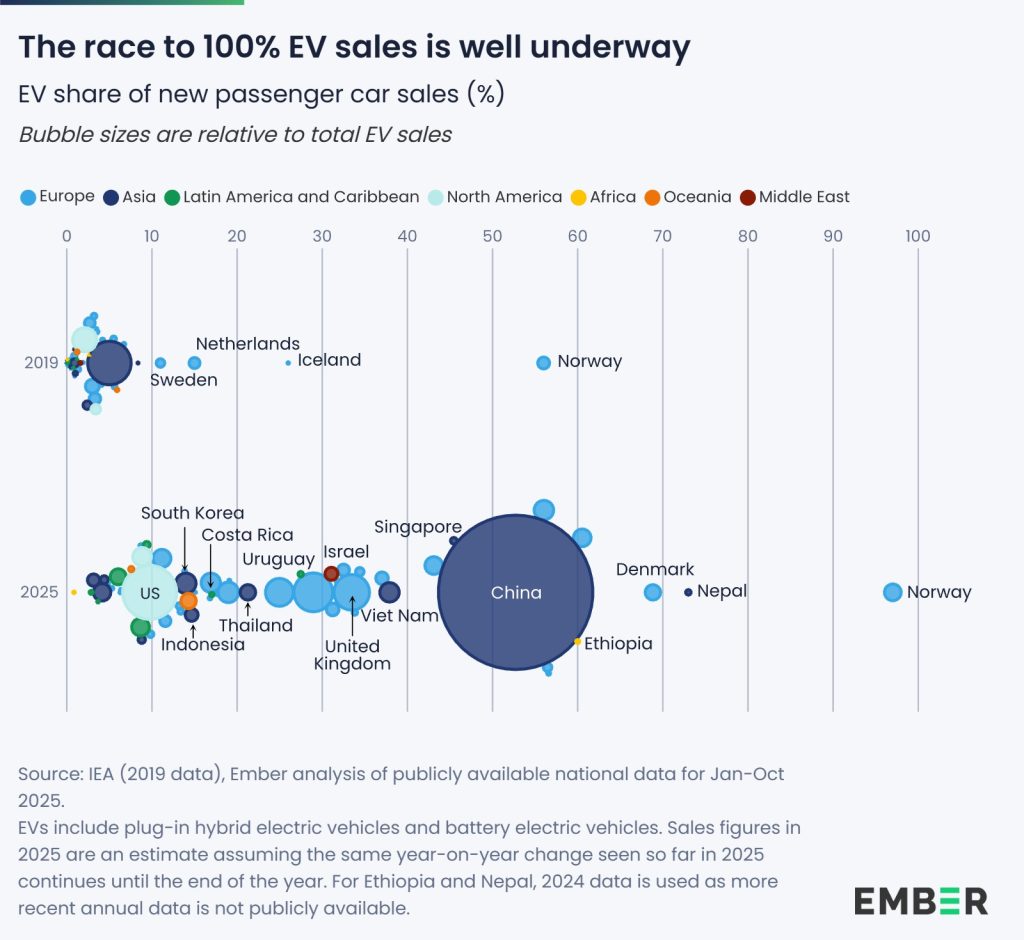
The global automotive landscape has reached a historic inflection point. According to a landmark analysis released by energy think tank Ember, electric vehicles (EVs) officially surpassed a major milestone in 2025, accounting for more than 25% of all new car sales globally.
What makes this milestone remarkable is not merely the aggregate percentage, but the structural shift in where these vehicles are being bought and sold. For years, the narrative surrounding the electric transition was dominated by early adopters in advanced Western economies—primarily Western Europe, select Scandinavian countries, and coastal pockets of the United States. Today, the center of gravity for EV adoption has decisively shifted toward emerging markets.
Regions that recorded negligible EV adoption just a half-decade ago are now leapfrogging traditional combustion-engine infrastructure entirely. Driven by targeted government policies, aggressive tax incentives, localized manufacturing pushes, and the rapid influx of affordable, high-tech Chinese electric vehicles, developing economies across Southeast Asia, Latin America, and the Middle East are setting the pace for the rest of the world.
As the global EV race broadens—with 39 countries now seeing EVs claim more than 10% of new car sales, up from just four nations in 2019—the implications for global energy markets, fossil fuel demand, and geopolitical trade dynamics are profound. This report explores the data behind the 2025 EV boom, the role of emerging economies, the driving force of Chinese manufacturing exports, and what this transition means for the future of global mobility.
Detailed Chronology of the 2025 EV Surge
To understand how the electric vehicle market achieved this unprecedented penetration rate in 2025, it is necessary to examine the rapid acceleration over the preceding half-decade.
2019–2021: The Niche Phase
At the close of the last decade, the global EV market was strictly localized. Ember’s historical data highlights that only four countries worldwide had achieved a double-digit market share for electric cars. The market was characterized by high upfront vehicle costs, limited battery supply chains, and nascent charging infrastructure. Western Europe led this initial wave, underpinned by strict EU emissions regulations and generous government subsidies.
2022–2023: The Supply Chain and Export Pivot
As global supply chains recovered from pandemic-era disruptions, manufacturing capacity—particularly in China—scaled aggressively. By mid-2023, domestic Chinese EV demand began to face fierce localized price wars, prompting major manufacturers (such as BYD, SAIC, and Great Wall Motor) to look outward. Almost all subsequent growth in Chinese EV exports targeted non-OECD (Organization for Economic Co-operation and Development) markets. These regions welcomed lower-cost electric options unburdened by the heavy tariff walls that would later emerge in North America and parts of Europe.
2024: The Infrastructure and Policy Realignment
During 2024, developing economies laid the groundwork for mass adoption. Governments in Southeast Asia and Latin America recognized the dual threats of escalating fossil fuel import bills and urban air pollution. Strategic policy shifts—including slashed import tariffs, localized assembly mandates, and direct consumer incentives—transformed EVs from luxury novelty items into economically attractive alternatives to internal combustion engine (ICE) vehicles.
2025: The Global Tipping Point
By 2025, the compounding effects of these structural changes materialized globally. Surpassing the 25% global sales threshold, the market saw staggering milestones:
The ASEAN Awakening: Association of Southeast Asian Nations member states transformed into powerhouses of adoption. Singapore and Vietnam vaulted past the UK and the European Union, hitting roughly 40% EV sales shares.
The American and Japanese Divergence: While the United States grappled with shifting federal incentives, emerging markets like Indonesia (15% EV share) surpassed the US market. Meanwhile, Japan’s EV adoption stagnated at roughly 3%, illustrating a stark divergence in Asian automotive trends.
Latin American Momentum: Uruguay surged to a 27% EV adoption rate—matching European Union averages—while Mexico and Brazil locked in steady growth trajectories that outpaced several traditional industrialized nations.
Supporting Context & Metrics: The Numbers Behind the Boom
The granular data compiled by Ember paints a vivid picture of a market undergoing tectonic shifts. The democratization of electric mobility is no longer theoretical; it is quantified by soaring adoption rates and shifting global trade routes.
Geographic Breakdown of the 2025 EV Landscape
Region / Country
2025 EV Market Share / Volume Indicator
Historical Comparison / Context
Global Total
>25% of all new car sales
Up from single digits in the late 2010s; 39 countries now exceed 10% EV share (vs. 4 in 2019).
Singapore & Vietnam
~40% EV sales share
Surpassed average levels seen across the UK and the European Union.
Thailand
20% EV sales share
Sold more EVs in the first three quarters of 2025 than Denmark.
Uruguay
27% EV sales share
Matches the average EV adoption rate of the European Union.
Türkiye
17% EV sales share
Overtook Belgium to become Europe’s fourth-largest Battery Electric Vehicle (BEV) market by volume.
Indonesia
15% EV sales share
Surpassed the United States market share percentage for the first time.
Japan
~3% EV sales share
Unchanged since 2022, highlighting sluggish domestic BEV adoption.
The Chinese Export Engine
A critical catalyst for this global expansion has been the redirection of Chinese manufacturing output. Non-OECD nations have become prime destinations for Chinese automakers. Brazil, Mexico, the United Arab Emirates, and Indonesia rank among the top ten global destinations for Chinese EV exports in 2025.
This symbiotic relationship thrives because emerging economies require affordable, robust electric vehicles to motorize their growing middle classes without locking into decades of high-cost petroleum consumption. In return, Chinese automakers find receptive markets free from the punitive protectionist barriers currently being erected in Washington and Brussels.
The Fossil Fuel Displacement Metric
Beyond carbon accounting, the 2025 analysis highlights an immediate, tangible benefit: the rapid erosion of oil demand.
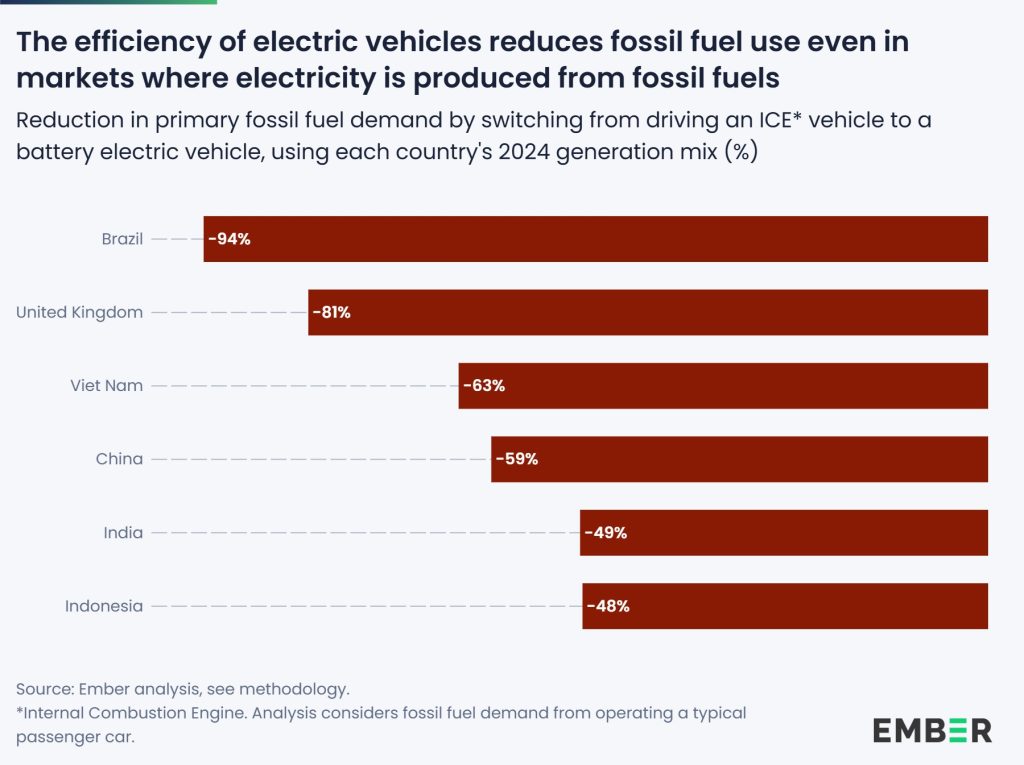
Electric vehicles are inherently three times more efficient than internal combustion engine vehicles. This thermodynamic advantage translates into dramatic reductions in petroleum consumption, even in developing nations where the electrical grid still incorporates fossil fuels:
Brazil: Benefiting from a predominantly clean energy matrix, the introduction of BEVs cuts fossil fuel demand by approximately 90%.
Indonesia: Despite utilizing coal in its power generation mix, the shift to EVs reduces fossil fuel demand for transportation by nearly 50%.
These metrics underscore that the environmental and economic dividends of electrification are realized immediately upon vehicle deployment, compounding rapidly as grids green over time.
Official Statements and Industry Insights
The speed and scale of the 2025 transition have prompted a reevaluation of traditional automotive forecasts. Analysts and energy experts emphasize that developing nations are no longer playing catch-up; they are charting the blueprint for future mobility.
Euan Graham, Electricity and Data Analyst at Ember, noted the gravity of the shift:
"This is a major turning point. In 2025, the center of gravity has moved. Emerging markets are no longer catching up; they are leading the shift to electric mobility. These countries see the strategic advantages of EVs, from cleaner air to reduced fossil fuel imports."
Graham further emphasized the urgency of forward-looking policy, noting:
"Emerging markets will shape the future of the global car market. The choices made now on charging infrastructure and early support will determine how fast this momentum continues."
Automotive industry executives echo these sentiments, pointing out that Western legacy automakers risk losing critical market share in high-growth Southern Hemisphere economies if they continue to focus exclusively on high-margin, expensive luxury EVs rather than accessible, mass-market electric cars.
Future Outlook: Challenges and Opportunities Ahead
As the world looks past 2025, the trajectory of the electric vehicle market faces a complex matrix of infrastructural, political, and economic headwinds and tailwinds.
1. The Infrastructure Bottleneck
While vehicle sales figures in emerging markets are surging, long-term sustainability hinges on grid modernization and charging infrastructure deployment. Nations like Thailand, Indonesia, and Brazil must scale up public and residential charging networks rapidly to support the next wave of multi-car households adopting electric options. Without proactive grid investments, rapid EV uptake risks localized brownouts and grid instability during peak charging hours.
2. Trade Tensions and Protectionism
The heavy reliance of emerging markets on Chinese EV imports introduces geopolitical friction. As North American and European regulators implement strict tariffs and trade barriers against Chinese-built vehicles, manufacturing giants in China may double down even harder on the Global South. For emerging economies, this presents both an economic windfall—access to cheap green technology—and a strategic challenge regarding the development of domestic automotive manufacturing ecosystems.
3. Policy Consistency
The successes recorded in 2025 were overwhelmingly policy-driven. Tax exemptions, low-interest green loans, and import duty reductions were the primary levers that lowered the total cost of ownership for consumers. Maintaining this momentum requires governments to sustain these supportive frameworks through the critical transition decade, even as budgetary pressures fluctuate.
Conclusion
The year 2025 will be remembered in automotive history as the moment the electric vehicle transition truly democratized. By crossing the 25% global sales threshold and witnessing explosive growth across Southeast Asia, Latin America, and the Middle East, the global market has proven that the electric future is not the exclusive domain of wealthy Western nations. Driven by pragmatism, economic self-interest, and access to affordable technology, emerging markets have transformed from spectators into the vanguard of the global EV revolution.