

Executive Overview
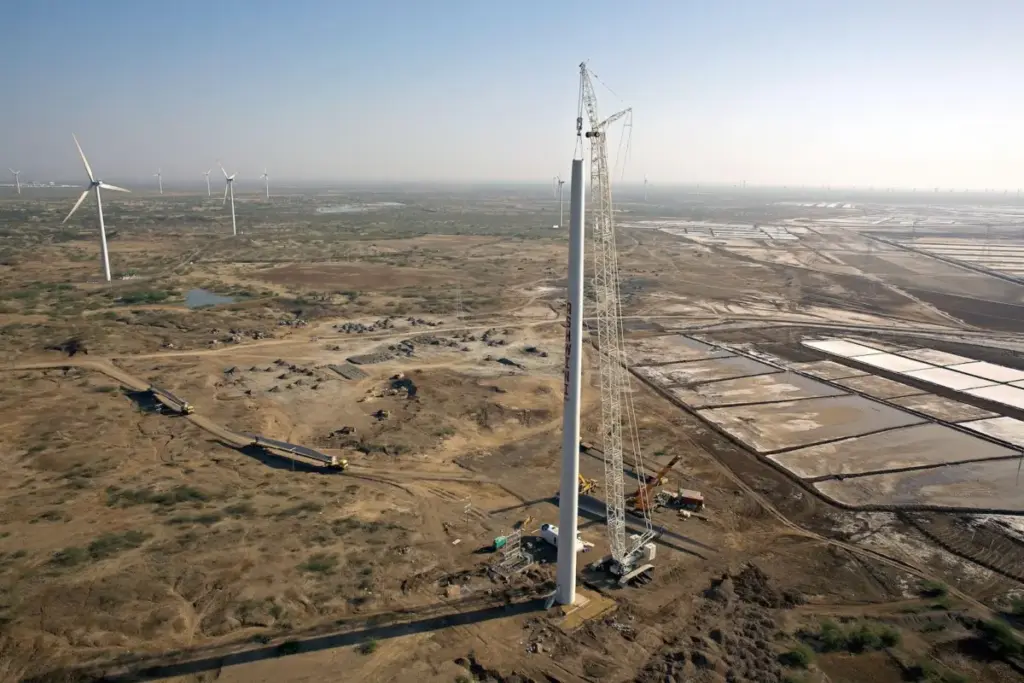
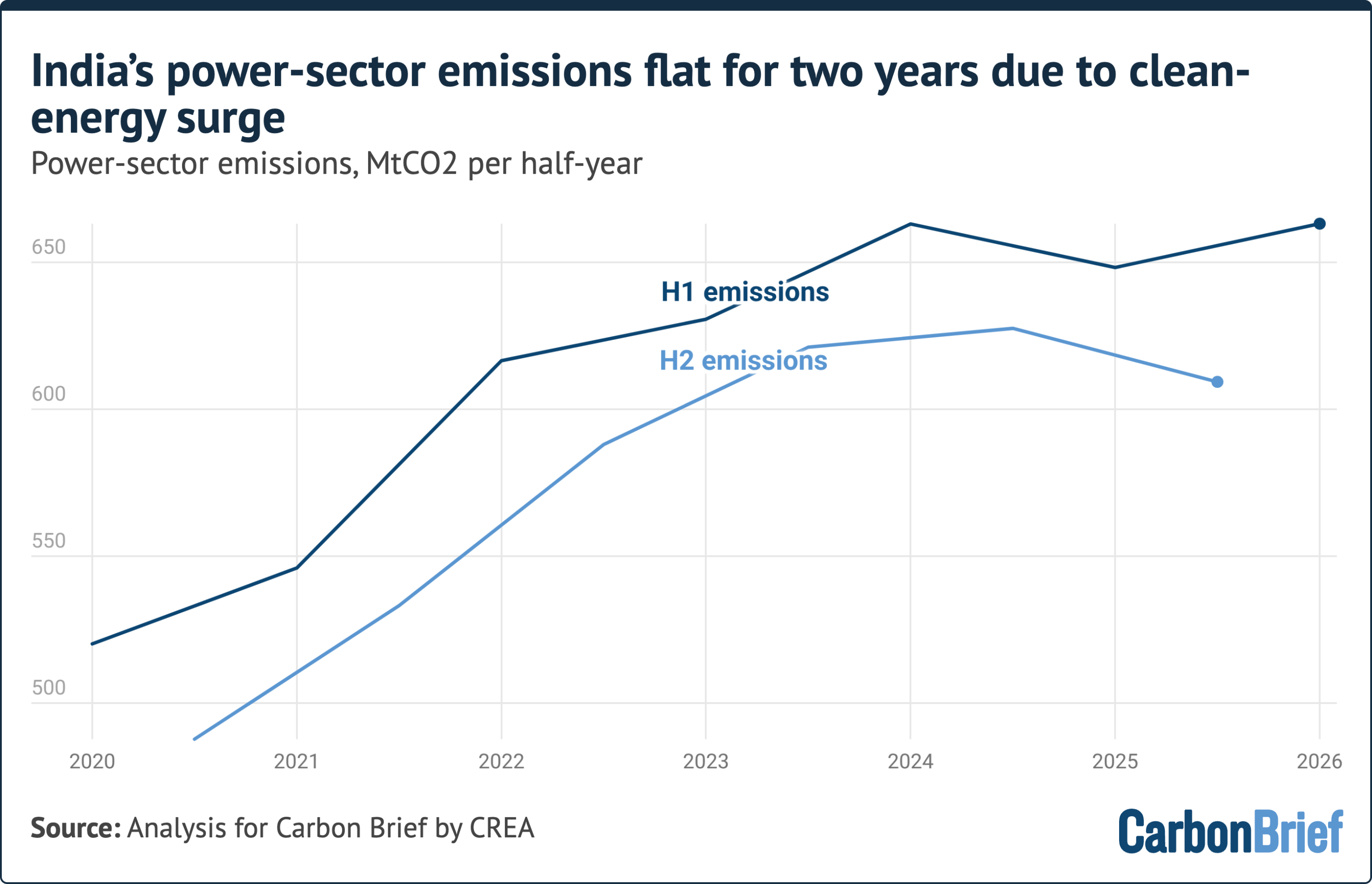
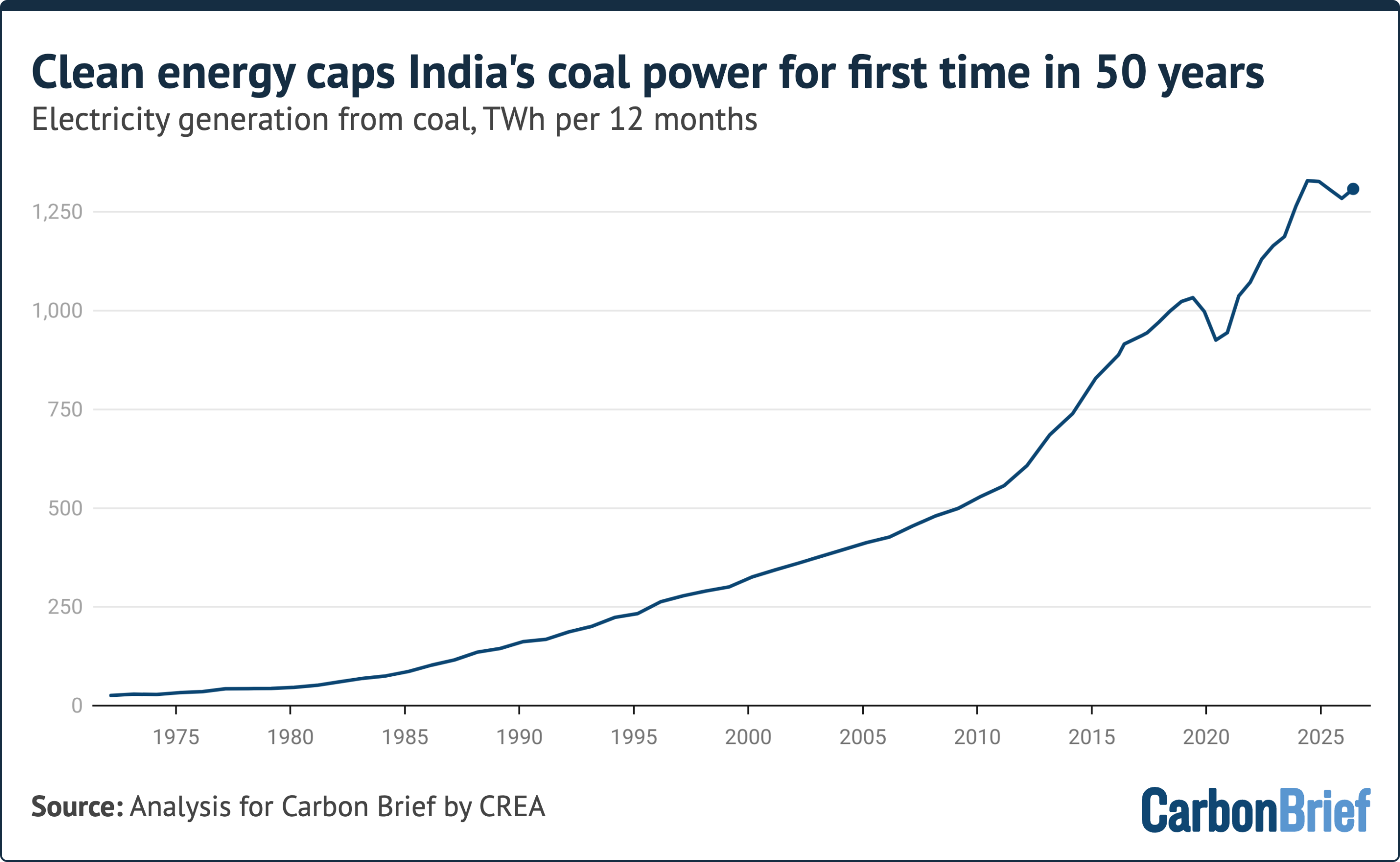
In a landmark shift for the world’s third-largest energy consumer, a massive surge in clean power generation has successfully halted carbon dioxide ($textCO_2$) emission growth across India’s electricity sector. According to a six-monthly analysis conducted for Carbon Brief by the Centre for Research on Energy and Clean Air (CREA), power sector emissions remained entirely flat from the first half of 2024 through the first half of 2026. This marks the first time in over 50 years that coal-fired electricity generation experienced zero growth over a two-year period during a phase of rising national electricity demand.
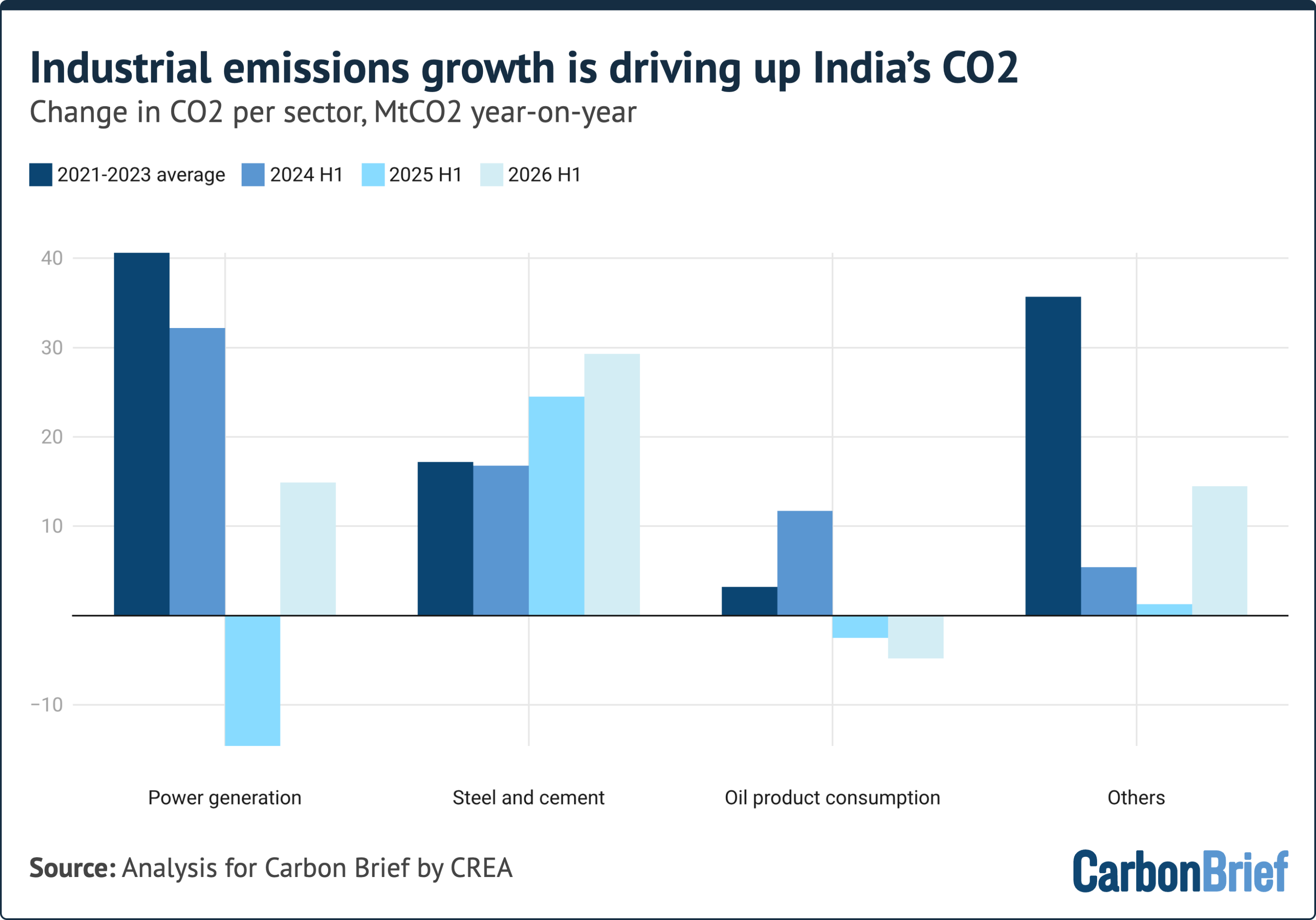
However, India’s broader climate trajectory presents a complex, dual-track reality. Despite the structural decoupling of power generation from carbon emissions and a second consecutive annual drop in oil and gas consumption, India’s total fossil fuel and cement $textCO_2$ emissions grew by 3.7% year-on-year in the first half of 2026. This rise was overwhelmingly driven by heavy industry, specifically rapid demand acceleration in the steel and cement sectors and an uptick in industrial coal combustion.
| Energy Metric / Sector (H1 2026 Focus) | Operational & Emission Trend | Macroeconomic / Energy Driver |
|---|---|---|
| Power Sector $textCO_2$ | Flat (0% growth over 2 years) | Clean energy additions exceeding total demand growth |
| Coal-Fired Power Output | Stagnant across 2-year period | Historic 50-year landmark achieved despite 7% demand growth |
| Total National $textCO_2$ Emissions | Increased by +3.7% YoY | Heavy industry acceleration outweighing power sector stagnation |
| Steel & Cement Emissions | Surged by +8% to +9% YoY | Real estate boom, urban infrastructure investment |
| Oil Demand | Contracted by -1.3% YoY | LPG and petcoke drops offsetting diesel/petrol heatwave growth |
| Clean Energy Capacity Additions | +77 GW Solar, +11 GW Wind (2-yr) | Accelerating renewable rollout and storage tenders |
The findings demonstrate that while India’s renewable energy transformation is starting to absorb power demand growth and displace expensive fossil imports, the country faces systemic decarbonization hurdles in its industrial heartland—where electrification rates lag significantly behind global benchmarks.
Power Sector Transformation: A Historic 50-Year Benchmark
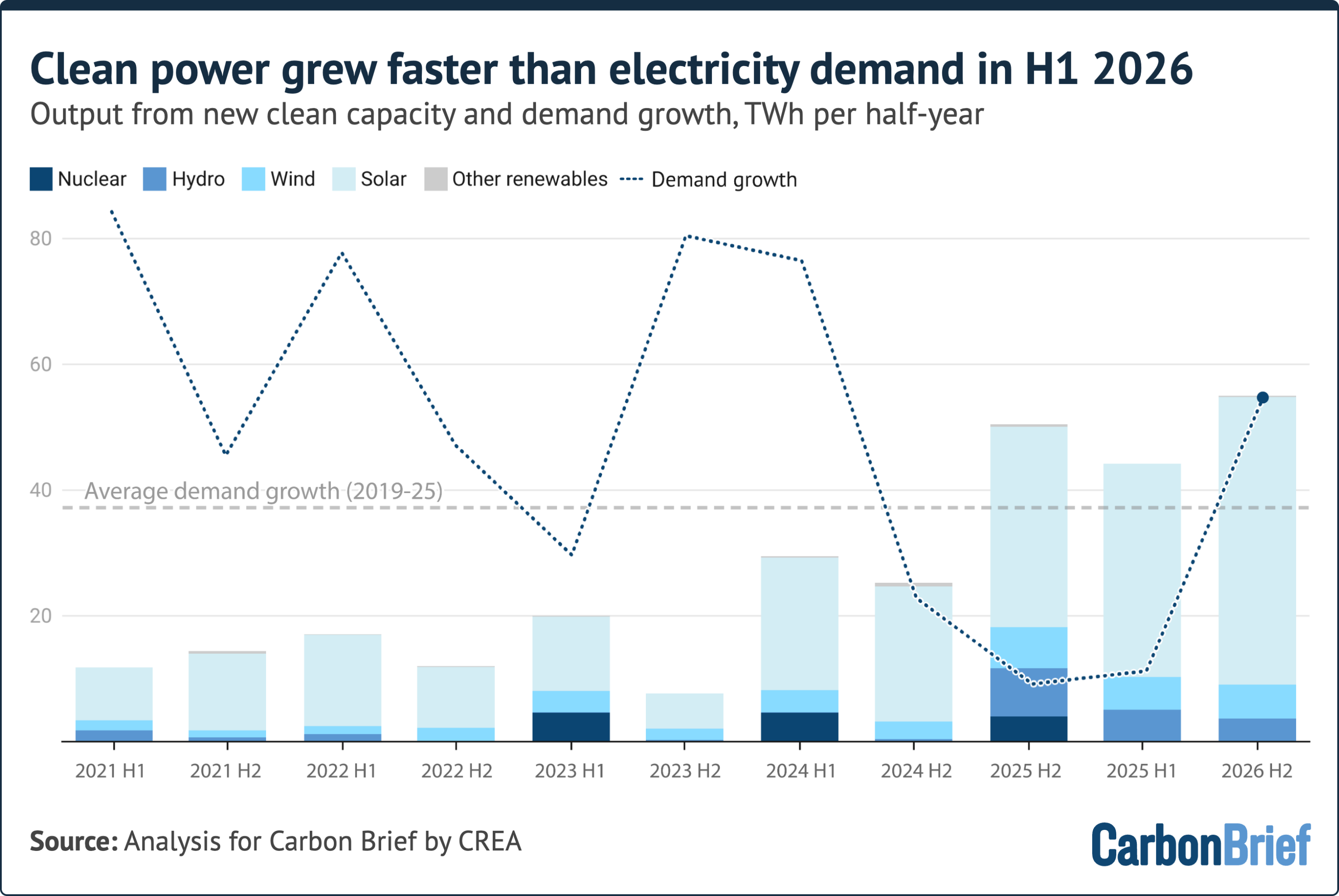
Between the first half of 2024 and the first half of 2026, India recorded its largest two-year expansion of non-fossil power generation on record. National electricity consumption rose by 7% over this timeframe—an absolute increase of 63 Terawatt-hours (TWh), roughly equivalent to the annual power consumption of Switzerland or Singapore.
Crucially, this entire demand increase was covered by non-fossil sources, which collectively added 70 TWh of generation over the same period:
- Solar Energy: Provided the primary engine of growth, contributing 44 TWh of additional power.
- Wind Energy: Expanded output by 13 TWh.
- Hydroelectric Power: Recovered to add 8 TWh.
- Nuclear Power: Added 7 TWh to the national grid.
       India's Power Demand Growth vs. Clean Supply Addition (H1 2024 - H1 2026)
       ========================================================================

       Electricity Demand Increase:  [ 63 TWh                               ]

       Clean Generation Addition:   [ 70 TWh                               ]
                                      |-- Solar:    44 TWh
                                      |-- Wind:     13 TWh
                                      |-- Hydro:     8 TWh
                                      |-- Nuclear:   7 TWh

       Net Fossil Generation Impact:  [ Zero Growth / Small Displacement     ]
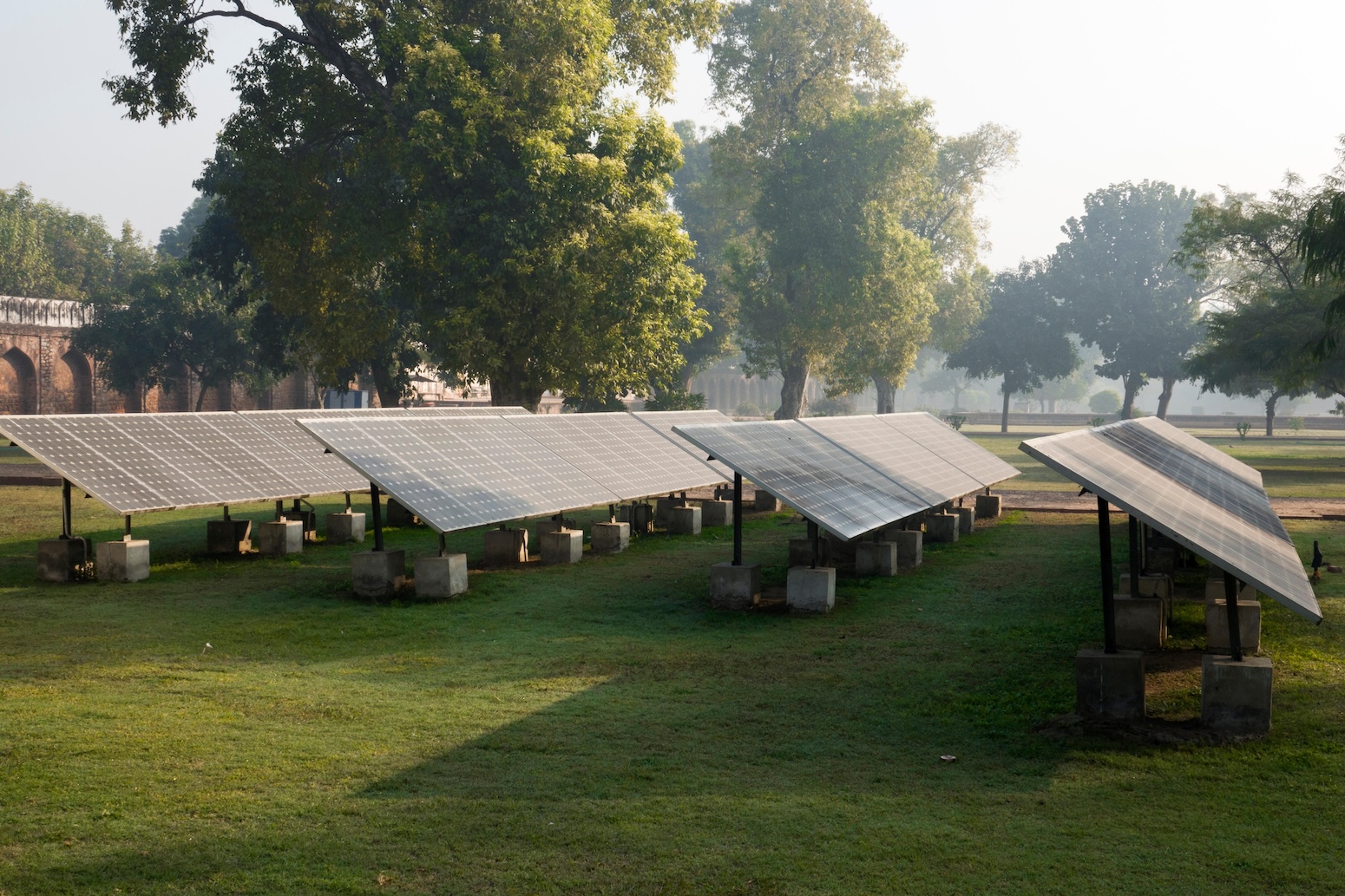
To achieve this generation surge, India installed an astounding 77 Gigawatts (GW) of new solar capacity, 11 GW of wind, 5 GW of hydro, and 0.6 GW of nuclear capacity over the two-year window. While solar dominated additions, non-solar clean technologies accounted for 40% of the overall increase in clean generation, underscoring a broadening renewable portfolio.
This structural expansion enabled the power system to absorb severe weather-induced demand shocks in H1 2026. Strengthening El Niño conditions delayed the Indian monsoon and intensified severe heatwaves across the subcontinent, sparking unprecedented agricultural pumping and residential cooling loads. Despite these strains, clean power expansion kept fossil-fuel generation completely flat across the two-year period, effectively shielding power-sector emissions from spiking.
Industrial Expansion Drives Total Carbon Emissions Upward
While clean power successfully capped electricity emissions, India’s industrial sector emerged as the primary source of carbon emissions growth. Industrial emissions accelerated to an 8% year-on-year increase in the first half of 2026, well above recent historic trends.
                  Sectoral Emission Growth Breakdown (H1 2026 vs. H1 2025)
                  ========================================================

  Steel & Cement Emissions  [========================================] +8.0%
  Non-Power Coal Demand     [===============================================] +14.0%
  Petrol (Motor Spirit)     [============================] +6.9%
  Diesel Consumption        [=================] +4.1%
  Overall National CO2      [================] +3.7%
  Power Sector CO2          [|] 0.0% (Flat over 2-year baseline)
  Oil Demand (Total)        [-======] -1.3%
  LPG Consumption           [-====================] -7.0%
  Petcoke Use               [-=========================] -9.9%
Steel and Cement Production
Production of steel and cement grew by 8% and 9% year-on-year, respectively, during H1 2026. This industrial push was propelled by institutional investment in domestic real estate—which jumped 58% in the first half of the year to reach $4.1 billion—and federal infrastructure spending. High raw material prices, particularly for imported coking coal, compressed manufacturer profit margins, but demand remained resilient as companies drew down existing material inventories.
Non-Power Coal Consumption
Coal consumption outside the power grid surged by 14% year-on-year in H1 2026, up sharply from a 3% growth rate in 2025. This expansion was driven by energy supply disruptions linked to international crises, which forced industrial consumers, commercial units, and households to substitute scarce natural gas and Liquefied Petroleum Gas (LPG) with coal and coal gasification products.
Industrial Electrification Deficit
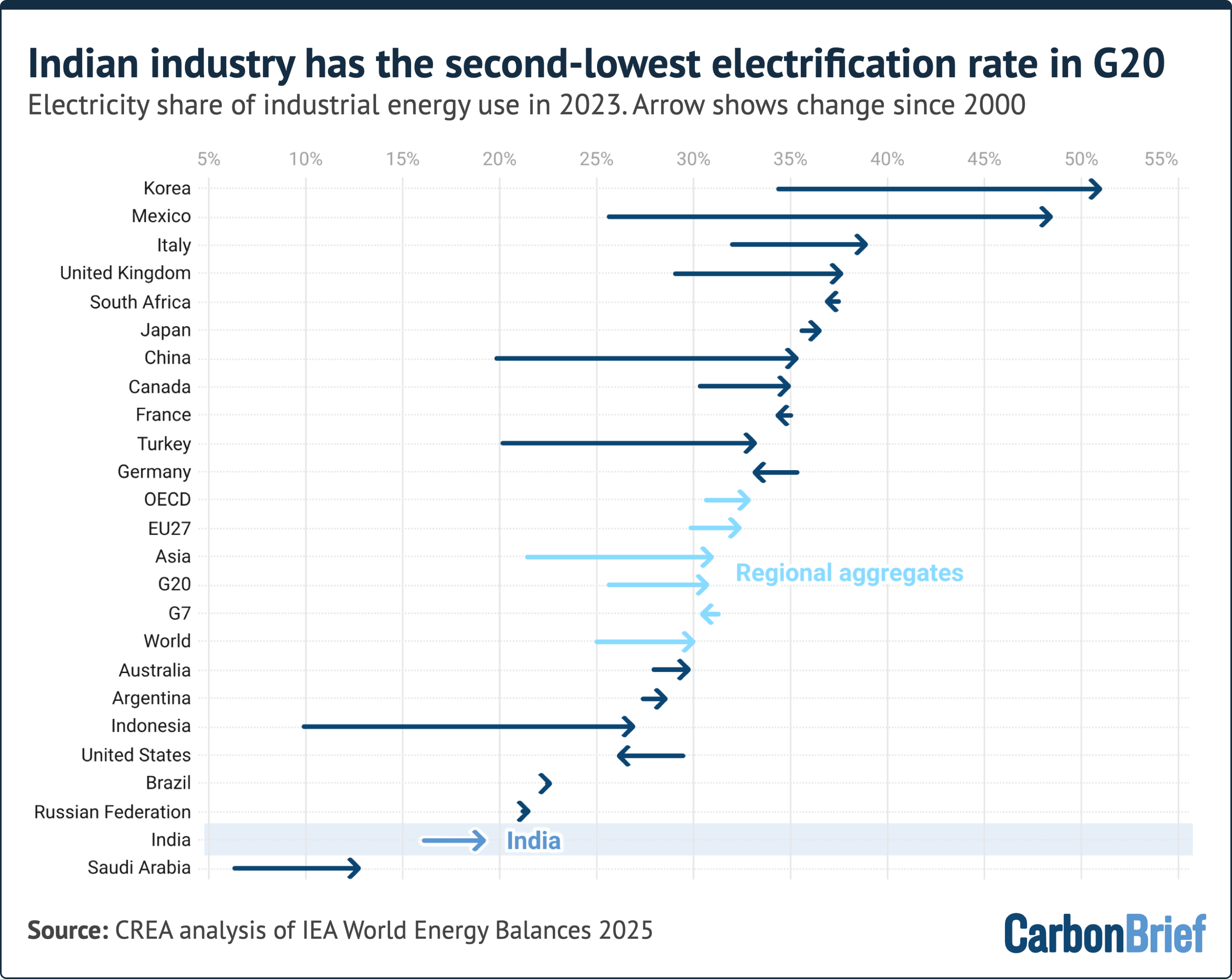
A major structural vulnerability highlighted in the report is India’s industrial energy composition. India possesses the second-lowest industrial electrification rate in the G20, with electricity supplying roughly 17% of industrial energy demand. Unlike competing major economies where industrial heat and process energy are progressively electrified, Indian manufacturing remains deeply reliant on direct fossil fuel combustion, meaning industrial growth translates directly into carbon emissions.
Oil and Gas Consumption: Geopolitical Shocks and Domestic Offsets
India’s total petroleum product consumption fell by 1.3% year-on-year in the first half of 2026, accelerating from a 0.7% decline in H1 2025. This marked an unprecedented two-year contraction in oil demand, breaking a half-century pattern of continuous growth that had previously only been interrupted by the COVID-19 pandemic.
The decline in overall liquid fuel consumption occurred alongside severe geopolitical volatility caused by the Strait of Hormuz crisis, which disrupted global shipping lanes, inflated import costs, and triggered supply shortfalls across South Asia.
                  Impact Matrix of the Strait of Hormuz Energy Shock
                  ==================================================

Global Energy Event              Domestic Sector Impact                 Operational Outcome
--------------------             ----------------------                 -------------------
Naphtha import prices double  -> Petrochemical plants cut runs       -> Naphtha demand contracts
LPG import supply disrupted   -> Household/commercial shortages      -> LPG consumption drops 7%
Aviation fuel cost spikes     -> Flight cancellations & route cuts   -> Jet fuel growth slows to 2%
High industrial gas prices -> Emergency fuel-switch regulations -> Temporary rebound in coal/fuel oil- LPG Market Contraction: Liquefied Petroleum Gas usage shrank by 7% due to international supply chain disruptions and elevated import costs following the Middle East conflict, reversing a 5.7% expansion recorded in H1 2025.
- Petcoke to Coal Switching: Petcoke consumption plunged by 9.9%. High international prices led cement manufacturers to substitute petcoke with thermal coal in kiln operations.
- Petrochemical Feedstocks: Naphtha demand contracted sharply as import prices nearly doubled and domestic prices surged by ~60%, forcing domestic polymer manufacturers to cut operational run-rates.
- Transport Fuel Divergence:
- Diesel consumption grew by 4.1%, buoyed by heavy freight movement and agricultural irrigation during the delayed monsoon.
- Petrol consumption rebounded by 6.9%, driven by private passenger vehicle mobility. However, petrol demand growth was moderated by India achieving its 20% ethanol blending target in 2025–26—five full years ahead of its original target schedule—which stripped roughly one percentage point off petrol growth.
- Electric Vehicles (EVs): Accelerated EV adoption across two-wheeler, three-wheeler, and commercial fleet segments, supported by municipal initiatives like Delhi’s EV Policy, began visibly dampening baseline petrol demand.
Regional Dynamics: State-Level Leadership in Clean Energy
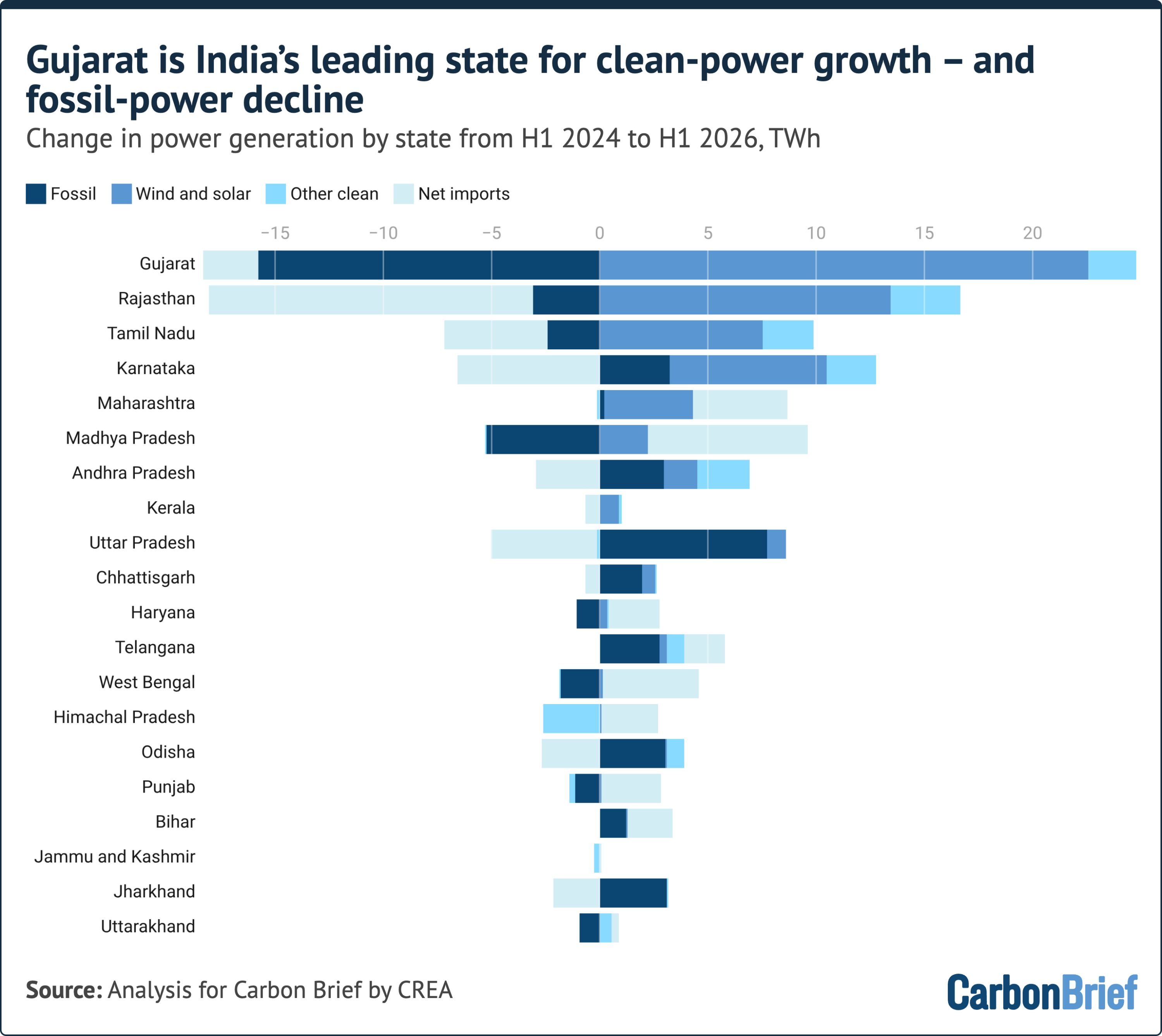
The nation’s power sector transition was highly concentrated, with a handful of industrial states driving the nation away from fossil fuel power generation.
              State-Level Contributions to India's Energy Transition (H1 2024–H1 2026)
              ========================================================================

  [GUJARAT]       --> Leader in clean power additions (Solar/Wind) AND largest drop in fossil generation.
  [RAJASTHAN]     --> Major solar capacity additions; absolute reduction in fossil power generation.
  [TAMIL NADU]    --> Wind/solar expansion absorbed local demand; reduced reliance on coal power.
  [MP / WB / PB]  --> Reduced local fossil output via net power imports rather than local renewables.
  [MH / TS]       --> High demand growth states; renewable additions successfully matched demand rise.
Top Performers
- Gujarat: Emerged as India’s top-performing state, recording both the largest absolute increase in clean power generation (solar and wind) and the single largest reduction in fossil-fuel power output nationwide.
- Rajasthan and Tamil Nadu: Followed closely, utilizing substantial utility-scale solar and wind installations to meet growing load requirements while cutting back thermal power generation.
Structural Exporters and Importers
- Madhya Pradesh, West Bengal, and Punjab: Reduced local fossil fuel power generation primarily by increasing net electricity imports from the interstate transmission network, rather than deploying localized clean power.
- Karnataka and Andhra Pradesh: Successfully expanded clean energy output faster than local demand growth. However, because both states exported large volumes of green power to neighboring states, their internal fossil-fuel power generation experienced temporary upticks.
- Maharashtra and Telangana: Registered the country’s highest demand growth rates but managed to offset the demand spike almost entirely through new clean energy additions.
Grid Constraints, Energy Storage, and Policy Bottlenecks
While renewable power capacity is expanding quickly enough to match national demand growth, integration challenges threaten to cap future progress unless power grid infrastructure is modernized.
                     Grid Challenges vs. Storage Solutions
                     =====================================

        CRITICAL BOTTLENECKS                     INFRASTRUCTURE ROADMAP
        --------------------                     ----------------------
  - 5.3 GW renewables delayed/penalized     - Storage Target 2026-27: 82 GWh
  - Increasing interstate transmission      - Storage Target 2031-32: 411 GWh
    curtailment                             - Tenders Issued (May 2026): 272 GWh
  - 1+ year delay in coal plant flexibility   (142 GWh Pumped Hydro / 133 GWh Battery)
    implementation                          - Mandatory 2-hr Battery Storage for
                                              new renewable tenders post-June 2027
Transmission Curtailment and Project Delays
Renewable energy curtailment—where clean electricity is wasted due to transmission congestion—has intensified, particularly along interstate high-voltage corridors. In H1 2026, renewable projects totaling 5.3 GW missed operational deadlines, forcing developers to pay financial penalties to the central grid operator to retain network connectivity.
Ramping Flexibility Delays
A national policy framework intended to force coal-fired power plants to operate flexibly—ramping down output during peak solar generation hours—has been delayed by over a year due to regulatory disputes and tariff-structure bottlenecks. This delay has exacerbated solar curtailment during midday peak output hours.
Energy Storage Mobilization
To resolve these grid constraints, the government is dramatically scaling up energy storage requirements:
- The National Electricity Plan targets 82 Gigawatt-hours (GWh) of total energy storage capacity by 2026–27, expanding to 411 GWh by 2031–32.
- As of May 2026, project tenders totaling 272 GWh have been issued, comprising 142 GWh of pumped hydro storage and 133 GWh of Battery Energy Storage Systems (BESS). Installed capacity currently stands at 7.5 GWh of batteries and 60 GWh of pumped hydro.
- The Central Electricity Authority (CEA) has proposed that, starting after June 2027, all new government-backed solar and wind tenders must include mandatory two-hour battery storage systems.
The Fossil Fuel Paradox: Dual-Track Investments
Despite the structural success of clean energy in holding power sector emissions flat, India continues to deploy significant capital into long-term fossil fuel infrastructure, creating a structural paradox in national energy policy.
                    India's Parallel Energy Strategy
                    ================================

       CLEAN ENERGY TRACK                      FOSSIL FUEL INFRASTRUCTURE
       ------------------                      --------------------------
  - 70 TWh clean generation added         - 43 GW coal power under construction
  - 272 GWh energy storage tenders        - 100 Mt/yr coal gasification target
  - 20% ethanol blending achieved         - Coking coal listed as "critical mineral"
- Mandatory battery storage mandates - Expansion of domestic coal mining- Coal Power Pipeline: Approximately 43 GW of new coal-fired power capacity was under active construction at the end of June 2026. Grid planners maintain that new thermal capacity remains necessary to cover late-evening peak loads until long-duration storage is fully deployed.
- Coal Gasification and Syngas: In pursuit of industrial import substitution, the government is pushing to develop 100 million tonnes per year of coal gasification capacity over the next four years to produce chemicals, fertilizers, and plastics. While Jindal Steel Limited is currently utilizing coal gasification syngas in steelmaking, the technology remains largely unproven at commercial scale in India.
- Domestic Coking Coal Push: Designated as a "critical and strategic mineral" in January 2026, domestic coking coal is receiving substantial state support. Steel producers and mining firms are constructing dedicated coal washeries to process domestic coal for blending with imported coking coal, aiming to insulate steelmakers from global price shocks.
- Coal Imports Shift: The clean energy surge allowed India to cut power-sector imports of coal by 38% and imported natural gas for power by 35% over the two-year period, demonstrating that domestic renewables are actively replacing foreign fossil fuels.
Strategic Outlook and Industrial Electrification Imperative
India’s energy transition stands at a critical juncture. The first half of 2026 provided definitive proof that clean energy expansion can curb fossil power growth and bolster national energy security during external geopolitical shocks. By capping power-sector emissions for two years despite robust economic growth, India has demonstrated a viable path toward peaking power sector emissions.
However, achieving national emission peaking and long-term net-zero goals will require expanding decarbonization efforts beyond the power grid.
                        Key Priorities for India's Next Decarbonization Phase
                        ====================================================

  [GRID MODERNIZATION]     --> Rapidly deploy 272+ GWh storage tenders & resolve transmission bottlenecks.
  [PLANT FLEXIBILITY]      --> Enforce coal ramping regulations to prevent solar curtailment.
  [INDUSTRIAL POWERING]    --> Raise industrial electrification from 17% toward global averages.
  [CLEAN STEEL & CEMENT]   --> Transition heavy manufacturing from direct coal use to green power/hydrogen.
To maintain its decarbonization momentum, India must address three primary strategic challenges:
- Accelerate Industrial Electrification: Without a concerted policy drive to replace direct coal combustion with clean electricity in heavy industry—such as deploying industrial heat pumps, electric arc furnaces, and green hydrogen—industrial emissions will continue to offset power sector gains.
- Modernize Grid Architecture: Rapidly scaling battery storage, completing delayed interstate transmission lines, and enforcing operational flexibility across the existing coal fleet are urgent priorities to prevent systemic renewable curtailment.
- Avoid Infrastructure Lock-In: Continued capital investments in coal gasification, new coal mines, and greenfield thermal power plants risk locking in carbon-intensive assets for decades, potentially complicating India’s long-term climate commitments and transition finance goals.
About the Underlying Data
The analysis featured in this report was produced for Carbon Brief by researchers at the Centre for Research on Energy and Clean Air (CREA). Power sector emissions were calculated by combining station-level coal consumption from the Central Electricity Authority (CEA) with specific calorific values and baseline database factors. Industrial fuel consumption and process emissions were derived from the Ministry of Commerce and Industry’s Index of Eight Core Industries, Coal Ministry monthly dispatch data, data compiled by Robbie Andrew (CICERO), and petroleum product figures from the Petroleum Planning and Analysis Cell (PPAC).



