By Ruth Kamnitzer
Published by Mongabay Conservation News
DOI: https://doi.org/10.66709/news-327848
Executive Overview
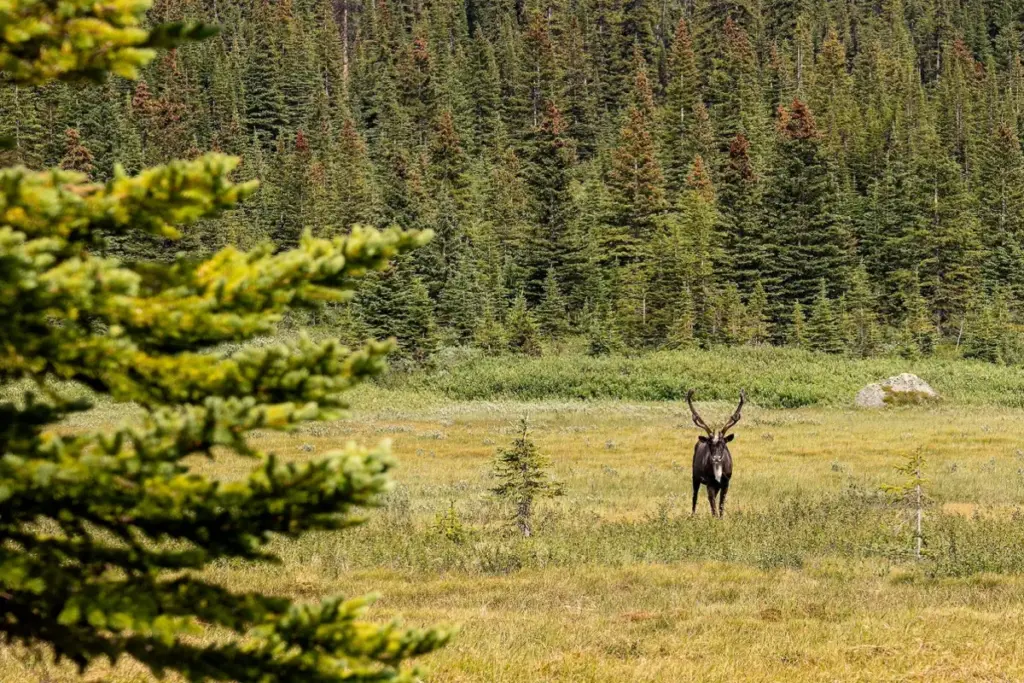
Western Canada’s ancient, snow-laden mountain forests are facing an ecological crisis of historic proportions. Deep within the inland temperate rainforests of British Columbia and Alberta, the southern mountain caribou—a distinct ecotype of the woodland caribou (Rangifer tarandus caribou)—are sliding rapidly toward the precipice of regional extinction.
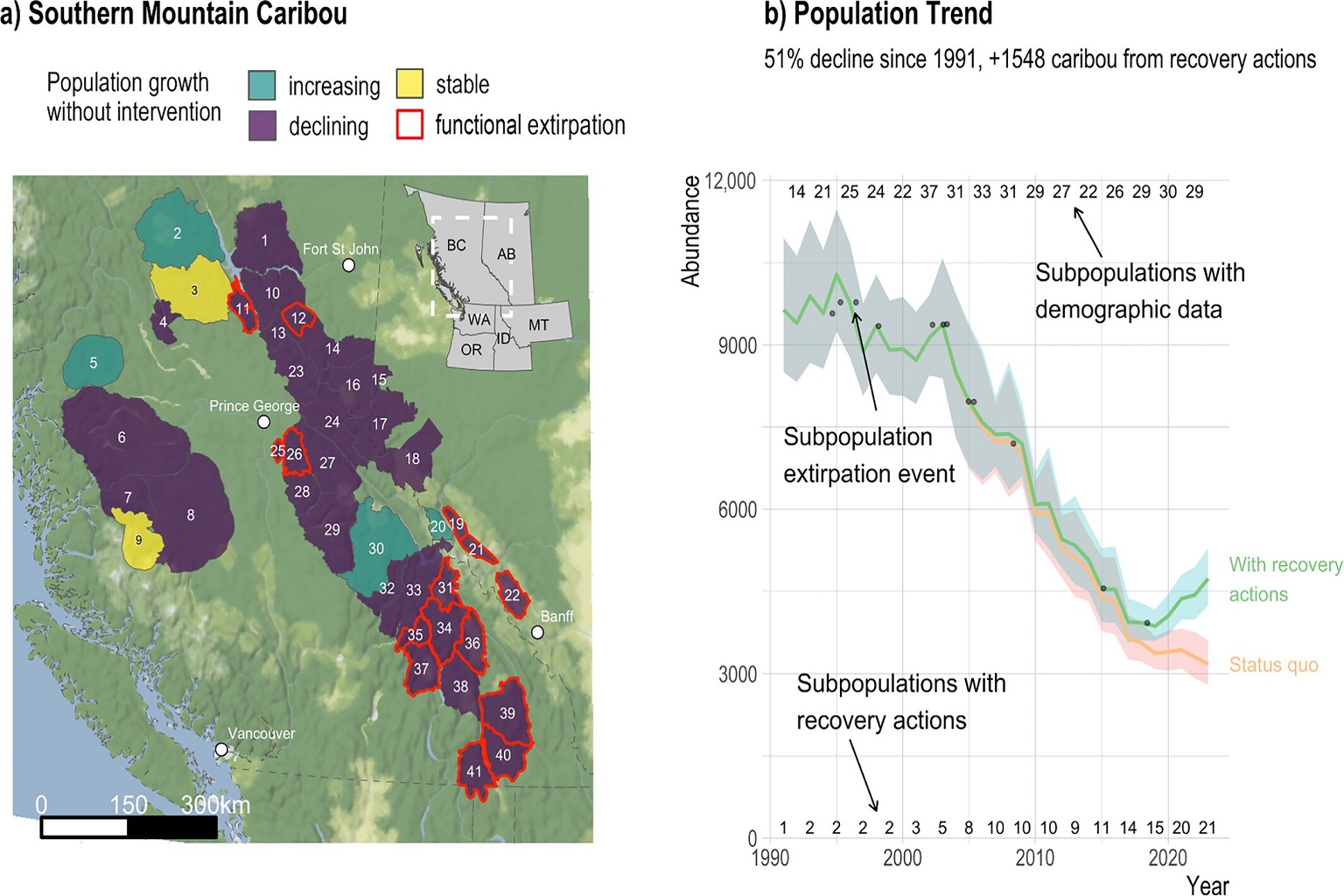
Driven by decades of relentless commercial logging, habitat fragmentation, and an engineered surge in predator-prey dynamics, these iconic "deep snow caribou" are disappearing faster than recovery policies can save them. Over the past 20 years, 15 out of 40 historical herds across B.C. and Alberta have vanished entirely or dropped below viable thresholds. Total population numbers have plummeted from nearly 10,000 individuals in 1991 to roughly 4,700 today. The last transboundary herd to roam into the United States was declared extirpated in 2019, and local extinctions continue to mount.

Amid mounting institutional gridlock and unfulfilled provincial commitments, Indigenous leadership has stepped into the breach. In a historic and urgent joint effort, the Syilx Okanagan Nation and the Xatśūll First Nation have petitioned the federal government to issue an emergency protection order under Section 80 of Canada’s Species at Risk Act (SARA).
This rare legislative tool, invoked only twice in Canada’s history, would bypass provincial jurisdiction to place immediate restrictions on industrial activities, forestry, and road-building within critical caribou ranges. Yet, as conservationists, independent ecologists, and government officials spar over the efficacy of short-term predator culls versus long-term habitat preservation, the core question remains: Will Canada act decisively before the remaining herds are lost to history?
Detailed Chronology: A Cascading Collapse
The decline of the southern mountain caribou is not a sudden catastrophe, but a slow, continuous attrition spanning more than half a century. Understanding this trajectory requires tracing the intersection of industrial forestry, policy failures, and legal interventions:

- 1991: Southern mountain caribou populations across British Columbia and Alberta peak at nearly 10,000 individuals, inhabiting a largely intact matrix of mid-to-high-elevation mature and old-growth forests.
- 2003: Canada’s Species at Risk Act (SARA) officially comes into force, establishing a legal framework for protecting endangered and threatened species, including provisions for emergency federal intervention (Section 80).
- 2011: Following previous emergency petitions, the federal government and the province of B.C. sign a Section 11 conservation agreement under SARA, committing the province to reversing caribou population declines through coordinated management strategies.
- 2014: Ottawa publishes an official southern mountain caribou recovery strategy, which includes partial mapping of critical habitats. Simultaneously, the B.C. government initiates intensive predator control programs (primarily aerial wolf culls) to arrest population free-falls.
- 2014–2019: Despite the federal recovery strategy, industrial logging carves through 909 square kilometers (351 square miles) of mapped critical caribou habitat over a five-year window.
- 2019: The South Selkirk herd—the final transboundary caribou subpopulation ranging into the United States—is officially extirpated.
- 2020: B.C. releases its landmark Old Growth Strategic Review, recommending a "paradigm shift" in forestry that prioritizes ecological health alongside timber extraction. An Old Growth Technical Advisory Panel (TAP) is formed to identify high-risk old-growth zones for logging deferrals, including critical caribou ranges.
- 2023: The Columbia South herd is officially extirpated from Syilx-Okanagan territory. Total regional caribou numbers languish just above 4,700.
- June–July 2026: Outraged by ongoing habitat destruction and stalled provincial action, the Syilx Okanagan Nation (in June) and the Xatśūll First Nation (in July) formally petition the federal government for emergency Section 80 orders. Concurrently, new scientific research reveals that logging rates within critical caribou habitats have remained completely unchanged over the preceding decade.
Supporting Context & Metrics: The Science of Habitat and Predation
To comprehend why southern mountain caribou are uniquely vulnerable, one must look to their specialized ecology. Unlike their northern counterparts that paw through shallow snow for ground lichen, deep snow caribou navigate deep winter snowpacks in wet interior forests, utilizing their broad hooves to walk atop the snow and pluck arboreal lichens draping from ancient western red cedars and hemlocks. These trees can measure up to 4 meters in diameter and stand between 1,600 and 1,800 years old.
Historically, these mature, high-elevation ecosystems supported few other ungulates, keeping natural predator densities low. However, over the last 50 years, clear-cut logging has converted old-growth forests into younger, dense seral forests choked with shrubs and grasses.
This landscape transformation has triggered a devastating ecological chain reaction:
- The Ungulate Shift: Abundant early-seral vegetation draws high densities of moose and deer into regions previously dominated by caribou.
- The Predator Influx: The rise in moose and deer populations invites higher numbers of wolves and cougars. Furthermore, an intricate network of industrial logging roads and seismic lines acts as a highway for these predators, carrying them deep into historic caribou strongholds.
- Bycatch Mortality: Caribou are ill-equipped to evade this influx of predators, frequently falling victim as incidental prey.
Quantitative Metrics of Decline
- 15 of 40: The number of southern mountain caribou herds in B.C. and Alberta that have disappeared or become functionally non-viable over the last two decades.
- 50% Reduction: Overall population numbers have dropped from nearly 10,000 individuals in 1991 to roughly 4,700 in 2023.
- 954 Square Kilometers: The area of critical southern mountain caribou habitat logged after 2020, demonstrating that the rate of industrial clear-cutting has failed to slow down despite heightened conservation warnings.
- 351 Wolves and 6 Cougars: The toll of the B.C. government’s 2024–2025 predator reduction program, executed across 13 caribou ranges at a cost exceeding $1.5 million CAD ($1.04 million USD).
Official Statements and Indigenous Leadership
For Indigenous Nations whose legal traditions and governance systems are deeply intertwined with the land, the extinction crisis is an urgent moral and cultural emergency.
"Under our Syilx Okanagan law, everything is sacred to us. We believe that Mother Earth is alive, all of k̓ʷul̓əncutm, the creator’s creation, that it’s all alive," Chief Dan Wilson of the Okanagan Indian Band explained in an interview with Mongabay. "That’s why the caribou are so important to us… they reflect on the job we’re doing for preserving k̓ʷul̓əncutm as a creation for the next generation."
Chief Wilson criticized the provincial government’s historical response to the crisis as "piecemeal" and "ad-hoc," emphasizing that logging continues to chip away at the deep snow caribou’s last refuges. "We’re trying to fulfill our responsibility—[by] protecting the last remaining herds of the deep snow caribou," he stated.

Within Syilx-Okanagan territory, three imperiled herds remain:
- Columbia North: The most robust subpopulation, numbering approximately 185 individuals.
- Central Selkirk: A fragile herd hovering at just 27 individuals.
- Frisby-Boulder: Down to a perilous eight individuals, placing it well below the threshold of long-term viability.
Echoing these demands, Chief Rhonda Phillips of the Xatśūll First Nation released a resolute statement following their July emergency petition: "Xatśūll will not stand idly by while selcwéycen [caribou] and their habitat continue to face serious threats."
In response to the petitions and mounting public scrutiny, a spokesperson for the B.C. Ministry of Water, Land and Resource Stewardship defended the province’s record, characterizing caribou recovery as a "long term complex effort" and asserting that B.C. is taking a "comprehensive, coordinated approach."

"All three herds referred to in the Syilx filing currently benefit from caribou-specific habitat protections and additional habitat designations protecting significant portions of core habitat," the ministry stated via email, adding that continued efforts are underway to scale up protections where necessary.
However, independent conservation scientists reject the narrative that current measures are sufficient. Eddie Petryshen, a conservation specialist with the B.C.-based NGO Wildsight, described ongoing clear-cutting in the inland temperate rainforest as heartbreaking. "You’re seeing these ecosystems that have been there for a very long time, go in a month or two… leaving on the back of logging trucks," Petryshen noted. A 2025 spatial analysis by Wildsight revealed that 76% of the critical habitat belonging to the vital Columbia North herd remains at risk of commercial timber harvesting.
Future Outlook: The Hard Choices Ahead
As the federal government weighs the unprecedented petitions from the Syilx Okanagan and Xatśūll Nations, caribou biologists and ecologists emphasize that avoiding total extinction requires confronting harsh, uncomfortable trade-offs.

According to Rob Serrouya, co-director of the Wildlife Science Centre, caribou recovery hinges on a two-pronged, yet highly contentious, strategy: immediate, intensive management of the predator-prey system to stop the bleeding, coupled with long-term, landscape-scale habitat protection.
"It’s hard to sugarcoat the reality," Serrouya said. While peer-reviewed studies (such as Lamb et al., 2024) confirm that active predator control—such as aerial wolf culls and maternal penning programs like the successful Klinse-Za initiative—can buy populations crucial time, they are not permanent solutions.
"It’s now mostly an ethical question," Serrouya observed. "How long does society and managers want to intensively manage the predator-prey system versus protecting habitat? That’s the trade off."

Independent caribou biologist Douglas Heard echoed this sentiment, noting that while high-elevation caribou recovery is "entirely doable," earnest political action has been sorely lacking. "We’re not changing the logging practices that will let the forest go to a more natural age distribution," Heard warned.
Without a drastic reduction in industrial logging across critical ranges, experts agree that management agencies will be trapped in an endless, punishing loop of predator control. Every fresh clear-cut locks in decades of artificial predator management, as young forests continue to draw moose, deer, and wolves back into caribou territory.
For the Syilx Okanagan Nation, Xatśūll First Nation, and a coalition of scientists and conservationists, the petition for a Section 80 emergency order represents a last line of defense. Whether Ottawa will exercise its constitutional authority to overrule provincial forestry interests and mandate sweeping habitat protections remains to be seen. But for the deep snow caribou of Western Canada, time is rapidly running out in the shadow of the chainsaw.