
Executive Overview
Across the rolling hills of Indiana, the sun-baked expanses of Texas, and the suburban fringe of Michigan, a profound political realignment is quietly taking shape. For over a decade, community organizers like Bryce Gustafson of the Citizens Action Coalition (CAC) have knocked on doors, encountering the predictable, entrenched divisions of contemporary American life. Whatever policy issue was raised, citizens invariably retreated into their ideological camps.
Yet, during a recent rural festival in Monrovia, Indiana—a town of just 1,600 residents facing a massive, 550-acre Google data center project—Gustafson experienced something entirely unprecedented.
"I had 50 people I talked to," Gustafson recalls. "Nobody wanted that data center in their community. And at least a half a dozen people came up to me to say, ‘Hey, I voted for Trump. What the heck’s he doing, supporting these things?’"
This spirit of unity is no isolated anomaly. Over the past year, intensifying waves of local resistance against Big Tech’s relentless data center buildout have surged into a nationwide tsunami. What began as a collection of localized NIMBYist (Not In My Backyard) disputes has transformed into a sweeping populist movement. Today, approximately three-quarters of Americans oppose local data center development—representing a staggering 30-point swing in public opinion in just twelve months. More than 500 counties and municipalities have enacted outright bans or temporary moratoria on hyperscale facilities, while dozens of multi-billion-dollar projects have been permanently shelved.

More importantly, this mobilization is fundamentally scrambling traditional political loyalties. By pitting ordinary working-class communities against an allied network of tech oligarchs and bipartisan political establishments, the data center debate offers a rare laboratory for what political scientists term "transformative repolarization." Rather than dividing the public along traditional left-right cultural axes, the fight against water-guzzling, air-polluting, power-hungry server farms is forging a powerful cross-ideological solidarity.
Detailed Chronology: From Whispered Deals to National Outrage
The rapid escalation of the data center backlash represents one of the fastest-moving localized political awakenings in modern American history.
Phase One: The Era of Secretive Approvals (2022–2024)
During the initial generative AI boom, tech giants including Google, Microsoft, Amazon, and Oracle quietly fanned out across rural and suburban America. Seeking cheap land, accessible water sources for cooling, and proximity to high-voltage transmission lines, these companies targeted communities with limited zoning resources. Utilizing heavy-handed tactics, corporate representatives routinely required local municipal officials to sign strict nondisclosure agreements (NDAs). Communities woke up to find that multi-hundred-acre industrial complexes—often consuming as much electricity as a mid-sized city—were being fast-tracked through local zoning boards with minimal public notice.
Phase Two: Local Defiance and Municipal Pushback (2025)
As construction commenced, the immediate, debilitating impacts became impossible to ignore. Residents began experiencing deafening industrial noise pollution, dramatic spikes in local electricity rates, and alarming strains on municipal water tables. Furthermore, heavy-handed utility maneuvers—including the threat of eminent domain to seize private land for transmission lines—sparked furious localized resistance. Town council meetings that historically drew a dozen attendees suddenly overflowed with hundreds of angry citizens. By late 2025, grassroots organizations were successfully unseating municipal incumbents who had signed off on tech deals, signaling that local politicians ignored the issue at their peril.

Phase Three: The National Political Shockwave (2026)
By early 2026, the movement had broken containment, spilling into state legislatures and high-profile federal election cycles.
- April 2026: Maine Governor Janet Mills vetoed a state-legislated data center moratorium, drawing fierce blowback from constituents and cementing the issue as a central fault line in New England politics.
- June 2026: Utah Senate President J. Stuart Adams was voted out of office, largely due to public outrage over his vocal support for hyperscale infrastructure proposals. Concurrently, citizens in Westfield, Massachusetts, celebrated as their city council passed a temporary construction ban.
- July 2026: Protesters converged on Saline Township, Michigan, outside "The Barn"—a massive data center development backed by Related Digital for Oracle and OpenAI. In Texas, Agriculture Commissioner Sid Miller joined hundreds of residents on the steps of the state capitol to demand legislative intervention against unchecked expansion.
- August 2026: Public opinion data confirmed a collapse in support, with pollsters noting that opposition had solidified across 500+ local jurisdictions. High-profile political figures scrambled to adjust: Michigan GOP Senate candidate Mike Rogers flipped his position to support a one-year moratorium following investigative reports detailing his personal AI investments, while Texas Governor Greg Abbott remarked that data centers had "dug their own grave."
Supporting Context & Metrics: Why Data Centers Sparked a Revolt
To understand why data centers have achieved what few other issues can—uniting MAGA Republicans, progressive Democrats, and independents—one must examine the unique catalog of grievances associated with these facilities.
Environmental and Infrastructural Degradation
Hyperscale data centers are industrial monoliths that defy normal zoning expectations. Their primary impacts include:
- Water Consumption: Cooling massive server arrays requires millions of gallons of water daily, severely threatening local aquifers and municipal water supplies in drought-prone regions.
- Energy Strains and Rate Spikes: These facilities demand staggering amounts of electricity. To meet their immediate needs, tech companies have increasingly turned to dirty fossil-fuel generators—including restarting aging gas turbines—which spew massive quantities of greenhouse gases and degrade local air quality. Consequently, everyday utility customers are seeing their monthly power bills skyrocket to subsidize corporate compute capacity.
- Opaque Legal Maneuvers: The widespread deployment of NDAs, coupled with the routine abuse of eminent domain by utility companies to seize private property for power lines, has fostered deep distrust in local governance.
The Value Proposition Deficit
Unlike traditional manufacturing plants or logistics hubs that promise long-term local employment, data centers offer virtually no enduring community benefits. Once construction concludes, these silent fortresses employ only a handful of technicians.

To the average citizen, the trade-off is glaring: communities shoulder permanent environmental degradation, inflated utility bills, and strained infrastructure, all to generate compute power for an artificial intelligence industry that many fear will soon automate human jobs. In the interim, AI is primarily experienced as a force that clogs the internet with noise, heightens corporate surveillance, and enriches an already despised class of tech billionaires.
"Data centers are the physical manifestation of the greed and the hubris and the power of the AI oligarchs," notes Bryce Gustafson. "That gets people thinking about why we are allowing these tech billionaires to just run roughshod over our state."
Official Statements and Political Realignment
The political fallout from the data center backlash has forced a dramatic recalculation among party leaders, even as institutional resistance remains entrenched at the highest levels.
The Populist Realignment
Political scientists Jennifer McCoy and Murat Somer define "transformative repolarization" as a process by which societies escape toxic, culture-war-driven polarization by shifting the primary axis of conflict toward a unifying struggle against structural threats. This dynamic is vividly illustrated on the ground.
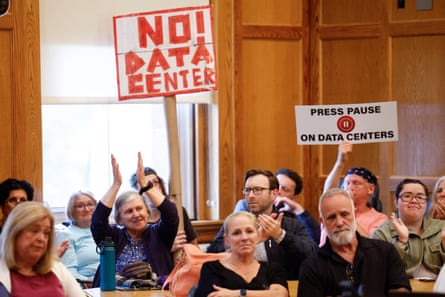
"On datacenters, we don’t have those firm camps formed," explains Ben Inskeep, program director at the Citizens Action Coalition. "So we’re seeing broad concern from Republicans, Democrats and everyone else… Folks are saying, ‘Hey, I might be a MAGA Republican and you might be a liberal yahoo from the big city, but if you’re coming to our community to help us fight this datacenter, you’re my best friend.’"
William Lawrence, a Sunrise Movement co-founder and congressional candidate who centered his successful primary campaign in Michigan on data center opposition, emphasizes the rarity of this cross-partisan harmony:
"At a time when people are so polarized and isolated from each other, something that brings people together is rare. We can all get together to watch the Spartans play… but to get together in a context where you’re also talking about politics? That is a gift, and is not at all to be taken for granted."
Bipartisan Complicity vs. Electoral Vulnerability
Despite clear voter mandates, national party leadership has been slow to adapt. On the right, President Donald Trump has pursued an aggressive pro-infrastructure agenda, opening federal lands to hyperscalers, stripping away public participation processes in permitting, and attempting to waive Clean Air and Clean Water Act requirements under the guise of national security. Concurrently, far-right figures like Steve Bannon have sought to channel populist anger into xenophobic or nationalist narratives, blaming foreign nations rather than corporate monopolies.

On the left, establishment figures remain heavily tied to Silicon Valley donors. Democratic leaders—including House Minority Leader Hakeem Jeffries, who opposes federal moratoria, and governors like Michigan’s Gretchen Whitmer and Maine’s Janet Mills—have frequently faced severe criticism for dismissing constituent concerns and pushing pro-tech policies.
However, voters are increasingly willing to punish compromised politicians regardless of party. When asked by reporters whether she would abandon conservative priorities and let the Senate fall to Democrats if it meant stopping data centers, a resident of heavily Republican Hood County, Texas, offered an immediate reply:
"Yep. My entire community’s going to break rank."
Future Outlook: A Singular Opportunity
As the United States barrels toward future legislative and presidential contests, the data center question hangs like a sword of Damocles over both major political parties.

The trajectory of this movement will depend entirely on political education and leadership. If progressive and populist organizers successfully channel anti-corporate fury into structural reform—holding tech oligarchs and monopolistic utilities accountable—they can achieve a lasting, cross-partisan realignment that revitalizes American democracy. Conversely, if mainstream parties continue to protect corporate interests, they risk leaving an open vacuum for bad-faith actors to exploit economic anxiety through divisive, xenophobic channels.
The lesson from Monrovia, Indiana, to Saline Township, Michigan, is clear: the billionaire class has profoundly overreached. For the first time in generations, Americans across the ideological spectrum share a common antagonist and a unified goal.
As Bryce Gustafson and organizers nationwide continue to build solidarity across county and state lines, the path forward is unmistakable. Whether the political establishment chooses to listen to the people—or suffer the electoral consequences—will define the landscape of American politics for decades to come.