PEMBA, Tanzania — Across the azure shallows of East Africa’s coastline, a quiet crisis unfolds with every low tide. For generations, the families of Shamiani—a picturesque fishing village on Pemba Island, part of Tanzania’s semi-autonomous archipelago of Zanzibar—relied on the sea’s bounty to feed their households and sustain their local economy. Today, however, fishers and gleaners watch their yields dwindle. Warming waters, degraded marine habitats, and decades of relentless fishing pressure have strained nearshore resources to their limits.
Once abundant sea cucumbers, which carpeted the shallow waters and supported vibrant local trade, have become remarkably scarce. Today, fishers must work longer hours for sharply diminishing returns.
Yet, amid this ecological and economic squeeze, Shamiani is charting an ambitious path forward. Brightly colored ropes now cordoff protected sections of shallow seagrass meadows—the visible markers of a high-stakes marine experiment. Born out of months of rigorous community negotiations, this initiative pairs local ecological restoration with commercial aquaculture. Spearheaded by the Tanzania-based enterprise Asili, the project seeks to prove that conservation can generate tangible wealth, transforming coastal residents from passive watchers of ecosystem collapse into active business partners.
Executive Overview
The sea cucumber ranching project in Shamiani represents a novel intersection of marine conservation, equitable enterprise, and rural development. Designed to combat overfishing while boosting local livelihoods, the initiative relies on a cooperative framework.
- The Core Concept: Protected "no-take" or low-take zones are established over shallow seagrass meadows. Within these enclosed zones, high-value sea cucumbers are ranched using juveniles produced in specialized hatcheries.
- The Economic Incentive: Sea cucumbers are among the most lucrative marine commodities globally, fetching premium prices in East and Southeast Asian markets. Freshly harvested specimens can command $70 to $80 per kilogram at the beach.
- The Equity Model: Moving away from traditional, top-down conservation models that exclude local populations, Asili has structured its enterprise around a 50-50 profit-sharing split. Half of future returns remain with the company to sustain operations, while the other half flows directly to the community—split evenly between labor wages and a communal development fund.
- The Stakes: While local residents and project founders express cautious optimism, the model carries inherent risks, ranging from market volatility and commercial timelines to the perennial threat of elite capture and shifting community consensus.
Detailed Chronology: From Crisis to Cooperation
The journey toward establishing Shamiani’s marine sanctuary was neither swift nor simple. It required a deliberate departure from the historic alienation often experienced by coastal communities when outside conservation groups step in.

Recognizing the Nearshore Collapse
For decades, the decline of East Africa’s coastal fisheries has been well-documented. Rapid population growth, destructive fishing methods, and the impacts of global climate change have devastated critical habitats like coral reefs and seagrass beds. On Pemba Island, this manifested in an acute scarcity of high-value marine invertebrates. Sea cucumbers—crucial benthic organisms—were heavily targeted for export markets, leading to local functional extinctions.
Engaging the Community (2022–Present)
When Asili co-founders Tim Kluckow and Alexandra Garcin began working with Pemba communities in 2022, they recognized that imposing restrictions without local buy-in would doom the project to failure.
"This didn’t happen quickly," Kluckow explained during a recent visit to the island. "This has been a process of many, many, many hours of discussions with the community—discussing what it means when the area will be closed, what the incomes that will be generated in the beginning, what the revenues, how they will be shared."
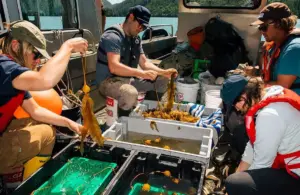
Through endless village assemblies, consensus was gradually reached. Approximately 300 of Shamiani’s roughly 900 adult residents volunteered to participate. Local youth and women stepped up to help clear pathways, build security infrastructure, and construct a floating watchtower designed to safeguard the perimeter against poaching.
Young residents like Sharif Tano Sharif, Ali Juma Ali, Ngana Hamza Juma, and Khamis Juma Ali became central to these efforts. Working alongside company organizers, they have taken ownership of the security patrols and habitat monitoring. "Based on what we are seeing, we think it’s going to bring a lot of benefits and profit," Sharif noted.

Supporting Context & Metrics: The Global Sea Cucumber Economy
To understand why Asili chose sea cucumbers as the vehicle for this marine experiment, one must look at the immense global demand for the species.
A Luxury Commodity and Ecosystem Engineer
In East and Southeast Asia—most notably in China—sea cucumbers hold elite status. Often grouped alongside shark fin, abalone, and bird’s nest as one of the four sacred products of traditional Chinese cuisine, they are prized both as luxury delicacies and for their purported medicinal properties. Furthermore, they are increasingly utilized in the growing global nutraceutical market, processed into powders and pills.
Ecologically, marine scientists refer to sea cucumbers as essential ecosystem engineers. Much like earthworms in terrestrial soil, sea cucumbers recycle nutrients, oxygenate bottom sediments, and maintain the overall health of benthic habitats. Without them, seabeds can stagnate, choking off surrounding marine life.
The Scale of the Trade
Historical data underscores the pressures facing wild populations. Previous Mongabay reporting from Tanzania’s Mafia Island revealed that between 2012 and 2019, Tanzania accounted for nearly 500,000 kilograms (1.1 million pounds) of the more than 3 million kilograms (6.6 million pounds) of dried sea cucumber exported from East Africa to Hong Kong alone.
The U.N. Food and Agriculture Organization (FAO) has repeatedly warned that unchecked wild harvesting threatens global species diversity, making controlled mariculture—farming marine organisms in saltwater environments—an urgent alternative to extinction.

Official Statements and Expert Perspectives
Balancing conservation with commercial enterprise is a delicate balancing act, and industry experts are closely watching the Pemba experiment.
-
Jennifer Howard (Conservation International):
Howard acknowledges that the high market value of sea cucumbers offers coastal communities a rare pathway to significant income generation. However, she sounds a note of caution regarding market dependency:"If it becomes the dominant livelihood, communities are exposed to variations in pricing and various market dynamics."
On the governance structure, Howard emphasizes the value of shared equity:
"When communities co-own decisions, equity, and profit flows, they have a direct stake in keeping ecosystems healthy and the business viable, which typically increases long-term conservation compliance and reduces conflict and project abandonment over time."

-
Tim Kluckow (Asili Co-Founder):
Kluckow stresses that the company’s model was directly shaped by past mistakes observed in other regional aquaculture initiatives, such as those in Madagascar:"What we saw is that after two years of making an income, the water situation wasn’t better; the healthcare situation wasn’t better; the school wasn’t better… We are building a ground-up equity-based model, where we are continually useful to the communities that we partner with."
-
Alexandra Garcin (Asili Co-Founder):
Garcin underscores the philosophy that local residents must remain business partners rather than passive beneficiaries:"People here are not supposed to be beneficiaries of a project. For this to be sustainable, they need to be considered as actors and enablers and business partners."
Future Outlook: Risks, Rewards, and the Road Ahead
As Shamiani’s sea cucumber ranches take shape, the initiative faces a rigorous test of endurance, management, and market viability.

Commercial and Biological Timelines
The enterprise is not yet generating revenue. Sea cucumbers require roughly 12 to 18 months to reach marketable size. The entire operation hinges upon the success of the central hatchery, which produces the juveniles needed to stock the protected meadows. Without a steady supply of juveniles, Garcin admits, "none of this is possible."
Mitigating Social Risks
While the 50-50 profit-sharing split—with half going to direct labor and half to a community development fund—is theoretically sound, practical implementation poses challenges. Kluckow acknowledges that while wage payments are easily tracked, communal funds remain vulnerable to "elite capture" if not managed through transparent, robust local governance frameworks.
Furthermore, the project relies entirely on the preservation of local consent. The founders refuse to lock communities into rigid, top-down legal documents that strip local authorities of their agency. "We’re taking a big bet, absolutely," Kluckow notes.
Empowering Women and Expanding Horizons
A striking feature of the Shamiani project is its deliberate inclusion of women in leadership roles. Women are slated to lead daytime monitoring, control, and surveillance shifts from the new watchtower, alongside ecological assessments of the seagrass meadows. This counters a narrowing local economy where women have historically been relegated to low-value tasks like harvesting small cowrie snails—a trend Kluckow describes as "fishing down the value chain."
Looking forward, Asili hopes to scale the model. If the sea cucumber initiative succeeds, the company aims to expand operations to at least 30 communities across the region, each managing 30 to 60 hectares (74 to 148 acres) of production zones. Over the long term, successful infrastructure could pave the way for farming other high-value marine species, including seahorses, oysters, and seaweed.

For now, all eyes remain on the cordoned-off shallows of Pemba Island. If Asili and the people of Shamiani succeed, they may forge a blueprint for coastal conservation across the globe—proving that when communities own both the stewardship and the spoils of the sea, the ocean can heal, and local economies can thrive once more.