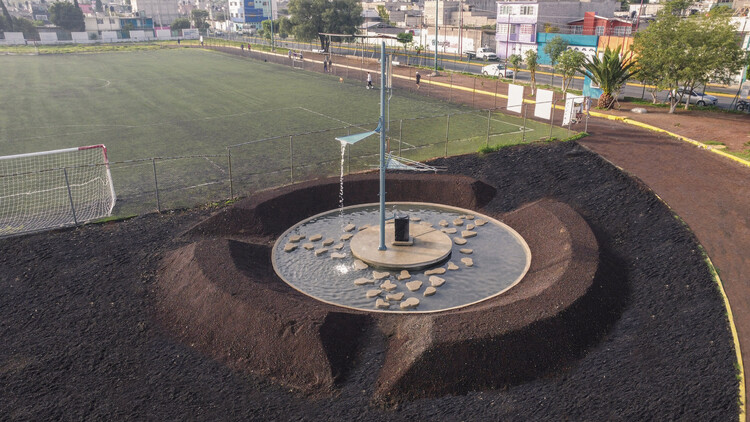
Curated by Valentina Díaz Published September 4, 2026 Photographs by Diego Rivero Borrell
Executive Overview
In the sprawling, densely built urban centers of Mexico, the fundamental relationship between citizen and civic infrastructure has undergone a quiet, profound transformation. Clean drinking water has largely disappeared from municipal public taps, replaced instead by a complex, high-stakes shadow economy of substitution. When residents turn on their faucets, they are often met with dry pipes or erratic flows, forcing a reliance on tanker trucks (pipas), endless lines of single-use plastic bottles, bulky 20-liter garrafones, rooftop storage cisterns, domestic filtration systems, and neighborhood purification shops.
This systemic breakdown of public utility networks has birthed an intricate spatial and economic culture. Responsibility for survival has been aggressively decentralized, shifted away from the state and directly onto individual households—and, disproportionately, onto the bodies of women and caregivers who routinely carry, purchase, clean, monitor, and manage water before a single drop can safely touch human lips.
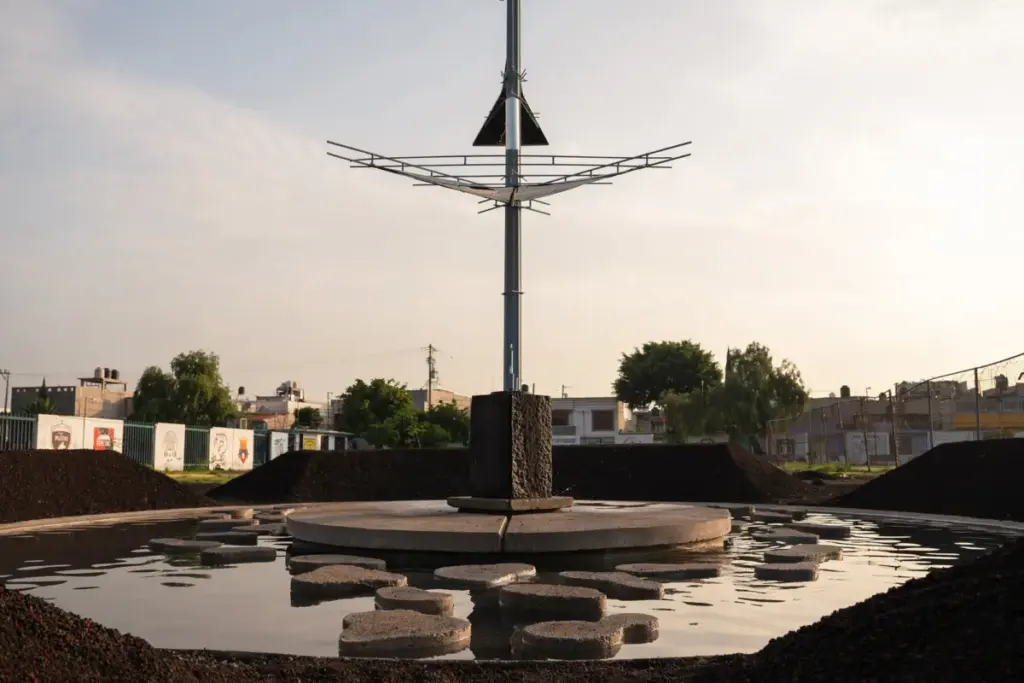
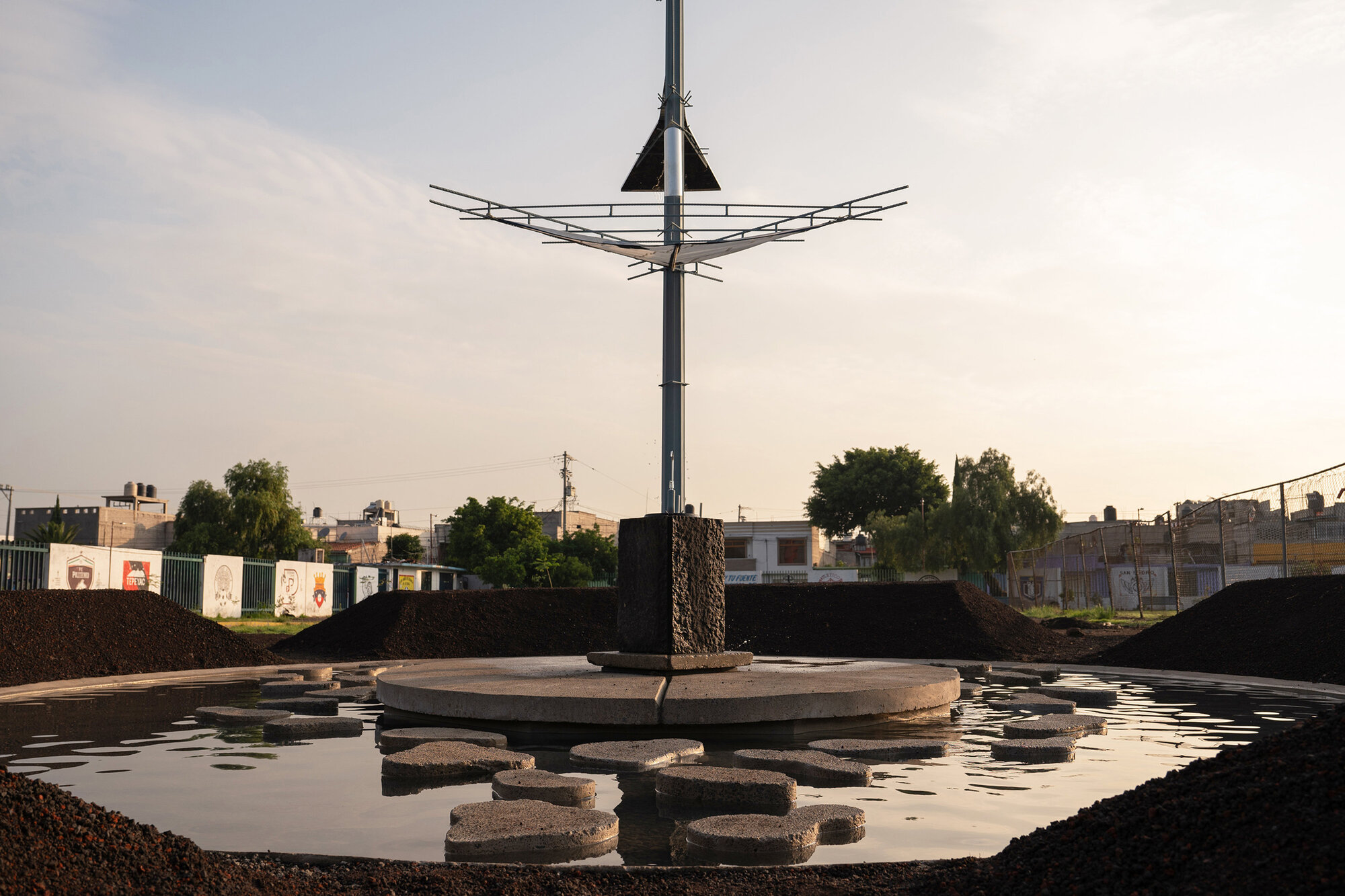
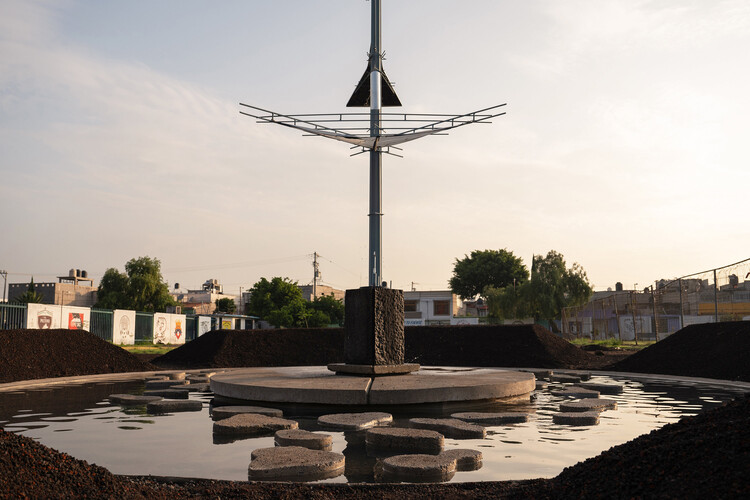
Enter Rain Rhizome (Rizoma de Lluvia), a visionary collaborative project by TANAT and Rizoma del Agua. Captured through the architectural lens of Diego Rivero Borrell, this project does not merely offer a technological fix to an environmental problem; it proposes a radical spatial, cultural, and political rethinking of how water is harvested, distributed, and valued. By treating the architecture of water collection as a living, decentralized network—a rhizome—the project confronts the structural failures of modern Mexican cities and offers a blueprint for grassroots ecological resilience.
Detailed Chronology: The Evolution of a Water-Stressed Metropolis
To understand the urgency and brilliance of Rain Rhizome, one must first trace the historical trajectory that brought Mexican urban centers—most notably Mexico City and its surrounding metropolitan valley—to the brink of hydrological collapse.
Phase 1: From Tenochtitlan’s Lakes to Piped Extraction (Pre-Hispanic to 20th Century)
The Valley of Mexico was originally a basin defined by an interconnected system of five massive lakes. Indigenous civilizations, most notably the Aztecs in Tenochtitlan, engineered sophisticated systems of dikes, canals, and chinampas that lived with the water, managing seasonal floods and droughts through natural equilibrium.
However, centuries of colonial and post-colonial urbanization reversed this relationship. Driven by European models of urban design, successive governments systematically drained the lakes, channeled rivers into underground concrete tubes, and paved over the absorbent volcanic soil. What was once an aquatic ecosystem was transformed into an impermeable concrete desert. As the city expanded exponentially through the 20th century, local aquifers were rapidly depleted, forcing the city to pump water from hundreds of kilometers away and from deeper underground reserves—a process that has caused monumental land subsidence, fracturing historic buildings and rupturing municipal water mains.
Phase 2: The Rise of the Substitution Economy (Late 20th Century to 2020s)
As municipal water infrastructure aged and institutional maintenance faltered, intermittent service became the norm rather than the exception. Neighborhoods across major Mexican cities developed a routine of acute calculation. Households learned to read the unpredictable rhythms of the municipal supply, scrambling to fill rooftop tanks (tinacos) whenever pressure returned, often in the middle of the night.
This structural failure spawned a booming private market. The pipa (water truck) industry became a powerful informal utility provider, while commercial bottled water conglomerates turned Mexico into one of the highest per-capita consumers of bottled water in the world. Water acquisition ceased to be a passive civic right and became an active, exhausting daily labor.
Phase 3: Conceptualizing and Constructing Rain Rhizome (Present Day)
Recognizing that centralized megaprojects are no longer capable of securing urban water futures, the design collaboratives TANAT and Rizoma del Agua embarked on Rain Rhizome. Moving away from top-down engineering, the project treats architecture as an active participant in ecological regeneration.
Rather than relying on a single, vulnerable pipe network, the project applies the biological concept of a "rhizome"—a root-like system characterized by multiple non-hierarchical entry and exit points, where if one path is blocked, the network adapts and reroutes. Completed and documented recently by photographer Diego Rivero Borrell, Rain Rhizome demonstrates how buildings can harvest, treat, and circulate rainwater locally, transforming individual structures into nodes of urban resilience.
Supporting Context & Metrics: The Scale of the Crisis
To fully appreciate the architectural intervention of TANAT and Rizoma del Agua, it is crucial to examine the hard data defining the urban water landscape in Mexico.
The Bottled Water Paradox: Mexico consistently ranks among the top global consumers of bottled water, with citizens spending billions of dollars annually on plastic-packaged hydration. This reliance is driven by a deep, culturally ingrained mistrust of municipal tap water quality.
The Energy Cost of Pipas: In neighborhoods disconnected from the municipal grid, families spend a staggering percentage of their monthly income on private water trucks. Transporting water via diesel-powered trucks not only burdens low-income households financially but also exacerbates urban carbon emissions and traffic congestion.
Aquifer Overexploitation: The Valley of Mexico’s primary aquifer is currently extracted at a rate estimated to be double its natural recharge capacity. This imbalance is the primary driver of regional land sinking, which in turn damages the very underground sewage and water pipes the city relies upon.
The Potential of Rainwater Harvesting: Mexico City receives an average of 700 to 1,000 millimeters of rainfall annually—a massive volume of water that largely goes uncaptured, causing catastrophic urban flooding during the rainy season before rushing out of the valley through concrete drainage tunnels. Rain Rhizome targets this exact inefficiency, turning seasonal floods from a municipal hazard into a localized resource.
Architectural Philosophy and Spatial Mechanics
Rain Rhizome reimagines the architecture of the building envelope. Roofs, gutters, downspouts, and structural columns are no longer treated merely as drainage mechanisms designed to repel water as quickly as possible. Instead, they are transformed into harvesting surfaces and expressive sculptural elements.
1. Decentralization as Resistance
Centralized municipal systems are inherently fragile; a single point of failure can leave millions dry. By contrast, Rain Rhizome champions a decentralized model. Each building equipped with these principles operates as an autonomous cellular unit within a larger urban ecosystem. If municipal supply fails entirely, the building’s internal rhizomatic storage and purification loops maintain local autonomy.
2. Materiality and Visibility
In traditional modern architecture, infrastructure is hidden behind drywall and buried beneath floors. Rain Rhizome subverts this convention by bringing water infrastructure out into the open. Cisterns, filtration columns, piping networks, and overflow channels are articulated with architectural clarity. This visibility serves a pedagogical and cultural purpose: it forces inhabitants and visitors to confront the journey of water, restoring an emotional and conscious connection to a resource that is otherwise taken for granted.
3. Alleviating Gendered Labor
Sociological studies on water scarcity in Latin America consistently highlight that the physical and mental burden of managing domestic water scarcity—fetching, boiling, filtering, and rationing—falls disproportionately on women. By automating and simplifying the collection and purification process at the architectural scale, interventions like Rain Rhizome alleviate invisible domestic labor, redistributing time and energy back to communities.
Official Statements and Design Intentions
While full technical specifications and municipal integration reports continue to evolve, the core ethos articulated by the design collectives centers on redefining the relationship between human habitation and natural cycles.
"In many Mexican cities, drinking water has not simply disappeared from public life; it has been reorganized through a dense economy of substitution," note the architects behind the project. "What appears as a failure of the network has also produced a spatial and economic culture in which responsibility is transferred to households, and often to the bodies that carry, buy, clean, mistrust, and manage water before it can be consumed."
By confronting this reality head-on, TANAT and Rizoma del Agua argue that architecture must step into the regulatory and infrastructural vacuum. Rather than waiting for stalled municipal bureaucracies to overhaul crumbling metropolitan grids, architects possess the spatial tools to decentralize infrastructure today. Rain Rhizome serves as a physical manifesto: water management must cease to be an invisible, extractive utility and become an integrated, visible pillar of urban design.
Future Outlook: Scaling the Rhizome
As climate change accelerates weather volatility—manifesting as prolonged droughts punctuated by intense, flash-flood downpours—projects like Rain Rhizome offer a vital glimpse into the future of urban architecture in the Global South.
The success of Rain Rhizome points toward several key trajectories for future development:
Policy Integration: For decentralized water harvesting to make a true dent in metropolitan water deficits, municipal building codes must evolve. Future zoning laws could mandate rainwater catchment and localized filtration systems for all new commercial and residential developments.
Neighborhood-Scale Networking: Moving beyond single-building applications, future iterations of the "rhizome" concept could connect adjacent properties, allowing excess harvested water to flow passively between buildings, creating hyper-local micro-watersheds within dense urban neighborhoods.
Cultural Shift: Beyond engineering metrics, the ultimate victory of projects like Rain Rhizome lies in cultural transformation. By making water harvesting visible, celebrated, and aesthetically engaging, architecture can help heal the alienation between modern urbanites and the natural hydrological cycles that sustain them.
In an era defined by ecological uncertainty, Rain Rhizome by TANAT and Rizoma del Agua proves that the antidote to systemic collapse is not waiting for a centralized rescue, but planting the seeds of resilience directly into the built environment.