Executive Overview
Early Friday morning, astronomy enthusiasts and early-rising stargazers across the British Isles and Western Europe will be treated to a breathtaking astronomical alignment. A deep partial lunar eclipse will grace the predawn skies, pushing the Earth’s shadow across roughly 93% of the lunar diameter at its peak. This near-total obscuration offers observers a rare visual spectacle that bridges the gap between partial and total lunar eclipses, heightening the drama of the lunar surface.
Brought to prominence by favorable planetary geometry, the event will plunge the lunar disk into shades of deep amber, burnt orange, and crimson. However, capturing this celestial phenomenon will not be without its logistical hurdles. Observers must contend with the challenges of an extremely early hour, potential regional cloud cover, and an exceptionally low-lying Moon hugging the western horizon just as dawn begins to break.
Authored in consultation with leading meteorological experts and astronomical societies, this report details the precise timelines, atmospheric mechanics, viewing advice, and regional outlooks for what promises to be one of the most visually engaging stargazing events of the year.
Detailed Chronology: The Lifecycle of the Eclipse
For those planning to stay up late or set their alarms for the early hours, understanding the exact timeline of the eclipse phases is vital for securing a glimpse before moonset and the rising sun wash out the sky.
The planetary ballet unfolds across several distinct stages, beginning with a subtle shading before transitioning into the dramatic core of the event.
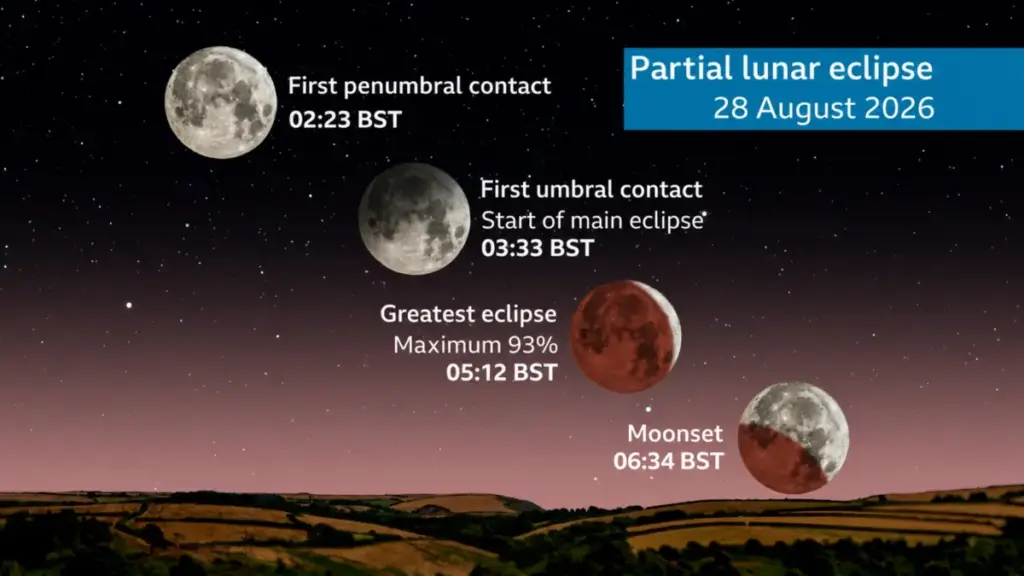
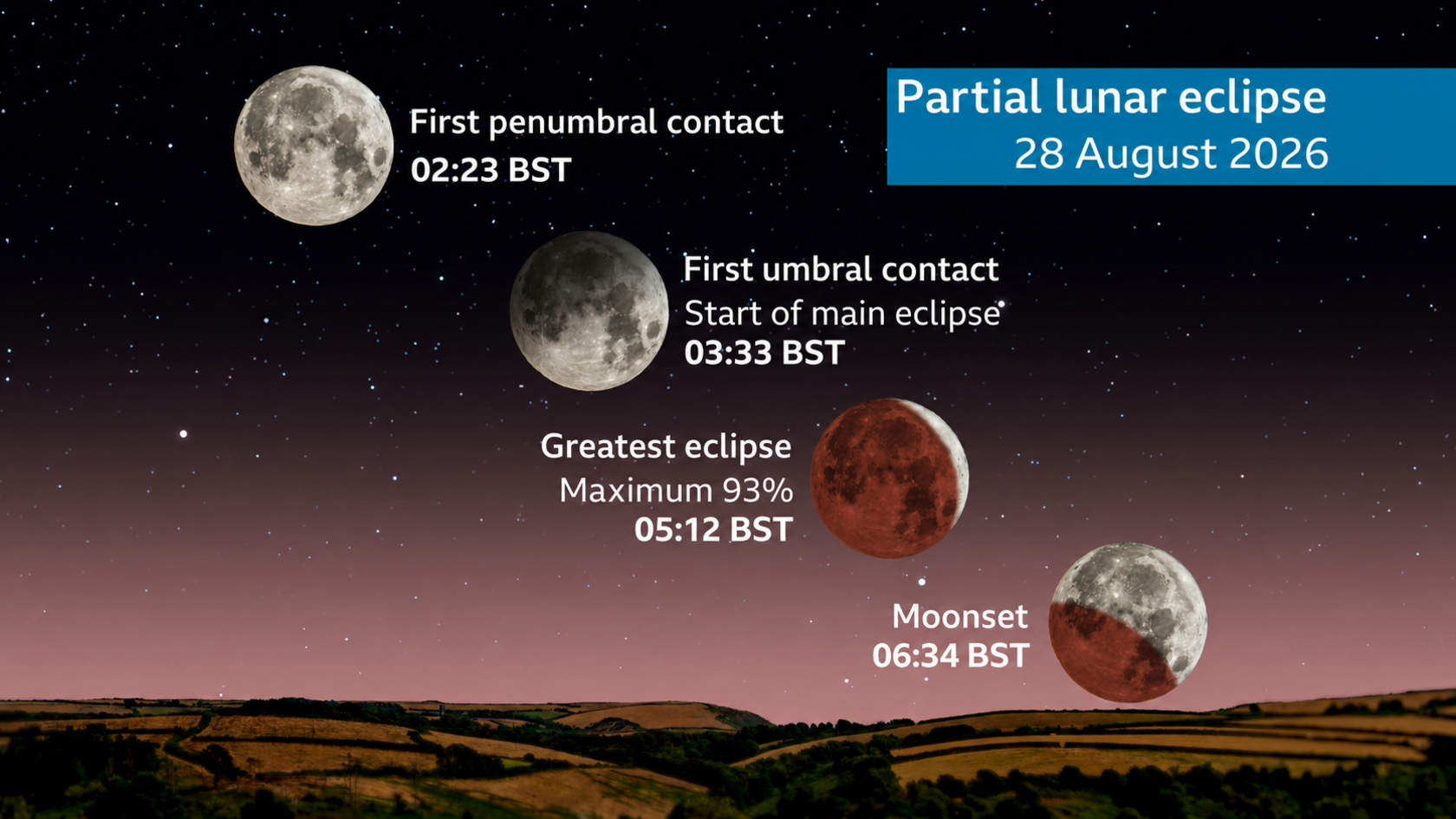
[02:23 BST] Penumbral Contact (Faint outer shadow begins)
    │
    ▼
[03:33 BST] Umbral Phase Begins (Dark central shadow moves across the Moon)
    │
    ▼
[05:12 BST] Maximum Eclipse (93% of the Moon's diameter eclipsed / Peak color)
    │
    ▼
[06:34 - 06:41 BST] Moonset / End of Visibility (Varies by location)
1. Penumbral Contact (02:23 BST)
The event officially commences when the Moon drifts into the penumbra—the lighter, outer fringe of the Earth’s shadow. During this initial phase, casual observers may notice little to no change in the Moon’s appearance, as the reduction of sunlight is subtle and gradual. The lunar surface will retain most of its familiar silvery brilliance, though sensitive cameras and attentive astronomers will note a slight dimming on the eastern edge of the lunar disk.
2. The Umbral Phase Commences (03:33 BST)
The visual drama truly begins an hour and ten minutes later when the Moon crosses into the umbra—the Earth’s dark, central core shadow. At this moment, a distinct, dark "bite" appears to take a chunk out of the lunar disk. As the minutes tick by, this shadow will steadily march across the craters, maria, and highlands of the Moon, consuming more and more of the visible surface in a slow, hypnotic progression.
3. Maximum Eclipse and Peak Color (05:12 BST)
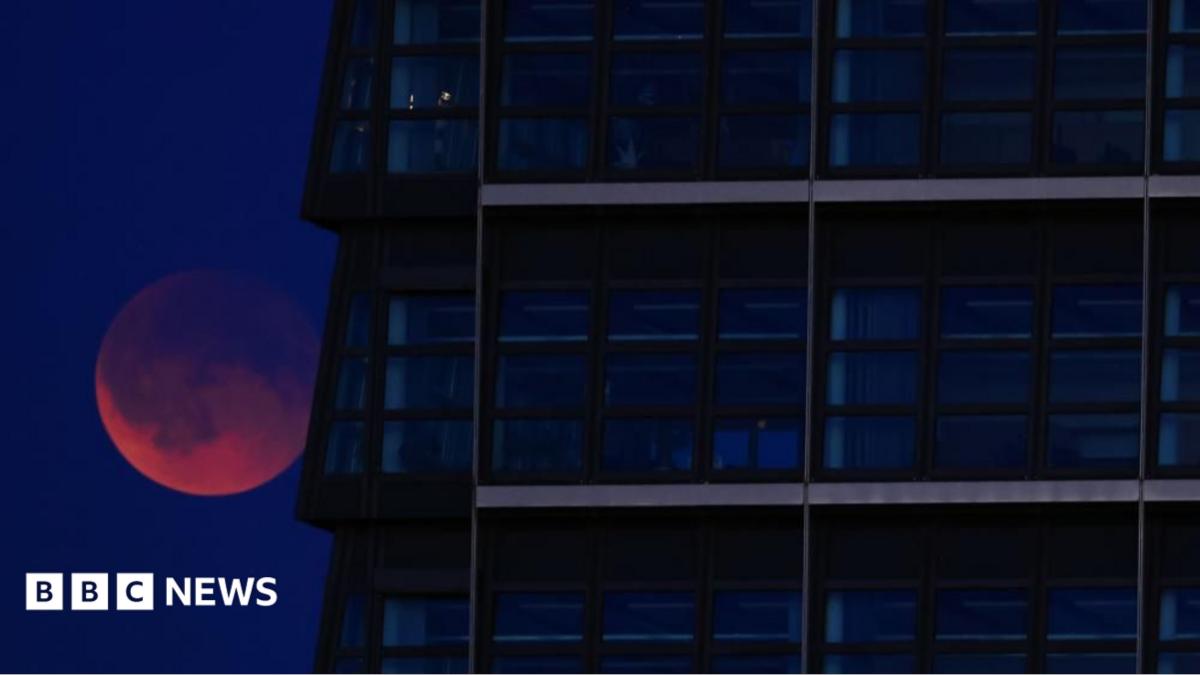
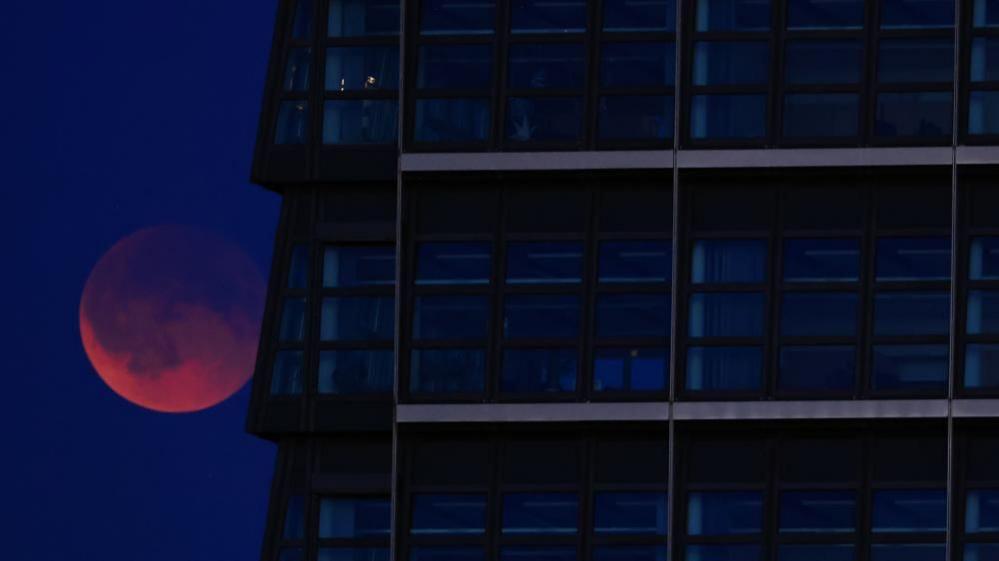
At precisely 5:12 AM BST, the eclipse reaches its zenith. With approximately 93% of the Moon’s diameter blanketed by the Earth’s umbral shadow, only a narrow sliver of the lunar surface will remain bright. This near-total coverage maximizes the visual contrast, creating an uncanny, haunting landscape on the Moon. It is during this window that the atmospheric scattering effect is most pronounced across the lunar disc, frequently bathing the shadowed regions in rich, coppery hues.
4. Moonset and the Conclusion of the Event (06:34 to 06:41 BST)
As the Earth continues to rotate, the eclipsed Moon will sink lower and lower toward the western horizon, eventually setting against the backdrop of an awakening morning sky. Depending on your exact geographic coordinates, the window of visibility closes rapidly around twilight:
- Belfast: Moonset occurs at 06:34 BST, with the Moon positioned at a precarious altitude of just nine degrees above the horizon.
- Dublin: Observers enjoy a marginally higher vantage point, with the eclipse remaining visible until final moonset at 06:38 BST.
- Enniskillen and Western Regions: Westernmost observers gain a slight geographical advantage, with moonset delayed until 06:41 BST, granting a few precious extra minutes of observation time before the lunar disk dips below the horizon.
Supporting Context & Metrics: The Science of the "Blood Moon"
While laypeople often refer to eclipsed moons as "Blood Moons," the mechanics behind this dramatic moniker are rooted in the physics of optics and planetary atmospheres.
A lunar eclipse occurs when the Sun, Earth, and Moon align in a straight or nearly straight configuration, known in astronomical terms as a syzygy. In this alignment, the Earth sits directly between the Sun and the Moon, casting a massive cone of shadow into space.
[Sun] ──► [Earth] ──(Umbra/Penumbra)──► [Moon]
            │
            └── Atmosphere filters light (Rayleigh scattering)
                └─ Short blue wavelengths scatter away
                └─ Long red wavelengths bend (refract) onto the Moon
Rayleigh Scattering in Action
If the Earth possessed no atmosphere, a lunar eclipse would cause the Moon to go entirely black as it passed through the umbra. However, our planet is cocooned by a dynamic layer of gases that acts as a refractive lens.
As direct sunlight streams past the edges of the Earth, the light passes through a thick slice of our atmosphere. During this journey, shorter wavelengths of light—such as blues and violets—scatter in all directions due to a phenomenon called Rayleigh scattering (the same process that makes our daytime sky blue).
Conversely, longer wavelengths of light—specifically reds, oranges, and deep ambers—survive the journey through the atmosphere relatively unscathed. Furthermore, the Earth’s atmosphere bends, or refracts, this long-wavelength light inward, focusing it directly onto the surface of the Moon.
Shades of Crimson
Terry Moseley of the Irish Astronomical Association explains the visual reality behind the dramatic terminology:
"This is sometimes called a blood moon—which is a nice dramatic name—but it’s not always the colour of blood. It can turn anything from orange to a deep red, but the part near the centre of the eclipse will be the most spectacular."
The exact shade of red or orange that the Moon assumes during an eclipse is never identical twice. It depends heavily on global atmospheric conditions at the time of the event. Volcanic eruptions, massive wildfires, particulate pollution, and cloud cover scattered across the Earth’s terminator line can inject dust and aerosols into the stratosphere, darkening the eclipse and deepening the lunar hues from a bright tangerine orange to a bruised, somber mahogany or blood red.
Official Perspectives and Expert Guidance
Professional astronomers and meteorological institutions emphasize that while partial lunar eclipses are not exceedingly rare on a global scale, the specific convergence of timing, percentage of coverage, and visibility window makes this week’s event worthy of early-morning disruption.
Unlike solar eclipses, which require certified, high-grade solar filter glasses to prevent permanent retinal damage, lunar eclipses are entirely safe for the human eye. Because the Moon is merely reflecting dim, refracted sunlight rather than emitting or focusing high-intensity direct solar rays, stargazers can gaze upon the spectacle with absolute peace of mind.
Furthermore, specialized equipment is strictly optional. While binoculars or a small backyard telescope will reveal incredible surface details—such as the darkened rings of famous lunar craters and the shifting chromatic gradients along the edge of the umbra—the entire event can be appreciated with the naked eye. The primary barrier to success is not optical power, but rather environmental clearance and horizon alignment.
Future Outlook & Practical Viewing Strategies
For those determined to witness this celestial event, success hinges on a blend of geographical positioning, early preparation, and meteorological luck.
1. Master the Western Horizon
Because the eclipse reaches its maximum peak at 5:12 AM BST and concludes shortly thereafter with moonset, the Moon will hang perilously low in the western sky. Urban dwellers and those living in densely wooded or hilly terrain will need to actively seek out elevated viewpoints or open fields with an unobstructed, panoramic view toward the west. High-rise buildings, mature tree lines, and rolling hills can easily obscure the Moon during its final, most dramatic moments before dawn.
2. Check the Local Forecast
Cloud cover remains the ultimate adversary of the amateur astronomer. Current meteorological models suggest a distinct regional divide across the British Isles:
- Western Regions: Forecasts favor western parts of the country, where clearer skies are more likely to hold through the predawn hours, offering optimal viewing conditions.
- Central and Eastern Regions: Central and eastern areas face a higher probability of stubborn cloud cover, which may obscure the delicate color shifts and the progress of the umbral shadow. Observers in these zones should monitor real-time satellite imagery and local forecasts closely before committing to an early wake-up call.
As the clock ticks down to Friday morning, stargazers across the region are encouraged to ready their cameras, brew a hot drink, and prepare for an arresting encounter with orbital mechanics. Whether captured through a high-powered telescope or simply witnessed from a back doorstep against a lightening sky, the 2026 partial lunar eclipse promises an unforgettable start to the day.