

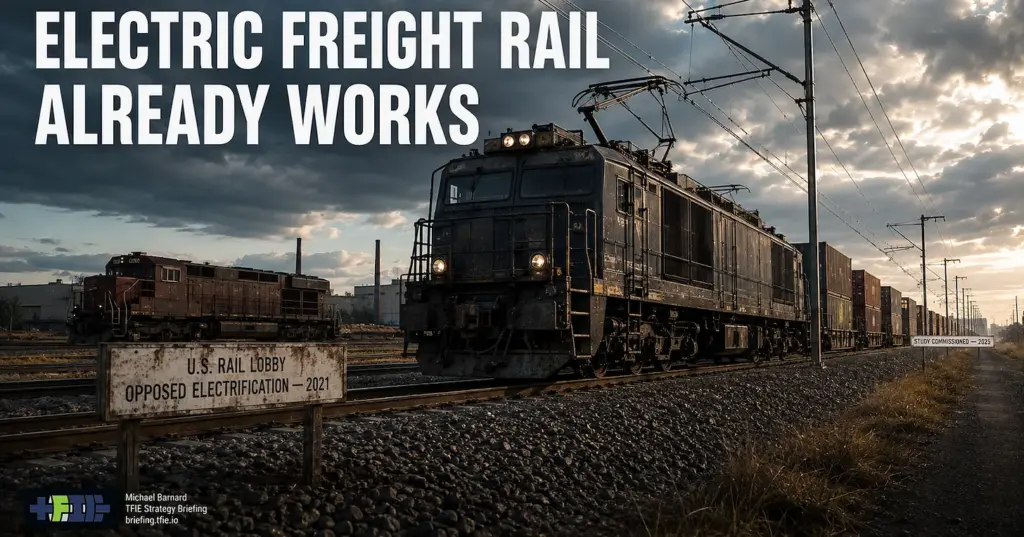
Electric freight rail is not a speculative technology, nor is it an unproven concept waiting on a breakthrough in basic physics. Across the globe, heavy freight moves daily via electric traction across immense railway systems, operating reliably in brutal climates, hauling massive tonnages, and outperforming diesel alternatives in efficiency and power output.
Yet, within North America, a persistent and pervasive narrative persists: that electrifying the continent’s sprawling freight network is a physical and financial impossibility.
This narrative received a major booster shot recently when the Association of American Railroads (AAR) published a heavily publicized study conducted by engineering consultancy HDR. The report estimated that outfitting roughly 105,000 to 139,000 track-miles of the Class I rail network with overhead catenary wires would cost between $870 billion and $1.1 trillion. Armed with these figures, the AAR declared that an “independent analysis” had confirmed full-scale catenary electrification to be outright “infeasible.”
However, a closer look at the underlying mechanics reveals a sharp disconnect between the data and the verdict. The HDR engineering report itself acknowledges that the system is technically feasible. The trillion-dollar price tag was not an assessment of whether any electric freight corridor could turn a profit or reduce emissions economically; it was an all-or-nothing estimate for transforming nearly the entire continental railway network in one massive, sweeping stroke.
By framing electrification as an impossible all-or-nothing megaproject, the rail industry has successfully deflected conversations about incremental transition. Meanwhile, federal bodies like the Federal Railroad Administration (FRA) are asking a fundamentally different, more rational question: Where does the first dollar of electrification pay off?
Detailed Chronology of the AAR-HDR Study
To understand how a multi-trillion-dollar engineering estimate morphed into an industry-wide rejection of electric freight, it is necessary to trace the chronology of the decision-making process.
Pre-Existing Positions and the Commissioning of HDR
Long before any engineering consultant put pen to paper, the Association of American Railroads had publicly staked out a position opposing prescriptive rail electrification mandates. Representing the interests of major Class I freight railroads, the AAR favored a gradual, self-directed evolution toward alternative fuels—primarily focusing on diesel optimization, biodiesel blends, and speculative long-term bets on hydrogen or heavy-duty batteries—while avoiding any binding regulatory push toward overhead wires.
It was within this institutional context that the AAR commissioned HDR, a prominent infrastructure and rail consultancy deeply embedded in the traditional freight-rail ecosystem, to evaluate a massive catenary rollout. The assignment was broad: model the capital costs of stringing overhead electrical wires across the vast majority of the Class I freight network.
The Engineering Reality Versus the Marketing Verdict
When the HDR catenary study was finally released, it contained a wealth of legitimate, highly detailed engineering data. Transforming a working freight railway requires an immense logistical ballet: setting up poles and foundations, building traction substations, tying into regional electrical grids, modifying signaling systems, clearing vertical clearances in bridges and tunnels, and executing construction adjacent to active, high-speed rail corridors. These costs are real, and no serious analyst suggests they should be minimized or waved away.
However, the analytical framework of the study suffered from a fatal flaw of scope. Instead of evaluating electrification as a phased, multi-decade infrastructure transition—where corridors are ranked by traffic density, highest-value early projects are built first, lessons are learned, and capital is recycled into the next phase—the HDR scenarios began at the extreme end of the process. They modeled a continental blanket deployment right out of the gate.

When the final price tag of $870 billion to $1.1 trillion (including contingency funds) hit the press, the AAR quickly seized the narrative. They announced that an independent analysis had definitively proven catenary systems to be infeasible for U.S. freight rail. Lost in the press releases and headlines was the awkward reality that HDR’s own underlying text conceded that the infrastructure is technically feasible.
The Propagation of a Misleading Metric
Once a bold headline is established, it tends to take on a life of its own. As the study traveled outside the insular rail ecosystem, its crucial caveats were stripped away. Major news outlets, such as Reuters, subsequently cited the trillion-dollar figure while reporting on the growing environmental footprint of U.S. freight rail—which in some metrics has fallen behind coal-fired power plants in relative emissions profiles.
Stripped of its extreme scope, hyperbolic assumptions, and sponsor-driven framing, the number stopped looking like the output of a worst-case scenario exercise and began to masquerade as a neutral, objective finding about the inherent limits of electric freight rail.
Supporting Context & Metrics: Challenging the American Exceptionalism Trap
The primary defense offered by North American railroads for remaining overwhelmingly reliant on diesel is geographical and logistical exceptionalism: the idea that America’s heavy loads, vast distances, and extreme weather patterns make international electrification models inapplicable.
A global audit of rail systems dismantles this argument piece by piece.
The International Reference Class
- India: Through a monumental national push, Indian Railways has successfully electrified roughly 99.6% of its broad-gauge network. This is not a quaint commuter system; it moves immense volumes of heavy freight—coal, steel, agricultural goods—across a subcontinent experiencing extreme seasonal weather and staggering traffic density.
- China: China operates the world’s largest and most heavily utilized high-speed rail network alongside a massive, heavily electrified freight grid. Electric locomotives dominate its primary coal and industrial corridors, moving freight trains that rival North American weights.
- South Africa: Even within HDR’s own cited data, successful electric freight operations are documented abroad. Notably, South Africa has deployed electrically hauled test trains that dwarf the weight and length of the representative North American freight trains used in the HDR baseline models.
Of course, important caveats apply. Ownership structures, labor laws, financing mechanisms, and traffic mixes vary wildly between nations. American railroads are privately owned and maintained, whereas foreign networks often involve heavy state backing and public infrastructure investments.
However, these institutional and financial differences do not alter the laws of physics. They do not explain why North American freight remains nearly 100% reliant on diesel while the rest of the industrialized world embraces catenary power for heavy-haul routes. Continental scale, harsh climates, and heavy trains are poor excuses for technological stagnation.
The Economic Frontier of Electrification
The core error of the AAR-HDR approach lies in misunderstanding how capital-intensive infrastructure transitions occur. No rational government or private consortium builds out an entire national grid or highway system all at once.
Instead, planners look for the economic frontier—the specific corridors where traffic density is highest, track utilization is constant, and the savings on diesel fuel, engine maintenance, and emissions pay back the capital expenditure the fastest.
- High-Density Corridors: In North America, a small fraction of the total track-miles handles a disproportionately large percentage of total gross ton-miles. Corridors connecting major ports to inland distribution hubs, or high-volume transcontinental mainlines shared by multiple Class I operators, represent prime candidates for early catenary deployment.
- The Diesel Savings Dividend: Modern electric locomotives offer vastly superior continuous horsepower, higher tractive effort at lower speeds, and drastically lower maintenance costs compared to diesel-electric equivalents. They do not require routine engine rebuilds, suffer from fuel degradation, or face the volatile price spikes of petroleum markets.
By evaluating the cost of wiring low-density branch lines alongside high-density corridors, the HDR study obscured the profitability of those early, high-return segments.

Official Statements and Divergent Regulatory Frameworks
While the Association of American Railroads sought to shut the door on catenary infrastructure through a sweeping feasibility study, public regulators are taking a much more nuanced, analytical approach.
The Federal Railroad Administration’s Pivot
The Federal Railroad Administration (FRA), recognizing the critical need to decarbonize the transportation sector, has approached the problem through a lens of technological neutrality and staged deployment.
In a framework developed in partnership with the University of Texas (known as the CURRENT framework), the FRA evaluates traditional catenary systems not as an all-or-nothing proposition, but alongside a suite of alternative decarbonization tools:
- Battery-Electric Locomotives: Ideal for switching yards, short-line operations, and bridging non-electrified gaps between catenary-fed corridors.
- Dual-Mode Locomotives: Equipment capable of drawing power from overhead wires where available and switching to onboard energy storage (batteries or diesel) on un-wired segments.
- Staged Deployment Strategies: Treating cost, uncertainty, and technological risk as variable parameters rather than fixed barriers.
This framework represents a return to rational public policy. It asks the question that the AAR’s study deliberately avoided: Where does the next incremental investment in electrification make economic sense?
The Conflict of Interest in "Independent" Research
The institutional architecture surrounding the HDR study also warrants strict journalistic scrutiny. HDR is a premier engineering consultancy heavily dependent on the Class I railroads for ongoing engineering, design, and infrastructure contracts. To describe a study commissioned by an industry trade association—and executed by a core industry consultant—as a purely "independent analysis" stretches the English language.
This is not to claim that HDR engineers falsified data or violated professional ethics. The physical inputs—the cost of copper wire, steel poles, and concrete foundations—are largely standard engineering metrics. Rather, the bias was baked into the scope of work. When you ask an engineering firm to price out the total replacement of a continental rail network under the assumption of blanket deployment, you will get a multi-trillion-dollar number. That number can then be weaponized in public relations campaigns to fend off regulatory pressure, even if it bears little resemblance to a sensible business case for targeted decarbonization.
Future Outlook: The Path Forward for North American Rail
As climate pressures mount and regulatory scrutiny intensifies, the U.S. and Canadian freight rail sectors cannot hide behind inflated infrastructure estimates forever. The economic reality of diesel fuel volatility, coupled with tightening corporate environmental, social, and governance (ESG) mandates, means that the status of rail as a "green" mode of transport is eroding. In fact, comparative studies have shown that in terms of direct emissions intensity and efficiency gains, modern freight rail risks falling further behind electrified logistics networks worldwide.
What a Credible Transition Looks Like
If North American freight rail is to modernize, the conversation must shift from political defense mechanisms to rigorous economic corridor planning:
- Corridor-by-Corridor Triage: Regulators, independent academic institutions, and forward-thinking logistics firms must map out high-density Class I corridors and run genuine cost-benefit models for partial electrification.
- Public-Private Partnerships: Because the initial capital expenditure for catenary infrastructure is high, early-stage deployment will likely require federal grant funding, low-cost loans, and risk-sharing models similar to those used to build out the early American highway and telecommunications grids.
- Hybrid Fleets as a Stepping Stone: Dual-mode and battery-electric locomotives can serve as transitional workhorses, proving the operational reliability of electric traction while laying the groundwork for future overhead wire installations on the busiest routes.
Conclusion
The AAR’s trillion-dollar scenario successfully achieved its political objective: it generated staggering headlines that made rail electrification look impossible. But it tells us nothing about whether the first economically attractive freight corridor exists in North America.
Electric freight rail works. It moves heavy loads up steep grades in harsh climates across the globe every single day. The only question left for North American railroads is whether they will choose to modernize voluntarily through intelligent, phased investments, or whether they will wait until regulatory mandates and competitive pressures force their hand.



