

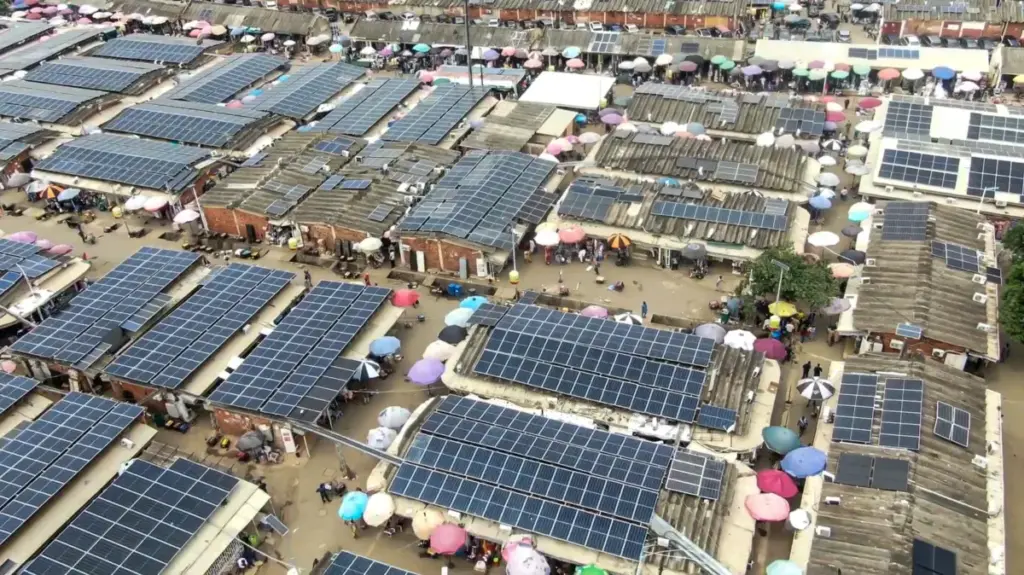
Executive Overview
On the bustling outskirts of Lagos, Nigeria’s commercial nerve center, a quiet industrial transformation is taking root inside a sunlit, state-of-the-art facility. Dressed in protective blue overalls, a new generation of young Nigerian engineers works along a precision-driven assembly line. Their focus is singular: meticulously inspecting shimmery blue photovoltaic cells before they are automated, tabbed, laminated, and framed into industrial-grade solar panels.
Once rigorous quality control checks—including advanced electroluminescence imaging—are complete, forklift operators transport the finished hardware to an expansive warehouse. From here, these systems are dispatched to commercial clients, rural microgrid developers, and residential properties across Nigeria and into neighboring ECOWAS member states. Embedded on every single module is a stamp of emerging technological sovereignty: “Made in Nigeria.”
For Emmanuel Agbola, the Operations Manager at indigenous solar manufacturing firm LPV Technologies, this facility represents much more than an operational assembly line or a commercially viable business venture. It stands as a direct challenge to Sub-Saharan Africa’s long-standing reliance on foreign technology imports and an unreliable centralized power grid.
For decades, West Africa’s largest economy has suffered from chronic power deficits, characterized by frequent national grid collapses and a heavy reliance on expensive, polluting fossil-fuel generators. The rise of domestic solar manufacturing facilities like LPV Technologies signals a pivotal shift. By localizing the production of renewable energy infrastructure, Nigeria is not only mitigating its severe energy poverty but is also establishing a foundational framework for industrialization, skilled job creation, foreign exchange conservation, and regional clean energy expansion.
Detailed Chronology: The Evolution of Nigeria’s Clean Energy Manufacturing
To understand the strategic significance of Nigeria’s nascent solar manufacturing sector, one must examine the socio-economic and policy trajectory over the past two decades that accelerated its growth.
+-----------------------------------------------------------------------------------+
| CHRONOLOGY OF NIGERIA'S SOLAR REVOLUTION                                          |
+-----------------------------------------------------------------------------------+
| 2010–2015: Deep Grid Fragility & Proliferation of Low-Quality Imports             |
|   • Grid supply hovers below 4,000 MW; high reliance on expensive diesel power.   |
|   • Market saturated with substandard, uncertified foreign solar equipment.       |
+-----------------------------------------------------------------------------------+
| 2016–2019: Early Decentralized Energy Initiatives                                 |
|   • Rural Electrification Agency (REA) targets off-grid solar mini-grids.          |
|   • Pioneering firms begin assessing local assembly feasibility to lower costs.    |
+-----------------------------------------------------------------------------------+
| 2020–2022: Pandemic Disruptions & The Push for Local Supply Chains                |
|   • Global supply chain shocks double freight costs and delay project timelines.   |
|   • Federal Government launches "Solar Power Naija" to expand off-grid connections.|
|   • Local assembly plants establish advanced testing facilities in Lagos and Ogun. |
+-----------------------------------------------------------------------------------+
| 2023–Present: Policy Pivots & The Industrial Surge                                |
|   • Removal of fuel subsidies drives power costs up over 200% for businesses.     |
|   • Enactment of the Electricity Act 2023 decentralizes power generation/market.   |
|   • Facilities like LPV Technologies scale up output, serving domestic & regional |
|     West African export markets under the AfCFTA framework.                       |
+-----------------------------------------------------------------------------------+
The Era of Vulnerability (2010–2015)
Throughout the early 2010s, Nigeria’s energy landscape was defined by severe structural fragility. Despite possessing an installed generation capacity of roughly 12,500 megawatts (MW), the centralized national grid delivered fewer than 4,000 MW on average to a population exceeding 180 million people. Businesses and households routinely depended on localized diesel and gasoline generators.
During this period, early attempts to introduce solar energy were hampered by an influx of low-quality, uncertified imported hardware that frequently failed in tropical conditions. The absence of local manufacturing standards and technical servicing infrastructure left consumers skeptical of clean energy alternatives.
Policy Frameworks and Supply Chain Crisis (2016–2022)
The trajectory began to shift as the Nigerian government, through the Rural Electrification Agency (REA), prioritized off-grid and mini-grid solar solutions to power underserved rural communities. However, the true vulnerability of complete reliance on imported solar panels became clear during the 2020–2021 global supply chain disruptions.
Soaring international freight rates, extended port shipping delays, and severe foreign exchange shortages paralyzed domestic installation projects. Recognized as a critical vulnerability, forward-thinking energy entrepreneurs began securing capital to build local assembly and manufacturing facilities, seeking to de-risk the supply chain by building technical capabilities within Nigeria.
The Subsidy Shift and Industrial Acceleration (2023–Present)
The decisive tipping point occurred in mid-2023. The total removal of the long-standing petrol subsidy, combined with currency unification and elevated electricity tariffs for high-consumption urban bands, caused corporate and residential energy costs to surge by more than 200 percent.
Concurrently, the landmark Electricity Act of 2023 de-monopolized power generation and distribution, empowering state governments and private entities to build independent power networks. Solar power transformed overnight from an environmental alternative to a core commercial necessity. Domestic manufacturers like LPV Technologies moved rapidly to fill the demand gap, scaling up automated assembly operations to produce high-efficiency monocrystalline modules tailored for high-ambient-temperature environments.
Supporting Context & Metrics: The Economics of the Energy Gap
The economic foundation for domestic solar panel manufacturing in Nigeria is rooted in stark macroeconomic realities and significant market demand.
The Macroeconomic Reality of Nigeria’s Energy Deficit
| Metric / Indicator | Figure / Impact | Strategic Implications |
|---|---|---|
| Installed National Grid Capacity | ~13,000 MW | High baseline capacity, but bottlenecked by gas supply and transmission failures. |
| Operational Grid Output | 3,500 MW – 4,500 MW | Severe power deficit for over 200 million citizens. |
| Annual Private Spend on Fuel Generators | $12 Billion to $14 Billion USD | Enormous capital outflow diverted from productive economic investments. |
| Estimated Diesel/Gasoline Generator Capacity | 20,000 MW (Cumulative) | Off-grid fossil fuel generation vastly outpaces official national grid output. |
| Commercial Solar Market Growth Rate (CAGR) | Estimated >22% (2024–2030) | Driven by rising fossil fuel costs and industrial electrification needs. |
    ANNUAL GENERATION CAPACITY COMPARISON (ESTIMATED MW)

    Grid Supply (Actual Available Output)  [█████               ]  4,000 MW
    Private Back-up Generators (Fossil)    [████████████████████] 20,000 MW
    Target Solar Capacity Expansion (2030) [███████████        ] 11,000 MW
Key Drivers Sizing the Local Solar Opportunity
- The Cost of Off-Grid Generation: Operating a enterprise on back-up diesel generation costs between $0.35 and $0.50 per kilowatt-hour (kWh). By contrast, localized commercial solar PV installations—even when amortizing the capital expenditure of battery storage—deliver levelized electricity costs between $0.12 and $0.18 per kWh over a 20-year lifespan.
- Foreign Exchange Strain: Importing fully assembled solar modules requires significant upfront foreign currency reserves. By importing raw silicon wafers, tempered solar glass, and aluminum frames—or sourcing components regionally—local manufacturers reduce net foreign exchange expenditure by up to 35 percent per module, conserving critical capital.
- Quality Control for Tropical Climates: Foreign-made solar panels built for temperate climates often experience accelerated thermal degradation when exposed to West Africa’s high ambient temperatures and dusty harmattan seasons. Local manufacturers customize encapsulation materials and frame thermal tolerances, extending operational lifespans and improving yield metrics by 8 to 12 percent over standard imports.
Official Statements and Industry Perspectives
The rise of domestic manufacturing has drawn commentary from corporate leaders, policy architects, and renewable energy analysts across the continent.
+-----------------------------------------------------------------------------------+
| KEY PERSPECTIVES FROM INDUSTRY LEADERS & POLICYMAKERS                             |
+-----------------------------------------------------------------------------------+
| "Our goal goes far beyond assembling hardware. We are building an ecosystem of   |
| engineering talent, proving that high-tech manufacturing can thrive in Nigeria."  |
|                                                                                   |
|  — Emmanuel Agbola, Operations Manager, LPV Technologies                          |
+-----------------------------------------------------------------------------------+
| "Localizing the solar value chain is no longer optional. It is a vital strategy   |
| for national energy security, currency stability, and youth employment."          |
|                                                                                   |
|  — Industry Policy Analyst, West African Energy Initiative                        |
+-----------------------------------------------------------------------------------+
Reflecting on the operational philosophy at LPV Technologies, Emmanuel Agbola emphasizes that establishing localized assembly plants is fundamentally about long-term capacity building and technological autonomy:
"In a bright, spacious factory on the outskirts of Lagos, young engineers in overalls work their way along the production line, carefully inspecting the shimmery blue solar cells that turn sunlight into electricity. Quality checks completed, the finished solar panels are loaded onto forklifts and taken to a warehouse—ready for delivery to buyers across Nigeria and in neighbouring West African countries. Each panel is labelled ‘Made in Nigeria.’
But for us, our mission goes beyond quality control and meeting customer orders. We are creating a sustainable engineering ecosystem. When young Nigerian graduates step onto this factory floor, they transition from theoretical knowledge to mastering advanced photovoltaics, automated precision soldering, and quality engineering. We are building the human and industrial capital that will power West Africa for the next half-century."
From a policy standpoint, executives within the Renewable Energy Association of Nigeria (REAN) emphasize the macroeconomic benefits of domestic production. A senior trade representative noted:
"Every solar panel imported fully assembled represents lost domestic labor hours, exported capital, and extended downtime if components arrive damaged. Local manufacturing hubs like LPV Technologies provide rapid component replacement, customized warranties, and direct local technical support. This gives institutional investors the confidence needed to fund major industrial clean-energy projects across the region."
Future Outlook: Overcoming Structural Bottlenecks to Scale Across West Africa
While the growth of Nigeria’s indigenous solar manufacturing sector is encouraging, long-term sustainability requires addressing several structural challenges.
       CHALLENGES
  ┌───────────────────────┐
  │ Port Logistics Bottlenecks│
  │ High Import Tariffs   │
  │ Currency Volatility   │
  └───────────┬───────────┘
              │
              ▼
   STRATEGIC MITIGATIONS
  ┌───────────────────────┐
  │ AfCFTA Regional Trade │
  │ Backward Integration  │
  │ Local Battery Storage │
  └───────────┬───────────┘
              │
              ▼
        FUTURE VISION
  ┌───────────────────────┐
  │ West Africa's Primary │
  │ Clean Energy Hub      │
  └───────────────────────┘
Overcoming Structural Challenges
- Raw Material Tariff Discrepancies: Currently, local manufacturers face complex import tariffs on specific raw materials—such as low-iron tempered solar glass and specialized EVA encapsulation films—whereas fully assembled panels occasionally benefit from lower import duties. Industry coalitions are actively lobbying the Federal Ministry of Finance for targeted duty exemptions on green manufacturing inputs.
- Infrastructure and Logistics Bottlenecks: Port congestion and transport infrastructure bottlenecks can delay raw material shipments. Addressing these logistical challenges requires streamlining customs clearing protocols for verified renewable energy manufacturers
.
- Foreign Exchange Volatility: Currency fluctuations impact the procurement of specialized raw components traded in foreign currencies. Manufacturers are working to hedge this exposure by developing regional export sales settled in stable cross-border currencies.
Strategic Horizon (2025–2030)
Despite these operational friction points, the long-term outlook for Nigeria’s solar manufacturing industry remains promising, driven by three major structural catalysts:
- The African Continental Free Trade Area (AfCFTA): As trade barriers decline under AfCFTA, Nigerian solar manufacturers are positioned to become primary clean-energy exporters across the 15 member states of the Economic Community of West African States (ECOWAS), leveraging Lagos’s manufacturing base and strategic maritime routes.
- Backward Integration and Supply Chain Localization: Top-tier manufacturers are assessing plans to localize frame extrusion using domestic aluminum processing facilities, while exploring local sourcing options for glass and wiring systems.
- Integration into Energy Storage Manufacturing: As solar adoption expands, manufacturers are planning to add lithium iron phosphate ($LiFePO_4$) battery packaging lines alongside PV module assembly. Providing fully integrated, locally built solar-plus-storage systems will help optimize upfront capital costs for commercial and industrial users.
Conclusion
The emergence of high-tech manufacturing plants on the outskirts of Lagos marks a significant milestone in West Africa’s economic trajectory. By pairing young engineering talent with automated clean technology, domestic pioneers like LPV Technologies are proving that the transition to clean energy can serve as a powerful engine for industrialization.
The “Made in Nigeria” label stamped onto these high-efficiency solar modules reflects more than origin—it represents a decisive step toward regional energy independence, economic resilience, and a sustainable industrial future.



