

Executive Overview
From a distance, it resembles a whimsical, brightly colored artifact straight out of a children’s television program—a vibrant, yellow inflatable sphere punctuated by playful orange spikes, resting unexpectedly on the banks of the River Thames. Yet, upon closer inspection, this striking architectural installation reveals a profound and sobering objective. Titled Pollenarium, the latest creation by acclaimed Bristol-based installation artist Luke Jerram merges high-concept public art with rigorous ecological science.
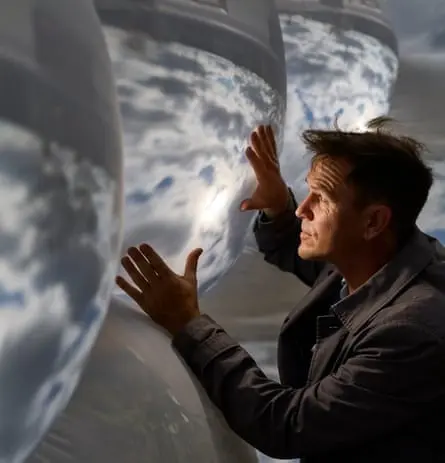
Commissioned by Creative Barking and Dagenham, the six-meter-tall dome scales up a microscopic grain of pollen to the dimensions of a small building. But the artistic exploration does not stop at its exterior. Stepping inside transports visitors into an immersive, multi-sensory environment designed to replicate the unique perspective of an insect’s compound eye. More than 100 specialized lenses line the interior, each functioning as a camera obscura that captures light from the surrounding landscape and projects a fragmented, mosaic-like moving image onto the dome’s inner walls.
Behind the playful aesthetics and optical marvels, however, lies an urgent rallying cry. Jerram has explicitly designed Pollenarium as a visceral commentary on the catastrophic collapse of pollinator populations across the United Kingdom and the broader globe. Amid compounding environmental pressures—ranging from aggressive agricultural land management to the continued deployment of controversial chemical pesticides—flying insect numbers in the UK have plummeted by a staggering 60% over the last two decades.
By inviting the public quite literally "inside a bee’s head," Jerram hopes to bridge the cognitive disconnect between human industrial practices and the silent, foundational collapse of the ecosystems that sustain human civilization. Following its high-profile debut at the Emerge East festival in Barking Riverside, East London, the installation is slated for a staging at the University of Bristol before embarking on an extensive nationwide tour, paired with educational workshops and community programming aimed at igniting a grassroots conservation movement.
Detailed Chronology of the Installation and Debut
The genesis of Pollenarium reflects a meticulous artistic process rooted in scientific consultation, structural engineering, and public engagement. While Luke Jerram is internationally recognized for monumental, awe-inspiring sculptures scaled from astronomical data—most notably his touring astronomical installations Museum of the Moon, Gaia, and Mars—his shift toward the microscopic world marks a deliberate pivot toward the often-overlooked architects of global biodiversity.
The Conception and Materialization
The project moved from conceptual blueprints to physical reality over several months of prototyping in Jerram’s studio space located at Paintworks in Bristol. The exterior shell is constructed from heavy-duty, brightly colored nylon, meticulously engineered to withstand outdoor weather conditions while maintaining the bulbous, sculptural morphology of an authentic pollen grain.
During early testing phases, the visual impact of the structure was immediate. As Jerram recalls of an unannounced test inflation in the Paintworks corporate parking lot, office workers streamed out of neighboring buildings in droves, transfixed by the surreal, larger-than-life biological form blooming against an urban backdrop.
The Interior Optics: Engineering the Compound Eye
Constructing the interior of Pollenarium required bridging avant-garde art with optical physics. The inner chamber houses over 100 individual glass and acrylic lenses. Rather than serving as passive windows, every lens operates on the principle of the camera obscura—an optical device that projects an inverted image of the external world onto a translucent or reflective interior surface.
As natural sunlight filters through the landscape surrounding the Thames or festival grounds, these lenses capture real-time, fragmented projections that dance across the interior walls. The resulting visual mosaic deliberately mimics ommatidia—the thousands of tiny independent photoreceptor units that make up the compound eye of a fly, bee, or butterfly. Visitors standing within the sphere do not merely look at art; they experience a simulated sensory shift, catching a glimpse of how the world looks through the visual apparatus of the creatures responsible for pollinating roughly one-third of the human diet.
The East London Unveiling
The public premiere of Pollenarium took place on the riverbanks of East London, specifically tied to the Emerge East festival at Barking Riverside. Opened to the general public free of charge from 11:00 AM, the installation immediately drew substantial crowds, capturing the curiosity of families, art critics, and environmentalists alike. Set against the regenerating industrial backdrop of the Thames estuary, the juxtaposition of a colossal pollen grain underscored the precarious intersection of urban development and natural habitat restoration.

Supporting Context & Metrics: The Scale of the Crisis
While Pollenarium provides an accessible and wondrous point of entry for the casual observer, its foundational motivation is anchored in alarming empirical data regarding global biodiversity loss. The crisis facing insects, and pollinators in particular, is no longer a theoretical projection for the distant future; it is a measurable, accelerating reality currently unfolding across British landscapes.
The 60% Decline: Quantifying the UK Insect Collapse
Data highlighted by conservation organizations and scientific bodies—including the Natural History Museum—reveal a catastrophic trajectory for British entomofauna. Most notably, flying insects in the UK have declined by a staggering 60% over the past 20 years. This metric, derived from standardized long-term monitoring projects such as the “Buglife” surveys and the Rothamsted Insect Survey, indicates that the abundance and biomass of flying insects are eroding at an unprecedented rate.
This widespread reduction is not limited to rare or specialized species; it spans common foundational groups, including hoverflies, butterflies, moths, beetles, and wild bees. Because insects occupy a central node in terrestrial food webs—serving as the primary protein source for insectivorous birds, bats, small mammals, and freshwater fish—their systemic collapse triggers cascading ecological failures up the entire trophic ladder.
The Chemical Threat: Neonicotinoids and Neuro-Disruption
A major driver behind this ecological regression is intensive agricultural practices, specifically the reliance on synthetic chemical pesticides. Luke Jerram has been particularly outspoken regarding the continued regulatory battles surrounding neonicotinoids—a class of neuro-active insecticides chemically related to nicotine.
Despite mounting scientific consensus detailing their devastating collateral damage to non-target organisms, regulatory loopholes and emergency authorizations have frequently permitted British farmers to continue utilizing these substances under specific conditions. Conservation watchdogs and environmental law charities, such as Wild Justice and the Wildlife Trusts, have repeatedly challenged governmental bodies like the Department for Environment, Food and Rural Affairs (Defra) over approvals that breach legal protections for fragile ecosystems.
The biological mechanism of neonicotinoids is ruthlessly efficient. As Jerram highlights:
"A minuscule trace can disrupt a bee’s ability to navigate and reproduce, with long-lasting consequences for their survival."
Even at sub-lethal concentrations—levels that do not immediately kill the insect outright—neonicotinoids impair spatial memory, olfactory learning, and forager flight dynamics. A forager bee exposed to trace chemical residues can become disoriented, failing to navigate the return journey to the hive. For a eusocial colony dependent on precise communication and efficient resource gathering, the loss of reliable foragers translates directly to nutritional deficits, weakened immune defenses, and eventual colony collapse.
Official Statements and Artistic Intent
The intersection of public art and activist intervention requires a delicate balance between didactic messaging and aesthetic wonder. In media appearances and public addresses surrounding the launch of Pollenarium, Luke Jerram has articulated a clear philosophical framework for his work.
Luke Jerram on the Urgency of Awareness
Addressing the press on the banks of the Thames, Jerram emphasized that public art must engage with the defining crises of our era.

"I hope it will make people think about how we need to protect pollinators," Jerram stated during the installation’s opening. "There has been a massive drop in insect numbers. Flying insects in the UK have declined by 60% in 20 years, which is mad."
By scaling the microscopic up to monumental proportions, Jerram forces viewers to confront objects and organisms that are typically dismissed or ignored due to their scale. A grain of pollen, invisible to the naked eye without magnification, becomes an imposing architectural presence. Similarly, the insect life that sustains agricultural yields is rendered visible, vibrant, and worthy of architectural homage.
Commissioners and Cultural Partners
The commission of Pollenarium by Creative Barking and Dagenham—a local arts organization dedicated to embedding cultural initiatives within community spaces—underscores the role of place-based art in driving local ecological conversations. Local authorities and cultural stakeholders have praised the project for its ability to draw diverse demographics into public parks and riverfronts, initiating dialogues about urban greening, rewilding, and pesticide reduction.
Future Outlook: National Tour and Educational Outreach
The debut of Pollenarium in East London marks merely the opening chapter for the installation. Recognizing that lasting behavioral and systemic change requires sustained engagement, Jerram and his production team have structured a comprehensive rollout plan for the coming months and years.
The University of Bristol Residency
Following its Thames-side exhibition, Pollenarium will travel west to the University of Bristol, integrating into the institution’s academic and public engagement programming. Here, the installation will serve as an intersectional platform for researchers across faculties—bringing together entomologists, botanists, climate scientists, and fine arts scholars. Academic seminars, panel discussions, and public lectures are planned to coincide with the residency, bridging the gap between peer-reviewed ecological data and public environmental literacy.
Nationwide Tour and Workshops
From Bristol, Pollenarium will embark on a broader tour across the United Kingdom, traveling to museums, botanical gardens, public squares, and festival sites. Crucially, the physical sculpture will not travel alone; it will be accompanied by an extensive educational framework featuring:
- Interactive Workshops for Schools: Hands-on sessions designed to educate young students about plant-pollinator mutualisms, floral morphology, and the lifecycle of wild bees.
- Citizen Science Initiatives: Programs training community members in local insect monitoring techniques, enabling citizens to contribute real-world data to national biodiversity databases.
- Policy and Conservation Forums: Collaborative events hosted alongside environmental NGOs, offering platforms to discuss sustainable farming incentives, pesticide phase-outs, and urban wildflower cultivation.
Conclusion: A Monument to the Miniature
As ecological pressures mount across the British countryside and global biomes face unprecedented strain, artistic interventions like Pollenarium offer a vital conduit for public empathy and understanding. By translating the microscopic trauma of the insect world into an unmissable, immersive architectural experience, Luke Jerram successfully bridges the gap between hard science and human emotion.
Whether gazing at the fractured, kaleidoscopic reflections inside the dome or contemplating the bright, spiky shell against the London skyline, visitors are reminded of an inescapable biological truth: human survival remains inextricably bound to the fate of the smallest creatures on Earth. As Pollenarium prepares for its national journey, its message echoes clearly across the landscape—to protect our food systems, secure our ecosystems, and preserve our natural heritage, we must first learn to see the world through the eyes of those we are currently losing.



