

Executive Overview
In the rapidly evolving landscape of public transit decarbonization, green technologies are routinely heralded as the definitive future of urban mobility. Yet, beneath the glossy brochures, pilot program announcements, and grand municipal targets lies a harsher, ledger-driven reality. A stark illustration of this tension has emerged from Scotland, where Aberdeen City Council is offloading its fleet of five-year-old hydrogen double-decker buses to commercial operator First Bus for a meager £30,000 per vehicle.
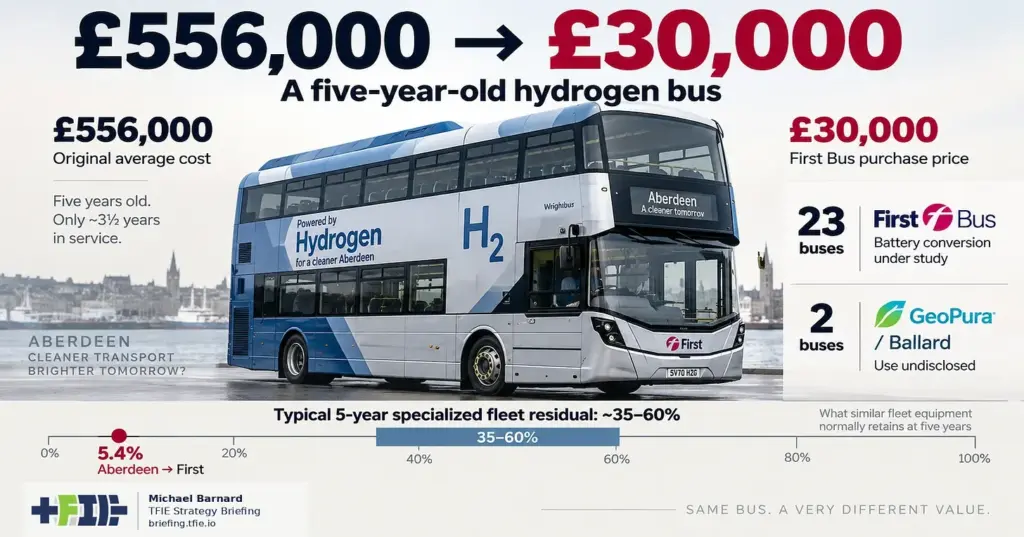
To grasp the magnitude of this depreciation, one must look at the starting line. Originally introduced to great fanfare in 2021, these 25 Wrightbus StreetDeck Hydroliners cost the city roughly £13.9 million, translating to an eye-watering average acquisition cost of £556,000 per bus. The agreed sale price to First Bus represents a staggering 94.6% loss, or just 5.4% of their original acquisition value.
Crucially, these are not dilapidated, end-of-life internal combustion buses being retired after 15 punishing years on the road. They entered service less than six years ago and saw only about three and a half years of actual revenue operation before persistent hydrogen-supply bottlenecks, escalating fuel costs, and refueling infrastructure hurdles forced them off the streets and into permanent storage.
This transaction moves the debate surrounding hydrogen mobility out of theoretical spreadsheet projections and into the harsh light of the secondary market. By testing the open market, Aberdeen has delivered a definitive real-world verdict on the residual value of specialized, first-generation hydrogen fuel-cell fleets when their localized operating models fracture. As transit agencies globally race to green their fleets, the Aberdeen case serves as a cautionary tale—and a fascinating test case for heavy-duty asset repurposing.
Detailed Chronology: From Aberdeen’s Hydrogen Ambitions to the Fire Sale
The story of Aberdeen’s hydrogen bus fleet is a case study in how municipal ambition can outpace systemic infrastructure maturity.
2020–2021: The Grand Rollout
Aberdeen positioned itself early as a vanguard of the hydrogen economy, leveraging its North Sea energy expertise to brand itself as a "pioneer hydrogen city." In 2020 and 2021, the city council orchestrated the introduction of a flagship fleet of 25 Wrightbus StreetDeck Hydroliners. Funded through a combination of municipal outlays, government grants, and European project support, the total acquisition cost hit £13.9 million—averaging £556,000 per bus. At the time, these vehicles were celebrated as technological marvels, combining electric drivetrain technology with on-board hydrogen fuel cells to offer zero-emission transit with rapid refueling times and extended ranges.
2021–2024: Operational Hurdles and the Bottleneck
Reality, however, quickly intervened. While the buses themselves largely performed as engineered, the supporting ecosystem proved brittle. Operational challenges—most notably regarding reliable, cost-effective hydrogen fuel supply chains and localized refueling station maintenance—plagued the project. As fuel costs fluctuated wildly and infrastructure reliability faltered, the operational costs became unsustainable for continuous revenue service. Consequently, the fleet was pulled from active duty, spending a significant portion of its design life parked rather than moving passengers.
Late 2024–2025: Testing the Market
Facing an idle, depreciating asset base, Aberdeen City Council took the pragmatic step of approaching the market to dispose of the fleet. A confidential council briefing obtained by the Press and Journal revealed that the city did not merely guess at residual values; it solicited formal bids. The response laid bare the profound lack of a deep, liquid secondary market for used hydrogen fuel-cell buses.
Alongside First Bus’s offer, the council received four other proposals—including multiple bids offering to take the buses off the city’s hands for free, and one token bid offering a mere £1 per vehicle. In this light, First Bus’s £30,000-per-bus offer was not an aggressive lowball by a predatory buyer, but rather the highest economic valuation generated by a genuine market test for specialized zero-emission vehicles whose proprietary hydrogen drivetrains no longer held commercial utility.

2026 and Beyond: The Staged Transfer
Under the finalized agreement, the vehicle transfers will occur in stages to align with operational planning. Seven buses are scheduled to transfer before the end of March 2027, with the remaining 16 transitioning during the 2027–28 financial year.
Supporting Context & Metrics: Breaking Down the Numbers
To fully understand the Aberdeen transaction, financial analysts must look past the headline-grabbing 94.6% depreciation figure and examine the structural economics of fleet management.
| Metric | Original Deployment (2021) | Current Market Transaction |
|---|---|---|
| Vehicle Type | Wrightbus StreetDeck Hydroliner (Hydrogen Fuel Cell) | Used Hydrogen Chassis & Body (Targeted for Repower) |
| Fleet Size | 25 Vehicles | 23 Vehicles (Acquired by First Bus) |
| Total Fleet Cost | ~£13.9 Million | £690,000 Total Purchase Price (23 × £30,000) |
| Average Cost per Bus | ~£556,000 | £30,000 |
| Value Retention | 100% | 5.4% of Original Acquisition Cost |
| Active Service Life | Designed for 12–15 Years | ~3.5 Years of Active Revenue Operation |
The "Donor Vehicle" Economics
First Bus is essentially acquiring these 23 Hydroliners not as functional hydrogen buses, but as premium "donor vehicles." The structural integrity, bodywork, seating, and core chassis of a modern Wrightbus double-decker possess intrinsic utility, provided the problematic or obsolete hydrogen apparatus can be excised.
By acquiring a five-year-old chassis and body for £30,000, First Bus has drastically lowered its capital exposure. A standard, brand-new zero-emission double-decker—whether battery-electric or fuel-cell—commands hundreds of thousands of pounds. By securing the physical bus shell for pennies on the dollar, First Bus creates the financial headroom necessary to absorb the high engineering costs associated with vehicle conversion.
The Conversion Equation: Hydrogen to Battery-Electric
According to municipal briefings, First Bus is drawing up strategic plans to overhaul these former hydrogen buses for battery-electric operation. While technically feasible, this is far from a simple plug-and-play operation. A comprehensive repower requires:
- Decommissioning and safe removal of high-pressure hydrogen storage tanks, fuel cell stacks, and specialized cooling loops.
- Restructuring internal weight distributions to accommodate several hundred kilowatt-hours of heavy traction batteries.
- Recertifying axle loads and structural load-bearing capacities.
- Integrating unified thermal management, charging systems, and digital control software.
- Securing comprehensive engineering warranties and regulatory certifications for the modified vehicles.
Thus, the £30,000 acquisition price is merely the opening installment in a much larger capital allocation decision.
Official Statements and Industry Insights
The collapse of Aberdeen’s hydrogen fleet has triggered intense debate across the clean-transportation sector, drawing commentary from infrastructure analysts, municipal leaders, and transit executives alike.
Industry analysts specializing in zero-emission transit economics have pointed out that public clean-transport programs systematically under-index exit optionality and residual asset valuation. Municipalities frequently calculate total cost of ownership (TCO) based on grants, subsidies, fuel expenditure, and initial operational grants, while ignoring what happens when a technology paradigm shifts or local supply chains disintegrate.
“A technology can work brilliantly in technical service and still utterly destroy capital if it creates an asset that no secondary buyer wants when the original operating model breaks down,” noted one transit infrastructure strategist. “Aberdeen has absorbed virtually all of that capital loss on behalf of the industry, leaving First Bus in a uniquely insulated position to experiment with repowering.”

First Bus itself is uniquely positioned to handle this high-stakes engineering gamble. The operator has maintained these specific Hydroliners since they rolled off the assembly line, granting its maintenance teams an intimate, granular understanding of their mechanical histories, chassis wear, and structural conditions. Furthermore, First Bus is no stranger to fleet electrification or repowering initiatives. The company previously spearheaded a £12.7 million investment in Aberdeen featuring 24 new battery-electric double-deckers alongside 12 internal-combustion buses retrofitted to run on battery power. With rapid DC charging infrastructure already established at its King Street depot and existing commercial ties to Wrightbus’s NewPower conversion wing, First Bus possesses the institutional knowledge required to evaluate whether a full-fleet repower makes financial sense.
Future Outlook: What the Aberdeen Verdict Means for the Global Transit Market
As the dust settles on Aberdeen’s £30,000 hydrogen sell-off, transport planners across Europe, North America, and Asia are closely watching First Bus’s next moves. Two distinct trajectories lie ahead for this stranded fleet, each carrying profound implications for the broader hydrogen bus market.
Scenario A: Successful Repowering
If First Bus successfully engineers a reliable, cost-effective battery-conversion package, Aberdeen will demonstrate that stranded hydrogen buses can indeed be salvaged under highly favorable, localized conditions.
However, industry experts caution that this outcome will not prove that hydrogen buses retain high resale value. Rather, it will prove that the underlying bus chassis can be rescued by stripping away the hydrogen fuel-cell apparatus and replacing it with mature battery technology. Much of the recovered value will stem directly from the elimination of the hydrogen system, proving that the secondary market values the vehicle despite its hydrogen origins, not because of them.
Scenario B: Conversion Economics Fail
If First Bus finds that the engineering overhead, battery costs, and structural modifications make the repower economically unviable even at a £30,000 donor price, the verdict for the wider hydrogen sector becomes stark.
Few secondary operators are likely to replicate Aberdeen’s unique alignment of conditions: acquiring nearly new, five-year-old heavy-duty buses for 5.4% of their cost, backed by an incumbent operator intimately familiar with the chassis, supported by pre-existing depot charging infrastructure, and paired with an established OEM repowering partnership. If the math fails under these golden conditions, the secondary market for first-generation hydrogen transit fleets may effectively be closed.
The Broader Takeaway
Aberdeen has delivered a sobering reality check to the zero-emission transition. While hydrogen fuel cells retain theoretical advantages for heavy-duty applications requiring rapid refueling and long daily ranges, the economic reality of infrastructure vulnerability and secondary-market liquidity cannot be ignored.
For municipal leaders and transit operators worldwide, the lesson of Aberdeen is clear: long-term asset planning must account for exit strategies, residual market demand, and technology lock-in. As First Bus embarks on its conversion trials through 2027 and 2028, the global transit community will be watching to see whether these fallen hydrogen pioneers can find a second life on battery power—or if they will stand as a monument to the high financial risks of early-stage clean-tech pivots.



