

Executive Overview
In an era defined by rapid biodiversity loss and unprecedented ecological challenges, access to historical scientific literature is more critical than ever. For nearly two decades, the Biodiversity Heritage Library (BHL) has served as the world’s ultimate open-access digital repository for biodiversity literature and archives. Containing over 64 million pages of foundational scientific texts, field notes, and historic illustrations, it is an irreplaceable digital ark for researchers, conservationists, educators, artists, and natural history enthusiasts across the globe.
However, the institution recently faced an existential crisis. Following the sudden loss of long-term institutional backing from the Smithsonian Institution—its primary home for nearly twenty years—BHL was thrust into a precarious position with no guaranteed future. Without immediate intervention, the digital library risked fragmentation, paywalls, or outright closure.
What followed was a remarkable testament to the power of the global open-access community. Through a coordinated public fundraising campaign launched in late 2025, supporters from 46 countries rallied to raise over USD $113,000, successfully guiding BHL through a complex structural transition. By July 2026, the library had officially relocated its core technical infrastructure to the Field Museum in Chicago, establishing a resilient, distributed, partner-supported governance model.
Today, having successfully weathered the storm of its foundational transition, BHL stands as a beacon of collaborative preservation. Yet, survival was only the first milestone. This article examines the dramatic chronology of BHL’s transition to independence, the metrics of its community-driven rescue, and the ongoing campaign to secure its long-term financial sustainability through the new "BHL Sustainers" initiative.
Detailed Chronology: From Existential Threat to Distributed Independence
The journey that transformed BHL from a federally anchored institution into a globally governed, independent entity is a masterclass in modern digital library resilience. To understand the gravity of the recent fundraising efforts, one must trace the timeline of events that threatened to dismantle the world’s largest open-access biodiversity repository.
The Catalyst: Loss of Institutional Anchorage
For close to twenty years, the Biodiversity Heritage Library operated under the umbrella and robust institutional support of the Smithsonian Institution. This partnership provided stability, technical infrastructure, and administrative backing. However, changes in institutional priorities and funding structures led to a sudden withdrawal of this foundational support.
Suddenly, BHL faced the daunting prospect of operating without a primary host. The library’s operational continuity hung in the balance. Every facet of the organization—from staff retention and day-to-day services to technical systems, international partnerships, legal governance, and long-term funding—had to be completely re-engineered. The core mission, however, remained non-negotiable: BHL had to remain a free, open-access resource available to everyone on the planet, without paywalls or subscription barriers.
The Turning Point: Launching "Give BHL Wings"
Recognizing that public awareness and financial backing were critical to survival, BHL leadership initiated a public fundraising campaign on October 17, 2025. Entitled #GiveBHLWings, the campaign served as a rallying cry for the global scientific and conservation communities.
The campaign set out with an ambitious and urgent mandate: raise sufficient funds to bridge the gap between institutional separation and complete structural independence by January 1, 2026. The response was immediate and international. Donors from all walks of life—ranging from academic institutions and professional taxonomists to amateur naturalists and nature illustrators—stepped forward to preserve the digital archive.
The Transition Peak and Infrastructure Migration
The formal transition period officially culminated at the end of June 2026, marking the closure of BHL’s initial restructuring phase. However, the logistical feat of securing BHL’s future extended into the summer.
In July 2026, the final major piece of the structural puzzle fell into place: the physical and digital migration of BHL’s servers and core technical infrastructure from the Smithsonian Institution to the Field Museum in Chicago, Illinois. This move symbolized more than just a change of address; it marked the formal birth of BHL’s new operational model. Rather than relying on a single central benefactor, BHL transitioned into a distributed, globally supported collaborative network, ensuring that no single political or institutional shift could ever again threaten its existence.
Supporting Context & Metrics: By the Numbers
The success of the transition campaign is best understood through the hard data of global solidarity. The numbers reflect not just financial contributions, but a truly international cross-section of stakeholders invested in keeping biodiversity knowledge open.

Financial and Geographic Metrics
- Total Funds Raised: More than USD $113,000 was contributed by dedicated supporters worldwide following the launch of the transition initiative.
- The Final Sprint: During the intense final seven weeks of the
#GiveBHLWingscampaign—leading right up to the independence transition on January 1, 2026—supporters contributed USD $51,000. - Global Reach: Contributions poured in from donors across 46 distinct countries, highlighting the truly international utility and appreciation of the library.
- Scale of the Archive: Thanks to this financial lifeline, BHL successfully retained its expert staff, maintained uninterrupted public services, and kept more than 64 million pages of historic biodiversity literature, field journals, and artistic plates freely accessible online.
The Power of Micro-Philanthropy
While major gifts and institutional grants remain vital, the BHL transition underscored the extraordinary power of collective, grassroots philanthropy. Donors utilized BHL’s fiscal sponsor, the Council on Library and Information Resources (CLIR), to channel funds securely. Donations were accepted in over 135 currencies, breaking down economic barriers to participation and allowing supporters from developing nations and wealthy industrialized economies alike to have a stake in the library’s survival.
Official Statements and Community Impact
The survival of the Biodiversity Heritage Library is fundamentally a human story. It reflects the deep emotional and professional bonds researchers and nature lovers share with the natural world’s recorded history.
Nicole Kearney, BHL’s Communications Director, Manager of BHL Australia, and Chair of the Persistent Identifier Working Group, has been a vocal champion of the library’s mission. Reflecting on the community’s response, Kearney emphasizes that BHL’s existence has never been merely transactional; it is rooted in a shared philosophical commitment to open science.
"For 20 years, BHL has opened biodiversity literature to the world. It exists because of a global community committed to open access, shared infrastructure, and the belief that biodiversity knowledge should be available to everyone. Last year, that community gave BHL wings. Now we’re asking you to help us keep flying."
Scholars, taxonomists, and environmental historians have frequently echoed these sentiments. Without BHL, describing new species—a process that legally requires the consultation of historic taxonomic literature—would become exponentially more difficult, particularly for researchers in the Global South who lack access to well-endowed university libraries. By maintaining an open-access digital commons, BHL democratizes scientific discovery, allowing a high school student in rural Kenya, a conservation biologist in Brazil, and a professor at a top-tier European university equal access to the exact same foundational texts.
Future Outlook: Sustaining the Digital Ark
With its administrative independence secured and its technical infrastructure successfully relocated to the Field Museum, BHL has survived its greatest existential trial. Yet, survival is not synonymous with long-term stability. The architectural reality of running a digital library of this magnitude requires constant maintenance, server upkeep, cybersecurity vigilance, and ongoing digitization efforts.
The Case for Monthly Support: The BHL Sustainers Initiative
To transition from mere survival to thriving longevity, BHL has launched its latest phase of community engagement: the BHL Sustainers program.
While large, one-time donations are always impactful, the library’s leadership emphasizes that predictable, recurring monthly gifts are the lifeblood of modern digital infrastructure. Monthly support provides the financial predictability needed to:
- Retain skilled technical and administrative staff.
- Modernize aging digital infrastructure and user interfaces.
- Improve searchability, metadata tagging, and discoverability of complex historical texts.
- Continuously grow and connect international collections.
- Ensure that biodiversity knowledge remains perpetually open, free, and accessible to all.
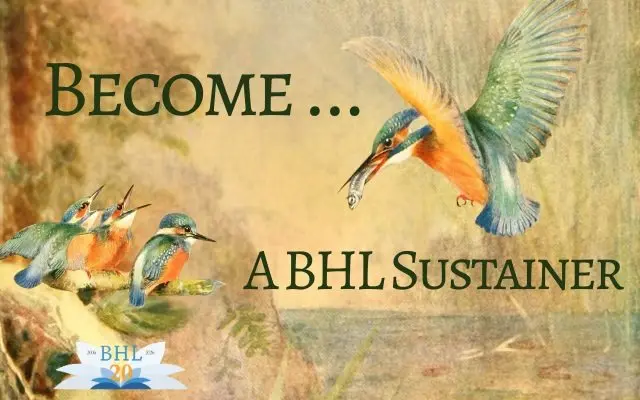
Drawing a poetic parallel to the natural world, BHL literature often highlights the delicate processes of life—such as the upbringing of baby kingfishers or the intricate illustrations of avian eggs found in historic natural history plates. Just as these natural systems rely on consistent, foundational support to thrive, the digital repository requires steady, reliable contributions of all sizes to endure.
How to Get Involved
As BHL looks toward its third decade of operation, the call to action remains clear and urgent. The global community successfully united to give the library wings; the next challenge is ensuring those wings never stop beating.
Individuals and institutions wishing to support the ongoing mission can do so in several ways:
- Become a Monthly Sustainer: Set up a recurring donation of any size through the official BHL Sustainers Donation Portal. Donations can be made in over 135 currencies.
- Legacy and Major Giving: Supporters interested in major gifts, wire transfers, bequests, or other legacy giving options can explore tailored pathways via the BHL Ways to Give page.
- Spread the Word: Researchers, educators, artists, and writers whose work relies on natural history literature are encouraged to advocate for institutional memberships and share the importance of open-access biodiversity archives within their professional networks.
The Biodiversity Heritage Library belongs to everyone who has ever looked at a blooming flower, tracked an endangered bird, or marveled at the complexity of evolutionary history. By transforming a moment of crisis into an opportunity for decentralized global ownership, the BHL community has proven that the collective love for nature’s literature can overcome any institutional barrier. Now, the task ahead is to sustain that legacy for generations to come.



