The global automotive landscape has crossed a historic threshold. According to groundbreaking new data released by the energy think tank Ember, electric vehicles (EVs) officially accounted for more than 25% of all new car sales worldwide in 2025. This milestone represents a monumental acceleration in the global energy transition. Just a half-decade ago, widespread EV adoption was largely confined to a handful of heavily subsidized Western markets and early-adopting Scandinavian nations. Today, the narrative has fundamentally changed.
The primary catalyst behind this unprecedented growth is not found in legacy automotive powerhouses like the United States or Japan, but rather in dynamic emerging markets. Nations across Southeast Asia, Latin America, and the Middle East—many of which registered virtually zero electric vehicle sales at the turn of the decade—are now leapfrogging traditional internal combustion engine (ICE) adoption phases altogether. Powered by strategic government policies, aggressive tax incentives, and an influx of affordable, high-quality Chinese EV exports, these emerging economies are steering the wheel of the global transport revolution.
As the center of gravity in the automotive world shifts toward the Global South, the implications for the fossil fuel industry are profound. With battery-electric vehicles proving to be vastly more efficient than their internal combustion counterparts, oil demand is facing structural headwinds sooner and more aggressively than previously anticipated. This deep-dive report analyzes the data, tracks the geographic shifts, examines the geopolitical trade dynamics, and evaluates what this 25% tipping point means for the future of global mobility.
Detailed Chronology: From Niche Market to Global Dominance
To fully comprehend the magnitude of the 2025 EV boom, one must examine the rapid velocity of change over the past several years. The transformation of the electric vehicle market from an affluent novelty into a dominant mass-market force is one of the fastest industrial shifts in modern history.
The 2019 Baseline: A Four-Country Club
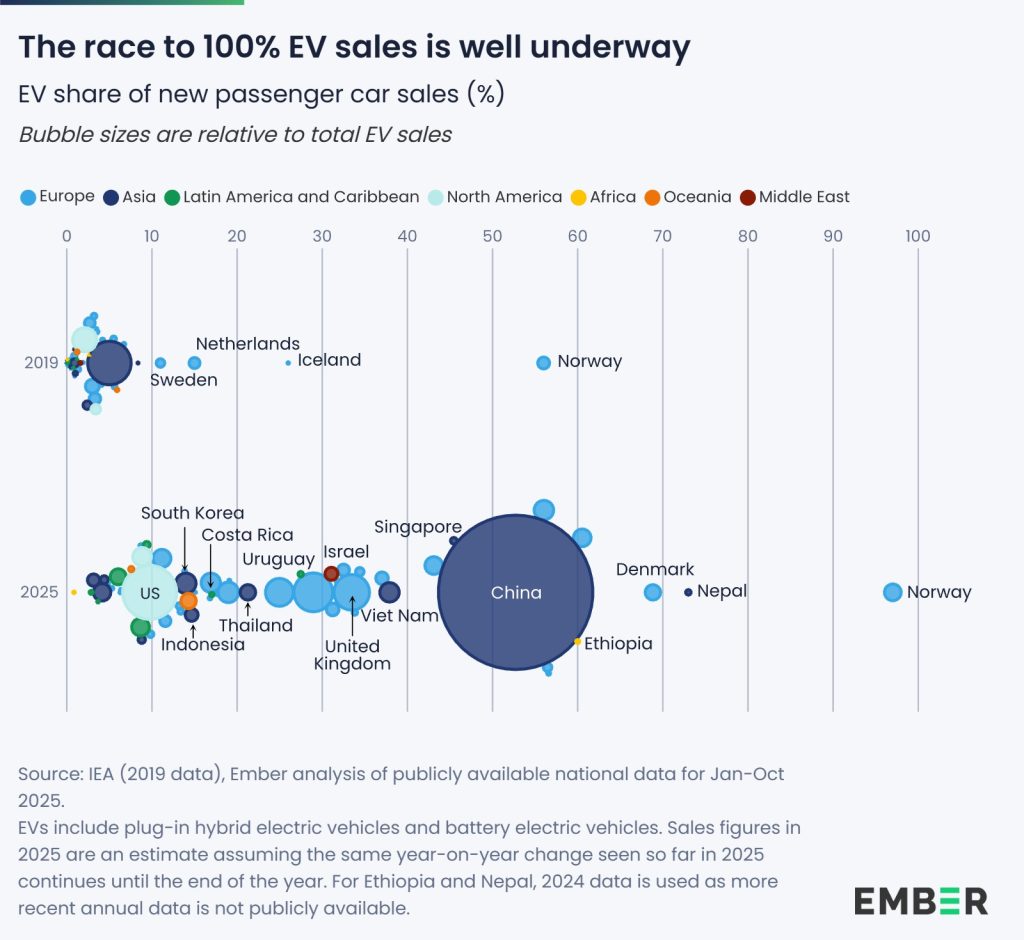
Back in 2019, the global EV market was exceptionally concentrated. According to Ember’s historical datasets, there were only four countries on the entire planet where electric vehicles managed to capture more than 10% of total new car sales. These pioneers were predominantly Scandinavian nations—led by Norway—alongside isolated pockets of early policy-driven adoption in California and select Chinese megacities. For the vast majority of the world, buying an EV meant navigating sparse charging infrastructure, exorbitant upfront vehicle costs, and a severe lack of model availability.
The Post-Pandemic Acceleration (2020–2023)
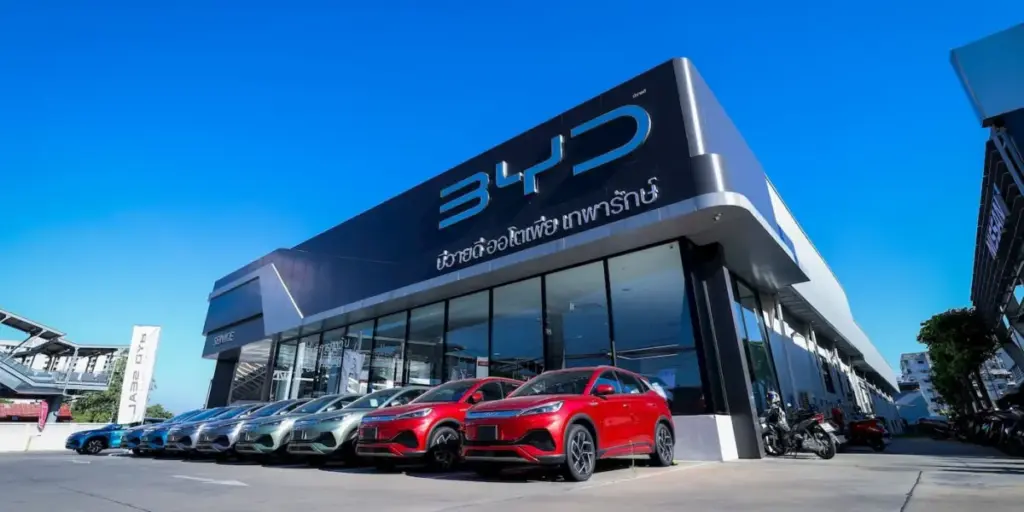
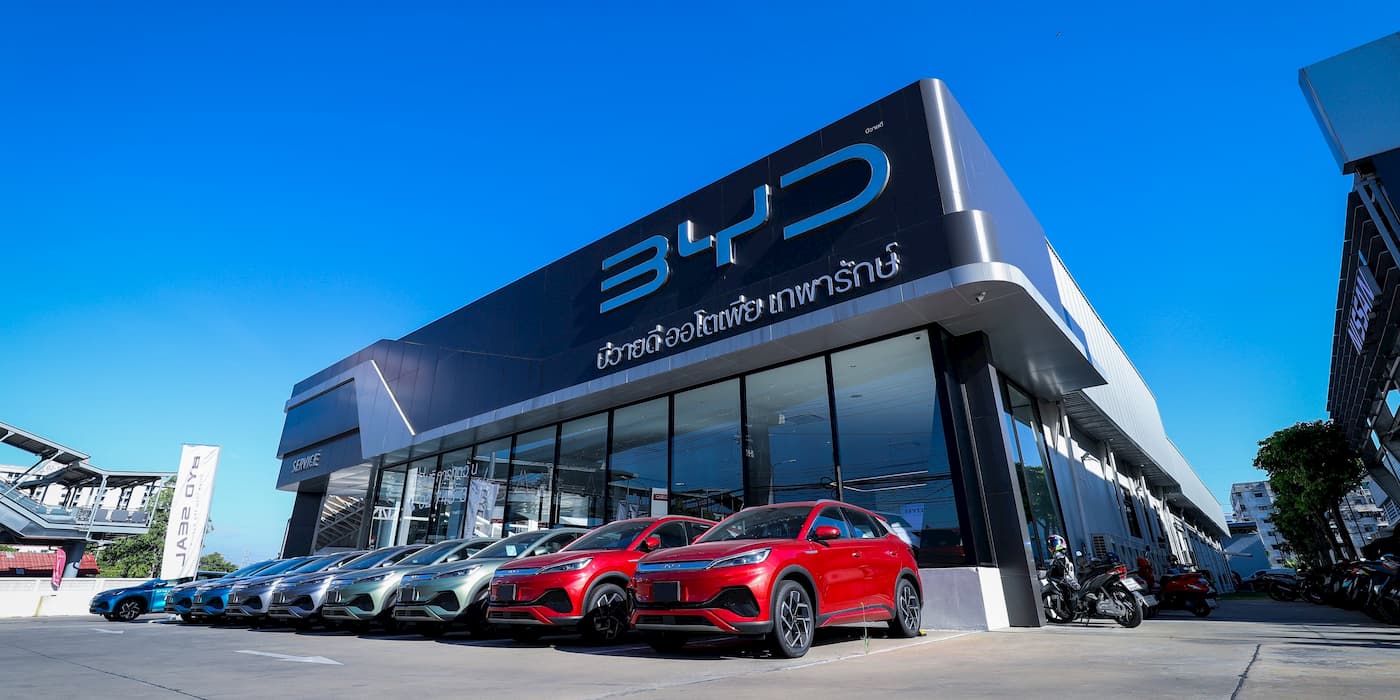
The COVID-19 pandemic acted as an unexpected stress-test and catalyst for green technologies. While global supply chains fractured, policy frameworks in Europe and China hardened around net-zero commitments. By mid-2023, legacy automakers began pivoting capital expenditures away from combustion platforms toward dedicated EV architectures. Crucially, this era marked the aggressive international expansion of Chinese automakers. Facing fierce domestic competition and a localized price war, companies like BYD, SAIC, and Great Wall Motor looked outward, flooding non-OECD markets with competitively priced battery-electric vehicles (BEVs) and plug-in hybrids (PHEVs).
The 2025 Tipping Point: A Polycentric EV Ecosystem
Fast-forward to 2025, and the baseline has completely inverted. Ember’s comprehensive analysis reveals that there are now 39 countries where electric vehicles make up more than 10% of new car sales. More importantly, the geographic distribution of these sales has decentralized. The race is no longer a bilateral competition between China and the European Union. Instead, a polycentric ecosystem has emerged, characterized by hyper-growth in developing economies that are bypassing the traditional milestones of automotive development.
Supporting Context & Metrics: The Rise of the New Vanguard
The traditional heavyweights of the automotive industry are finding themselves outpaced by nimble, policy-agile emerging economies. The metrics compiled in Ember’s 2025 report highlight remarkable anomalies and power shifts that would have seemed implausible just a few years ago.
The ASEAN Surge: Singapore, Vietnam, Thailand, and Indonesia
The Association of Southeast Asian Nations (ASEAN) region has transformed into an unexpected epicentre of global EV adoption.
Singapore and Vietnam: Both nations have skyrocketed to an extraordinary 40% EV sales share, effectively leapfrogging legacy automotive markets like the United Kingdom and the broader European Union. Dense urban planning, proactive sovereign incentives, and a tech-savvy consumer base have greased the wheels for this rapid transition.
Thailand: Long known as the "Detroit of Asia" due to its heavy reliance on Japanese ICE vehicle manufacturing, Thailand has made a dizzying pivot. The nation achieved a 20% EV market share in 2025. In a testament to its velocity, Thailand sold more electric vehicles in the first three quarters of 2025 than Denmark—a country universally lauded as a mature green-transport leader.
Indonesia: Leveraging its vast domestic reserves of nickel—a critical mineral for lithium-ion battery chemistry—Indonesia has aggressively courted battery and EV manufacturers. The country reached a 15% EV sales share in 2025, officially surpassing the United States market adoption rate for the first time.
Latin America and the Middle East Join the Fray
The momentum is not isolated to Asia. Emerging markets across Latin America and the Middle East are recording impressive figures:
Uruguay: Demonstrating that South America is ready for electric mobility, Uruguay has achieved a remarkable 27% EV share, placing it roughly on par with the standards of the European Union.
Mexico and Brazil: Both nations are experiencing steady, exponential curves of adoption. Their growth rates have now outstripped Japan, where domestic EV market share has stagnated at roughly 3% since 2022 due to a deeply entrenched domestic preference for hybrid technologies.
Türkiye: Positioned strategically at the crossroads of Europe and Asia, Türkiye hit a 17% EV share in 2025. This performance allowed it to overtake Belgium, solidifying Türkiye’s status as Europe’s fourth-largest battery-electric vehicle market by sheer volume.
The Trade Pipeline: Emerging Markets Fueling Chinese Export Growth
A vital pillar of this global expansion is the realignment of international trade routes. Data indicates that since mid-2023, virtually all growth in Chinese EV exports has been directed away from protected Western markets (such as the United States and, increasingly, the European Union due to anti-subsidy tariffs) and toward non-OECD markets.
Countries such as Brazil, Mexico, the United Arab Emirates, and Indonesia now comprise the top destinations for Chinese automotive exports. Governments in these regions have shrewdly implemented welcoming regulatory frameworks, slashing import tariffs and offering localized tax breaks for consumers, while simultaneously demanding that foreign automakers invest in domestic manufacturing ecosystems.
Official Statements and Industry Insights
The speed and structural nature of this market transformation have drawn high praise and analytical warnings from industry experts.
Euan Graham, a leading electricity and data analyst at Ember, captured the essence of the 2025 shift in a recent statement:
"This is a major turning point. In 2025, the center of gravity has moved. Emerging markets are no longer catching up; they are leading the shift to electric mobility. These countries see the strategic advantages of EVs, from cleaner air to reduced fossil fuel imports."
Graham emphasizes that the motivation behind this transition in the Global South goes far beyond abstract climate goals. For many emerging economies, transitioning to electric vehicles is a matter of macroeconomic survival and energy security. By swapping imported crude oil—which drains foreign exchange reserves and exposes domestic economies to volatile geopolitical commodity shocks—for domestically generated electricity (often powered by local solar and wind resources), these nations are securing long-term financial stability.
Furthermore, Graham highlighted the immediate ecological and infrastructural dividends already being realized:
"Emerging markets will shape the future of the global car market. The choices made now on charging infrastructure and early support will determine how fast this momentum continues."
The Macro Impact: Decimating Fossil Fuel Demand
One of the most profound takeaways from the 2025 Ember analysis is the immediate, tangible effect that rising EV adoption is having on global fossil fuel consumption.
Skeptics of the energy transition have historically argued that electric vehicles merely shift emissions from tailpipes to smokestacks, particularly in developing nations where power grids still rely heavily on coal or natural gas. However, thermodynamic physics heavily favors electrification.
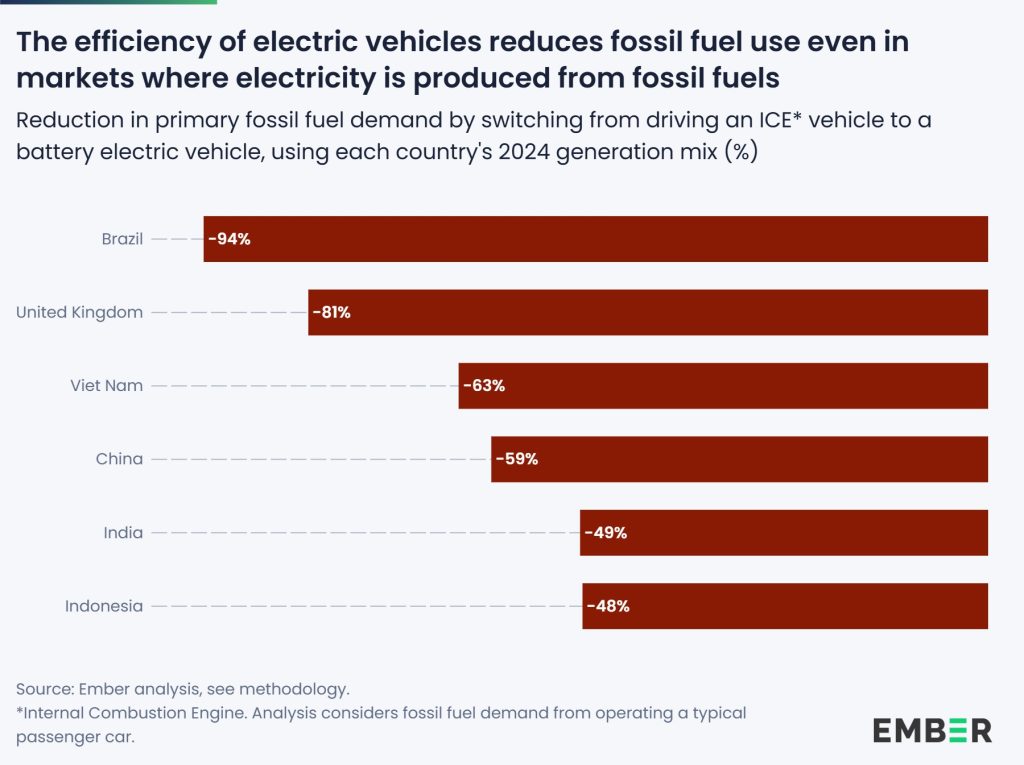
Electric motors are roughly three times more efficient than internal combustion engines. Consequently, even in power grids with a heavy fossil-fuel baseline, replacing gas-guzzling cars with EVs results in an immediate and dramatic net reduction in primary oil demand.
The report highlights staggering regional examples:
Brazil: Benefiting from a grid that is already predominantly powered by renewable hydroelectric energy, the adoption of battery-electric vehicles has cut fossil fuel demand by an astonishing 90%.
Indonesia: Despite maintaining a power grid heavily reliant on coal, the sheer efficiency gains of electric drivetrains have successfully reduced fossil fuel demand by nearly half compared to equivalent ICE vehicle operations.
These efficiency metrics prove that waiting for a 100% decarbonized electrical grid before deploying electric vehicles is a false dilemma. EVs improve energy efficiency immediately upon rolling off the showroom floor.
Future Outlook: Navigating the Road Ahead
As the world looks past 2025, the trajectory of the global automotive market is clear: internal combustion engines are in structural, irreversible decline, and electric vehicles are the undisputed future of transport. However, the next phase of this transition will not be without friction.
The speed at which emerging markets can sustain their current momentum will depend heavily on three critical factors:
Charging Infrastructure Deployment: As seen in initiatives like commercial parking electrification rollouts (such as LAZ Parking’s recent commitment to deploy chargers across 50,000 everyday parking spaces), convenient, ubiquitous charging is paramount. Emerging markets must avoid range-anxiety bottlenecks by scaling urban and highway charging networks at a pace that matches vehicle sales.
Grid Modernization: As millions of new vehicles plug into regional grids, utility providers must invest in smart-charging technologies, grid upgrades, and localized renewable generation to handle surging electricity demand without destabilizing local infrastructure.
Geopolitical and Trade Resilience: With trade tensions simmering between Western superpowers and Chinese manufacturing hubs, emerging markets will need to carefully navigate diplomatic and economic ties to ensure continued access to affordable clean-transport technology.
The 25% global EV tipping point of 2025 proves that the electrification of transport is no longer an exclusive luxury for the wealthy West. It is a truly global phenomenon, driven by the undeniable economic, environmental, and strategic benefits demanded by consumers and policymakers across every corner of the planet.