

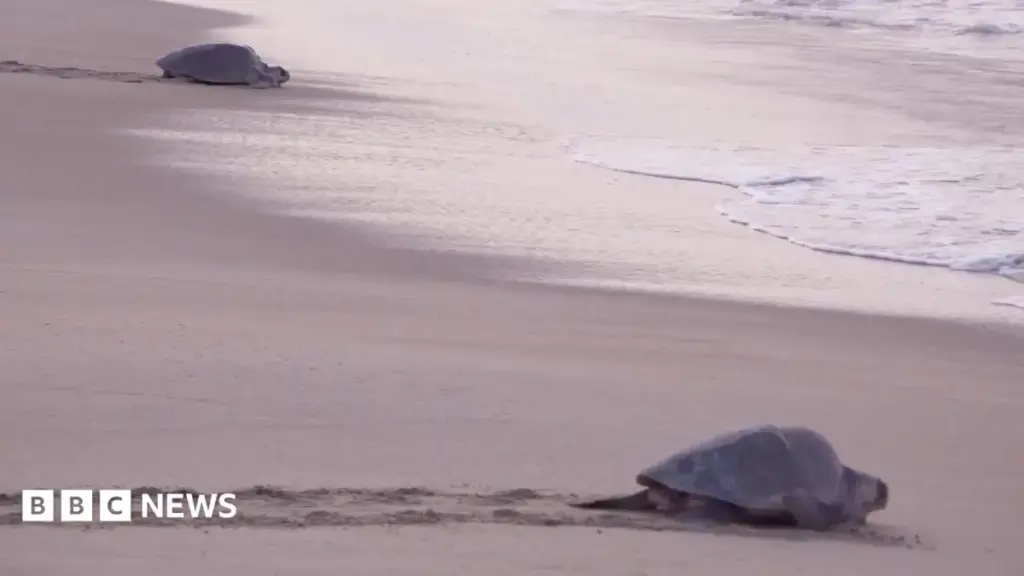
OAXACA, MEXICO — In a breathtaking display of synchronization driven by evolutionary imperatives older than human civilization itself, an estimated multitude of olive ridley sea turtles (Lepidochelys olivacea) surged ashore at La Escobilla beach in the southern Mexican state of Oaxaca. According to sanctuary officials monitoring the coastline, this colossal mass-nesting event—locally and internationally celebrated as la arribada (the arrival)—unfolded over an intense, highly concentrated 48-hour window.
The phenomenon saw hundreds of thousands of marine reptiles emerge from the churning Pacific surf under the cover of night and the glare of the tropical sun, transforming miles of pristine golden sand into a living, shifting tapestry of shells. This remarkable biological surge marks the sixth major wave of nesting activity recorded during the current season, which officially commenced in March and continues to defy the mounting pressures of anthropogenic climate change and coastal degradation.
Executive Overview
The recent mass nesting at La Escobilla stands as one of the most significant ecological events of the marine calendar in the Western Hemisphere. La Escobilla, alongside Playa Escanilla in Costa Rica, remains one of the premier sanctuaries globally for the olive ridley species, acting as an irreplaceable crucible for the continuation of the lineage.
Within a strict 48-hour period, park rangers, marine biologists, and conservation volunteers documented a staggering density of nesting females. This particular wave—the sixth of the 2024–2025 season—has underscored both the resilience of the species and the critical importance of sustained, community-backed conservation frameworks. While arribadas are a natural wonder, they are also moments of profound vulnerability. Millions of eggs deposited in close proximity create a rich nutritional target for natural predators, while human-induced pressures, ranging from poaching to plastic pollution, loom heavily over the shoreline.
This comprehensive report details the chronological unfolding of the event, examines the ecological metrics and historical context governing the arribada, analyzes official statements from environmental authorities, and evaluates the long-term outlook for the olive ridley turtle in an era of rapid environmental transformation.
Detailed Chronology of a Natural Phenomenon
To understand the magnitude of the recent event at La Escobilla, one must trace the timeline of how an arribada develops, peaks, and recedes. Marine biologists note that while the triggers of an arribada remain partially shrouded in scientific mystery—likely a complex cocktail of offshore wind patterns, lunar phases, ocean currents, and pheromone signaling—the physical execution of the event follows a rigorous, almost militaristic chronology.
Phase One: The Offshore Aggregation (Days -5 to -1)
Weeks before the physical landing on the beaches of Oaxaca, adult olive ridleys begin congregating in the warm, nutrient-rich coastal waters just offshore from La Escobilla. During this pre-nesting staging period, the turtles feed, mate, and synchronize their physiological cycles. Scientists from the Mexican Center for the Protection of Sea Turtles (CMPTM) observed unusually high densities of floating marine aggregations in the days leading up to the event. The females, laden with developing eggs, wait offshore until environmental cues reach a critical threshold, prompting a collective decision to move shoreward.
Phase Two: The Initial Surge (Hours 0 to 12)
The vanguard of the sixth wave hit the shoreline just after dusk. Moving with a deliberate, heavy grace, the first wave of turtles breached the surf line, testing the sand conditions with their flippers. As the tide crested, the trickle quickly transformed into a torrent. By midnight, tens of thousands of turtles were navigating the beach simultaneously.
Eyewitness accounts from sanctuary workers describe a surreal landscape where the sound of scraping shells and rhythmic flipper-sweeps drowned out the roar of the ocean waves. During this initial twelve-hour window, the highest concentration of nesting occurred along a central two-kilometer stretch of La Escobilla. Females rapidly excavated body pits using their rear flippers, deposited an average of 100 leathery, ping-pong-ball-sized eggs into the warm earth, covered them meticulously, and dragged themselves back toward the sea.
Phase Three: Peak Saturation and Spatial Overlap (Hours 12 to 36)
As the sun rose over the Oaxacan coast, the intensity of the arribada did not wane; instead, it reached a saturation point. With thousands of turtles vying for prime nesting real estate above the high-tide line, a fascinating and delicate ecological conflict unfolded: spatial overlap.
Later-arriving turtles frequently dug into nests deposited by earlier arrivals, inadvertently unearthing previously laid eggs. While this density can lead to a certain percentage of destroyed eggs, conservationists emphasize that this is a natural evolutionary trade-off of the arribada strategy. The sheer volume of eggs deposited—numbering in the tens of millions—overwhelms local predators, ensuring that a statistically significant percentage survives to hatching.
Phase Four: The Ebb and Post-Arribada Calm (Hours 36 to 48)
By the end of the second day, the relentless wave of reptiles began to subside. The thinning lines of turtles returning to the Pacific left behind a deeply churned landscape resembling a plowed agricultural field rather than a natural beach. Sanctuary officials immediately shifted their operational focus from crowd and predator management to ecological assessment and security protocols. Patrol units deployed across the beach to map the nesting density boundaries and secure vulnerable sections of the sand against illegal harvesting.
Supporting Context & Metrics
To fully grasp the significance of the La Escobilla arribada, one must examine the biological metrics, historical population data, and the unique physiological characteristics of the olive ridley turtle (Lepidochelys olivacea).
+-----------------------------------------------------------------+
          OLIVE RIDLEY (Lepidochelys olivacea) QUICK METRICS
+-----------------------------------------------------------------+
| Adult Carapace Length : 60 – 70 cm (24 – 28 inches)            |
| Average Adult Weight  : 35 – 50 kg (77 – 110 lbs)              |
| Clutch Size (Eggs)    : 80 – 120 per nest                      |
| Incubation Period     : 45 – 55 days (temperature-dependent)   |
| Global Conservation   : Vulnerable (IUCN Red List)             |
| Primary Nesting Mode  : Synchronous Mass Nesting (Arribada)    |
+-----------------------------------------------------------------+
The Biology of the Arribada
Unlike most sea turtle species—such as the green turtle (Chelonia mydas) or the hawksbill (Eretmochelys imbricata)—which nest solitarily or in small groups throughout the season, the olive ridley and its close relative, Kemp’s ridley (Lepidochelys kempii), have evolved the unique strategy of mass synchronization.
This behavior is an evolutionary adaptation known as "predator saturation." By concentrating millions of vulnerable eggs and hatchlings into a brief window of time, the turtles ensure that local predators—including coyotes, coatis, crabs, vultures, and stray dogs—simply cannot consume more than a fraction of the available biomass. Once the predators are completely satiated, the remaining millions of hatchlings are left to make their unimpeded dash to the sea.
Historical Context of La Escobilla
La Escobilla is not merely a geographic location; it is a monument to successful modern conservation. In the mid-20th century, Mexican coastal communities engaged in extensive commercial exploitation of sea turtles. Meat, leather, and eggs were harvested on an industrial scale, driving populations of olive ridleys toward the brink of collapse.
In 1990, the Mexican federal government enacted a total, indefinite ban on the capture and commercialization of all marine turtles, recognizing the urgent need for intervention. Coupled with the establishment of protected sanctuaries like the Sanctuary of La Escobilla (established as a protected natural area), the turtle populations began a slow, multi-decade recovery. Today, La Escobilla stands alongside Playa Nancite in Costa Rica as one of the few places on Earth where large-scale arribadas still occur with regularity.
Environmental Stressors and Metrics
Despite the inspiring scale of the sixth wave, marine biologists caution against viewing the numbers through a lens of uncritical optimism. The species faces continuous, compounding pressures:
- Climate Change: Sea surface temperature increases not only disrupt marine food webs (such as the availability of pelagic crabs, shrimp, and fish that form the core of the olive ridley’s diet) but also skew sex ratios. Sea turtle sex determination is temperature-dependent; warmer sands produce a disproportionate number of female hatchlings, threatening long-term demographic balance.
- Marine Plastic Pollution: Ingestion of marine debris and entanglement in ghost nets continue to claim the lives of adult turtles during their pelagic migrations.
- Coastal Development: Light pollution from expanding beachfront settlements disorients emerging hatchlings, drawing them inland toward highways and predators rather than toward the reflective horizon of the ocean.
Official Statements and Expert Analysis
The scale and timing of the sixth wave prompted immediate responses from federal environmental agencies, researchers, and local conservation alliances operating along the Oaxacan coast.
Dr. Elena Vasquez-Morales, senior marine ecologist at the National Autonomous University of Mexico (UNAM) and lead scientific advisor to the Oaxaca turtle protection program, emphasized the ecological implications of the event:
"What we witnessed over these 48 hours at La Escobilla is a masterclass in evolutionary resilience. The synchronization of these animals is nothing short of miraculous. However, we must remain sober in our assessment. An arribada is a high-stakes ecological lottery. The sheer volume of nests deposited is essential, but the survival of this generation depends entirely on our capacity to maintain clean oceans, stable beach profiles, and rigorous enforcement against poaching over the next 55 days while these eggs incubate."
Representatives from Mexico’s Secretariat of Environment and Natural Resources (SEMARNAT) and the National Commission of Protected Natural Areas (CONANP) issued joint communiques detailing the deployment of enhanced security and monitoring details.
"The protection of La Escobilla during an arribada requires a coordinated civil-military and scientific effort," stated CONANP regional director Javier Mendez-Rios. "Federal wildlife rangers, supported by elements of the Mexican Navy and local community cooperatives, have established a 24-hour perimeter. Our primary objectives are twofold: safeguarding the nesting females from human interference and ensuring that the structural integrity of the nesting beds is preserved against accidental vehicular or human compaction."
Local conservation cooperatives, many of which transitioned decades ago from turtle harvesting to eco-tourism and conservation guardianship, played an indispensable role on the ground. Mateo Ruiz, coordinator of the La Escobilla Community Protection Brigade, spoke on the changing cultural relationship with the species:
"Our parents and grandparents saw these turtles as a resource to be consumed. Today, our children see them as our heritage and our responsibility. When an arribada like this happens, the entire community wakes up. We patrol the beaches through the night, we rescue disoriented hatchlings from the brush, and we take immense pride in knowing that the world is looking at Oaxaca and seeing how nature can heal when we step back and protect it."
Future Outlook: Safeguarding the Legacy of the Olive Ridley
As the physical traces of the sixth wave begin to blend back into the natural topography of La Escobilla, attention within the scientific and conservation communities turns inexorably toward the future. The immediate challenge is the incubation period. Over the next 45 to 55 days, the millions of eggs deposited during this 48-hour window will develop beneath the sun-baked sands of Oaxaca.
Anticipating Future Waves
While the sixth wave has concluded, sanctuary officials note that the nesting season is far from over. Historical data suggests that subsequent waves—a seventh and potentially an eighth—could materialize before the season winds down toward late autumn or early winter, provided oceanographic conditions remain favorable and food sources in the pelagic zones stay abundant.
Policy and Conservation Recommendations
To ensure that future generations continue to witness the awe-inspiring spectacle of la arribada, conservationists outline several critical pathways for policy action:
- Expansion of Marine Buffer Zones: Establishing strict no-fishing and low-speed navigation zones up to five miles off the coast of La Escobilla to protect pre-nesting turtles from propeller strikes and commercial fishing gear entanglement.
- Advanced Climate Mitigation Research: Investing in long-term studies regarding sand temperatures at key nesting beaches, with potential deployment of experimental shading structures or artificial irrigation techniques if thermal stress threatens catastrophic hatching failure.
- Strengthened Community-Based Enforcement: Providing increased financial and logistical support to local cooperatives and indigenous groups who act as the frontline defenders of the sanctuary.
- Light Pollution Regulations: Enforcing stringent zoning and lighting ordinances for current and future real estate developments along the Oaxacan coast to eliminate artificial horizon glow that misleads both nesting females and emerging hatchlings.
Conclusion
The massive arrival of olive ridley turtles at La Escobilla beach is a powerful reminder of the enduring, ancient rhythms of the natural world. In an epoch defined by ecological loss and habitat fragmentation, the sight of hundreds of thousands of marine reptiles reclaiming their ancestral shoreline offers a profound testament to the power of targeted, science-driven conservation. As the eggs incubate beneath the warm sands of Oaxaca, the global community is reminded that the survival of these magnificent creatures is inextricably linked to our own stewardship of the marine environment.



