As the Biodiversity Heritage Library (BHL) marks its momentous 20th anniversary, celebratory reflections often center on the sheer volume of digitized biodiversity literature—millions of pages of fragile texts, historical illustrations, and irreplaceable archives now freely accessible to anyone with an internet connection. Yet, behind every high-resolution scan lies a human story of persistence, institutional coordination, and cross-border collaboration.
In this special contribution to the BHL at 20: Treasures from the Biodiversity Heritage Library series, Bianca Crowley, Digital Collections Manager for the BHL, shifts the focus from the content of the texts to the arduous, backstage labor required to bring them from dusty physical shelves onto digital screens. At the heart of this narrative is an extraordinary 11-year undertaking: the complete digitization of the public-domain volumes of the Journal of The Asiatic Society and its legacy publications.
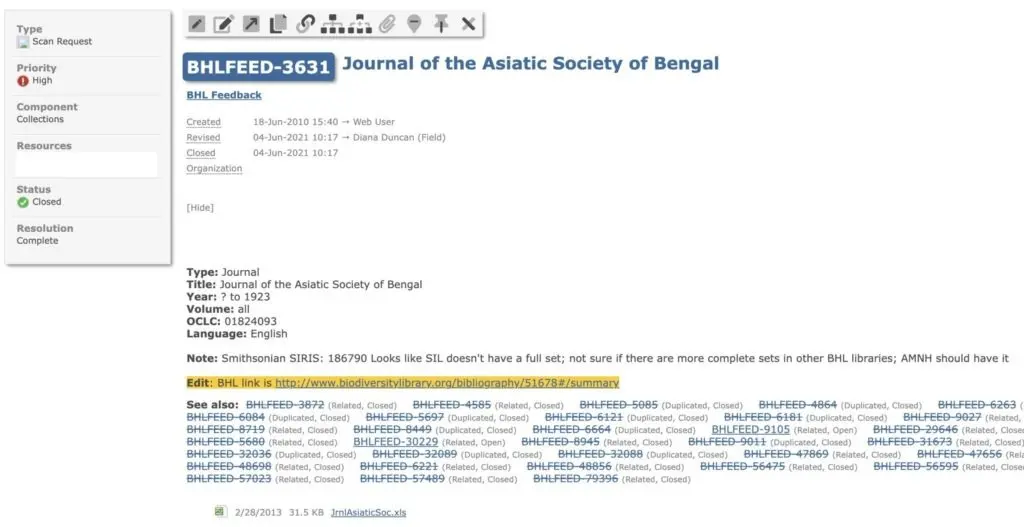
Spanning from June 2010 to June 2021, this monumental project required the synchronized efforts of 9 founding and partner institutions, 19 dedicated contributors, and an intricate digital paper trail managed through BHL’s issue-tracking systems. The completed collection represents far more than a technical achievement; it safeguards the legacy of the oldest surviving publishing house in India and a foundational pillar of modern Asian studies. This article examines the historical weight of The Asiatic Society, the logistical hurdles of a distributed labor model, and the roadmap for modernizing digital curation as BHL steps into its next operational chapter.
Detailed Chronology: An Eleven-Year Archival Labor
The story of the Journal of The Asiatic Society begins long before the advent of digital repositories. Founded in Kolkata in 1784 by British Orientalist and jurist Sir William Jones through British India’s highest court, the Asiatick Society was established with an ambitious mandate: to study the "History, Civil and Natural, the Antiquities, Arts, Sciences, and Literature of Asia." More than 240 years later, The Asiatic Society endures as a vital institution of learning, designated by the Indian government as an Institution of National Importance. Its publications—spanning from 1788 to the present day—cover a sprawling interdisciplinary landscape encompassing the cultural, natural, and medical sciences.
Bringing these irreplaceable texts into the digital age was not the result of a heavily funded, centralized grant project. Instead, it was an organic, incremental marathon. In June 2010, BHL consortium members initiated a cataloging and scanning pipeline dedicated to the series of titles associated with the Journal of The Asiatic Society.
What followed was an 11-year operational trial. Over the course of the project, the workflow generated:
9 participating institutions coordinating scanning, cataloging, and quality control.
19 individual contributors navigating disparate technical environments and institutional protocols.
40 distinct tickets logged within BHL’s issue-tracking system (Gemini).
Over 82 substantive comments and revisions, detailing everything from missing page numbers to bibliographic discrepancies and hardware failures.
By June 2021, the painstaking curation of all public-domain volumes within the Journal’s historical lineage was finally declared "complete" to the best of the consortium’s ability. Alongside the core journal volumes, the project successfully integrated the Society’s Memoirs and an array of associated legacy publications into BHL’s open-access ecosystem, ensuring that foundational works—such as the landmark 1806 edition of Asiatic Researches; or, Transactions of the Society Instituted in Bengal—are preserved for global scholarship.
The completion of the Asiatic Society project underscores a fundamental reality of the Biodiversity Heritage Library: BHL operates not as a monolithic, centrally funded corporation with a dedicated army of digitization technicians, but as a decentralized federation of independent partners.
The Backbone of Distributed Labor: Issue Tracking
Managing a project involving multiple institutions, shifting personnel, and a timeline stretching over a decade requires robust communication channels. BHL achieved this synchronization through Gemini, an issue-tracking system deployed across the consortium. Originally designed for software bug tracking and platform maintenance, Gemini became the centralized "source of truth" for physical scan requests, gap identification, cataloging remediation, and workflow documentation.
For a globally distributed workforce, this administrative architecture was non-negotiable. Tracking the back-and-forth communication among 19 people over eleven years without such a platform would have been practically impossible. It provided a transparent, accountable framework that allowed institutions separated by oceans and time zones to operate as a cohesive unit.
The Ebb and Flow of Resourcing
The slow pace of the Asiatic Society digitization reflects broader systemic realities within the cultural heritage sector. Since the closure of BHL’s major grant funding through the MacArthur Foundation in 2013, participating institutions have had to navigate fluctuating internal budgets, staffing shortages, and shifting institutional priorities.
Furthermore, technical and physical bottlenecks routinely interrupted the workflow:
Physical Constraints: Fragile bindings, degraded paper quality, and tightly bound gutters required specialized, careful scanning equipment and techniques to avoid damaging original texts.
Metadata Complexities: Historical name changes, complex serial hierarchies, and legacy catalog records necessitated extensive cross-referencing and bibliographic curation.
Software and Training: Aligning disparate institutional scanning standards required ongoing documentation, troubleshooting, and peer training.
Because BHL’s distributed labor model allows partners to "come as they are"—contributing resources, time, and expertise only when institutional capacities permit—projects of this scale naturally require extended timelines.
Official Statements & Institutional Perspectives
Reflecting on the milestone, Bianca Crowley emphasizes that the true treasures of the Biodiversity Heritage Library extend far beyond rare paper and ink.
"As the Digital Collections Manager for the Biodiversity Heritage Library, my take on the treasures of BHL’s collection is less about the content or significance of any particular title, and more about the work over many (many) years behind the scenes by the people within BHL partner institutions to bring these treasures from the shelves to the screen and make them accessible and discoverable for anyone with an internet connection."
This human-centric philosophy is particularly vital as BHL navigates a significant institutional transition. Recently, the organization adopted a shared-ownership model designed to foster greater autonomy, decentralization, and independence from any single host institution. Yet, the core ethos remains unchanged: cross-border, cross-institutional collaboration dedicated to making humanity’s shared biodiversity knowledge openly accessible.
Crowley notes that while grassroots collaboration has sustained BHL for two decades, long-term sustainability requires financial fortification.
"If BHL were fortunate enough to secure a major source of long-term funding, centralized resources could help support the processing, digitization, and integration of content across the collection. Please consider supporting the Biodiversity Heritage Library with a recurring donation or planned gift."
Future Outlook: Modernizing for Efficiency
While the successful digitization of the Journal of The Asiatic Society legacy volumes is a crowning achievement in persistence, an 11-year turnaround for a single journal series is an operational timeline that the library aims to shorten in the future.
As BHL drafts its next strategic chapter—guided by the foundational principles of its recent organizational transition—the consortium is actively pursuing platform modernization and workflow optimization. Crowley outlines several critical imperatives for the digital library moving forward:
Streamlining Workflows: Reducing friction between physical artifact handling and digital ingestion by standardizing metadata templates and digitizer training modules.
Enhancing Discovery: Upgrading search indexing and data architectures to ensure that historical texts, such as those from The Asiatic Society, are fully text-searchable and easily integrated with modern taxonomic databases.
Deepening Partnerships: Cultivating new global alliances that can share the labor burden of scanning and curation, particularly in regions whose historical literature remains underrepresented in digital repositories.
Securing Sustainable Funding: Building diversified revenue streams and endowment structures to transition away from purely ad-hoc, resource-dependent processing models.
Conclusion: Sustaining the Next Chapter
The 11-year journey of the Journal of The Asiatic Society in BHL stands as a monument to what can be achieved when global institutions unite under a shared vision of open access. It demonstrates that preserving the history of science is not merely a technical procedure, but an ongoing act of international stewardship.
As the Biodiversity Heritage Library celebrates its 20th anniversary and looks toward the horizon, the dedication of its global community ensures that the intellectual fabric of human history—from the natural histories of 18th-century Asia to the modern biodiversity archives of today—will remain open, discoverable, and preserved for generations to come.