

By Naeemah Dudan, Digital Specialist for Greenpeace Africa
Executive Overview
For generations, the definition of wealth was deceptively straightforward. To be rich meant possessing vast amounts of capital—enough to live extravagantly, acquire luxury goods without hesitation, and remain entirely insulated from the rising costs of everyday life. However, this narrow conceptualization of affluence is undergoing a fundamental transformation. As unprecedented economic inequality collides with an escalating climate crisis, the conversation surrounding extreme wealth has evolved from a matter of personal status into a critical systemic debate.
At a time when governments worldwide struggle to finance public services, combat soaring living costs, and respond to environmental catastrophes, wealth is increasingly concentrated in the hands of a microscopic elite. This imbalance is not merely a statistical anomaly; it is a structural driver of societal instability and ecological degradation.
Enter the Fair Share for People and Planet campaign—a global Greenpeace initiative fighting for equitable international tax rules. Recently, this movement crossed a monumental threshold: 200,000 individuals have officially added their names to the Tax the Super-Rich petition. From high-profile protests in Venice to diplomatic interventions at the G20 in Johannesburg, this campaign demonstrates that the capital required to fund a sustainable, equitable future already exists. It is simply in the wrong hands.
Detailed Chronology: The Global Fight for Tax Justice
The momentum behind the global tax justice movement has accelerated dramatically through a series of coordinated, high-visibility actions across multiple continents.
2025: Mobilization at the World Economic Forum and Beyond
The campaign’s offensive against unbridled wealth began in earnest at the start of 2025. In January, Greenpeace International activists from across Europe staged a symbolic "confiscation" of private jets at Engadin Airport in Samedan, Switzerland. This high-profile intervention targeted participants attending the World Economic Forum (WEF) in Davos, directly calling out the top 1% of the world’s population whose carbon-heavy lifestyles and hoarded wealth supercharge the climate emergency.

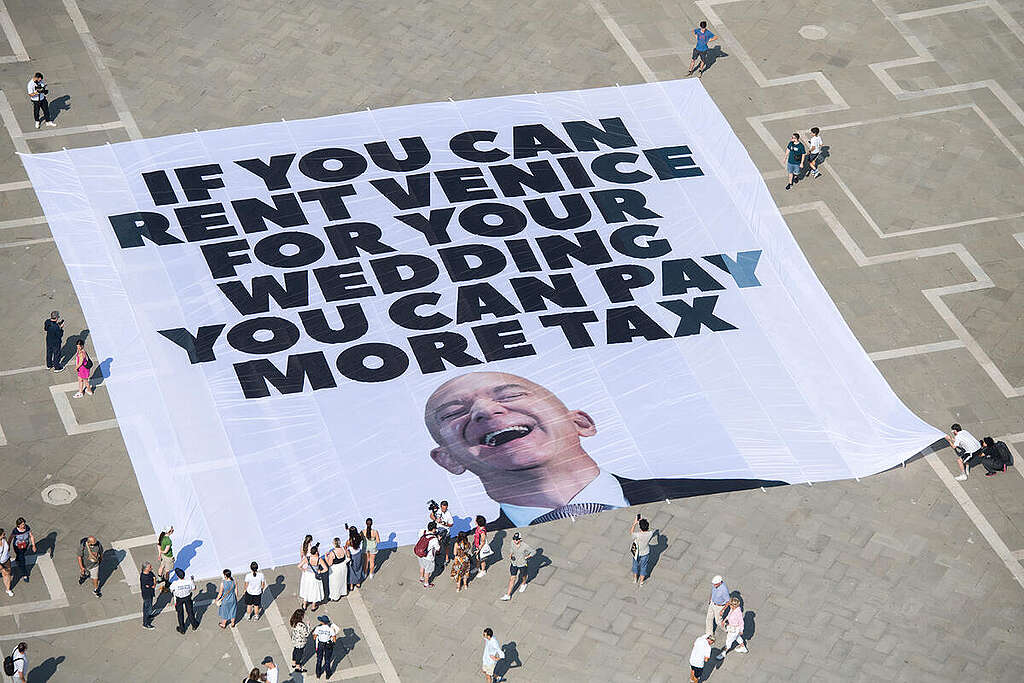
By June 2025, the movement captured global headlines in Italy. Activists from the UK group "Everyone Hates Elon" and Greenpeace Italy unfurled a massive 20×20-meter banner in Venice’s historic Piazza San Marco. Bearing the stark message, “If you can rent Venice for your wedding, you can pay more tax,” the protest directly confronted billionaires like Jeff Bezos ahead of his high-profile nuptials. Digital footage of the action surged across social media platforms, amassing over 35 million views and sparking an international discourse on the disconnect between extreme luxury and planetary survival.
July 2025: Taking the Fight to the G20 in South Africa
As G20 Finance Ministers convened in Cape Town and Johannesburg in mid-2025, Greenpeace Africa escalated the pressure. Demonstrators demanded that world leaders implement aggressive wealth taxes, grounding their appeals in the African philosophy of Ubuntu—the ethos of interconnectedness, solidarity, and collective equality. The message was clear: modern global governance must uphold these values rather than serving an elite few.
Late 2025 to 2026: Paving the Way for the UN Tax Convention
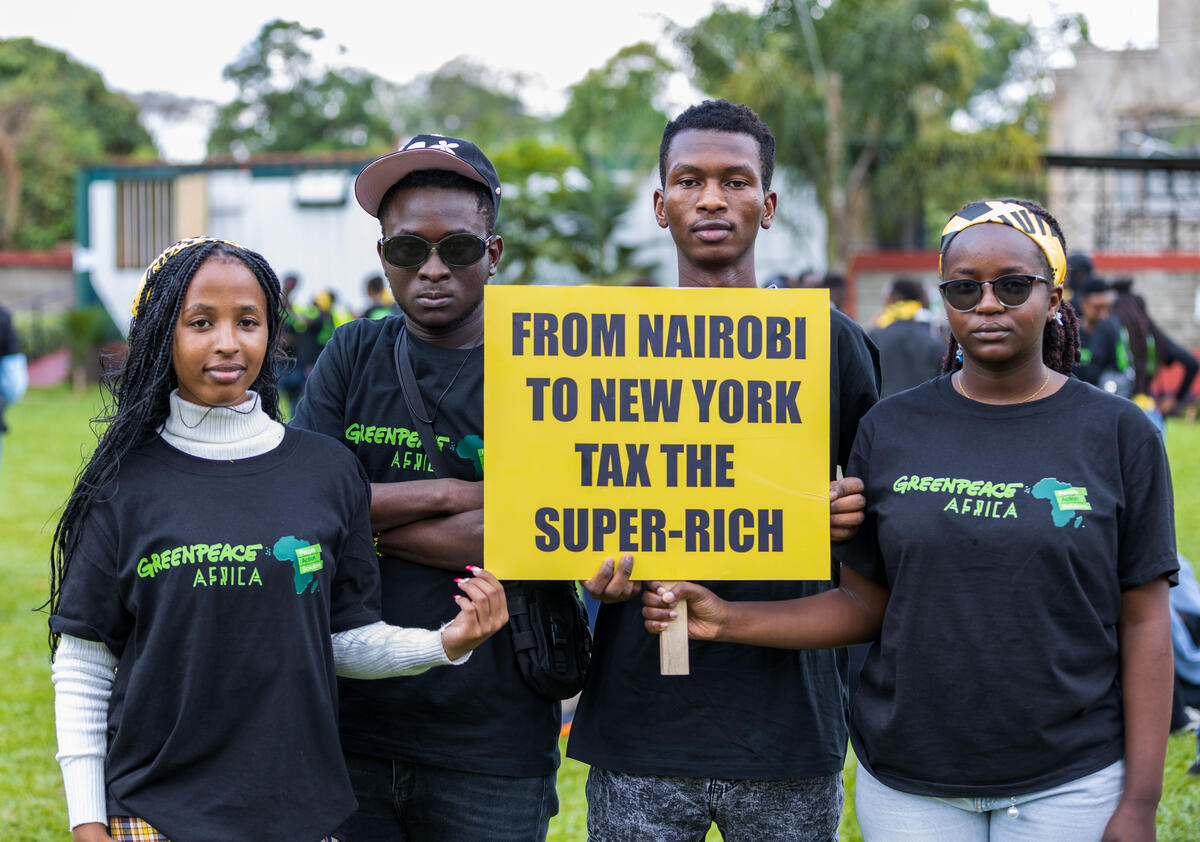
Ahead of the pivotal UN Framework Convention on International Tax Cooperation (UN Tax Convention) negotiations in Nairobi, 500 Greenpeace Africa volunteers assembled a human banner representing the African continent, bearing the demand: “Tax the Super-rich for People and Planet.”
This momentum carried into 2026, highlighted by creative civil society mobilizations in Seville, Spain, ahead of the 4th International Conference on Financing for Development (FfD4). Greenpeace Spain unveiled a striking four-meter-tall doll depicting a chainsaw-wielding baby Elon Musk, symbolizing corporate recklessness and environmental destruction. Simultaneously, labor movements—such as GEBRAK in Jakarta, Indonesia—aligned with climate activists on May Day 2026, linking workers’ rights and economic stability directly to the taxation of extreme wealth.
Supporting Context & Metrics: The Economics of Inequality
The urgency of the Fair Share campaign is underscored by glaring economic disparities and escalating environmental costs.
The Concentration of Capital
Global wealth accumulation has reached unprecedented peaks, even as public infrastructure crumbles. While billionaires enjoy tax loopholes, offshore accounts, and multi-billion-dollar payouts, governments face crippling national debts and depleted treasuries. This fiscal starvation directly impairs their ability to fund:

- Climate Action & Disaster Response: Financing relocation, building sea walls, and managing increasingly severe wildfire and flood seasons.
- Public Health and Education: Ensuring universal access to quality medical care and schooling.
- Sustainable Infrastructure: Developing affordable green housing, expanding zero-emission public transport, and securing clean water networks.
The Intersecting Crises of Climate and Class
Climate change does not affect all populations equally. When extreme weather strikes—such as the devastating wildfires that ravaged southern Chile in the 2025–2026 season (burning 193% more land than the previous year) or recurrent catastrophic flooding in East Kalimantan and Southern Africa—the socioeconomic fault lines are laid bare.
- Who has comprehensive insurance?
- Who possesses the savings to relocate?
- Who can access immediate healthcare when disaster hits?
These are ostensibly environmental queries, but at their core, they are economic questions. Without wealth redistribution through taxation, marginalized communities bear the brunt of ecological shocks caused primarily by fossil fuel conglomerates and ultra-wealthy polluters.
Official Statements and Strategic Objectives
The core philosophy of the Greenpeace campaign centers on the implementation of systemic, legally binding mechanisms rather than relying on the fickle nature of billionaire philanthropy.

The Push for a UN Global Tax Treaty
Greenpeace, alongside a coalition of international allies, is actively campaigning for an ambitious UN Global Tax Treaty. This treaty seeks to establish robust international frameworks for taxing high-net-worth individuals and multinational corporations uniformly, closing the loopholes that drain developing nations of vital resources.
Public opinion research conducted by Greenpeace across six African countries revealed overwhelming support for tax justice principles. The most resonant messages tested centered on three core tenets:
- Ability to Pay: Those who amass the most wealth must contribute proportionally to the functioning of society.
- National Development: Fair taxation directly bolsters funding for domestic schools, hospitals, and infrastructure.
- Accountability: Billionaires and major polluters must pay for the ecological debts they accrue.
Future Outlook: Redefining True Wealth
Reaching the milestone of 200,000 petition signatures is a testament to the surging appetite for systemic economic reform. It signifies that hundreds of thousands of global citizens reject the premise that our economies must prioritize endless capital accumulation over human survival and planetary health.

As Naeemah Dudan reflects:
"The rose-tinted, dollar-sign glasses have slowly come off. Material wealth starts to feel a little less important when compared with the richness of human connection, safety, and a healthy environment."
True affluence in the 21st century cannot be measured solely by bank balances or stock portfolios. Being rich in life means having access to clean air, drinkable water, stable food supplies, and the peace of mind that a climate disaster will not obliterate generations of hard work. No amount of private fortune can construct an independent biosphere; billionaires and working-class citizens alike share the exact same atmosphere and water sources.
The Path Forward
The mobilization of 200,000 supporters is merely a stepping stone. As international bodies deliberate on global tax frameworks—from Nairobi to Seville—the pressure from civil society must intensify. Fair taxation is not a radical utopian ideal; it is a pragmatic, urgent economic necessity.
By compelling governments to tax extreme wealth, society can unlock the capital required to secure a livable planet, bridge deepening inequality chasms, and build resilient communities. Being rich should not mean hoarding more than one could ever spend at the expense of a shared Earth. It should mean living in a world where everyone has enough.



