Executive Overview
BANGKOK, Thailand — Against a backdrop of severe, climate-induced flooding submerging neighborhoods across Thailand, global financial leaders have touched down in Bangkok for the high-stakes annual meetings of the International Monetary Fund (IMF) and the World Bank. Yet, while delegates deliberate behind the closed, air-conditioned doors of convention centers, the stark realities of the climate emergency are playing out on the muddy streets outside. Ordinary citizens are left to grapple with ruined homes, shattered livelihoods, and evaporating incomes, paying an unconscionable price for an ecological crisis they did little to create.
As international financial institutions (IFIs) convene to chart the course of the global economy, a powerful coalition of environmental watchdogs, grassroots movements, trade unions, and civil society organizations from across the Global South has launched a fierce counter-narrative. Spearheaded by groups like Greenpeace Thailand and Greenpeace Africa, alongside over 200 allied coalitions, the collective message is unmistakable: the era of corporate impunity must end. Securing sufficient, scalable funds for climate adaptation, mitigation, and loss and damage demands a fundamental structural overhaul—starting with aggressive taxation on the wealthiest polluters and ultra-high-net-worth individuals whose carbon-heavy investments continue to yield astronomical profits.
This year’s convergence in the Thai capital is not merely a routine economic summit; it has become a ideological battleground over who shoulders the financial burden of a warming planet. Activists argue that current global financial architectures are deeply rigged, prioritizing fiscal austerity, debt repayments, and corporate protectionism over human survival. By synthesizing empirical data on the staggering climate debts amassed by the ultra-rich with pressing calls for a transformative UN Tax Convention, this movement aims to dismantle a global tax system that drains public budgets in developing nations while shielding the fossil fuel elite from accountability.
Detailed Chronology: The Bangkok Summit and the Rising Tides
The Convergence in Bangkok: October 2024
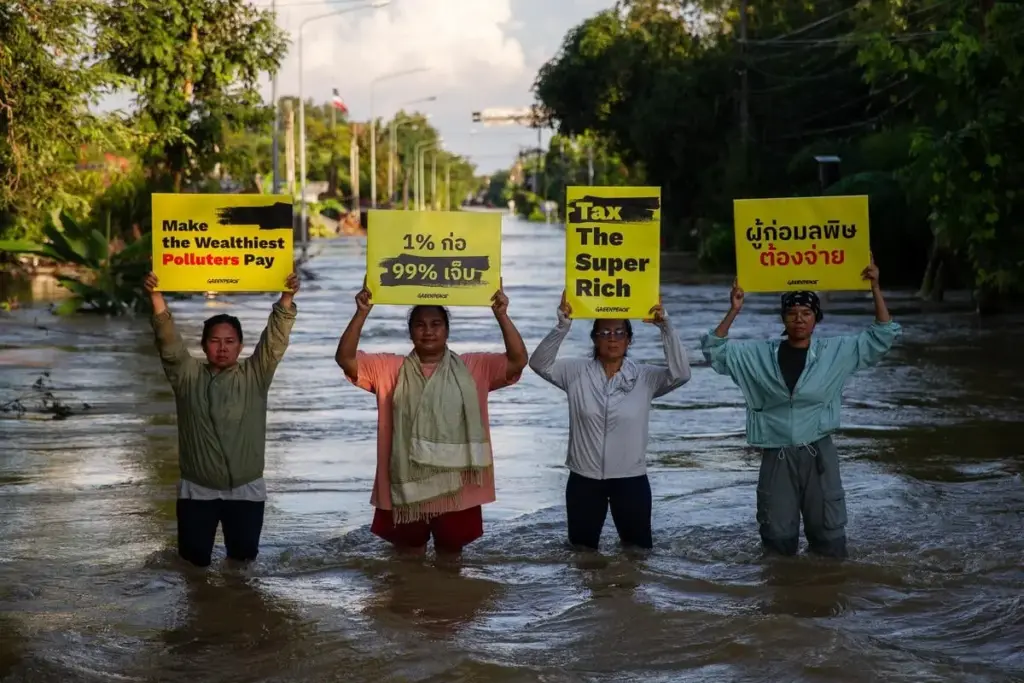
The timing of the IMF and World Bank annual meetings in Bangkok has provided activists with a visceral, inescapable visual of climate injustice. As global finance ministers, central bankers, and economic technocrats gather to debate macroeconomic stability, Thailand is enduring severe seasonal and climate-intensified monsoonal flooding. Rivers have breached their banks, urban infrastructure has been paralyzed, and vulnerable communities find themselves wading through waist-deep waters.
For local residents, the floods are not a theoretical policy challenge; they are an immediate humanitarian crisis. They represent lost wages, structural damage to homes that lack insurance, and a diversion of scarce public funds toward emergency disaster relief rather than sustainable development or education. It is within this charged atmosphere that the International Peoples’ Assembly convened from October 12–13 at the Ambassador Hotel Bangkok. Bringing together delegates from Asia, Africa, and Latin America, the Assembly serves as a unified platform for marginalized populations bearing the brunt of ecological collapse to demand systemic economic justice.
The Anatomy of Climate Debt
The concept of "climate debt"—the ecological and financial obligation owed by historic high emitters to those disproportionately impacted by environmental degradation—took center stage during the Bangkok dialogues. Environmental advocates utilized the summit to expose the profound disparity between who generates greenhouse gas emissions and who pays for their fallout.
While island nations sink, African agricultural belts face unprecedented droughts, and Southeast Asian cities drown in floodwaters, the ultra-wealthy continue to extract record profits from carbon-intensive industries. Rather than financing the green transition, the surplus capital of the world’s financial elite is continually funneled into fossil fuel extraction, petrochemical expansion, and industrial agriculture, actively perpetuating the cycle of destruction.
The Road to Nairobi and the UN Tax Convention
Simultaneously, the global civil society coalition in Bangkok is casting its gaze toward upcoming diplomatic milestones. The debate in Thailand directly feeds into the international push for the UN Framework Convention on International Tax Cooperation (often referred to as the Global Tax Treaty or UN Tax Convention).
Unlike legacy institutions historically dominated by Western-led bodies like the Organisation for Economic Co-operation and Development (OECD)—where consensus models often favor wealthy nations—the UN Tax Convention offers a genuinely inclusive forum. Here, every member state holds an equal vote, and decisions are reached through majority rule. The upcoming round of negotiations (INC-6), scheduled to take place in Nairobi, Kenya, from November 30 to December 12, is being framed by activists as a generational opportunity to rewrite the rules of global finance, close illicit tax havens, and secure the taxing rights of developing nations.
Supporting Context & Metrics: The Trillion-Dollar Carbon Footprint of Extreme Wealth
To understand the urgency behind the demands raised in Bangkok, one must examine the staggering financial architecture underpinning global emissions. Climate finance requirements—the capital needed worldwide to transition away from fossil fuels, build resilient infrastructure, and compensate for unavoidable loss and damage—are frequently described by governments as impossibly expensive. Yet, the money exists; it is simply concentrated in the hands of a microscopic fraction of the global population.
The $992 Billion Climate Toll
According to groundbreaking research published by Greenpeace, in 2022 alone, the investments made by the world’s richest 0.01% in carbon-intensive industries were associated with an estimated US$992 billion in climate costs incurred globally.
To put this figure into perspective, $992 billion is roughly comparable to total annual global climate finance requirements frequently debated at United Nations climate summits (COPs). In essence, the carbon footprint generated by the investment portfolios of a few thousand ultra-wealthy individuals inflicts nearly a trillion dollars in socioeconomic and environmental damage every single year.
Yet, under current global tax regimes, these high-net-worth individuals pay virtually nothing relative to the immense ecological debt their portfolios accumulate. Their profits are privatized, while their pollution costs are socialized onto taxpayers, municipal governments, and frontline communities.
The Failure of Fiscal Austerity
International financial institutions like the IMF and the World Bank have long prescribed structural adjustment policies, fiscal austerity, and debt-servicing regimes to developing nations. For decades, these institutions have forced governments in the Global South to slash public spending on healthcare, education, and social safety nets to service foreign debts.
Activists in Bangkok argued that this orthodox economic model is fundamentally broken in the face of the polycrisis. When a country is struck by climate-induced flooding—as Thailand is experiencing, or as nations like Pakistan, Mozambique, and Brazil have suffered in recent years—imposing fiscal austerity guarantees that governments cannot respond adequately. Public coffers are bled dry by external debt repayments, leaving zero fiscal space for climate adaptation or disaster recovery.
By demanding a pivot from austerity to wealth taxation, the coalition in Bangkok is challenging the core ideological assumptions of modern central banking. They assert that public budgets can easily be restored—and climate action fully funded—if governments summon the political will to tax extreme wealth, eliminate corporate subsidies for fossil fuels, and crack down on cross-border tax evasion.
Official Statements & Voices from the Frontlines
The resistance movement in Bangkok was anchored by impassioned testimonies from environmental leaders representing regions worst hit by ecological degradation.
Pichmol Rugrod, Plastic-Free Future Project Lead, Greenpeace Thailand
"The floods affecting communities across Thailand show how the costs of a changing climate are increasingly being borne by ordinary people—through damaged homes, lost income and livelihoods, and public money needed for recovery. This is what climate debt looks like in people’s lives.
Those who have contributed the least should not continue to pay the highest price, while the wealthiest polluters continue to profit and pay nothing. As global financial leaders meet in Bangkok, taxing the wealthiest polluters must be identified as part of the solution, with the revenues used to support affected communities and fund climate action."
Rugrod’s comments directly challenge the Thai government and international delegates to look out the window of their air-conditioned conference halls and witness the human toll of inaction. By framing the floods as a physical manifestation of "climate debt," Greenpeace Thailand has localized a global economic argument, connecting abstract macroeconomic policies directly to the water rising in Thai living rooms.
Gerance Mutwol, Fair Share Project Lead, Greenpeace Africa
"As the climate crisis worsens, policy responses are falling far short of the urgent need for funding for mitigation, adaptation, and loss and damage. It is outrageous that ultra-wealthy polluters continue to profit from investments in and ownership of highly polluting industries driving the climate crisis, while international financial institutions continue to put debt repayments and fiscal austerity ahead of protecting communities.
To fund a fair and resilient future for generations to come, governments must be able to redesign tax systems so they benefit the majority, not just the wealthiest. Governments must support a strong UN Tax Convention to close tax loopholes that drain national budgets, protect countries’ taxing rights, and ensure tax systems support sustainable development goals and not work against them."
Mutwol’s perspective underscores the intersectional nature of the global justice movement. Developing nations across Africa and Asia face a dual crisis: suffocating external debt burdens imposed by institutions like the IMF, and escalating climate impacts they did not cause. Without a radical restructuring of tax systems, these nations will remain trapped in a perpetual cycle of poverty and climate vulnerability.
The Greenpeace International Demand
Echoing these sentiments, Greenpeace International has issued a formal set of policy demands directed squarely at the leadership of the IMF and the World Bank:
- Abandon Austerity: Immediately cease recommending fiscal austerity measures that undermine public health, education, and climate resilience in developing economies.
- Tax High-Net-Worth Individuals: Implement progressive wealth taxes targeting the ultra-rich, specifically focusing on capital gains and investments in carbon-intensive sectors.
- Target Corporate Polluters: Enforce windfall profit taxes on fossil fuel conglomerates and major corporate polluters to recover the true costs of environmental destruction.
- Champion the UN Tax Convention: Call on national governments to actively participate in and empower the upcoming UN Framework Convention on International Tax Cooperation in Nairobi, ensuring a democratic, inclusive global tax architecture that ends harmful tax practices and prevents the drainage of billions in national revenues.
Future Outlook: The Road Ahead for Global Climate Finance
As the Bangkok meetings draw to a close and delegates pack their bags, the ideological battle over the future of global finance is only intensifying. The convergence of grassroots organizers, trade unions, and international environmental NGOs at the International Peoples’ Assembly marks a growing, highly coordinated resistance against neoliberal economic orthodoxy.
The coming weeks will prove critical. With the INC-6 negotiations for the UN Tax Convention looming in Nairobi from November 30 to December 12, the international community faces a historic crossroads. Will governments bend to the lobbying power of fossil fuel executives and financial elites, or will they summon the courage to build a fair, inclusive global tax system capable of financing a green and equitable future?
One thing is certain: as long as extreme weather events continue to devastate communities from Bangkok to Nairobi, and as long as the ultra-wealthy rake in billions from the destruction of the planet, the demand to make polluters pay will only grow louder. The voices gathered in Thailand have drawn a definitive line in the sand—proving that the solutions to the climate crisis are not out of reach, provided the world is willing to tax the wealth that caused it.