

By Rick Smith, President, Canadian Climate Institute
Published in partnership with The Weekly Roundup
Executive Overview
By now, it is abundantly clear that Prime Minister Mark Carney’s government is charting a radically different course for climate-change policy in Canada. In shifting away from the foundational frameworks established by the previous Trudeau administration, the Carney administration has embarked on a delicate balancing act: attempting to maintain Canada’s international credibility on decarbonization while fundamentally redesigning the tools used to achieve it.
Reflecting on the inherited approach, Prime Minister Carney remarked, "The climate plan we inherited from the previous government was well-intentioned and well-suited for the times in which it was designed . . . but as times have changed, we must change our plan to get there."
While the specific contours of this new climate architecture have been slow to materialize, more than a year and a half into the government’s mandate, the operational realities, policy compromises, and strategic ambitions are coming into sharper focus. This transition is taking place against a backdrop of escalating climate impacts. Across the country, communities continue to grapple with the devastating economic, social, and ecological tolls of increasingly dangerous wildfire seasons supercharged by a warming planet. The urgency to act has never been more acute, yet the gap between ambition and implementation remains a central tension in Canadian politics.
As Parliament prepares to return, the national conversation is shifting. Early debates centered on how the Carney administration would dismantle or distance itself from Trudeau-era policies. Today, the focus is sharpening on accountability: Is the Carney government actually living up to its own explicit climate commitments?
This report provides a comprehensive breakdown of the five core pillars defining Carney’s climate agenda, evaluating their current trajectory, implementation hurdles, and long-term viability.
Detailed Chronology: The Evolution of Canada’s Post-Trudeau Climate Policy
To understand where Canadian climate policy stands today, it is necessary to trace the legislative and executive milestones that have defined the Carney government’s first eighteen months in office.
- Late 2024 to Early 2025 (The Transition Phase): Following the political transition, early signals from the newly minted Carney government indicated a pivot away from rigid, top-down regulatory mandates toward market-friendly, investment-centric mechanisms. Economists and policy analysts noted a deliberate effort to court private capital while simultaneously placating resource-rich provinces.
- Budget 2025 (Spring 2025): Tabled in the spring, Budget 2025 formalized the government’s intention to reshape sustainable finance in Canada. Crucially, it introduced the framework for "Made-in-Canada sustainable investment guidelines," laying the groundwork for a national taxonomy designed to direct billions in private capital toward credible green ventures.
- November 2025 (The Federal-Alberta Partnership): In a major political development, Prime Minister Carney announced a landmark partnership agreement and Memorandum of Understanding (MOU) with the government of Alberta. Billed as a pragmatic compromise, the MOU sought to recalibrate industrial carbon pricing and align resource extraction exports with economic diversification—though it immediately drew scrutiny from environmental analysts concerned about emissions loopholes.
- Spring 2026 (The Auto Sector Overhaul): The federal government formally moved to repeal the existing Electric Vehicle (EV) mandate and signal a restructured automotive strategy. The revised approach aimed for an emissions-reduction equivalent to a 75% EV adoption rate, pushing back strict enforcement timelines and drawing mixed reviews from clean-transport advocates.
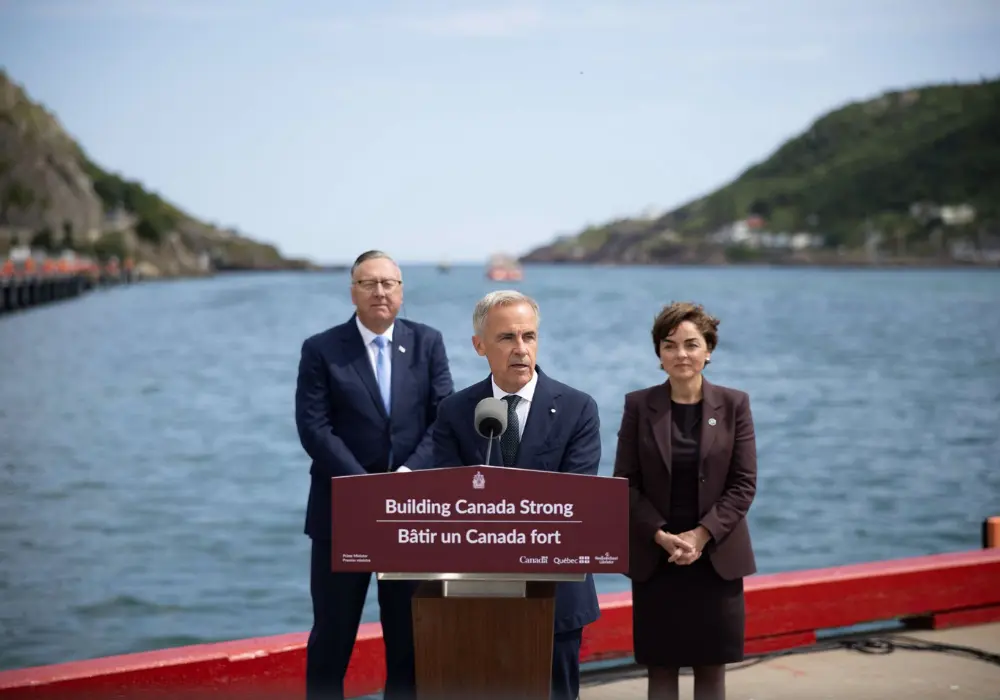
- Summer 2026 (Clean Energy Megaprojects & Framework Drafts): The summer months saw aggressive signaling regarding clean power. A major trilateral clean-energy agreement was struck between the federal government, Quebec, and Newfoundland and Labrador, headlined by developments surrounding Churchill Falls. Concurrently, the Canadian Climate Institute and Business Future Pathways released the first public draft of the new sustainable finance taxonomy, opening a critical public comment period.
Supporting Context & Metrics: Evaluating Carney’s Five Core Commitments
To evaluate the credibility of the Carney administration’s climate agenda, we must examine the five explicit commitments driving its policy platform.
1. "A Carbon Market That Actually Works"
Industrial carbon pricing remains the beating heart of Canada’s carbon mitigation strategy, capable of driving substantial emissions reductions at minimal economic cost. This mechanism formed a core pillar of the MOU signed with Alberta.
However, subsequent analyses from the Canadian Climate Institute reveal significant shortcomings. The modifications made to Alberta’s industrial carbon market under the MOU are simply insufficient to anchor a robust, firm-footed system nationwide. In fact, following the signing of the agreement, the market price of carbon credits in Alberta actually declined—a symptom of loosening compliance pressures. Industrial carbon pricing required structural fixes when Prime Minister Carney took office, and independent data shows that it still requires urgent course-correction today.
2. The 75% Electric Vehicle Adoption Target (Scaling to 90% by 2040)
The government’s revised automotive strategy represents one of its most specific numerical commitments. During the press conference launching the updated policy, the Prime Minister stated the federal government would strengthen vehicle emissions standards to achieve “the equivalent emissions reductions of a 75% EV adoption rate,” anchored by a longer-term objective of 90% by 2040.
Yet, the path to these targets has been fraught with self-inflicted friction. By repealing the previous administration’s binding EV mandates and delaying the rollout of the replacement standard, the government has inadvertently made its task much harder. Technical evaluations of the newly proposed federal standards suggest they lack the regulatory teeth required to guarantee the projected adoption curves.
3. Transforming Canada into a "Clean and Conventional" Energy Superpower
The phrase "clean and conventional" has saturated federal communications, serving as the ideological wrapper for Canada’s energy future. In his "Forward Guidance" video address, the Prime Minister set an exceptionally ambitious benchmark, pledging to “build clean energy on a scale that would astound even Sir Adam Beck”—invoking the legendary Ontario politician and pioneer of Niagara hydropower.
While the "conventional" half of this policy equation is crystal clear—backed by billions of dollars in public capital and loan guarantees for fossil fuel infrastructure—the "clean" component remains less defined. The trilateral clean-energy agreement struck between Ottawa, Quebec, and Newfoundland and Labrador is an undeniably important step forward for regional grid integration. However, replicating this scale of inter-provincial clean power cooperation nationwide will require sustained political will, massive capital deployment, and unprecedented regulatory harmonization.
4. Made-in-Canada Sustainable Investment Guidelines
A standout policy win from Budget 2025 was the commitment to establish domestic sustainable investment guidelines by 2027, paired with an exploratory framework for sustainable sovereign bonds. Recognizing the complexity of defining what truly constitutes a "green" investment in a resource-dependent economy, the federal government tapped the Canadian Climate Institute and Business Future Pathways to lead the development of these guidelines collaboratively.
In July, the initiative hit a major milestone with the release of the first draft report, providing a transparent, metrics-driven taxonomy designed to combat greenwashing and unlock trillions in institutional capital.
5. Achieving Net-Zero Emissions by 2050
Codified within the final text of the federal-Alberta MOU and echoed across numerous ministerial speeches, the 2050 net-zero target remains the ultimate litmus test for the government’s environmental integrity.
A target, however, is only as good as the policy levers enforcing it. Right now, independent tracking by initiatives like the 440 Megatonnes project indicates that current policy trajectories—weakened by provincial compromises and delayed regulatory rollouts—are not sufficient to get Canada on the necessary pathway.
Official Statements and Stakeholder Perspectives
The friction between political rhetoric and policy execution has generated robust debate among economists, industry leaders, and civil society organizations:
- Prime Minister Mark Carney: Defending the administration’s pragmatic pivot during a first ministers’ meeting, the Prime Minister emphasized that economic resilience and climate action must walk hand in hand: "As times have changed, we must change our plan to get there . . . We are building an economy that is secure, sustainable, and built to compete globally."
- The Canadian Climate Institute: While acknowledging positive strides—such as the sustainable finance taxonomy and regional energy pacts—analysts at the Institute have maintained a vigilant watch. In recent policy briefs, the Institute cautioned that “not all carbon market price floors are created equal,” warning that concessions made to appease industrial stakeholders risk hollowing out the environmental integrity of regional markets.
- Industry and Labour Coalitions: Proponents of the "clean and conventional" strategy praise the pragmatic tone coming out of Ottawa, arguing that a hostile approach to traditional energy sectors only harms workers and stalls capital deployment. Conversely, environmental NGOs have expressed mounting frustration over repealed regulations, arguing that watering down EV mandates and carbon pricing compromises Canada’s international obligations under the Paris Agreement.
Future Outlook: What Lies Ahead as Parliament Returns
When Parliament reconvenes, the political landscape will be defined by a shift from theoretical debate to hard accountability. The Carney government has laid out an extensive matrix of policy promises—promises that possess the genuine capacity to modernize infrastructure, electrify the national economy, and drive down emissions.
Yet, the window for effective climate action is narrowing. The economic and human costs of climate inaction are no longer distant projections; they are written in the smoke-filled skies of recurring wildfire seasons and felt in the balance sheets of communities rebuilding after extreme weather events.
The central question facing the Carney administration moving forward is whether its preference for market-led flexibility and intergovernmental compromise can deliver the absolute emissions reductions required by science. If the government’s explicit climate goals are to be more than well-crafted rhetoric, they must be matched by unyielding regulatory enforcement, aggressive capital mobilization, and a willingness to stand firm when provincial pushback threatens national targets.
The blueprint has been drawn. Now, the hard work of building—and measuring—begins.
The Weekly Roundup
Get all our stories, policy deep dives, and expert analyses in one place, delivered to your inbox every Wednesday at noon EST. Subscribe to our mailing list to stay informed on the evolving landscape of Canadian climate policy.



