

Executive Overview
The global automotive landscape is undergoing a profound structural shift, one defined by the rapid ascension of electric vehicles (EVs) and the dramatic repositioning of industrial superpowers. For more than a century, legacy automakers from North America, Europe, and Japan viewed emerging markets—and later, the roaring industrial engine of China—as lucrative cash cows. These legacy giants relied on mature, occasionally stagnant domestic markets for baseline revenues while treating developing regions as secondary frontiers for growth.
However, the script has flipped. When the Chinese domestic auto market began its aggressive, unprecedented pivot toward electrification, Western legacy manufacturers found themselves flat-footed, outpaced by domestic competitors who approached EV design with agility, software integration, and aggressive cost optimization.
Today, China’s domestic EV market—and its broader automotive sector—has hit a plateau, contracting in parts and slowing significantly overall. Faced with massive production capacities and domestic saturation, Chinese automotive giants are executing a playbook remarkably similar to the one Western automakers used decades ago: looking outward for salvation and scale. At the vanguard of this movement is BYD, the world’s leading new energy vehicle (NEV) manufacturer.
BYD’s international momentum is no longer a localized phenomenon; it is a global industrial juggernaut. With record-shattering overseas sales figures, ambitious plans to export 2.5 million vehicles annually by 2027, and a localized manufacturing strategy designed to bypass punitive international tariffs, BYD is aggressively reshaping the global transportation paradigm. Simultaneously, the company is doubling down on its domestic stronghold, aiming for an unprecedented 25% share of China’s colossal automotive market.
Detailed Chronology: From Domestic Dominance to Global Conquest
Phase 1: The Great Electrification Awakening
The foundation of BYD’s current global dominance was forged during the early days of China’s green energy transition. While legacy automakers viewed electric vehicles as niche compliance projects or high-end luxury novelties, Chinese manufacturers recognized an existential opportunity to leapfrog traditional internal combustion engine (ICE) technologies.
BYD invested heavily in battery chemistry, vertical integration, and semiconductor supply chains. When the Chinese government implemented targeted subsidies and favorable regulatory frameworks for New Energy Vehicles, local companies were uniquely positioned to capture the wave. By the time Western legacy automakers realized the depth of the shift, Chinese brands had already established an unassailable lead in battery production, supply chain mastery, and consumer-facing EV technology.
Phase 2: Domestic Saturation and the Export Imperative
As the 2020s progressed, the Chinese auto market began showing clear signs of maturation. Growth rates slowed, and intense domestic price wars squeezed profit margins across the board. Companies producing hundreds of thousands of EVs month after month faced a critical choice: scale back production or aggressively target international markets.
Choosing growth, companies like BYD looked abroad. Shipping lines were chartered, distribution partnerships across Europe, Southeast Asia, and Latin America were forged, and international showrooms began filling up with competitively priced, highly sophisticated electric vehicles. What began as exploratory overseas shipments rapidly transformed into a systematic, high-volume export strategy.
Phase 3: The Current Frontier—Overcoming Bottlenecks and Localizing Production
BYD’s export growth has not been without friction. Throughout 2025 and 2026, the company encountered significant supply chain bottlenecks, most notably a shortage of dedicated shipping vessels capable of transporting thousands of vehicles safely across oceans.
To solve this, BYD has commissioned its own fleet of car-carrying vessels. Furthermore, recognizing that shipping vehicles halfway across the world leaves them vulnerable to protectionist trade policies, the company has pivoted toward localized manufacturing. With overseas plants—such as the upcoming facility in Hungary—scheduled to come online, BYD is transitioning from a pure exporter to a localized global manufacturer, setting the stage for its aggressive 2027 targets.
Supporting Context & Metrics: The Numbers Behind the Juggernaut
To understand the scale of BYD’s current trajectory, one must examine the hard data. The company’s international performance metrics illustrate a business operating at a historic velocity.
August Sales Breakdown
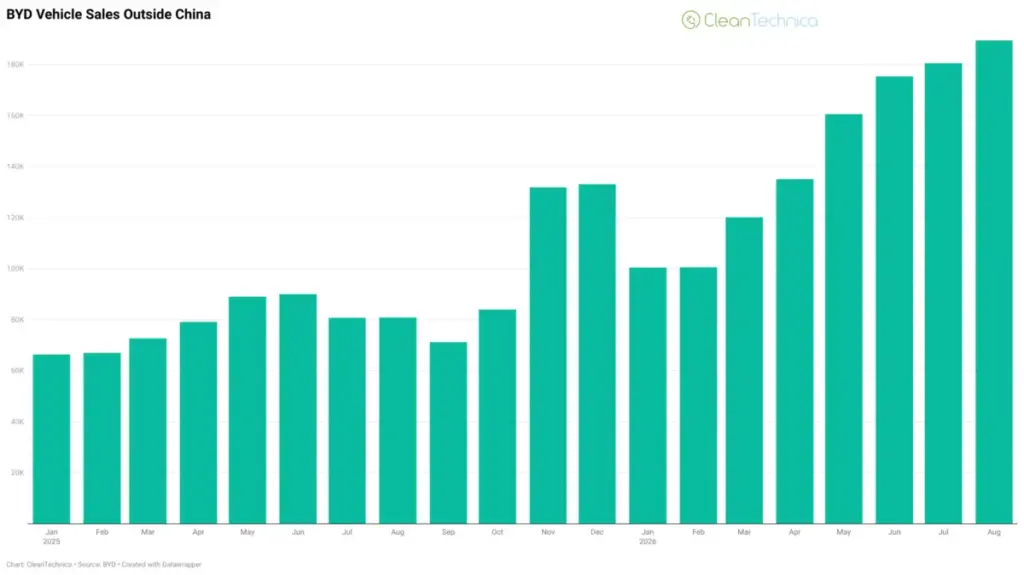
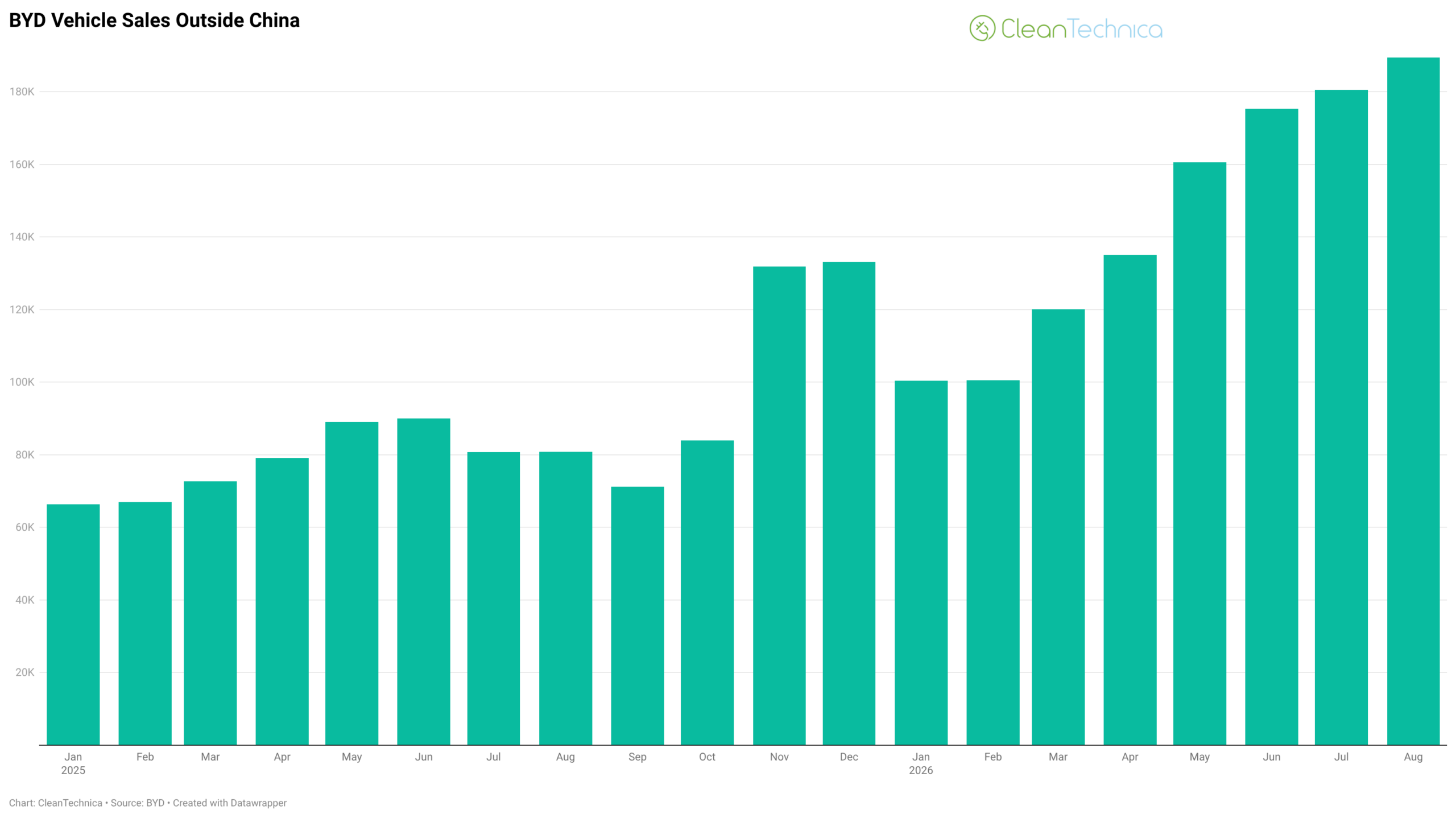
In August, BYD reported a staggering 189,466 vehicles sold outside of China. This figure represents a monumental 134.5% year-over-year increase compared to August 2025. On a month-over-month basis, the company achieved a robust 5% growth rate.
Because BYD’s international sales have climbed sequentially month after month, August marked yet another historic all-time high for the company’s overseas division. This continuous upward curve demonstrates that international demand is not merely a temporary spike driven by initial launch campaigns, but a sustained, compounding trend.
2026 YTD Performance and the 2027 Target
The sheer scale of BYD’s ambition becomes clear when looking at annual projections. So far in 2026, BYD has accumulated 1,162,260 vehicle sales outside of China. This equates to a monthly average of approximately 145,282 vehicles. If this run-rate is annualized over a standard 12-month period, it projects out to roughly 1.74 million export units for the year.
However, management’s eyes are fixed much higher. BYD has officially announced its intention to sell 2.5 million vehicles outside of China in 2027. Reaching this milestone will require a dramatic acceleration over 2026 figures, demanding that the company rapidly scale both its transport logistics and foreign retail networks.
Navigating Tariffs Through Localization
Financial institutions tracking the sector have closely monitored BYD’s pivot toward localized manufacturing. Deutsche Bank, referencing recent meetings with BYD management, noted that the company had initially targeted 1.9 million to 2 million overseas sales for 2026—a figure that would have doubled its 2025 international volume. Analysts noted that shipping constraints were the primary governor preventing even higher export totals this year.
To mitigate logistical hurdles and dodge punitive trade barriers, localized production has become BYD’s masterstroke. Financial services firm Citi highlighted the immense economic logic behind this strategy:
- The European Union currently levies roughly a 27% tariff on battery electric vehicles imported from China.
- Brazil imposes a steep 34% import tariff on incoming vehicles.
By establishing manufacturing plants within these key regional markets, BYD can bypass these tariffs entirely. According to Citi, local production yields savings of more than 40,000 yuan (approximately $5,961) per vehicle. These savings are more than enough to offset the capital expenditure and initial ramp-up costs of building overseas factories, preserving healthy profit margins while keeping retail prices highly competitive for local consumers.

Official Statements and Industry Analysis
Industry analysts and institutional investors have responded to BYD’s aggressive targets with a mix of awe and strategic caution.
According to updates provided by Reuters, BYD management has been transparent regarding the physical limitations of its global expansion. Executives acknowledged that shipping bottlenecks—specifically a shortage of specialized Roll-on/Roll-off (RoRo) cargo ships—capped what could have been an even larger export volume throughout 2026. By addressing this through proprietary fleet expansion and foreign assembly lines, BYD is systematically removing its operational ceilings.
Furthermore, Deutsche Bank highlighted the impending operational launch of BYD’s manufacturing plant in Hungary, which is expected to begin assembly operations between November and December. Management has confirmed that it is actively evaluating additional overseas manufacturing sites across various continents to further insulate the company from geopolitical trade friction.
While international expansion dominates headlines, BYD’s domestic strategy remains ruthlessly ambitious. Having captured nearly 15% of the massive Chinese auto market in 2025 and scaling up to roughly 18% by July 2026, the company is setting its sights on an ultimate domestic market share of 25%. Securing a quarter of the world’s largest and most competitive automotive market would provide BYD with an unshakeable financial foundation, funding its ongoing global conquests.
Future Outlook: Can BYD Reach the Mountaintop?
As the automotive industry looks toward the latter half of the decade, all eyes are on BYD to see if its hyper-growth strategy can maintain its momentum.
The road ahead is fraught with complex challenges. Protectionist sentiment is rising in North America and Europe, where regulators view the influx of affordable Chinese EVs as an existential threat to domestic manufacturing ecosystems. Non-tariff barriers, shifting regulatory compliance standards, and geopolitical tensions will undoubtedly test BYD’s diplomatic and corporate agility.
Yet, the fundamental economic realities favor the efficient. With unmatched vertical integration—spanning from lithium mining and battery cell production to semiconductor fabrication and maritime logistics—BYD commands cost structures that legacy automakers struggle to replicate.
If BYD successfully brings its Hungarian facility online, scales its proprietary shipping fleet, and navigates regional trade barriers, its target of 2.5 million overseas sales by 2027 transitions from an ambitious corporate aspiration to an achievable reality. The transformation of BYD from a regional Chinese battery maker into a dominant planetary automotive superpower is accelerating. The question facing the rest of the global auto industry is no longer whether BYD will arrive, but how traditional automakers intend to compete in a world reshaped by its momentum.



