

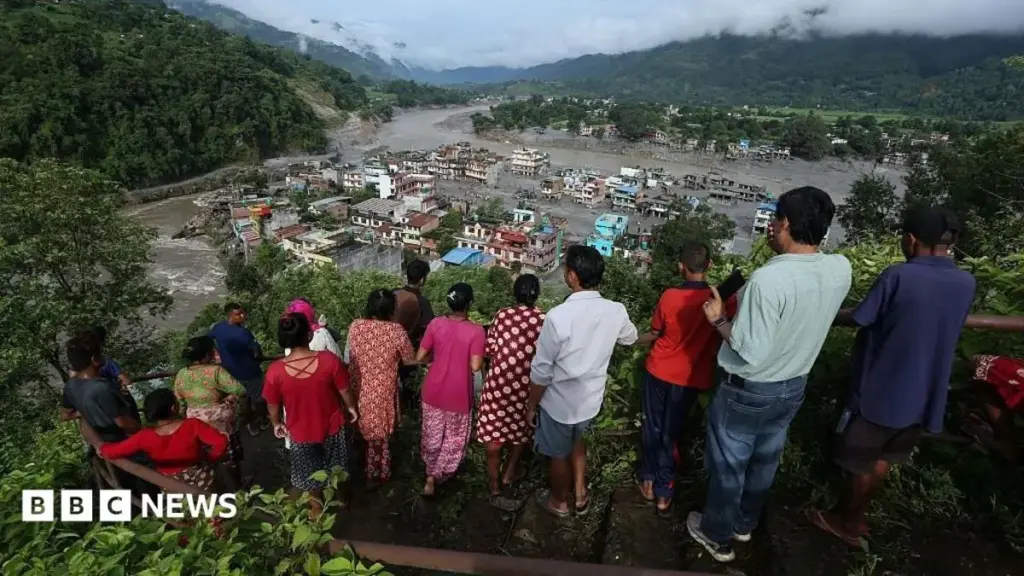
KATHMANDU — In the shadow of the world’s highest peaks, a devastating human and environmental crisis has precipitated an urgent diplomatic and financial battle. Following a catastrophic cataclysm that obliterated communities along the Nepal-Tibet border last month, the government of Nepal is preparing a high-stakes financial claim against a landmark United Nations climate fund. Armed with newly minted scientific evidence linking the disaster directly to anthropogenic global heating, Kathmandu is seeking roughly $20 million (£15 million) to kickstart immediate recovery efforts—even as national leaders estimate the total reconstruction bill will soar past $5 billion (£3.7 billion).
The unfolding situation underscores a cruel irony of the global climate crisis: nations like Nepal, which contribute infinitesimally to historical greenhouse gas emissions, are disproportionately bearing the catastrophic costs of planetary warming. As Prime Minister Balendra Shah prepares to take the international stage at the United Nations General Assembly in New York, the eyes of the global climate community are fixed on Kathmandu. The outcome of Nepal’s petition could establish a vital precedent for the newly operational UN Fund for Responding to Loss and Damage, testing whether the international financial architecture can respond with the speed and scale required by an escalating climate emergency.
Executive Overview: A Compound Crisis in the Himalayas
The disaster that struck the Nepal-Tibet border last month was not merely an isolated act of nature, but a complex, multi-layered "compound event" supercharged by a warming planet. Official government data released on Wednesday presents a staggering toll: approximately 1,400 people have perished, while an estimated 6,150 individuals remain missing. Entire border towns and villages have been wiped off the map, swallowed by an unstoppable avalanche of rock, ice, and roaring floodwaters that decimated critical energy infrastructure, washed away roads, and left thousands of families destitute.
At the epicenter of the catastrophe was a massive structural collapse near the peak of Langtang Lirung, a towering giant on the Nepali side of the Himalayas. According to a landmark study published on Thursday by the premier international research group World Weather Attribution (WWA), the disaster was triggered by the sudden failure of a steep rock wall and overlying glacier ice.
Scientists emphasize that while pre-existing geological vulnerabilities—potentially including the lingering structural scars of the devastating 7.8-magnitude earthquake that struck Nepal in 2015—played a role, human-induced climate change acted as the critical, destabilizing catalyst. The WWA study concludes that unseasonable warmth, thinning glaciers, thawing permafrost, and extreme meltwater combined to create an environmental powder keg.
For Kathmandu, the WWA report transforms an intuitive tragedy into a legally and scientifically actionable claim. Nepali officials are finalizing submissions to the UN Fund for Responding to Loss and Damage, relying on the study as definitive proof that the disaster falls squarely within the fund’s mandate. Yet, this localized financial crusade occurs against a backdrop of severe global resource constraints, raising profound questions about equity, the "polluter-pays" principle, and the resilience of high-mountain communities in a rapidly warming world.
Detailed Chronology: From Mountain Collapse to Diplomatic Mobilization
Phase One: The Cataclysmic Failure
The roots of last month’s disaster stretch back across decades of rising global temperatures, but the immediate countdown began months before the catastrophe. Scientific analysis shows that heavy snowfall during the previous October and November created an unusually large reservoir of snow and ice across the high-altitude Himalayan zones. As spring transitioned into summer, this accumulated mass faced unprecedented thermal pressures.
Data from the WWA study reveals that July and August temperatures in the affected border region were approximately 1.5°C (2.7°F) warmer than pre-industrial averages—an anomaly driven squarely by human influence on the global climate. Simultaneously, regional glaciers were found to be thinning at an alarming rate of about half a meter (1.6 feet) per year. This relentless thermal erosion widened existing fractures within the mountain’s rock mass and accelerated the thawing of internal permafrost, systematically stripping Langtang Lirung of its natural structural integrity.
When the final collapse occurred, it triggered an instantaneous, violent avalanche of rock and ice that roared down into river valleys, breaching natural barriers and unleashing catastrophic flash floods. The wall of water and debris tore through border settlements with terrifying speed, overwhelming local warning systems and catching residents entirely unawares.
Phase Two: Immediate Aftermath and Humanitarian Scramble
In the wake of the deluge, the immediate priority shifted to search-and-rescue operations. Emergency services, local volunteers, and military personnel mobilized under harrowing conditions, navigating destroyed infrastructure, blocked mountain passes, and unstable terrain.
However, the sheer scale of the devastation quickly outpaced domestic rescue capacities. As the days rolled on into weeks, the grim tally mounted. By Wednesday, official figures confirmed that the death toll had climbed to roughly 1,400, with more than 6,150 people still unaccounted for. Thousands of displaced survivors found themselves sheltering in makeshift camps, facing the dual threats of disease and impending winter conditions, while national leaders confronted the reality of a crippled economy and obliterated energy grids.
Phase Three: Scientific Validation and the Pivot to the UN
Recognizing that traditional disaster relief mechanisms would be wholly inadequate for a rebuilding effort estimated at $5 billion (£3.7 billion), Nepali authorities immediately began gathering evidence to pursue international climate reparations. Officials initially compiled satellite imagery, drone footage of the rupture zones, and preliminary geological assessments.
However, the release of the World Weather Attribution study on Thursday provided the missing linchpin for their diplomatic and financial strategy. The report offered rigorous, peer-supported scientific validation that anthropogenic climate change was not a peripheral background factor, but a primary driving force behind the disaster.
Armed with this evidence, Maheshwar Dhakal, spokesperson for Nepal’s Ministry of Agriculture, Forest and Environment, confirmed that the WWA report would serve as the foundational bedrock of Kathmandu’s formal petition to the United Nations. "It has detailed what role climate has played in this disaster," Dhakal stated, signaling a coordinated push to leverage international climate justice frameworks.
Supporting Context, Metrics, and Scientific Analysis
To fully comprehend the mechanics of the Langtang Lirung disaster, one must examine the intricate web of physics, geology, and climatology that international researchers dissected in the days following the event.
The Science of High-Mountain Destabilization
The WWA study categorized the disaster as a classic "compound event"—a scenario where multiple environmental stressors converge simultaneously to produce an extreme outcome that none would have triggered independently.
- Thermal Stress: The 1.5°C spike in July and August temperatures fundamentally altered the thermal profile of the mountain slopes, melting internal ice seams that act as natural glue for steep rock faces.
- Glacial Thinning: The ongoing loss of half a meter of ice per year unloads weight from valley walls while destabilizing adjacent slopes, a process known as debuttressing.
- Permafrost Thaw: As frozen ground transitions to liquid water, soils and fractured rock lose their shear strength, turning vertical and sub-vertical cliffs into dynamic hazard zones.
- Historical Trauma: Researchers noted that the magnitude 7.8 earthquake in 2015 severely fractured the underlying rock mass throughout Nepal’s northern ranges. While direct attribution of the recent collapse to the 2015 tremor remains complex, scientists agree that the earthquake left a legacy of deep structural fatigue that made the mountain vastly more susceptible to modern thermal pressures.
Dr. Friederike Otto, a climatologist at Imperial College London and co-author of the WWA study, stated unequivocally that there was "absolutely no doubt that human-induced climate change played a role here in the preconditioning of the disaster."
This assessment is echoed by independent experts. Dr. Simon Cook, a glacier expert at the University of Dundee who previously warned of Himalayan destabilization, praised the WWA report as a "very worthwhile study." In an interview on Thursday, Cook noted that while attributing any single, isolated weather event entirely to climate change remains scientifically challenging, "climate warming ultimately destabilises these high mountain environments."
At the same time, Cook struck a note of scientific caution: "We are not yet at a point of being able to say exactly how this happened. There remains much to learn about the processes involved… and what we can do to monitor these high-mountain regions to provide early warnings of such events in the future."
The Economics of Loss and Damage
The financial dimensions of Nepal’s plight highlight the structural inequities of global climate governance.
- The Request: Nepal is seeking approximately $20 million (£15 million) from the UN Fund for Responding to Loss and Damage—a specialized financial mechanism that became operational only last year, designed specifically to assist vulnerable developing nations coping with unavoidable climate impacts.
- The Deficit: The structural mismatch between global need and available capital is glaring. Nearly 120 developing nations have already submitted claims to the fund, with aggregate requests totaling nearly $3 billion (£2.2 billion). Yet, the fund’s current coffers hold less than $400 million (£300 million) available for immediate disbursement.
- The Broader Need: Against this backdrop of micro-financing sits Nepal’s macro-reconstruction reality: national leaders estimate that rebuilding housing, roads, schools, and hydro-energy infrastructure will require an astronomical $5 billion (£3.7 billion).
Danya Liu, a climate adaptation specialist at BloombergNEF, highlighted the ideological shift embedded in Nepal’s approach. "Nepal has repeatedly used the term ‘compensation’ to describe much-needed recovery funds," Liu observed. "The distinction points toward a polluter-pays model, rather than one in which affected countries shoulder most of the cost and rely on aid to fill the gaps."
Official Statements and Diplomatic Strategy
As Kathmandu prepares its diplomatic offensive, the nation’s leadership is framing the disaster not merely as a humanitarian emergency, but as a profound moral failing of the industrialized world.
Nepal has long pointed out the stark asymmetry of the climate crisis: the nation is among the lowest per-capita contributors to global greenhouse gas emissions, yet it occupies one of the most geographically and ecologically vulnerable positions on Earth. The fragile Himalayan ecosystem acts as a bellwether for planetary health, meaning that emissions generated thousands of miles away manifest locally as melting glaciers, shifting weather patterns, and catastrophic geological failures.
This message will form the core of Prime Minister Balendra Shah’s inaugural international address. Set to take the podium at the United Nations General Assembly in New York next week during his first foreign trip as prime minister, Shah is expected to deliver a passionate plea for climate justice. He will outline the human toll of the recent disaster, present the scientific backing of the WWA report, and demand that the international community move beyond empty pledges of solidarity toward tangible, compensatory financial flows.
However, navigating the corridors of UN bureaucracy will not be straightforward. Nepalese diplomatic officials have reported a mixed reception among international stakeholders. While several nations have expressed deep sympathy and offered political backing for rapid fund disbursement to Nepal, others—mindful of fiduciary oversight and the immense volume of competing global claims—have insisted on strict adherence to established rules, bureaucratic protocols, and procedural evaluations.
Future Outlook: The December Decision and Global Precedent
The immediate future of Nepal’s reconstruction efforts now hinges on a critical upcoming meeting. Administrators and board members responsible for overseeing the UN Fund for Responding to Loss and Damage are scheduled to convene in December. During this session, the panel will formally evaluate pending applications, determine which requests will be accepted, and decide whether Nepal’s catastrophic circumstances warrant an expedited, emergency disbursement.
The implications of the December decision extend far beyond the borders of Nepal. If Kathmandu successfully secures its $20 million claim backed by attribution science, it will validate the Loss and Damage fund as a functional, responsive instrument of international climate justice. It would establish a vital legal and scientific precedent: that peer-reviewed attribution studies can successfully bridge the evidentiary gap between extreme weather events and international financial compensation.
Conversely, should Nepal’s request be delayed by procedural red tape or swallowed by the fund’s severe capital deficit, it will expose glaring vulnerabilities in the current global architecture for climate reparations. It would reinforce the fears of developing nations that the wealthy polluters primarily responsible for global warming are failing to provide adequate, timely support when climate catastrophes strike the Global South.
As winter approaches the high valleys of the Himalayas, thousands of displaced families remain in limbo, waiting to see if the international community will honor its moral obligations. For Nepal, the upcoming United Nations General Assembly and the pivotal December board meeting represent more than diplomatic exercises—they are critical milestones in the fight for national survival, economic recovery, and historical accountability in an increasingly unstable world.



