By Environmental Investigative Desk Published September 15, 2026
Executive Overview
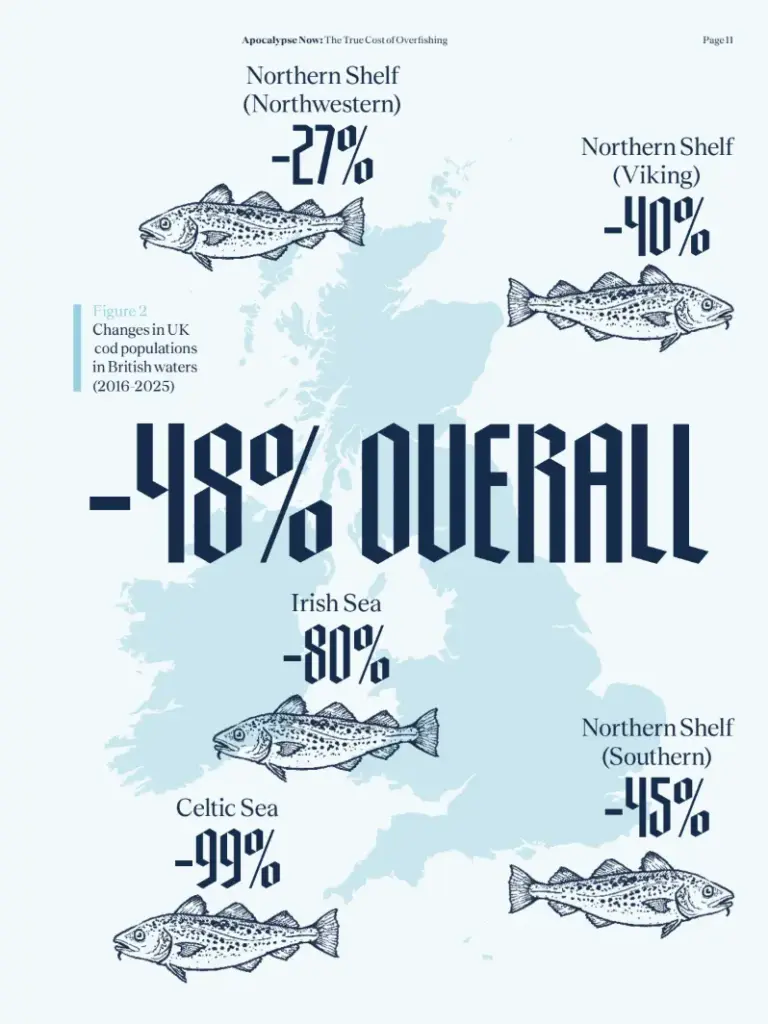
The quintessential British tradition of fish and chips faces an existential threat as new scientific findings reveal that UK cod stocks have plummeted by an alarming 48 percent over the past decade. A landmark study published by the ocean conservation charity the Blue Marine Foundation highlights the catastrophic trajectory of Britain’s marine ecosystems, driven primarily by persistent overfishing and what environmentalists characterize as a systemic governmental failure to heed scientific warnings.
Most shockingly, the data singles out the Celtic Sea—one of the five distinct regional cod populations surrounding the British Isles—where the total biomass of mature, spawning-capable cod has nose-dived by a staggering 98 percent over the last 10 years. With fish populations pushed to the brink of total collapse, marine biologists, conservationists, and industry observers are warning that immediate, radical intervention is required. Without a dramatic pivot in national fisheries management, one of Britain’s most cherished culinary staples could soon vanish from menus entirely.
Detailed Chronology: A Decade of Decline
To understand how UK cod stocks reached this critical tipping point, it is necessary to examine the trajectory of marine policies and catch quotas over the last ten years.
2016–2018: Early Warnings Ignored
At the mid-point of the previous decade, independent marine scientists and advisory bodies such as the International Council for the Exploration of the Sea (ICES) began issuing cautious advisories regarding the sustainability of North Atlantic and Celtic Sea cod quotas. Despite clear indicators that fishing mortality was outpacing natural stock replenishment, regulatory bodies routinely set total allowable catches (TACs) above scientific recommendations.
2019–2021: Post-Brexit Policy Shifts and Management Fragmentation
Following the United Kingdom’s departure from the European Union, policymakers promised a "gold standard" in sustainable fisheries management through the Fisheries Act. However, conservationists argue that short-term economic pressures faced by the commercial fishing sector took precedence over long-term ecological health. During this period, fluctuating environmental conditions—compounded by rising sea temperatures linked to climate change—began exerting additional stress on juvenile cod recruitment, accelerating the population decline.
2022–2024: The Accelerating Collapse
By the early 2020s, the degradation of cod populations transitioned from a quiet scientific concern to an acute crisis. Spawning stock biomass in regional areas like the Celtic Sea began recording historic lows. Fishermen reported dwindling yields, yet administrative inertia kept legacy catch limits in place. NGOs escalated their lobbying efforts, accusing successive governments of prioritizing political expediency over marine protection.
2025–2026: The Blue Marine Foundation Awakening
The crisis culminated in September 2026 with the release of a damning report by the Blue Marine Foundation, entitled "The Four Horsemen of the UK Fisheries Policy Apocalypse." The comprehensive study synthesized a decade of fisheries data, revealing that overall UK cod stocks had halved, while localized populations, such as those in the Celtic Sea, faced functional extinction. The findings sparked immediate national headlines, placing the future of the British fishing industry and the classic chippy under intense public scrutiny.
Supporting Context & Metrics: The Hard Numbers Behind the Crisis
The figures underpinning the Blue Marine Foundation’s latest report paint a grim picture of ecological degradation in British waters.
The 48 Percent Overall Drop: Across all five primary UK cod stocks (which include the North Sea, West of Scotland, English Channel, Rockall, and the Celtic Sea), the aggregate biomass of mature fish has fallen by nearly half over the past ten years.
The 98 Percent Celtic Sea Catastrophe: Most alarming is the state of Celtic Sea cod. A 98 percent reduction in spawning-stock biomass means that the population is no longer self-sustaining. Without emergency closures, genetic recovery in this region becomes virtually impossible.
The Five Distinct Populations: Fisheries scientists emphasize that cod do not form a single homogeneous school in British waters. Instead, they are divided into five isolated regional stocks. Treating them under broad, generalized quotas has masked the localized extinction events unfolding in western and southern waters.
The Socio-Economic Ripple Effect: The UK fish and chip sector—comprising over 10,500 specialist shops nationwide—relies heavily on a steady, affordable supply of whitefish. Decades of dwindling domestic stocks have already forced many vendors to import cod from Norwegian and Icelandic fisheries. However, as global climate shifts impact Arctic stocks as well, reliance on imports is becoming an increasingly precarious and costly business model.
Official Statements and Industry Reactions
The release of the study has ignited a fierce debate between environmental advocates, governmental bodies, and commercial fishing representatives.
In its newly published report, the Blue Marine Foundation launched a blistering critique of current state practices, stating unequivocally:
"Overfishing has driven many of our most iconic commercial fish stocks to the point of total collapse. Successive governments have routinely ignored the clear, unambiguous warnings of marine scientists in favor of short-term political appeasement. The current framework is failing both our marine life and the sustainable elements of the fishing industry."
Environmental spokespeople have echoed these sentiments, pointing out that failing to enforce science-based catch limits creates a "tragedy of the commons" scenario, where the last remaining fish are hunted down until commercial fisheries become economically unviable anyway.
Conversely, representatives from commercial fishing organizations have defended their operational practices, arguing that fishers are already working under some of the most heavily regulated monitoring schemes in the world. Industry bodies contend that external environmental factors—such as warming marine temperatures, shifting plankton availability, and warming currents driving cod further north—play a far greater role in population decline than fishing pressure alone. They argue that unilaterally slashing UK quotas without addressing international transboundary fish movements or climate change will only penalize domestic fleets while foreign vessels continue to fish adjacent waters.
Future Outlook: Can the British Staple Be Saved?
As the debate intensifies, policymakers face a stark choice. The trajectory of UK cod stocks over the next decade depends entirely on the willingness of the government to enact decisive, albeit politically difficult, reforms.
Immediate Emergency Closures: Marine conservationists are demanding emergency moratoria on cod fishing in severely depleted zones like the Celtic Sea, allowing depleted year-classes time to reach maturity and spawn.
Adopting Strict Science-Based Quotas: Future total allowable catches must strictly adhere to independent scientific recommendations from bodies like ICES, removing political discretion from the quota-setting process.
Ecosystem-Based Management: Fisheries policy must evolve beyond single-species management. Protecting seabed habitats from destructive bottom-trawling gears is essential to restoring the complex marine food webs that cod rely upon for survival and growth.
Transparency and Accountability: Enhanced digital monitoring, remote electronic monitoring (REM) on fishing vessels, and transparent supply chains will be critical to eliminating illegal discarding and ensuring catch limits are strictly honored.
If these measures are embraced, there is a narrow window of hope for the recovery of British cod stocks. If they are ignored, the traditional Friday night fish and chips may soon transition from a working-class culinary staple to an unaffordable luxury—or worse, a vanished memory of a bygone era in British history.