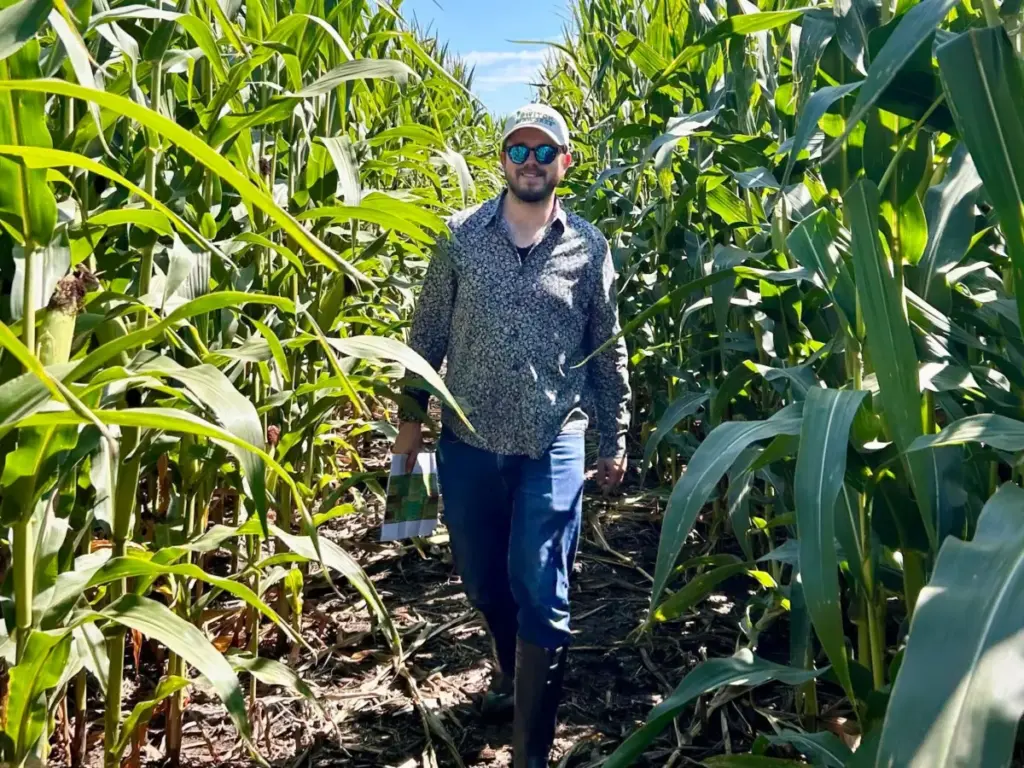
For over a century, modern agriculture has maintained a Faustian bargain with synthetic nitrogen fertilizers. While these chemical inputs have successfully fueled a global food boom, supporting a population that has nearly quadrupled since the early 20th century, they carry a staggering environmental and economic cost. The primary production method for synthetic nitrogen—the energy-intensive Haber-Bosch process—relies heavily on natural gas, accounting for roughly 2% of total global greenhouse-gas emissions.
Today, this fragile agricultural paradigm faces unprecedented stress. Geopolitical instability, most notably conflicts in energy-rich regions like Iran, has triggered violent fluctuations in global energy markets, causing fertilizer prices to skyrocket. Concurrently, farmers are grappling with a punishing economic double-whammy: soaring input costs colliding with falling market prices for major commodity crops like corn.
Enter a quiet revolution unfolding in the soil beneath our feet. A growing body of scientific research and burgeoning ag-tech innovation is zeroing in on an ancient biological mechanism: harnessing beneficial soil microbes to naturally fix atmospheric nitrogen and feed crops. By seeding the root zones of plants with engineered bacteria, researchers hope to significantly curb the agricultural sector’s reliance on synthetic chemicals, slashing greenhouse-gas emissions and offering much-needed financial relief to growers.
Yet, scaling biological fertilizers has long been hampered by a fundamental biological bottleneck: it is energetically expensive for microbes to fix nitrogen. When bacteria expend their metabolic energy synthesizing and releasing ammonia, their own growth and colonization suffer.
Now, cutting-edge biotech startups like Switch Bioworks are pioneering a sophisticated workaround. By deploying precision "genetic switches" that control when microbes turn their nitrogen-producing machinery on and off, these companies are striving to engineer bacteria that can first establish robust colonies around crop roots before pivoting into high-efficiency fertilizer factories. As early field trials span across multiple U.S. states and industry pioneers like Pivot Bio scale up commercial adoption, the agricultural sector stands on the precipice of a major paradigm shift—one where biologicals go mainstream, offering a vital, hard-to-abate climate solution.
Detailed Chronology: From Ancient Manure to the Haber-Bosch Age and Biotech
To understand the magnitude of today’s biological fertilizer movement, it is necessary to trace humanity’s long and fraught relationship with soil nutrition across distinct historical eras.
1. The Pre-Industrial Era: Relying on Nature’s Cycles
For thousands of years, human agriculture operated entirely on closed-loop biological systems. Farmers relied on animal manure, compost, crop rotation strategies—particularly integrating nitrogen-fixing legumes like beans, clover, and alfalfa—and naturally occurring soil microbiology to maintain soil fertility. While these organic methods were sustainable, they were fundamentally constrained by geography, labor, and local resource availability, ultimately capping the carrying capacity of global food production.
2. The 20th Century: The Haber-Bosch Miracle and its Environmental Toll
The dawn of the 20th century shattered these natural constraints. In 1909, German chemists Fritz Haber and Carl Bosch developed a catalytic high-pressure method to synthesize ammonia directly from atmospheric nitrogen and hydrogen gas. The Haber-Bosch process effectively unlocked the sky—which is nearly 80% nitrogen—and transformed it into a tangible, high-yield agricultural tool.
While this invention averted mass global starvation and underpins modern food security, it created an industrial leviathan. The process demands immense amounts of energy, typically sourced from fossil fuels, rendering modern farming inextricably linked to the oil and gas sectors. Furthermore, excess synthetic fertilizer washes out of fields, polluting waterways with toxic algal blooms and releasing nitrous oxide—a greenhouse gas roughly 273 times more potent than carbon dioxide over a 100-year timescale—into the atmosphere.
3. The 2010s: The Rise of Commercial Microbial Ag-Tech
Recognizing the unsustainable trajectory of synthetic inputs, agricultural biotechnology began shifting its gaze toward the microbiome. In 2011, the founding of companies like Pivot Bio marked a turning point. Rather than relying solely on traditional inoculants, these firms began applying synthetic biology and advanced screening techniques to isolate, modify, and commercialize microbes capable of delivering consistent nitrogen directly to crop roots.
However, early iterations faced severe biological hurdles. Microbes engineered to constantly produce nitrogen often struggled to survive in the wild, outcompeted by native soil bacteria that jealously guarded their metabolic energy for self-preservation rather than altruistic crop feeding.
4. The Present Day: Genetic Switches and the Quest for Precision
Today, the ag-tech landscape is entering its next evolutionary phase. Startups such as Switch Bioworks are moving beyond crude microbial application, utilizing synthetic biology to install precise genetic switches within bacteria. Simultaneously, established players like Pivot Bio are expanding their footprint across millions of acres and diversifying their product lines beyond corn into cotton, wheat, and small grains like sorghum and barley. As field trials mature across the American Heartland, the industry is racing toward a future where biologicals can reliably complement—if not fully replace—a substantial fraction of global synthetic inputs.
Supporting Context & Metrics: The Anatomy of a Microbial Solution
The chemistry and logistics underpinning biological fertilizers reveal why engineering them has been exceptionally difficult, and why recent breakthroughs represent a major leap forward.
The Nitrogen Conundrum
Nitrogen is the most critical nutrient for vegetative growth, playing an essential role in the formation of proteins, enzymes, and chlorophyll. Although the Earth’s atmosphere is roughly 80% nitrogen gas ($textN_2$), plants cannot utilize this "free" nitrogen because the two nitrogen atoms are bound by a triple covalent bond that is exceptionally difficult to break.
In nature, certain bacteria utilize an enzyme called nitrogenase to fix atmospheric nitrogen, converting it into reactive compounds like ammonia ($textNH_3$) that plants can readily absorb. Certain plants, most notably legumes, have evolved sophisticated symbiotic relationships with these diazotrophic bacteria, housing them in specialized root nodules where the plant supplies sugars in exchange for fixed nitrogen.
Most staple crops—such as corn, wheat, and rice—lack these symbiotic structures. Consequently, they depend entirely on reactive nitrogen introduced via synthetic fertilizers or organic matter.
The Metabolic Dilemma of Microbes
When biotechnology companies attempt to deploy nitrogen-fixing microbes to non-legume crops, they immediately encounter a fundamental thermodynamic wall. Nitrogen fixation is an energetically expensive metabolic process.
As Dan Blaustein-Rejto, director of food and agriculture at the Breakthrough Institute, explains:
"You have this inherent biological reality, where it’s really expensive for microbes to fix nitrogen. It takes a lot of energy, and if they do fix the nitrogen, they want to use it for themselves, to build proteins and survive."
Furthermore, logistics dictate that farmers cannot afford to coat seeds with astronomical quantities of bacteria. A successful biological fertilizer must rely on a relatively small initial population of microbes that can successfully colonize the rhizosphere (the narrow region of soil directly influenced by root secretions), multiply, and establish thriving colonies. If a microbe immediately diverts all its cellular energy into producing and releasing ammonia, its growth is severely stunted, leading to population collapse in the competitive soil environment.
The Innovation: Switch Bioworks’ Genetic Switch
To solve this dilemma, Switch Bioworks is betting on a novel approach: a genetic switch. A genetic switch is a targeted sequence of DNA designed to regulate gene expression based on specific environmental triggers.
In Switch’s leading product candidate, the engineered microbes are programmed to monitor the nitrogen levels within the surrounding soil. During the initial phase of crop growth, the bacteria focus entirely on survival and colonization, multiplying rapidly to establish a healthy population density in the root zone. Only when soil nitrogen levels drop below a critical threshold does the genetic switch flip, activating the genes responsible for ammonia synthesis and release. This ensures that the plant receives vital nutritional support precisely when its natural soil reserves deplete.
Hard Metrics and Market Realities
Global Emissions: Production of synthetic nitrogen fertilizer accounts for roughly 2% of global greenhouse-gas emissions.
U.S. Corn Dominance: Corn remains the most widely planted crop in the United States, spanning over 90 million acres in 2026.
Replacement Ceilings: Industry modeling suggests that biological fertilizers cannot entirely displace synthetic inputs. Current company projections and scientific modeling indicate a maximum replacement ceiling of approximately 50%, with initial commercial products typically capable of replacing about 25% of a farm’s synthetic nitrogen requirement.
Commercial Timeline: Next-generation innovators like Switch Bioworks are currently conducting multi-state field trials across the U.S., projecting full commercial product availability within two to three years.
Official Statements and Industry Perspectives
Leaders across academia, environmental policy, and commercial ag-tech offer a nuanced outlook on the promise and limitations of microbial fertilizers.
Tim Schnabel, founder and CEO of Switch Bioworks, emphasizes the sheer ambition required to transform the agricultural inputs market:
"We have to reinvent fertilizer… It’s too early to tell exactly how well this works in the field. The company plans to harvest the plants in late October or early November, but as of August, some corn plants treated with Switch microbes already looked visibly healthier than those that hadn’t been."
Highlighting the economic pressures weighing down on modern producers, Travis Frey, chief technology officer at Pivot Bio, notes the convergence of macroeconomic headwinds and technological readiness:
"Growers right now are experiencing a double whammy from the farm economics point of view. Fertilizer costs are going up, and the price of commodity crops like corn has dropped. That’s a big opportunity for Pivot and others in the industry… This next decade is when biologicals on the farm are going to go mainstream."
Academic experts echo optimism regarding the long-term integration of biologicals into traditional agronomic practices. John Havlin, a professor in the department of crop and soil sciences at North Carolina State University, states:
"I’m very excited about the future of the use of these products… They’ll eventually have a role to play to reduce the load of nitrogen that’s being applied."
At the same time, policy and research analysts urge caution, emphasizing the necessity of rigorous, independent validation before broad commercial claims are finalized. Dan Blaustein-Rejto of the Breakthrough Institute points out:
"There’s a lot of potential for these companies and products to help farmers reduce emissions… This could be a really important solution for a quite hard-to-abate sector. This is one of the final steps before they can go to market and make strong claims to farmers. Independent trials are important as well, since there can be a large gap between a company’s reported data and what independent researchers find."
Future Outlook: The Path to Mainstream Agricultural Decarbonization
As the agricultural sector looks toward the latter half of the 2020s, the integration of microbial fertilizers represents one of the most promising frontiers in climate tech and sustainable food security. However, transitioning from promising laboratory constructs and multi-state field trials to ubiquitous farm-level adoption will require navigating several critical milestones.
1. Navigating Rigorous Field Validation and Regulatory Scrutiny
While preliminary visual inspections in experimental cornfields suggest that genetically switched microbes can stimulate healthier early-season growth, rigorous, multi-year, independent field trials remain mandatory. Agronomic conditions vary wildly across soil types, moisture levels, temperature fluctuations, and regional microclimates. Ensuring that microbial performance remains consistent across diverse geographical landscapes will determine whether these products earn the trust of risk-averse farmers.
2. Economic Viability and Pricing Pressures
For biologicals to truly dislodge entrenched synthetic supply chains, their cost-to-benefit ratio must be unequivocally favorable to growers. With geopolitical volatility keeping energy and synthetic fertilizer prices high, biological alternatives have a unique economic window. However, to achieve mass market penetration, startups must scale production efficiently, ensuring that microbial seed treatments or in-furrow applications remain price-competitive against bulk chemical inputs.
3. Coexistence: A Hybrid Agricultural Future
Despite the rapid ascent of biological ag-tech, experts agree that synthetic fertilizers will not vanish anytime soon. With modeling indicating a practical replacement ceiling of 25% to 50% for microbial technologies, chemical fertilizers will retain a foundational role in meeting global caloric demands.
As Dan Blaustein-Rejto notes:
"There is no clear and plausible vision for replacing it entirely in the foreseeable future. So other ways to reduce emissions and reduce other types of nitrogen pollution from farms remain really critical."
Conclusion
The convergence of synthetic biology, genetic switching mechanisms, and mounting economic and environmental pressures has set the stage for a profound transformation in how we feed the world. By recruiting microscopic allies to capture the boundless nitrogen overhead, innovators like Switch Bioworks and Pivot Bio are doing more than just cutting costs for cash-strapped farmers—they are forging a viable pathway toward decarbonizing one of humanity’s most essential, yet hardest-to-abate, global sectors. The fields of tomorrow may well be nourished not by fossil-fuel-derived chemistry, but by engineered nature itself.