

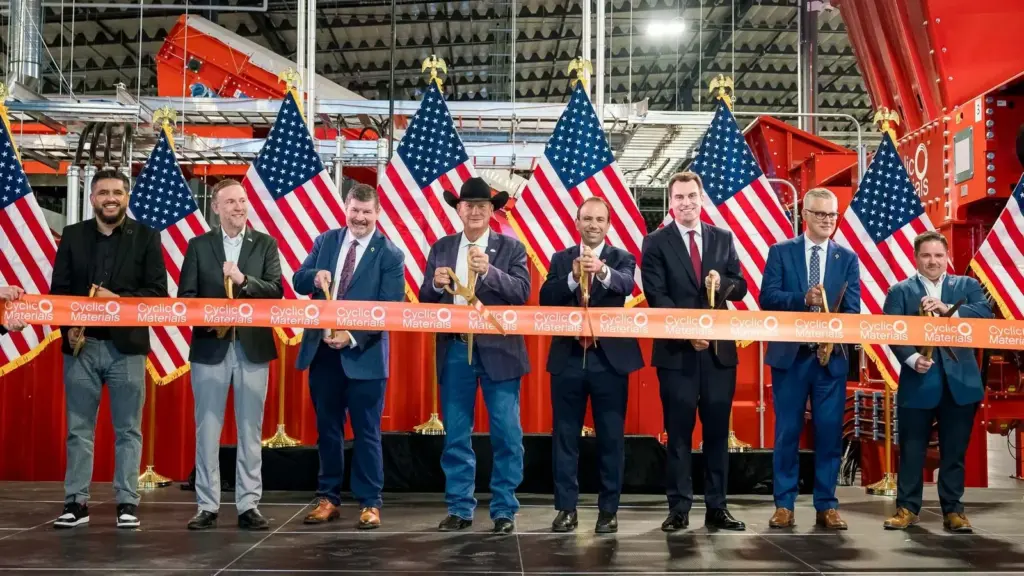
MESA, Ariz. — In a milestone move for domestic manufacturing, national security, and the green transition, Toronto-based clean-tech pioneer Cyclic Materials officially opened its flagship $20 million rare-earth magnet recycling facility in Mesa, Arizona. The expansive 144,000-square-foot plant represents the company’s largest rare-earth magnet recycling operation by annual processing capacity to date.
The grand opening brings together corporate, state, and federal leaders, underscoring a unified, urgent push to shore up America’s critical mineral supply chains. As global demand for artificial intelligence, clean energy infrastructure, and advanced defense systems skyrockets, the facility aims to solve one of modern technology’s most glaring vulnerabilities: heavy reliance on foreign nations for the foundational materials that power the future.
Executive Overview: Bridging the Critical Mineral Gap
Modern technology relies on an invisible backbone: rare-earth elements (REEs) and critical minerals. From the electric motors driving next-generation automotive vehicles and high-tech robotics to the drives housed inside sprawling data centers, permanent magnets made from materials like neodymium and dysprosium are indispensable. Yet, for decades, the United States supply chain for these elements has faced severe bottlenecks, with processing and refining heavily concentrated overseas—most notably in China.
Enter Cyclic Materials. By bridging the gap between waste and manufacturing, the company’s new Mesa facility breathes new life into discarded automotive parts, end-of-life electronics, and industrial scrap. Utilizing proprietary recycling technologies, the plant extracts valuable rare-earth elements from scrap streams and prepares them for reintegration into the domestic industrial ecosystem.
The timing of the launch aligns closely with broader federal initiatives. Following recent executive actions by the Trump administration to designate recoverable critical minerals as vital to national defense under the Defense Production Act, projects like Cyclic Materials’ Mesa plant are transforming from environmental initiatives into matters of sovereign economic security.
With commercial operations already underway, initial feedstock processing exceeding 7,000 metric tons, and regional pipelines brimming with potential, Cyclic Materials is positioning itself as an indispensable linchpin in the North American industrial renaissance.
Detailed Chronology: From Concept to Commercial Launch
The realization of Cyclic Materials’ Mesa facility is the culmination of a rapidly accelerated strategic rollout designed to establish robust domestic processing infrastructure across the United States.
The Foundation and Funding Growth
The journey toward the Mesa site gained significant momentum following the company’s technological validations and the opening of its commercial-scale rare-earth magnet recycling facility in Kingston, Ontario, in 2025. Recognizing the immense market demand in the United States, Cyclic Materials targeted the American Southwest for its premier commercial footprint.
The momentum accelerated dramatically in August 2026, when Cyclic Materials closed a robust $75 million strategic growth financing round. This capital injection was explicitly earmarked to scale U.S. rare-earth production, fast-tracking the completion of the Mesa site and laying the groundwork for parallel industrial developments.
Groundbreaking to Grand Opening
Initially announced as a $20 million investment in April 2025, the Mesa project quickly moved from blueprints to physical reality. Selecting Mesa, Arizona, was a calculated strategic decision. The city sits at the heart of a rapidly expanding manufacturing hub encompassing automotive production, semiconductor fabrication, advanced electronics, and energy-intensive data centers.
By September 10, 2026, the facility was ready for its official ribbon-cutting ceremony. Distinguished guests, including Cyclic Materials founder and CEO Ahmad Ghahreman and U.S. Undersecretary of Commerce for the International Trade Association William Kimmitt, toured the massive 144,000-square-foot plant.
Ahead of the grand opening, the facility received an influx of more than 7,000 metric tons of scrap material. Commercial operations commenced immediately, with the first outgoing shipments of processed rare-earth intermediates scheduled to leave the plant later in the month. The project has already created over 30 direct, high-paying jobs in the region, serving as a catalyst for local economic development.
Supporting Context & Metrics: The Mechanics of Modern Recycling
To understand the scale and significance of Cyclic Materials’ operation, one must examine the technological infrastructure and the sheer volume of untapped waste sitting in North American industrial yards.
Proprietary MagCycle Technology
Recycling rare-earth magnets from complex waste streams is notoriously difficult. Magnets are typically bonded into heavy assemblies, encased in steel, or fused within larger components like electric vehicle motors and wind turbine generators. Traditional mechanical dismantling is labor-intensive, economically unviable, and environmentally hazardous.

Cyclic Materials overcomes these barriers through its proprietary MagCycle technology. According to Chief Operating Officer Matt Cherevaty, the Mesa plant utilizes mechanical separation processes to extract magnets cleanly from steel housings and other matrices.
The output of this initial separation phase is an intermediate product known as Mag-Xtract. Once produced, Mag-Xtract is shipped to specialized chemical facilities for final refining and separation, yielding high-purity rare-earth oxides ready for alloy makers and magnet manufacturers. This multi-step process drastically reduces the energy and environmental footprint compared to virgin mining, cutting carbon emissions and waste.
Feeding the Beast: Market Metrics and Regional Potential
The economic viability of the Mesa facility rests on a vast, previously underutilized mountain of industrial scrap. Cyclic Materials estimates that there is an astounding 155,000 tons of regional feedstock sitting in scrap yards, end-of-life vehicles, and manufacturing facilities across the American Southwest.
By tapping into this localized supply chain, the company is slashing logistical lead times. The initial intake of 7,000 metric tons of scrap material demonstrates the immediate appetite of the market for certified, domestic recycling services.
Furthermore, Mesa is not Cyclic Materials’ sole U.S. venture. The company has invested more than $82 million in a second, highly ambitious facility in McBee, South Carolina. Unlike the Mesa site—which focuses on the initial separation and recovery stages—the McBee facility is designed to handle both magnet recovery and advanced chemical refining at a single location. Having broken ground earlier this year, the South Carolina plant is projected to create approximately 90 direct jobs upon completion, further solidifying the company’s bi-coastal manufacturing footprint.
Official Statements: Perspectives from Government and Industry Leadership
The high-profile attendance of federal trade officials at the Mesa grand opening underscores the intersection of clean technology and national security priorities.
The Federal Viewpoint: Securing the Supply Chain
Speaking at the facility’s grand opening, William Kimmitt, Undersecretary of Commerce for the International Trade Association, emphasized that supply chain vulnerability is a multi-decade challenge that requires immediate, decisive intervention.

"For decades, the United States has become too reliant on foreign materials, leaving the country vulnerable to potential supply disruptions from China and other countries," Kimmitt stated. "You can’t expect to lead in the technologies of tomorrow without reliable access to the foundational materials that make those technologies possible."
Kimmitt highlighted the impact of the Trump administration’s late-July decision to recognize recoverable critical minerals and materials as essential to national security and defense under Section 101 of the Defense Production Act of 1950. This regulatory designation elevates rare-earth recycling from a commercial venture to a matter of strategic state priority.
"That means stronger supply chains," Kimmitt added. "It means additional material available for American manufacturers. It means less reliance on production outside of the United States. And it means another important industrial capability located here at home."
The Corporate Vision: Shaving Years Off the Timeline
From the perspective of Cyclic Materials leadership, the Mesa plant represents a massive leap forward in speed-to-market for critical industries dependent on electronics and defense hardware.
"Cyclic is quickly closing gaps in the domestic supply chain as we expedite our rare-earth and critical mineral infrastructure development in the U.S.," said Ahmad Ghahreman, CEO and founder of Cyclic Materials. "This means shaving months, if not years, off the delivery of the critical materials required to drive AI, energy, and defense sectors forward."
The company’s executive team views the regional concentration of tech, automotive, and aerospace companies in Arizona as the ideal crucible for circular-economy models. By keeping materials within a closed regional loop, Cyclic Materials protects its partners from volatile international pricing spikes and geopolitical embargoes.
Future Outlook: The Road Ahead for Domestic Rare-Earths
The opening of the Mesa facility marks a watershed moment, but it is merely the opening salvo in what is expected to be a massive overhaul of the North American critical mineral landscape.
As the facility ramps up to full capacity over the coming months, industry analysts will closely monitor its operational efficiency, the purity yields of its Mag-Xtract product, and the speed at which downstream chemical refineries can process the material into market-ready oxides. Success in Mesa will likely serve as a blueprint for future expansions across North America and Europe.
Concurrently, the progress of the McBee, South Carolina facility will be watched as a test case for fully integrated domestic recycling and refining ecosystems. By combining mechanical recovery with chemical separation under one roof, South Carolina could provide a model for minimizing transportation emissions and maximizing local economic impact.
Furthermore, the macroeconomic tailwinds driving this sector show no signs of abating. The exponential growth of artificial intelligence hardware—which requires vast arrays of specialized server components—combined with the ongoing electrification of the global automotive fleet, ensures that demand for permanent magnets will remain at historical highs for the foreseeable future.
At the same time, geopolitical tensions and tightening export controls on critical minerals by foreign suppliers mean that self-reliance is no longer optional for Western economies. Cyclic Materials, through its strategic investments in Mesa and McBee, has positioned itself at the vanguard of this industrial transformation.
By turning the waste of yesterday into the advanced technologies of tomorrow, Cyclic Materials is proving that the path to energy independence and technological leadership does not lie solely in new mines, but in the intelligent, circular stewardship of the resources we have already unlocked.



