As the Biodiversity Heritage Library (BHL) marks its momentous 20th anniversary, reflections on its collection often lean toward the sheer volume of digitized pages, the rarity of its historical texts, or the biological breakthroughs hidden within centuries-old volumes. However, to truly understand the triumph of BHL, one must look beyond the digitized screens and examine the invisible infrastructure: the painstaking, cross-continental labor of dedicated individuals working behind the scenes.
As part of the ongoing BHL at 20: Treasures from the Biodiversity Heritage Library series, Digital Collections Manager Bianca Crowley sheds light on a monumental achievement that spans continents, institutions, and more than a decade of persistent effort: the complete open-access digitization of the Journal of The Asiatic Society and its legacy publications.
What began as an ambitious scanning initiative in June 2010 culminated in June 2021, representing an incredible eleven-year journey. Spanning 9 foundational institutions, 19 dedicated contributors, and a complex web of tracking tickets and editorial revisions, this project underscores both the profound value of historical scientific literature and the fragile, distributed nature of modern digital preservation. In an era where open access is often taken for granted, the story of the Journal of The Asiatic Society in BHL stands as a masterclass in global institutional cooperation, resourcefulness, and unwavering dedication to preserving humanity’s shared intellectual heritage.
Detailed Chronology: An Eleven-Year Archival Odyssey
The story of the Journal of The Asiatic Society begins long before the advent of digital libraries. Founded in Kolkata (formerly Calcutta) in 1784 by Sir William Jones through British India’s highest court, the Asiatick Society was established with an extraordinarily broad and ambitious mandate: to study the "History, Civil and Natural, the Antiquities, Arts, Sciences, and Literature of Asia."
More than 240 years later, The Asiatic Society endures as a cornerstone of scholarly learning in India. Recognized by the Indian government as an Institution of National Importance, it holds the distinction of being the country’s oldest surviving publishing house. Its publications, running continuously from 1788 to the present day, cover an expansive array of disciplines, seamlessly blending cultural studies, literature, medicine, and the natural sciences.
Bringing this sprawling publishing legacy into the digital age was no small feat. In June 2010, founding institutions of the BHL consortium initiated a targeted digitization project focused entirely on the legacy volumes of the Journal of The Asiatic Society and its subsequent name variations, as well as related companion series like the Memoirs.
What followed was a meticulous, eleven-year workflow characterized by continuous coordination across international time zones:
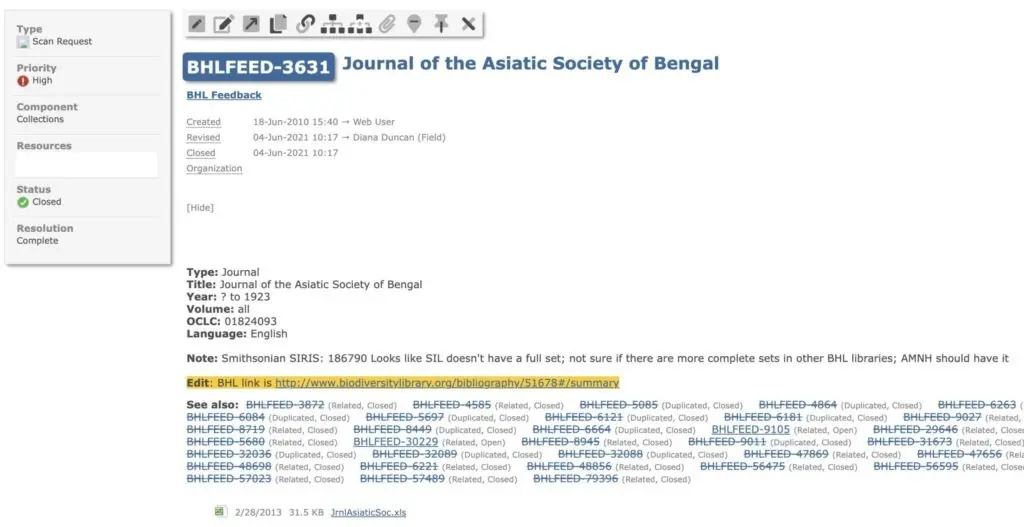
June 2010: The scanning request and curation tickets are officially opened within BHL’s internal issue tracking system. Initial assessments of library holdings across consortium partners reveal significant collection gaps, physical damage to brittle pages, and varying cataloging standards.
2010–2013: Initial momentum is supported by foundational grant funding, allowing partners to digitize large tranches of public-domain volumes. However, structural shifts—including the conclusion of major grant funding through the MacArthur Foundation in 2013—cause institutional digitization resources to ebb and flow dramatically.
2013–2020: Operating without dedicated, centralized digitization staff or continuous funding, BHL partners rely on volunteer efforts, institutional goodwill, and overlapping shifts in local capacity. Gaps are systematically identified and fulfilled through inter-institutional loans, physical scanning of rare library copies, and rigorous metadata cleanup.
June 2021: Exactly eleven years after the initial ticket was generated, BHL officially marks the digitization of all public-domain volumes of the Journal of The Asiatic Society as "complete" to the best of its ability. The project closes out with a verified paper trail encompassing 40 distinct system tickets and over 82 collaborative comments, cementing a historic milestone for open-access biodiversity literature.
Managing a distributed workforce across multiple countries and institutional frameworks requires robust communication channels. For BHL, the backbone of this coordination is Gemini, an issue-tracking system that has served for decades as the single source of truth for internal projects, website maintenance, troubleshooting, and collection enhancement.
While Gemini is a powerful tool, its configuration and customization possibilities are vast—at times, overwhelmingly so. Adapting an enterprise-grade issue tracker to handle the nuanced, highly specialized demands of biodiversity bibliography required years of trial and error. BHL staff had to develop specialized information architectures to categorize tasks, monitor scan requests, identify missing periodical issues, and resolve complex cataloging discrepancies.
Without this centralized digital communication backbone, the project would have collapsed under its own weight. The back-and-forth among 19 distinct contributors over eleven years demanded absolute transparency, candid communication, and meticulous documentation.
The Realities of a Distributed Labor Model
Unlike commercial digital archives backed by corporate endowments or heavily funded state-sponsored initiatives, the Biodiversity Heritage Library operates on a distributed labor model. BHL possesses no dedicated, centralized digitization or cataloging staff, nor does it enjoy a permanent, guaranteed funding stream specifically earmarked for scanning.
Instead, BHL’s strength lies in its consortium framework. Participating institutions contribute staff time, equipment access, and collection resources as their individual capacities allow. This decentralized model offers remarkable resilience, allowing partners to "come as they are" to the organization. However, it also introduces significant vulnerabilities:
Resource Fluctuations: When institutional budgets tighten or external grants expire, partner contributions invariably slow down.
Physical Preservation Challenges: Centuries-old paper, fragile bindings, and historical printing variations frequently require specialized, careful handling that cannot be rushed.
Technical and Cataloging Hurdles: Mismatched legacy catalog records, software bugs, and the steep learning curve associated with specialized metadata standards often create operational bottlenecks.
Despite these hurdles, the successful integration of the Journal of The Asiatic Society proves that a community-driven, collaborative model can achieve monumental results when guided by shared passion and mutual commitment.
Official Perspectives: The Human Element of Digital Conservation
Reflecting on the milestone, Bianca Crowley emphasizes that BHL’s true treasures extend far beyond rare paper volumes and digitized plates.
"As the Digital Collections Manager for the Biodiversity Heritage Library, my take on the treasures of BHL’s collection is less about the content or significance of any particular title, and more about the work over many (many) years behind the scenes by the people within BHL partner institutions to bring these treasures from the shelves to the screen and make them accessible and discoverable for anyone with an internet connection."
This sentiment captures the philosophical core of BHL’s organizational ethos. The library is not merely a passive repository of scanned books; it is an active, living network of human beings whose persistence, care, and daily collaboration bridge the gap between physical archives scattered across the globe and curious minds with an internet connection.
Furthermore, BHL is currently navigating a historic organizational transition. By adopting a newly shared ownership model designed to be more autonomous and globally distributed, BHL is intentionally distancing itself from reliance on any single institution. This structural evolution aims to empower the global community, ensuring that regional partners have a greater voice in governance, strategic planning, and collection priorities.
Yet, the fundamental ethos remains unchanged: the core work of cross-institutional and international collaboration continues to drive the mission forward, exactly as it has for the past two decades.
Future Outlook: Modernizing the Platform and Sustaining the Mission
While the completion of the Journal of The Asiatic Society digitization project is a cause for celebration, it also serves as a stark reminder of systemic inefficiencies. Taking eleven years to shepherd a single journal series through the pipeline is an unsustainable timeline for a modern digital library operating in a rapidly accelerating information landscape.
As BHL drafts its next operational chapter, organization leaders are looking closely at how to streamline workflows, reduce administrative friction, and accelerate collection growth. Guided by the core tenets of BHL’s collection development policy—which prioritizes access, usability, discovery, and breadth in descending order of importance—the leadership team is actively formulating a comprehensive platform modernization plan.
To build a more efficient, agile future, Crowley and her colleagues have identified several critical imperatives for the organization:
Workflow Automation: Reducing reliance on manual ticket-based tracking for routine scanning tasks by developing streamlined, integrated ingestion pipelines.
Enhanced Training and Documentation: Lowering the barrier to entry for new partner institutions by standardizing training modules, cataloging guidelines, and digitization best practices.
Strengthened Partnerships: Fostering new, strategic alliances with global institutions to share the labor burden more equitably across geographic regions.
Long-Term Financial Sustainability: Actively seeking recurring donations, planned gifts, and structural funding sources to establish dedicated resources for processing and curation.
Sustainability for BHL means much more than simply keeping web servers online and domains active. True sustainability requires the continuous, active growth and maintenance of its peerless collection of biodiversity literature and archives—ensuring that historical records of life on Earth remain safe from physical decay and universally accessible to scientists, historians, and the public.
As the Biodiversity Heritage Library celebrates its twentieth anniversary, the journey of the Journal of The Asiatic Society serves as both a monument to past perseverance and a roadmap for future innovation. By honoring the human labor behind the screens and investing in modernized, agile systems, BHL is well-positioned to navigate its next chapter, ensuring that the rich intellectual heritage of the natural world remains open and accessible to all for generations to come.