

Executive Overview
In the realm of digital scholarship and global conservation science, few assets are as vital—or as vast—as the Biodiversity Heritage Library (BHL). Operating as the world’s largest open-access digital library for biodiversity literature and archives, BHL serves as an irreplaceable cornerstone for researchers, taxonomists, historians, educators, and nature enthusiasts worldwide. With a digital repository spanning more than 64 million pages of historical literature, field notes, illustrations, and scientific monographs, the library bridges centuries of human inquiry into the natural world.
However, the institution faced an existential crisis. Following nearly two decades of foundational institutional backing from the Smithsonian Institution, BHL was confronted with the sudden loss of this primary support structure. Stripped of its historical safety net and facing an uncertain future with no guarantees of survival, the library had to conceptualize, fund, and execute a complete structural independence in record time.
What followed was a remarkable testament to the power of the global open-access community. Through a historic international fundraising mobilization—spearheaded by the successful "#GiveBHLWings" campaign—supporters from 46 countries rallied to raise over USD $113,000, enabling the library to retain essential staff, maintain uninterrupted services, and complete a massive infrastructural migration. By July 2026, the transition was formalized, shifting core technical operations from Washington, D.C., to the Field Museum in Chicago under a new, globally distributed, partner-supported governance model.
Having successfully navigated its survival, BHL is now entering a critical new phase. In June 2026, the formal transition period concluded, pivoting the organization’s focus from emergency rescue to long-term sustainability. Through the newly launched "BHL Sustainers" initiative, the library is appealing for predictable, monthly contributions to modernize its technical architecture, expand global collections, and guarantee that the historical record of Earth’s biodiversity remains free and accessible to everyone, forever.
Detailed Chronology: From Existential Threat to Independent Sovereignty
The modern history of the Biodiversity Heritage Library is defined by a rapid, high-stakes evolution from a centralized, institutionally anchored archive to a resilient, globally federated digital utility.
The Turning Point: The Loss of Smithsonian Support
For nearly twenty years, BHL functioned under the secure wing of the Smithsonian Institution, which provided the administrative, financial, and technical bedrock necessary to scale the repository into a global powerhouse. However, shifting institutional priorities and structural realignments led to a sudden withdrawal of this primary support.
For the leadership team, staff, and international partner consortium, the news was staggering. BHL was not merely a website; it was a complex, living digital ecosystem comprising intricate technical systems, global bibliographic partnerships, specialized staff, and massive data pipelines. Without immediate intervention, the infrastructure risked going dark, threatening to orphan decades of painstaking digitization work and cut off researchers worldwide from foundational taxonomic literature.
The Mobilization: Launching "#GiveBHLWings"
Realizing that traditional grant funding cycles moved far too slowly to meet the immediate emergency, BHL leadership made a bold decision: they turned directly to the global community.
On October 17, 2025, BHL launched its public fundraising campaign under the banner "#GiveBHLWings." The campaign was designed to bridge the gap between the loss of institutional sponsorship and the finalization of its independent governance structure, scheduled for January 1, 2026. The call to action resonated deeply across academic, scientific, and conservation communities. Over the final seven weeks leading up to the transition date, donors from 46 countries stepped forward, injecting critical capital into the organization.
The Technical Migration: Moving to the Field Museum
While financial contributions kept the lights on and retained vital personnel through the end of 2025, the logistical challenge of independence extended far beyond fundraising. The formal transition period, which kicked off at the start of the year, required a complete overhaul of the library’s legal, administrative, and technical frameworks.
The culmination of this massive operational pivot took place in July 2026, when BHL executed one of the most complex procedures in its history: the migration of its servers and core technical infrastructure from the Smithsonian Institution to the Field Museum in Chicago. This move signified more than a change of physical address; it marked the structural embodiment of BHL’s new distributed, partner-supported governance model. Rather than relying on a single institutional benefactor, BHL was now anchored by an international coalition of libraries, museums, and botanical gardens dedicated to shared stewardship.
Supporting Context & Metrics: The Scale of the Digital Repository
To fully appreciate the gravity of BHL’s transition and why its survival mattered so profoundly to the global scientific community, one must examine the sheer scale and scope of the repository it protects.
Unprecedented Access to 64 Million Pages
BHL is not a localized archive; it is a global public utility. The platform houses more than 64 million pages of digitized biodiversity literature, ranging from rare 15th-century botanical folios to vital 19th-century expedition logs and modern ecological journals.

- Taxonomic Discovery: Taxonomists rely on BHL’s historical texts to locate original species descriptions (protologues), which are legally required for naming new species and resolving nomenclature debates. Without open access to these foundational texts, modern species discovery and conservation planning would grind to a crawl.
- Interdisciplinary Impact: The library serves a vastly diverse user base. Historians of science study its collections to trace the evolution of evolutionary theory; artists and designers draw inspiration from its high-resolution natural history illustrations; and educators utilize its open archives to foster environmental literacy in classrooms worldwide.
Financial Resilience and Global Reach
The numbers behind the rescue effort highlight the breadth of BHL’s international constituency:
- Total Funds Raised: Over USD $113,000 raised since the public transition appeal began.
- Campaign Milestone: USD $51,000 secured during the intense seven-week sprint of the #GiveBHLWings campaign ending January 1, 2026.
- Geographic Diversity: Contributions poured in from supporters across 46 distinct countries, underscoring that BHL is viewed not as a localized American institution, but as a priceless global commons.
- Currency Flexibility: Recognizing its global audience, BHL engineered its donation infrastructure to accept gifts in more than 135 currencies, ensuring that supporters from every corner of the earth could contribute regardless of local economic conditions.
Official Statements and Institutional Reflections
Reflecting on the turbulent transition period, BHL leadership and administrative partners have emphasized both profound gratitude for the past year’s rescue and a sober recognition of the work that lies ahead.
In communications distributed to the library’s global network, representatives highlighted the human element behind the digital architecture:
"Because our community rallied around BHL, staff were retained, services continued, and more than 64 million pages of biodiversity literature and archives remain freely accessible online. Together, we saved BHL. Now we need to sustain it."
The transition from a centralized institutional model to a distributed, partner-supported network represents a fundamental shift in how large-scale digital heritage is preserved. By anchoring its core technical infrastructure at the Field Museum in Chicago—while maintaining decentralized partnerships spanning continents—BHL has insulated itself against future single-point-of-failure vulnerabilities.
Fiscal sponsorship through the Council on Library and Information Resources (CLIR) further provided the necessary regulatory and administrative framework to steer the organization through its complex legal restructuring without interrupting public-facing services.
Future Outlook: The "BHL Sustainers" Initiative and Long-Term Stability
Having successfully survived its existential crisis, BHL’s overarching mission for the remainder of 2026 and beyond is clear: transitioning from emergency recovery to permanent sustainability.
Why Monthly Support Matters
Emergency fundraising campaigns are vital for weathering acute crises, but they cannot support the day-to-day operational realities of running a world-class digital library. Server maintenance, software modernization, optical character recognition (OCR) improvements, metadata enhancement, and staff salaries require predictable, recurring revenue streams.
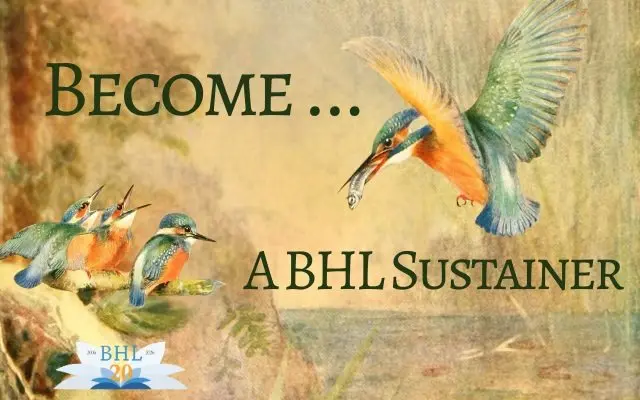
This realization prompted the launch of the BHL Sustainers program. Drawing inspiration from the natural world—such as the varied sizes of eggs illustrated in historic plates within BHL’s own collections, or the delicate needs of developing wildlife like baby kingfishers—the program emphasizes that monthly gifts of any size compound to create an unshakeable foundation.
- Predictable Income: Monthly contributions allow BHL to forecast operational budgets accurately, ensuring uninterrupted service for the millions of global users who rely on the platform daily.
- Infrastructure Modernization: Ongoing funds will directly support upgrading technical capabilities, improving search discoverability, and seamlessly integrating newly digitized partner collections into the master repository.
How to Get Involved
As the library looks toward its third decade of operation, its leadership is issuing a direct appeal to the beneficiaries of its vast digital commons:
"If BHL matters to your work, your collections, your teaching, your research, your art, your writing, or your love of the natural world, please consider becoming a monthly donor today."
Beyond monthly sustainership, the library continues to welcome major philanthropic commitments, wire transfers, bequests, and legacy gifts through its structured "Ways to Give" portal. Tax-deductibility provisions are managed through CLIR, adapting to the individual circumstances and country residencies of international donors.
Twenty years ago, the Biodiversity Heritage Library opened the written history of life on Earth to the global public. Last year, a passionate international community answered the call to keep those digital doors open. Now, by sustaining the library month after month, that same community is ensuring that BHL will continue to fly for generations to come.



