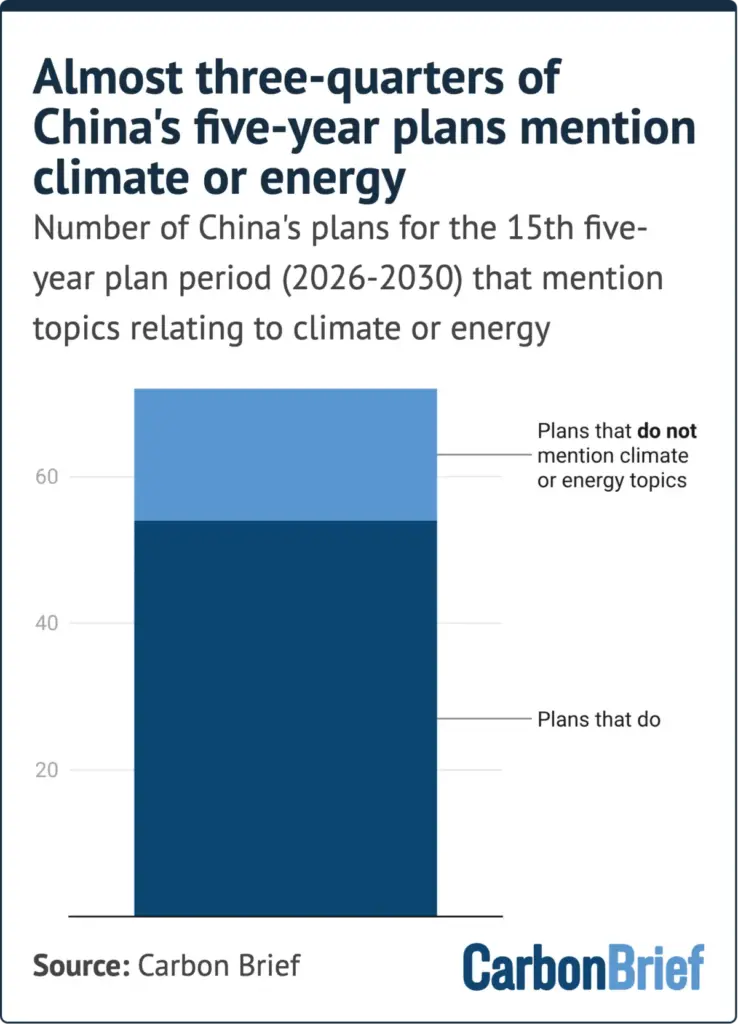
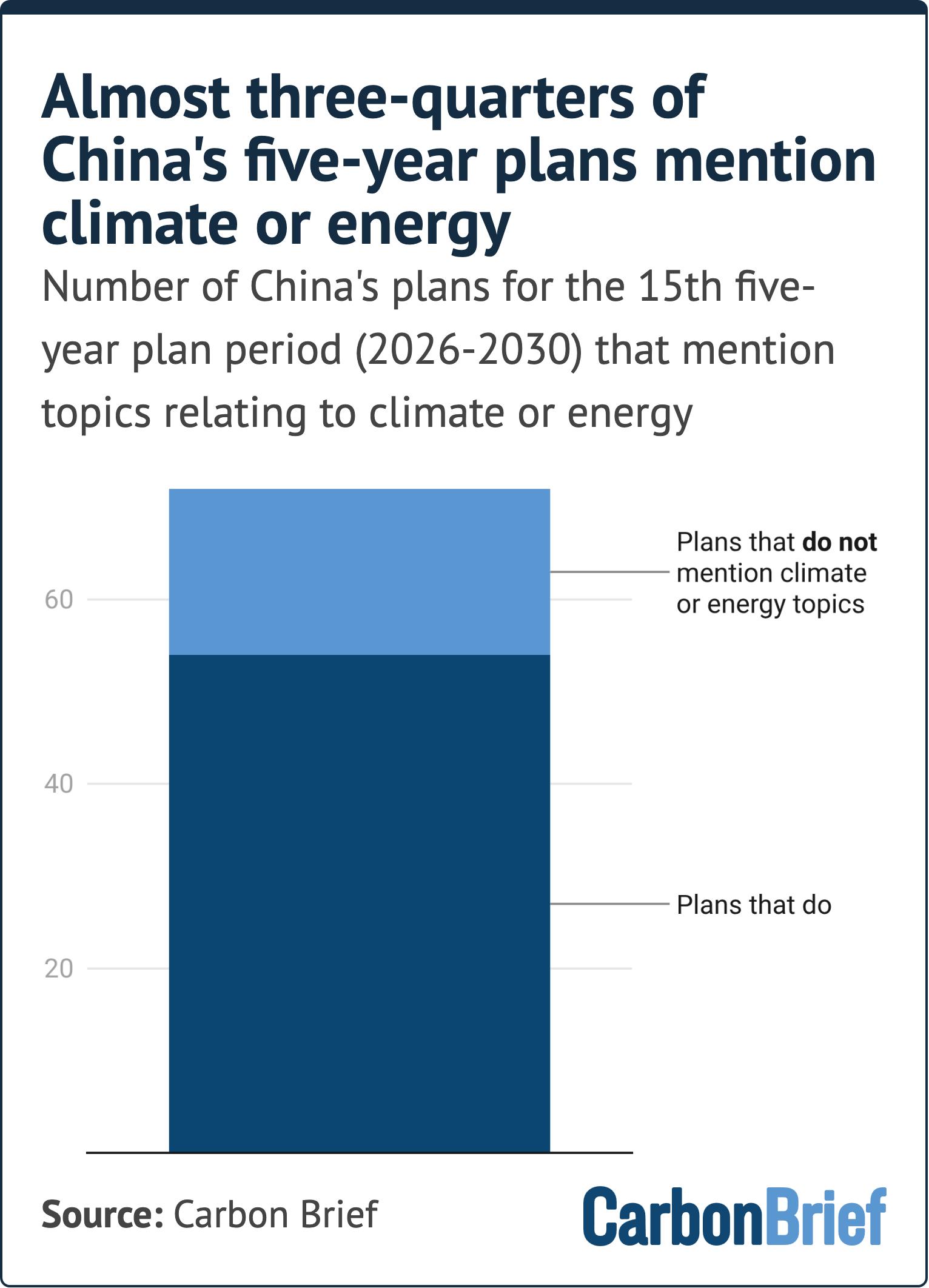
In a structural shift that signals the total integration of environmental policy into national economic planning, nearly three-quarters of the policy blueprints released for China’s 15th Five-Year Plan (2026–2030) explicitly incorporate climate and energy targets. According to a comprehensive investigation by Carbon Brief, 54 out of the 72 central-government five-year plans made public to date embed green directives, range-bound metrics, or operational mandates aimed at accelerating the nation’s energy transition.
The findings demonstrate that climate mitigation in China is no longer confined to specialized environmental ministries like the Ministry of Ecology and Environment (MEE) or energy administrators like the National Energy Administration (NEA). Instead, decarbonization policies have systematically permeated every arm of the state apparatus—from civil aviation and heavy logistics to digital infrastructure, state archives, cultural heritage management, and traditional medicine.
As Beijing prepares for the critical multi-year window preceding its target to peak carbon dioxide emissions before 2030, this policy architecture lays the administrative foundation for the country’s economic strategy. Anchored by an overarching goal to reduce carbon intensity—emissions per unit of Gross Domestic Product (GDP)—by 17% over the 2026–2030 period, these interlinked policy directives seek to align macroeconomic expansion with rigorous emission control mechanisms.
       CHINA'S 15TH FIVE-YEAR PLAN POLICY ARCHITECTURE (2026–2030)

       +---------------------------------------------------------+
       |   Overarching 15th Five-Year Plan (March 2026)          |
       |   - Target: Cut Carbon Intensity by 17% by 2030         |
       |   - Framework: National Dual-Carbon Goals               |
       +----------------------------+----------------------------+
                                    |
            +-----------------------+-----------------------+
            |                                               |
+-----------v-------------------+               +-----------v-------------------+
| Core Energy & Climate Plans   |               | Peripheral Sector Plans       |
| (54 out of 72 Total Plans)    |               | (Cross-Ministry Integration)  |
+-------------------------------+               +-------------------------------+
| * Renewable Energy            |               | * PBOC Green Financial Reform |
| * New-Type Power System       |               | * Smart NEV & Transport Grid  |
| * Climate Response & Adaptation|              | * Industrial Digitalization   |
| * Coal & Oil Industry Shift   |               | * Urban Renewal & Agriculture |
+-------------------------------+               +-------------------------------+
Detailed Chronology
The deployment of China’s quinquennial planning regime follows a precise, hierarchical cadence. The architecture for the 15th Five-Year Plan cycle was formally initiated with the publication of the foundational master plan, followed by a cascade of sector-specific and institutional policies.
+-------------------------------------------------------------------------------+
|                              RELEASE TIMELINE                                 |
+-------------------------------------------------------------------------------+
|  MARCH 2026       Overarching 15th Five-Year Plan released at "Two Sessions" |
|                   - Establishes 17% Carbon Intensity Reduction Target         |
|                   - Solidifies 2030 Carbon Peaking Framework                  |
+-------------------------------------------------------------------------------+
|  MID-2026         Core Energy & Climate Sector Plans Released                 |
|                   - Renewable Energy & New-Type Power System FYPs             |
|                   - National Climate Change Response FYP (MEE)                |
|                   - Industrial Low-Carbon Transformation FYP (NDRC)           |
+-------------------------------------------------------------------------------+
|  LATE 2026 ONWARD Peripheral Ministry & Action Plans Roll Out                 |
|                   - People's Bank of China Reform Plan                        |
|                   - Transport, Urban Renewal, & Agriculture FYPs              |
|                   - Specialized 2026–2030 Action/Implementation Plans         |
+-------------------------------------------------------------------------------+
March 2026: The Master Blueprint
The overarching 15th Five-Year Plan for National Economic and Social Development of the People’s Republic of China was officially ratified and published in March 2026 during the annual "Two Sessions" (Lianghui) legislative assemblies in Beijing. This top-level document set the legally binding baseline for the nation’s direction through 2030, reinforcing international commitments under the Paris Agreement—including the goal to cut greenhouse gas emissions to 7–10% below peak levels by 2035 and achieving carbon neutrality before 2060.
Mid-2026: Sectoral and Thematic Rollouts
Following the March unveiling, primary state organs—led by the National Development and Reform Commission (NDRC), the MEE, and the NEA—began publishing thematic plans. Core strategies focusing on renewable energy deployment, new-type power grid construction, industrial decarbonization, and fossil-fuel industry restructuring were released in rapid succession. These documents translated the high-level 17% carbon intensity reduction directive into concrete capacity quotas and regulatory mandates.
Late 2026 and Beyond: Peripheral Mainstreaming
In the months following the core releases, non-environmental ministries published their respective specialized plans. Agencies managing civil aviation, emergency management, public finance, postal logistics, and electronic information manufacturing integrated specific "green and low-carbon" mandates into their 2026–2030 roadmaps. Simultaneously, targeted framework documents—termed "action plans" and "implementation plans"—were launched to govern public institution energy consumption, digital-green co-transformation, and meteorological disaster prevention.
Supporting Context & Metrics
The comprehensive dataset compiled by Carbon Brief reflects an exhaustive audit of public central-government filings. Out of 72 available ministerial plans governing the 2026–2030 window, 54 explicitly incorporate climate change policies, decarbonization metrics, or ecological preservation goals.
Distribution of 15th Five-Year Plans by Climate Integration
Plan Classification
Total Evaluated
Plans with Climate/Energy Focus
Primary Focus Areas
Overarching Plan
1
1
Macroeconomic carbon intensity, national dual-carbon strategy
Core Energy & Climate Plans
14
14
Power systems, renewables, coal/oil management, climate adaptation
Action & Implementation Plans
4
4
Peaking action roadmaps, digital greening, public sector reduction
Peripheral & Sectoral Plans
53
35
Green finance, low-carbon transit, circular economy, industrial standards
Total
72
54
~75% Integration Rate Across Central Government
Distribution of Evaluated Plans (Total: 72)
===========================================
[#################################........] 54 Plans Include Climate Targets (75%)
[.........................................] 18 Plans Without Direct Climate Targets (25%)
Primary Numerical Targets vs. Non-Numerical Directives
The planning documents bifurcate goals into binding numerical indicators (zhuyaozhibiao) and qualitative operational directives (zhuyaorenwu).
1. Macro Quantitative Anchors
Carbon Intensity Reduction: A headline primary target requiring a 17% decrease in CO2 emissions per unit of GDP by 2030, relative to 2025 levels.
Greenhouse Gas Abatement: Operationalizing earlier commitments to reduce national GHG emissions to 7–10% below peak levels by 2035.
Non-Fossil Energy Consumption: Sectoral targets embedded within power system plans to boost the ratio of non-fossil fuels in total primary energy consumption.
2. Sector-Specific Secondary Mandates
Energy Infrastructure: The New-Type Power System 15th FYP and Renewable Energy Development FYP mandate enhanced grid flexibility, high-voltage direct current (HVDC) line expansion, and battery storage integration to prevent renewable curtailment.
Heavy Industry & Fossil Fuels: The Coal Industry Development FYP mandates structural retrofits for legacy thermal assets, shifting coal from a primary baseload fuel toward a peak-shaving, load-balancing utility.
Clean Mobility: The Smart and Connected New-Energy Vehicle (NEV) Industry Development FYP establishes adoption floors for electric, hybrid, and hydrogen fuel-cell vehicles, supported by requirements in the Integrated Transportation Services FYP.
   RENEWABLE GRID INTEGRATION MODEL (2026-2030)

   +-----------------------+     +-----------------------+
   |  Wind & Solar Generation |     | Coal Thermal Units    |
   |  (Variable Power Source) |     | (Shifted to Peaking)  |
   +-----------+-----------+     +-----------+-----------+
               |                             |
               +--------------+--------------+
                              |
               +--------------v--------------+
               | Ultra-High Voltage Grid     |
               | & Battery Storage Systems   |
               +--------------+--------------+
                              |
               +--------------v--------------+
               | End-Use Demand & NEV Assets |
               +-----------------------------+
Financial Mobilization: The People’s Bank of China 15th Five-Year Reform and Development Plan obligates financial institutions to expand green credit facilities, standardize transition finance taxonomy, and evaluate climate-related systemic financial risks.
Official Statements
State departments and regulatory authorities have reinforced the operational necessity of embedding climate directives across all administrative domains.
In policy literature accompanying the release of the environmental roadmaps, officials from the Ministry of Ecology and Environment (MEE) emphasized the foundational nature of the current planning cycle:
"The 15th Five-Year Plan period represents an indispensable strategic window for China’s carbon emissions to reach their historical peak. Achieving our commitments requires unwavering policy continuity, rigorous quantifiable metrics, and complete administrative coordination across every sector of the national economy."
Similarly, leadership within the National Development and Reform Commission (NDRC) underscored the economic realignment required to balance growth with carbon control:
"Decarbonization is not a constraint on development, but rather the core engine for cultivating ‘new quality productive forces.’ By embedding low-carbon requirements directly into industrial planning, digital infrastructure development, and financial architecture, we ensure that high-quality economic growth is intrinsically green."
Technical authorities from the National Energy Administration (NEA) highlighted the challenge of power system transformation in official briefings on the energy sectoral plans:
"Building a new-type energy system demands that we reconcile supply security with rapid green transformation. The sectoral five-year plans provide a precise timeline to scale non-fossil capacity while systematically modernizing fossil fuel assets to serve as dynamic support mechanisms during peak demand."
Future Outlook
The publication of these 54 climate-integrated plans positions China at a critical juncture in its economic and environmental history. As the nation enters the core operational window of the 15th Five-Year Plan, several structural dynamics and execution challenges will define the outcome of these policies between 2026 and 2030.
       CHALLENGES & STRATEGIC PRIORITIES (2026–2030)

  +-----------------------+     +-----------------------+
  | Grid Modernization    |     | Local Fiscal Balance  |
  | Integration of wind/  |     | Reconciling local     |
  | solar into UHV grids. |     | debt with green spend.|
  +-----------+-----------+     +-----------+-----------+
              |                             |
              +--------------+--------------+
                             |
              +--------------v--------------+
              | Industrial Carbon Accounting |
              | Transition from intensity to|
              | absolute capacity limits.   |
              +-----------------------------+
Key Implementation Determinants
Grid Absorption and Storage Bottlenecks:
While targets for utility-scale solar and wind buildout remain ambitious, the key variable lies in grid integration. The success of the New-Type Power System FYP depends on expanding high-voltage transmission lines, scaling energy storage technology, and reforming regional power spot markets to prevent localized curtailment.
Sub-National Alignment and Fiscal Pressures:
Municipal and provincial governments face the task of translating national targets into local enforcement. Balancing provincial economic performance with strict carbon intensity caps will test regional governance, particularly in heavy industry hubs reliant on coal revenues.
Transition from Carbon Intensity to Absolute Emission Caps:
The 15th FYP period serves as the bridge between China’s traditional carbon intensity metric (emissions per unit of GDP) and an absolute carbon cap framework. Establishing verifiable, real-time emissions accounting across all industrial sectors will be essential prior to the 2030 threshold.
Global Trade and Climate Diplomacy:
The mainstreaming of low-carbon mandates across export-oriented sectors—such as electronic manufacturing, automotive industries, and heavy equipment—is designed to buffer Chinese industrial goods against international border carbon adjustments. How these 54 ministerial plans are executed will directly shape global supply chain standards and international climate negotiations through the end of the decade.