

Executive Overview
For decades, the global wind energy industry has followed a rigid, highly successful trajectory. Through an iterative process of trial, error, and immense capital expenditure, engineers and manufacturers largely converged on a singular, dominant archetype: the massive, three-bladed, upwind horizontal-axis wind turbine mounted atop a towering, rigid tubular structure. This design philosophy became the gold standard because it effectively mitigated aerodynamic fatigue, maximized power capture, and provided reliable predictability in volatile marine environments.
Consequently, radical departures from this blueprint—particularly dual-rotor layouts and downwind configurations—have historically been met with severe skepticism by offshore wind veterans. These alternative designs carry baggage: a legacy of rhythmic noise pollution, structural resonance issues, and devastating blade-fatigue problems caused by turbulent wakes passing behind thick support towers.
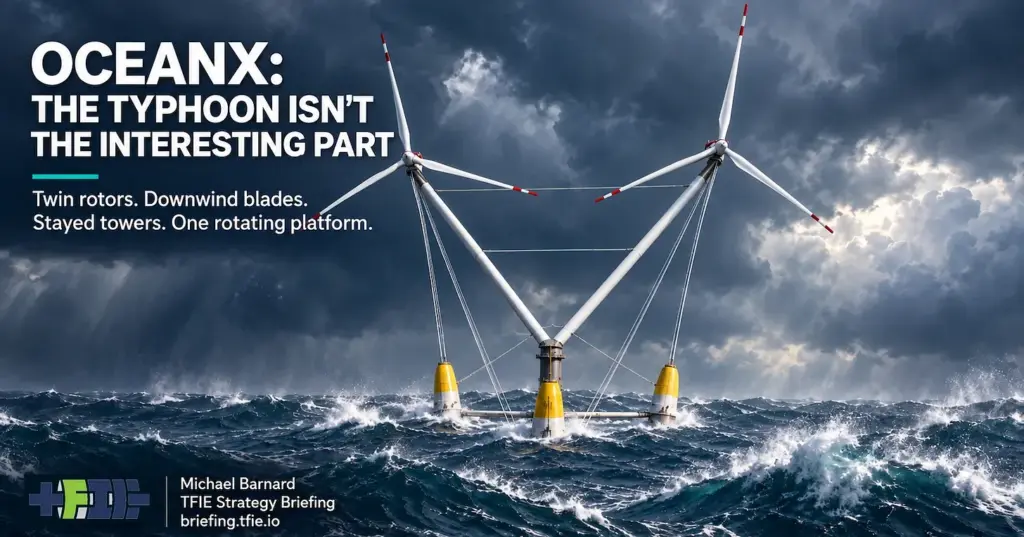
Enter OceanX, an unconventional floating offshore wind platform that initially seemed destined to join the graveyard of impractical engineering concepts. Featuring dual rotors mounted downwind of their supports on a heavily stayed, weather-vaning floating structure, OceanX checks almost every box on the traditional offshore engineer’s list of red flags.
However, engineering theory must eventually face empirical reality. Recently, OceanX was thrust into the ultimate proving ground: Super Typhoon Yagi, one of the most violent tropical cyclones to strike the region in recent memory. The survival of the platform—coupled with remarkably stable telemetry data collected during the height of the storm—has forced a critical re-examination of the machine.
While the platform’s dual-rotor configuration remains a subject of ongoing debate, the structural synergy of its slender stayed supports, downwind operation, and whole-platform weather-vaning has successfully challenged decades of orthodox offshore thinking. This article provides a comprehensive deep dive into the engineering mechanics of OceanX, the performance metrics recorded during Super Typhoon Yagi, and what this radical design means for the future of floating offshore wind.
Detailed Chronology: OceanX in the Eye of Super Typhoon Yagi
To understand the engineering significance of OceanX’s recent trial, one must examine the sheer violence of the environment it endured. Super Typhoon Yagi did not merely offer a stiff breeze; it delivered a ferocious, multi-directional onslaught of extreme wind shear and chaotic sea states that tested every bolt, stay, and mooring line on the platform.
The Storm Conditions
During the height of Super Typhoon Yagi, operational data captured by Mingyang documented environmental conditions that pushed offshore machinery to its absolute limits:
- Nacelle Wind Speeds: Sustained velocities exceeding 41.5 meters per second (approx. 93 mph), with severe gusts creating extreme transient aerodynamic loads.
- Significant Wave Heights ($H_s$): Averaging 6.5 meters (21.3 feet), creating massive hydrodynamic pressures against the floating substructure.
- Maximum Individual Wave Height: Reaching a staggering 9.8 meters (nearly 32 feet), capable of inducing violent pitching and heaving moments on the platform.
Platform Dynamics and Telemetry
Despite these punishing conditions, the telemetry sent back from OceanX surprised even seasoned observers. Most notably, nacelle inclination varied by only zero to three degrees throughout the height of the typhoon.
In the world of floating offshore wind—where structural stability is notoriously difficult to maintain under dynamic wave loading—a minor tilt variation of 0 to 3 degrees is an exceptional metric. It indicates that the floating foundation, the mooring spread, and the upper structural skeleton functioned as a cohesive, highly damped system rather than a collection of independent, flexing components.
Furthermore, post-storm structural analysis revealed a critical validation point: the measured platform response tracked pre-storm computational fluid dynamics (CFD) and finite element analysis (FEA) simulations with remarkable precision. There was no evidence of abnormal structural resonance, uncontrolled harmonic oscillation, or lasting plastic deformation in the platform’s attitude.

For a full-scale floating machine carrying two widely separated rotors on long, inclined, cable-stayed supports, these numbers transition OceanX from the realm of "expensive novelty" to a subject of serious engineering study. The storm did not unilaterally prove that OceanX is economically optimal or cheaper to build than conventional systems, but it definitively proved that its coupled structure behaves with incredible resilience under extreme loading.
Supporting Context & Metrics: Deconstructing OceanX’s Architecture
To truly appreciate why Super Typhoon Yagi’s data is so consequential, one must look past the headline storm metrics and dissect the individual engineering choices that define OceanX. According to advanced technical evaluations—such as those published in the TFIE Strategy Briefing—OceanX cannot be evaluated as a single monolithic concept. Instead, its architecture is best understood through four distinct design pillars: twin rotors, downwind operation, stayed supports, and whole-platform weather-vaning.
1. The Downwind Problem and the Stayed Support Solution
On a traditional upwind turbine, the blades sit forward of the tower, facing directly into the oncoming wind. This prevents the tower shadow from interfering with the blades. Historically, downwind turbines—where the wind hits the support structure before reaching the blades—failed because every time a massive rotor blade swept past the thick tubular tower, it passed through a turbulent wake. This cyclic shadowing effect caused massive fluctuations in aerodynamic loading, accelerating blade fatigue and generating distinct, intrusive low-frequency noise.
OceanX does not eliminate this aerodynamic reality, but it fundamentally alters the physics of the wake generator. Rather than relying on two massive, thick, freestanding tubular towers, OceanX utilizes slender, inclined structural members held in place by a complex network of pretensioned cable stays.
Because these stayed supports possess a vastly smaller cross-sectional area compared to conventional towers, they produce a significantly narrower, cleaner wake. Consequently, the historical "downwind penalty"—the severe aerodynamic turbulence and fatigue that doomed past downwind designs—is mitigated at its source, relieving the blades from excessive cyclic stress.
2. Whole-Platform Weather-Vaning
Traditional offshore turbines rely on active, motorized yaw systems mounted inside the nacelle. These massive gearboxes and motors continuously rotate the heavy rotor and nacelle assembly to track shifts in wind direction. On a floating platform, managing yaw forces via top-heavy nacelle motors adds immense weight and mechanical complexity.
OceanX bypasses this entirely through whole-platform weather-vaning. Rather than turning the turbines relative to the tower, the entire floating platform passively rotates around its single-point mooring system in response to changing wind vectors.
This design choice ensures that the slender supports, cable stays, and downwind rotors remain in a fixed, optimal aerodynamic alignment relative to incoming airflow at all times. By shifting the yaw compliance down to the subsea mooring interface, OceanX eliminates top-heavy yaw machinery and maintains smooth directional tracking.
3. The Twin Rotor Paradox: Radical vs. Rational
While the stayed supports, downwind alignment, and weather-vaning platform represent highly sophisticated engineering adaptations, OceanX’s most visually striking feature remains its most controversial: the twin rotors.
Mounting two complete wind turbines onto a single floating platform instantly divides opinions.

- The Argument For: Spreading the generating capacity across two smaller rotors allows for reduced hub heights and smaller, more manageable individual components. This can simplify component logistics, manufacturing scale, and assembly procedures for floating platforms, which are severely constrained by crane vessel capacities and port infrastructure limits.
- The Argument Against: Two turbines inherently mean two nacelles, two high-speed drivetrains, two heavy hubs, and six distinct blades. This duplicates expensive hardware, introduces complex aerodynamic interactions between the two rotors, and doubles the number of high-maintenance mechanical failure points compared to a single, mega-scale upwind turbine.
Ultimately, the twin rotors dominate every photograph of OceanX, making the machine look radically futuristic. Yet, from a purely technical standpoint, they are not necessarily the core innovation. A stayed support structure, a downwind rotor, and a weather-vaning floating foundation can theoretically exist independently of a dual-rotor layout. The dual-rotor configuration remains unproven in terms of long-term economic superiority.
Official Statements and Industry Implications
The survival of OceanX through Super Typhoon Yagi has triggered widespread discussions across the marine renewable energy sector. While formal press releases from developers emphasize the resilience of the structural telemetry, independent analysts have focused on the paradigm shift the storm represents for floating wind design boundaries.
Industry observers note that floating offshore wind is currently trapped in a cost-reduction bottleneck. As developers attempt to deploy larger 15MW to 20MW single-rotor turbines onto floating platforms, the top-heavy mass of the nacelle and the massive bending moments exerted on the tower require increasingly heavy, expensive substructures and massive mooring spreads.
By distributing loads through a cable-stayed upper framework, OceanX demonstrates that structural rigidity can be achieved without relying on massive, thick steel towers. As noted in strategic engineering briefs, the successful survival of Yagi proves that "cable-stayed, slender-member compression structures can maintain dimensional integrity under extreme hydrodynamic and aerodynamic cyclic loading."
Furthermore, offshore engineering firms are beginning to look closely at passive weather-vaning mooring solutions. As deeper-water leases push developers further offshore into harsher metocean conditions, minimizing active mechanical components at the top of the tower significantly reduces offshore maintenance interventions—a critical factor in slashing Levelized Cost of Energy (LCOE) over a 25-year project lifecycle.
Future Outlook: The Road Ahead for Downwind Floating Wind
While the empirical data gathered during Super Typhoon Yagi has successfully elevated OceanX from a speculative rendering to a credible engineering prototype, significant questions remain unanswered. Surviving a single catastrophic weather event proves short-term structural survivability, but it does not automatically translate to commercial viability.
Unresolved Engineering and Economic Challenges
- Long-Term Fatigue Analysis: While short-term wave and wind loading data look pristine, the true test of any offshore wind turbine is a 25-year operational lifecycle. Engineers must still verify how the cable stays, pretensioned rigging, and downwind blades handle cumulative high-cycle fatigue.
- Maintenance and Operational Complexity: Two drivetrains mean double the mechanical risk. Subsea rotating interfaces, wet-mate power cables, and complex nacelle components located far offshore require rigorous maintenance protocols. If a drivetrain fails on a twin-rotor floating system, repair logistics will be considerably more complex than servicing a standard single-rotor machine.
- Capital Expenditure (CapEx) vs. Operational Expenditure (OpEx): A detailed, transparent economic comparison between OceanX and conventional semi-submersible floating turbines is urgently needed. Does the savings in tower mass outweigh the added cost of duplicated nacelle hardware and complex cable-stayed rigging?
Conclusion
OceanX has accomplished something rare in modern engineering: it has forced a deeply skeptical technical community to reconsider an abandoned design philosophy. By cleverly pairing downwind rotors with slender, cable-stayed supports and a whole-platform weather-vaning floating foundation, the designers successfully circumvented the historical pitfalls that plagued downwind turbines of the past.
Super Typhoon Yagi provided the ultimate baptism by fire, demonstrating that this radical architecture can maintain structural integrity under extreme conditions with minimal nacelle inclination and zero abnormal resonance. While the jury is still out on whether the twin rotors can economically justify their added complexity, the broader structural architecture of OceanX has firmly earned its place at the forefront of the future of floating offshore wind innovation.



