

In November 2020, at the height of the COVID-19 pandemic’s initial waves, Mark Carney traveled to London to deliver the BBC’s prestigious Reith Lectures, titled How to Get What We Value. As he had done at many defining junctures throughout his career as a central banker and economic strategist, Carney’s message was anchored in a profound sense of crisis. He pointed not only to the immediate fallout of a global health emergency but to a deeper, structural failure of modern capitalism—a system that had fostered markets that were "not just financially but ethically fragile."
In Carney’s assessment, contemporary capitalism had succumbed to its most amoral impulses, characterized by a philosophy of "privatizing the profits while socializing the losses." Yet, his thesis was fundamentally optimistic: the system was not beyond repair. With deliberate, intelligent regulatory adjustments and a realignment of public and private incentives, society could, as his subsequent book Value(s) argued, build a better, more resilient world for all.
Today, Carney finds himself tasked with steering the Canadian economy through an entirely new kind of crucible: a harsher, more fragmented era of geopolitics defined by rising protectionism and an increasingly aggressive United States economic strategy aimed at securing regional hegemony at the expense of its neighbors. This threat runs far deeper than the cyclical ebb and flow of tariffs and trade disputes. Hanging over this economic cold war is a fundamental question of sacrifice and national identity: Must Canada regress to the absolute worst excesses of speculative, hyper-financialized capitalism, or can the nation still secure what it truly values?
While the federal government works urgently to reinforce shared national priorities—foremost among them economic and physical security—the strategy requires more than top-down state intervention. Protecting Canadian economic sovereignty demands fortifying the domestic industrial base through nation-building infrastructure projects, aggressively diversifying trade away from over-reliance on the United States, and, crucially, democratizing finance. Giving everyday Canadians direct ownership stakes in this emerging, localized economy is no longer just a progressive ideal; it is an economic imperative. The proposed Canada Strong Fund represents a step in this direction, designed to allow citizens to participate in financing major national projects and share in their eventual rewards.
Yet, a critical gap remains. For Canada to truly insulate itself from external shocks, everyday citizens need direct, frictionless pathways to channel their personal savings back into their own communities, fueling grassroots wealth creation and localized economic resilience.
Detailed Chronology: From the Reith Lectures to the New Geopolitical Reality
To understand the urgency of Canada’s current economic crossroads, it is necessary to trace the convergence of ideological shifts, global crises, and domestic policy adaptations that have shaped the past half-decade.
November 2020: The Ideological Turning Point
As the global economy reeled from pandemic lockdowns, Mark Carney’s Reith Lectures provided a intellectual roadmap for post-crisis recovery. He argued that market fundamentalism had stripped economies of their social scaffolding. By treating nature, community, and public health merely as externalities, global capitalism had created systemic vulnerabilities. Carney’s call to action was clear: capital must be harnessed to serve human values, rather than treating human society as a mere servant to capital.
2021–2023: The Great Wealth Disconnect
In the years following Carney’s lectures, the structural disconnect between financial capital and the real economy became glaringly apparent. While global asset markets surged on the back of monetary stimulus, local economies suffered from chronic underinvestment. In Canada, housing affordability plummeted, municipal infrastructure aged past its breaking point, and the green transition stalled in the face of massive capital flight toward foreign tech and energy markets. Wealth became hyper-concentrated, leaving regional economies starved of productive capital.
2024–2025: The Rise of Economic Nationalism
The geopolitical landscape shifted dramatically with the return of aggressive trade protectionism in the United States. Confronted by American policies designed to repatriate supply chains and siphon global investment southward, Canadian policymakers were forced to rethink long-held assumptions about continental integration. Economic security transformed from a theoretical policy objective into a matter of immediate national survival. Strategic decoupling and supply-chain sovereignty moved to the forefront of the national agenda.
2026: The Mobilization of Domestic Capital
Today, Canada faces the ultimate test of its economic resilience. With traditional channels of foreign capital proving increasingly volatile or predatory, attention has turned inward. The realization that Canada’s vast pools of private wealth are largely parked in foreign securities or concentrated in speculative mega-corporations has sparked a national conversation about citizen-led finance, community bonds, and the structural reforms needed to unlock trillions of dollars for domestic nation-building.
Supporting Context & Metrics: The Anatomy of Canadian Capital
To grasp the transformative potential of community capital, one must examine the staggering scale of Canadian financial assets and contrast them with how that money is currently deployed.
According to data compiled by Statistics Canada, total Canadian financial assets stand at an immense $11.95 trillion. Of that total, approximately 35%—amounting to $4.18 trillion—is held in personal investments, including equities, bonds, mutual funds, and exchange-traded funds (ETFs).
Total Canadian Financial Assets: $11.95 Trillion
 ├── Personal Investments (35%): $4.18 Trillion
 │    ├── Invested in U.S. Securities (End of 2024): $3.04 Trillion
 │    └── Invested in Productive Canadian Capacity: A Small Fraction
 └── Concentrated Corporate Assets & Institutional Holdings
However, a distressingly small fraction of this personal wealth is actively building productive economic capacity within Canada. Instead, Canadian investors have aggressively exported their savings to foreign markets. By the end of 2024, Canadian investors held a staggering $3.04 trillion in U.S. securities alone.
Furthermore, domestic capital markets are afflicted by extreme concentration. Wealth is heavily skewed toward a handful of corporate giants, mirroring trends in the United States where the 10 largest companies on the S&P 500 account for nearly 41% of the entire index’s value. This centralization leaves ordinary communities entirely dependent on decisions made in distant corporate boardrooms, far removed from local needs.
The Power of 1%
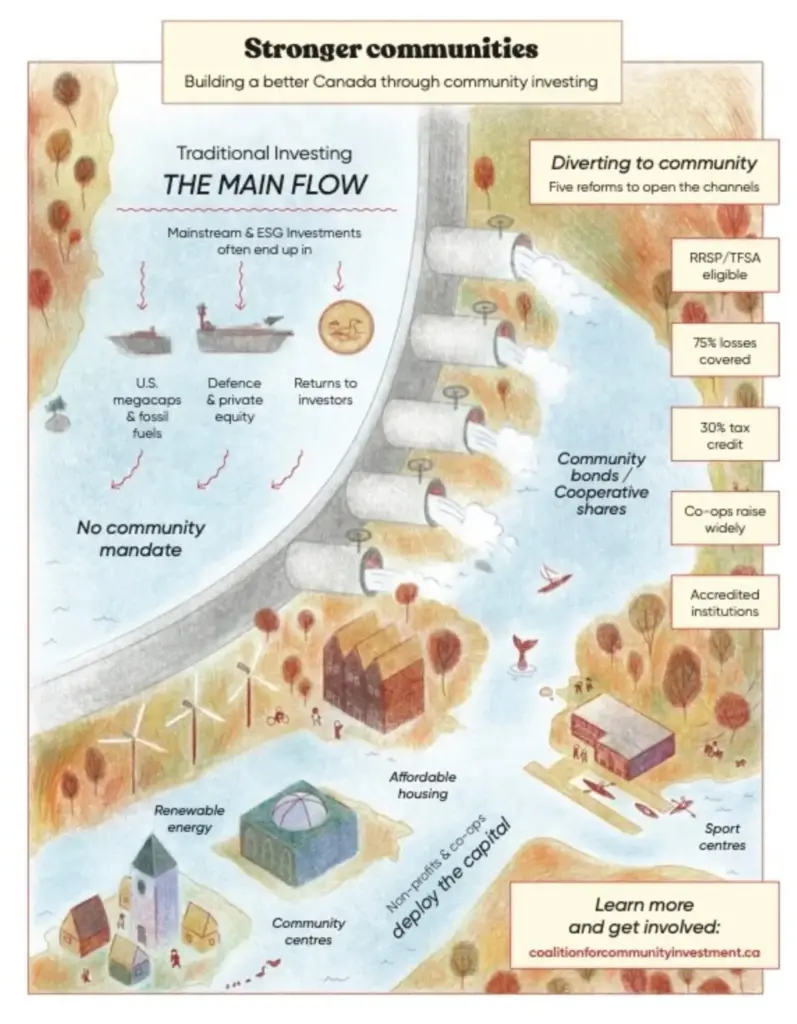
The solution does not require dismantling the financial system, but rather redirecting a minute fraction of its vast flows. Research conducted by Corporate Knights demonstrates that if just 1% of Canadian personal investments were redirected into community bonds and cooperative shares, the domestic community-finance market would experience an explosive expansion.

- Current Community-Finance Market: ~$150 million
- Projected Market with 1% Shift: $42 billion
Such a capital injection would instantly transform non-profits, charities, and cooperatives from underfunded local operations into major engines of regional economic development, funding everything from urban revitalization to rural clean-energy transitions.
Official Statements & Policy Solutions: The Five-Point Blueprint
Recognizing this immense untapped potential, the Canadian Coalition for Community Capital—an advocacy network uniting more than 30 organizations nationwide—has emerged as a powerful voice for structural economic reform. The coalition is actively lobbying the federal government to implement policy changes that will unleash citizen financing.
"Everyday Canadians are investing in the communities they call home," says Suzanne Faiza, the coalition’s coordinator. "They’re helping fund government priorities like affordable housing, renewable energy, and other projects they can actually see and experience in their own communities."
To harness this grassroots enthusiasm, the coalition has laid out a pragmatic, five-point legislative and regulatory blueprint for Ottawa:
1. Open Up Tax-Advantaged Savings Accounts
Canadians currently enjoy robust tax incentives for long-term savings through registered retirement savings plans (RRSPs), tax-free savings accounts (TFSAs), and first-home savings accounts (FHSAs). However, community bonds are systematically excluded or rendered operationally prohibitive to include within these vehicles. By updating the regulatory framework to seamlessly accommodate community bonds, the federal government would empower everyday citizens to invest safely and easily in revenue-generating, community-owned non-profits.
2. Share the Risk of Local Investing
No investment is entirely risk-free, but local investments offer asymmetric societal returns—generating economic, social, and environmental dividends that extend far beyond a narrow financial payout. By permitting investors to deduct 75% of losses incurred on eligible community-capital securities, Ottawa would dramatically lower the psychological and financial barrier to entry, instilling long-term confidence in regional markets.
3. Incentivize Community Finance via Targeted Tax Credits
The federal government routinely deploys targeted tax preferences to stimulate strategic sectors, offering lucrative credits for clean technology development, mineral exploration, research and development, and film and television production. Given their indispensable role in tackling affordable housing, deploying low-carbon energy, and driving local economic development, community bonds merit identical policy support. The coalition proposes a 30% community-capital tax credit (structured as a 20% non-refundable credit combined with a 10% refundable credit), subject to a $10,000 per-investor cap.
4. Expand the Reach of Cooperatives
Canadian cooperatives are exceptionally effective vehicles for raising local capital to support regional food systems, community housing, and low-carbon energy grids. Yet, archaic regulatory constraints prevent co-ops from selling ownership stakes or shares outside of their immediate membership bases. By dismantling these barriers and allowing all interested Canadians to invest in cooperative projects they believe in, Ottawa would inject vital momentum into a cooperative economy that historically prioritizes human need over speculative profit.
5. Build Essential Institutional Supports
To ensure investor confidence and market credibility, the nascent community-finance ecosystem requires robust institutional scaffolding. This necessitates establishing a trusted network of accredited intermediaries, rating agencies, and administrative platforms capable of facilitating bond issuances with institutional-grade reliability and transparency.
Future Outlook: Building Real Economic Strength from the Ground Up
Critics of government-backed tax incentives often point to short-term fiscal costs, but independent macroeconomic modeling reveals that the coalition’s proposed reforms are profoundly self-funding. Even under the most conservative economic scenarios, every single dollar of federal tax expenditure generates $17 in Canadian Gross Domestic Product (GDP), ultimately returning more in direct federal tax revenue than the initial policy implementation costs.
This is not merely a fiscal argument; it is a cultural and political reawakening.
"Canadians want their money to stay here," Faiza observes, drawing a direct parallel between consumer behavior and financial consciousness. "They’re checking labels at the grocery store, prioritizing Canadian products in their day-to-day lives. The government has an opportunity now to channel that sentiment into investment, too, building a network of local investment in community infrastructure. That’s real economic strength."
As Canada navigates a turbulent geopolitical future defined by economic nationalism and external coercion, the ultimate defense of national sovereignty lies not in defensive trade barriers alone, but in the collective agency of its citizens. By democratizing capital and aligning personal wealth with community well-being, Canada can successfully rebuild a capitalism that serves human values—ensuring that the nation not only survives the storms of the twenty-first century, but thrives on its own terms.
The Canadian Coalition for Community Capital is leading the charge to make it easier for everyday people to invest directly in local Canadian projects. To learn more about how grassroots finance can transform the national economy, visit coalitionforcommunitycapital.ca.



