

Executive Overview
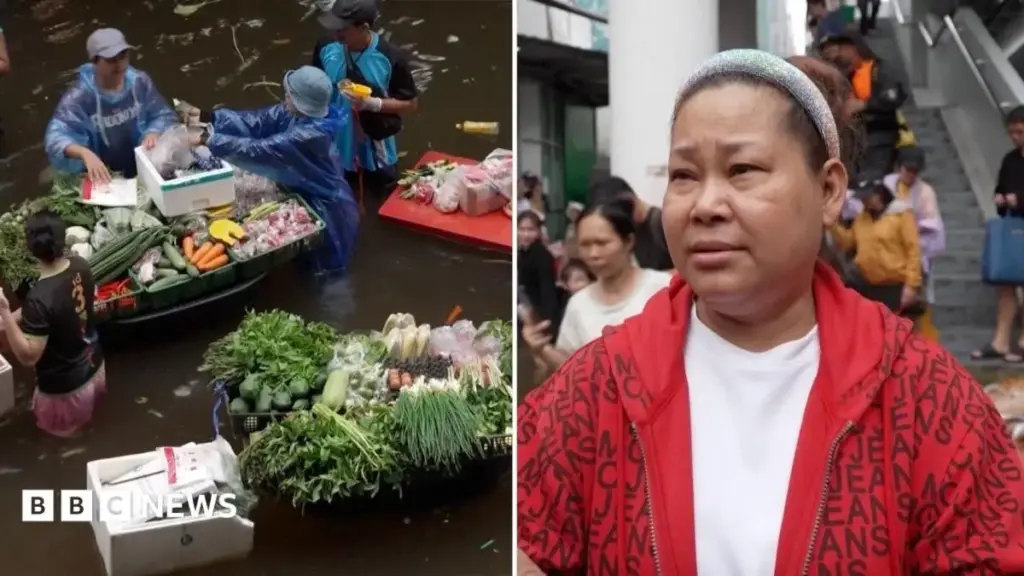
In an extraordinary display of urban resilience and cultural adaptability, residents of Thailand’s capital transformed a waterlogged thoroughfare outside a prominent downtown shopping mall into a bustling, impromptu floating market. Following days of unrelenting monsoon downpours that overwhelmed municipal drainage infrastructure, Bangkok was officially declared a disaster-affected zone.
Rather than succumbing to the paralysis typically associated with crippling urban floods, local vendors waded through knee-high brown water, utilizing foam boxes, makeshift wooden rafts, and inflated inner tubes to hawk fresh produce, seafood, and household essentials. Navigating the inundated asphalt via paddleboards, small plastic boats, and on foot, consumers engaged in commerce amidst the submerged urban landscape, painting a vivid picture of ingenuity in the face of climate adversity.
This surreal marketplace serves as a microcosm of Bangkok’s enduring vulnerability to severe weather events, laying bare the tensions between rapid, high-density commercial development and archaic hydrological management systems. While the imagery of floating vendors in front of luxury retail outlets offers a striking cultural juxtaposition, it underscores a pressing socioeconomic reality: urban communities in Southeast Asia are increasingly forced to improvise as extreme weather outpaces municipal adaptation strategies.
As experts evaluate the long-term viability of Bangkok’s flood defenses, this localized phenomenon captures both the indomitable spirit of its populace and the urgent need for structural systemic reform.
Detailed Chronology of the Crisis
Phase 1: The Gathering Storm and Initial Precipitation (Days 1–2)
The meteorological sequence leading to Bangkok’s latest disaster designation began with a stationary monsoon trough sitting directly over central Thailand, reinforced by a low-pressure cell moving inland from the Gulf of Thailand. Forecasters at the Thai Meteorological Department (TMD) issued severe weather warnings nearly 72 hours in advance, predicting heavy to very heavy cumulative rainfall across the Chao Phraya River basin.
By the end of the second consecutive day of uninterrupted precipitation, central Bangkok had recorded over 180 millimeters of rainfall within a 36-hour window. Drainage canals (khlongs), already operating near capacity from seasonal high tides, began to back up rapidly. Urban runoff overwhelmed storm drains in major commercial districts, pooling at critical intersections and low-lying transit corridors.
Phase 2: Infrastructure Overload and the Disaster Declaration (Day 3)
As downpours intensified during the early morning commute on the third day, municipal pumping stations struggled to discharge water quickly enough into the swelling Chao Phraya River. Major arterial roads transformed into aquatic bottlenecks. Traffic ground to a halt as stalled vehicles flooded, leaving motorists stranded in rising waters.
Recognizing the severity of the crisis—with over 45 distinct flood zones paralyzing traffic, halting public transport networks, and threatening structural stability in residential sectors—the Bangkok Metropolitan Administration (BMA), in coordination with the Department of Disaster Prevention and Mitigation (DDPM), formally declared the capital a disaster-affected zone. This designation unlocked emergency funds, streamlined bureaucratic procurement for heavy-duty pumps, and mobilized civil defense units and the Royal Thai Army to assist with evacuation and relief operations.
Phase 3: Emergence of the Impromptu Floating Market (Day 4)
With traditional retail supply chains disrupted and neighborhood wet markets inaccessible due to water depth, local entrepreneurialism filled the vacuum. Outside a major shopping mall in one of the city’s densely populated commercial zones, vendors recognized that the persistent floodwaters presented both a challenge and a commercial opportunity.
Capitalizing on the trapped foot traffic of stranded shoppers, office workers, and local residents, sellers repurposed materials at hand. Foam shipping boxes, discarded pallets, and flat-bottomed utility skiffs were pressed into service as aquatic storefronts. By mid-morning, a vibrant maritime economy had materialized over municipal asphalt. Vendors waded waist-deep through the turbid runoff, balancing baskets of freshwater fish, leafy green vegetables, and tropical fruits, while buyers paddled makeshift watercraft or waded through the current to barter and buy their daily provisions.
Supporting Context & Metrics: Urban Hydrology and Climate Vulnerability
Geographical and Topographical Challenges
To understand Bangkok’s perpetual struggle with inundation, one must examine its foundational geography. Built upon a low-lying alluvial delta at the mouth of the Chao Phraya River, the city sits an average of just 1.5 meters above sea level. This flat, saucer-like topography makes natural drainage exceptionally difficult, leaving the metropolis heavily dependent on an artificial network of canals, flood walls, and mechanical pumps.
Furthermore, Bangkok suffers from aggressive land subsidence. Decades of excessive groundwater extraction, compounded by the immense weight of rapid high-rise construction, have caused parts of the city to sink by several centimeters annually. Consequently, large swaths of the urban area now sit below the mean high-tide level of the adjacent river, rendering them perpetual bowls awaiting the next seasonal surge or torrential cloudburst.
Quantitative Overview of the Flood Impact
- Cumulative Rainfall: 180+ mm recorded across central Bangkok within a 36-hour operational window.
- Inundation Zones: Over 45 primary urban intersections and residential quarters severely flooded.
- Economic Disruption: Estimated daily losses running into the hundreds of millions of Thai Baht due to paralyzed retail trade, logistical bottlenecks, and commuting halts.
- Municipal Response Assets: More than 1,900 high-capacity drainage pumps deployed across 180 drainage stations, supplemented by mobile water-removal units.
- Displaced Populations: Thousands temporarily affected by structural power outages and impassable residential access roads.
Official Statements and Institutional Responses
The Bangkok Metropolitan Administration (BMA)
Bangkok Governor Chadchart Sittpunt addressed the media during an emergency press briefing, acknowledging the unprecedented volume of water that overwhelmed the city’s defenses.
"The sheer volume of rainfall we have experienced over the past 48 hours exceeds the design capacity of our primary drainage systems by a factor of nearly two," Governor Sittpunt stated. "While our teams are working around the clock at every drainage station and mobilizing mobile pumps to critical bottleneck zones, the combination of high river tides and extreme precipitation leaves us with very narrow margins. We commend the resilience of our citizens, but our absolute priority remains the rapid clearance of water from main transit arteries and the safeguarding of vulnerable populations."
Department of Disaster Prevention and Mitigation (DDPM)
The Director-General of the DDPM issued a comprehensive update regarding nationwide relief operations, emphasizing the cascading nature of the monsoon season.
"The declaration of Bangkok as a disaster-affected zone enables us to deploy federal resources directly to municipal authorities without administrative delay," the Director-General noted. "Army engineers and disaster response units are currently operating in tandem with local civil servants to clear clogged drainage gates, distribute dry rations, and provide medical assistance in submerged communities. We urge all residents in low-lying sectors to heed local advisories and remain clear of electrical hazards in flooded zones."
Economic and Retail Sector Perspectives
Representatives from the commercial real estate sector affected by the deluge noted the immediate impact on consumer foot traffic while acknowledging the cultural resilience displayed on their doorsteps.
"Retail hubs are designed to be safe, climate-controlled environments for commerce and social gathering," said a spokesperson for the downtown shopping mall association. "When extreme weather breaches our perimeters, it disrupts the entire economic ecosystem. However, the sight of vendors utilizing the flooded plaza outside our complex highlights the irrepressible entrepreneurial spirit of Bangkokians. Moving forward, private-public coordination on climate adaptation must become our primary operational focus."
Future Outlook: Mitigation, Adaptation, and Long-Term Survival
Infrastructure Overhaul: The "Water City" Blueprint
As climate change accelerates the frequency and intensity of extreme weather events across Southeast Asia, urban planners argue that traditional flood-prevention paradigms—relying solely on concrete walls, deeper canals, and larger pumps—are no longer sufficient for Bangkok. Urban hydrologists are increasingly advocating for a transition toward "Sponge City" concepts, where urban spaces are engineered to absorb, store, and naturally filter excess rainwater rather than aggressively repelling it.
Key proposals currently under evaluation by the BMA include:
- Underground Retention Tunnels: Expanding the network of subterranean water storage tunnels capable of holding millions of cubic meters of runoff during peak cloudbursts before discharging it safely into the sea.
- Creation of Urban Retention Parks: Transforming vacant lots and public green spaces into multi-functional public parks that double as retention basins during monsoon surges.
- Strict Zoning and Subsidence Controls: Enforcing stricter building codes and monitoring groundwater extraction to halt or reverse the dangerous land subsidence trends plaguing the metropolitan core.
Socioeconomic Adaptation and Community Resilience
While structural engineering projects require years of capital investment and political will, the immediate future demands agile community-level adaptation. The transformation of a flooded shopping mall street into a floating market demonstrates that Bangkok’s residents possess an innate capacity to improvise under duress.
However, reliance on ad-hoc buoyancy and informal disaster entrepreneurship cannot substitute for robust public safety nets. Future urban policy must integrate informal vendors and vulnerable populations into formal disaster preparedness frameworks, ensuring that early-warning systems, financial relief, and health services reach marginalized communities before the next major deluge strikes.
Ultimately, Bangkok stands at a critical historical crossroads. The juxtaposition of luxury retail outlets and makeshift floating markets on the same waterlogged asphalt is a stark reminder of the challenges ahead. Whether the Thai capital can successfully navigate the rising waters of climate change will depend on its ability to merge traditional grassroots resilience with visionary, future-proof urban engineering.



