


Executive Overview
The landscape of American transportation is undergoing a quiet yet profound structural transformation. Amid shifting federal policies, macroeconomic volatility, and fluctuating fuel markets, the commercial trucking sector is stepping up as the primary engine of the United States’ electric vehicle (EV) movement. While consumer EV adoption has faced headwinds following the expiration of federal tax incentives, commercial fleet operators are proving that clean transportation is no longer merely a sustainability talking point—it is a financial necessity driven by the skyrocketing cost of gasoline and diesel.
Nowhere is this shift more evident than in a landmark announcement from logistics giant FedEx. In a decisive move toward fleet decarbonization, FedEx has placed a monumental order for 2,000 all-electric trucks from Harbinger, a California-based commercial EV startup. This acquisition stands as one of the largest single orders for medium-duty electric trucks in US history. It signals a broader market reality: while individual drivers have alternative transit options, commercial work vehicles must remain operational, cost-effective, and resilient against volatile fossil fuel pricing.
This article examines the convergence of soaring fuel costs, startup innovation, and heavy-duty fleet electrification. We will analyze the broader context of the US EV market, explore the mechanics behind massive fleet transitions like those led by FedEx, Harbinger, Workhorse, and Tesla, and assess what the future holds for domestic automotive manufacturing and commercial freight.
Detailed Chronology: Milestones in the Commercial EV Resurgence
To understand the current momentum in commercial vehicle electrification, it is essential to trace the critical milestones that have shaped the market over the past several years, culminating in the recent wave of historic fleet commitments.
- Late Summer 2025: Automakers and industry stakeholders begin re-evaluating supply chains as gasoline and diesel prices exhibit severe upward pressure. Concurrently, legacy manufacturers like Ford outline their "Universal EV" architecture aimed at dramatically slashing production costs and closing the price gap with internal combustion engine (ICE) vehicles.
- September 30, 2025: The federal $7,500 consumer EV tax credit officially sunsets. While consumer adoption slows significantly across the passenger vehicle market, commercial entities begin heavily modeling total cost of ownership (TCO) advantages for electric logistics vehicles.
- April 2026: Market reports highlight surging demand for medium-duty electric trucks as fleet operators seek insulation from volatile fuel markets. Startups like Harbinger and established players like Workhorse gain traction by targeting vocational segments largely ignored by passenger-focused manufacturers.
- July 2026: Industry analysts mark a turning point as legacy heavy-duty makers—including Mack Trucks and PACCAR (Peterbilt)—face intensified competition from specialized EV startups and high-volume production initiatives.
- September 20,–26, 2026: Tesla officially launches volume production at its new Class 8 Semi factory in Sparks, Nevada, targeting an ambitious output of 50,000 trucks annually. Concurrently, the transportation industry collective ZET SCALE (led by Catalyst Mobility) announces a pre-qualification agreement for 2,500 Tesla Semis to aggregate member demand across corporate giants like Microsoft and PepsiCo.
- September 30, 2026: In a flurry of domestic commercial activity, Harbinger announces its 2,000-vehicle deal with FedEx, slated for complete delivery across North American pickup and delivery routes by the end of 2027. On the same day, Workhorse Group confirms an expansion order of 200 W56 electric step-vans from Gateway Fleets, underscoring robust manufacturing output at its Union City, Indiana facility.
Supporting Context & Metrics: Navigating Fuel Costs and Market Pressures
The US vehicle electrification movement is navigating a complex paradox. On one hand, the abrupt termination of federal policy support for consumer EVs created a temporary contraction in the light-duty market, sparking intense debate over whether the United States risks falling behind global competitors like China. On the other hand, commercial fleet operators operate under strict economic imperatives that transcend political shifts.
The True Cost of Diesel vs. Electricity
As fuel prices periodically breach historic highs, the arithmetic of fleet management becomes unmistakable. Commercial delivery vehicles rack up tens of thousands of miles annually, making them disproportionate consumers of diesel fuel. When fuel prices spike, operating margins for logistics companies narrow dramatically.
Consider the economic profile of the recent FedEx-Harbinger agreement:
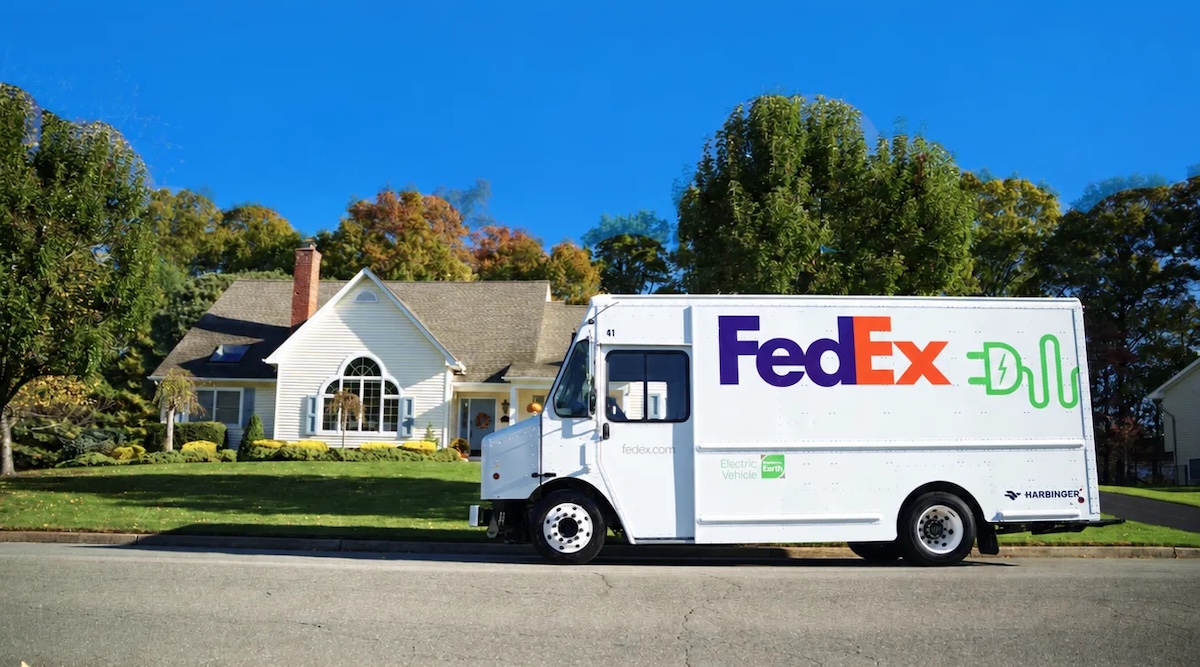
- Vehicle Class: Harbinger’s vehicles fall into the Class 5 and Class 6 medium-duty categories, the workforce backbone of urban and suburban parcel delivery.
- Operational Lifespan: These purpose-built electric trucks are engineered for a 20-year working life, matching the durability expectations of conventional fossil-fueled medium-duty trucks.
- Projected Savings: According to preliminary estimates released by Harbinger, the 2,000-vehicle FedEx order is projected to yield staggering cumulative 20-year fuel savings exceeding $800 million.
This massive economic delta explains why fleet operators are unwilling to wait for legislative pivots. By executing a strict one-to-one retirement strategy—replacing internal combustion engine trucks with electric alternatives rather than simply appending them to existing fleets—companies like FedEx are locking in structural cost reductions.
The Infrastructure and Aggregation Challenge
Transitioning commercial fleets is not merely a matter of swapping engine blocks; it requires comprehensive ecosystem coordination. Individual fleet operators often struggle with the capital expenditures required for depot charging, route planning, and vehicle procurement.
This friction has fueled the rise of demand-aggregation collectives such as ZET SCALE. By organizing major corporate fleets, these alliances pre-qualify original equipment manufacturers (OEMs), negotiate volume discounts, streamline charging infrastructure deployment, and bundle innovative financing solutions. Such coordination bridges the gap between nascent EV manufacturers and massive corporate buyers, ensuring that zero-emission freight is commercially viable from day one.
Official Statements and Industry Perspectives
The rapid pivot toward electric commercial vehicles has prompted widespread commentary from executives, startup founders, and industry analysts alike.
John Garcia, an independent logistics analyst, notes the divergence between consumer and commercial markets:
"While the consumer passenger vehicle sector absorbed a heavy shock when federal tax credits lapsed, logistics operations operate on strict spreadsheet mathematics. When diesel breaches critical price thresholds, fleet managers do not look at political talking points; they look at operating cost per mile. Electric trucks are winning because the math demands it."
The collaborative ethos driving these monumental orders is echoed by transition accelerators. Catalyst Mobility, the lead partner behind the ZET SCALE alliance, emphasized the strategic necessity of collective action:

"Rather than asking individual companies to navigate the transition alone, ZET SCALE aligns the entire value chain—unlocking better vehicle pricing, innovative financing, coordinated charging infrastructure, and freight demand that helps make zero-emission trucking commercially viable."
On the manufacturing front, companies emphasizing domestic production have underscored the importance of localized scale. Workhorse, highlighting its Union City, Indiana facility—capable of producing over 5,000 vehicles annually on a single shift—demonstrates that domestic manufacturing infrastructure is expanding to meet localized demand for box trucks, step-vans, and refrigerated transport. Similarly, Harbinger’s ability to secure a multi-thousand-unit commitment from a global logistics titan like FedEx validates the viability of vertically integrated, startup-driven innovation tailored specifically for medium-duty vocations.
Future Outlook: The Horizon of US Fleet Electrification
Looking ahead, the trajectory of vehicle electrification in the United States will likely be defined less by federal consumer subsidies and more by commercial necessity, infrastructure maturation, and manufacturing capacity.
1. Scaling the Medium- and Heavy-Duty Sectors
While Class 8 long-haul trucks—spearheaded by Tesla’s volume production ramp-up in Sparks, Nevada, and backed by early adopter consortia—continue to capture headlines, the true volume of urban logistics rests in Classes 3 through 6. The FedEx-Harbinger deployment of 2,000 trucks through 2027 serves as a bellwether. Expect other major delivery networks to follow suit as pilot programs yield verifiable maintenance and energy savings.
2. Domestic Supply Chain Resilience
Concerns regarding US competitiveness in global automotive manufacturing have spurred domestic investments. General Motors is advancing plans for lithium-manganese-rich (LMR) battery cells to secure lower-cost, high-performance local supply chains, while Ford continues refining its "Universal EV" platform to drive down manufacturing overhead. The survival and growth of domestic EV production will increasingly hinge on whether traditional automakers and agile startups can outpace foreign competitors in commercial-scale production efficiency.
3. The End of the Diesel Era in Urban Delivery
As municipal governments tighten emissions standards and corporate sustainability mandates mature, urban centers are becoming increasingly hostile to diesel-powered delivery fleets. The transition is transitioning from a voluntary corporate social responsibility (CSR) initiative to an essential operational baseline. With startups like Harbinger and Workhorse delivering purpose-built, long-lasting electric architectures, and giants like FedEx and Gateway Fleets aggressively modernizing their footprints, the foundation of a clean American transport network is firmly taking shape.
Ultimately, the message from the American trucking sector is clear: vehicle electrification is not fading away. Driven by undeniable economic fundamentals and relentless corporate demand, the electric commercial truck revolution is accelerating down the highway.



