

Executive Overview
For two decades, the Biodiversity Heritage Library (BHL) has served as the world’s most comprehensive open-access repository for digital literature concerning Earth’s biological diversity. As the institution marks its landmark 20th anniversary through the commemorative series BHL at 20: Treasures from the Biodiversity Heritage Library, attention naturally turns to the historical foundations that underpin modern ecological and evolutionary sciences. Among the most profound contributions to this global archive are the rare archival materials, comprehensive field logs, and foundational monographs contributed by the University of Illinois Urbana-Champaign Library.
At the heart of these regional contributions lie the life works of two pioneering 19th- and early 20th-century naturalists: Stephen Alfred Forbes and Charles Robertson. Though their methodological approaches differed—Forbes surveying the broad, interconnected webs of aquatic and terrestrial biomes, and Robertson meticulously cataloging the minute symbiotic dances between specific flora and fauna—both men fundamentally altered humanity’s understanding of ecological systems.
Today, their preserved writings, specimen logs, and landmark publications, hosted seamlessly within the BHL ecosystem, do more than chronicle historical milestones. They provide an irreplaceable ecological baseline. In an era marked by rapid industrialization, habitat fragmentation, and global biodiversity loss, the meticulous observations of Forbes and Robertson offer modern researchers an invaluable lens through which to measure environmental change over a span of more than a century. This article explores the extraordinary lives, methodologies, and enduring scientific echoes of these two foundational figures, contextualizing their work within the broader mission of the Biodiversity Heritage Library.

Detailed Chronology: The Lives and Milestones of Forbes and Robertson
Stephen A. Forbes: The Architect of Aquatic and Environmental Science
Stephen Alfred Forbes was born on May 29, 1844, at a time when the American midwestern landscape was undergoing profound agricultural and industrial transformation. Possessing a voracious intellect, Forbes emerged as a towering titan in the fields of zoology, entomology, and nascent ecology. His early academic and field studies defied narrow specialization; he investigated the interconnected lives of insects, crustaceans, fishes, and birds, viewing them not as isolated taxonomic specimens, but as dynamic actors within complex environmental networks.
- 1886: Forbes’s international reputation solidified when he was awarded the prestigious first-class medal of the Société d’Acclimation de France in recognition of his groundbreaking scientific publications.
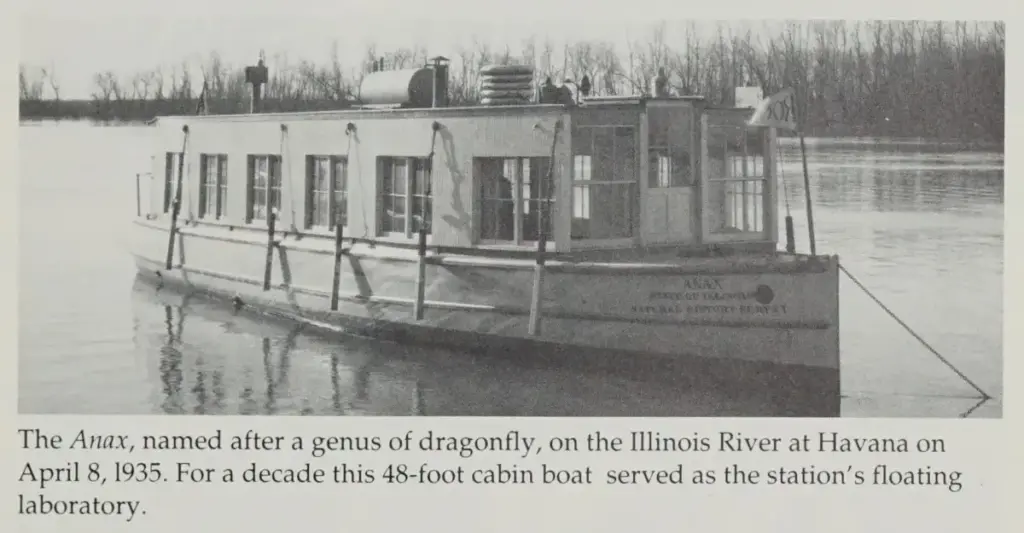
- 1894: Recognizing the necessity for continuous, localized aquatic research, Forbes established the pioneering Forbes Biological Station. Two years later, in 1896, he directed the construction of a 48-foot floating biological laboratory anchored on the Illinois River in Havana, Illinois. This innovative floating station allowed researchers to live and work directly upon the waterway they studied, setting a new standard for field biology.
- 1908: Forbes published his monumental work, The Fishes of Illinois, a landmark text documenting over 150 fish species derived from more than 200,000 specimens painstakingly gathered from all 102 counties of Illinois. Illustrated with rich, exquisite color paintings by artists Lydia M. (Hart) Green and Charlotte M. Pinkerton, and paired with precise distribution maps, the volume became an instant classic in aquatic biodiversity research.
- 1917: Appointed as the director of the Natural History Survey Division, Forbes led the organization with characteristic vigor and administrative acumen until his death on March 13, 1930, in Urbana, Illinois.
- 1994 (May 26): The Illinois Natural History Survey (INHS) celebrated the sesquicentennial (150th anniversary) of Forbes’s birth, cementing his legacy as a founding father of American ecological science.
Charles Robertson: The Master of Plant-Pollinator Interactions
Born on June 12, 1858, in Carlinville, Illinois, Charles Robertson led a life of quiet, intense dedication that contrasted sharply with Forbes’s institutional leadership, yet proved equally revolutionary. After initiating his academic journey at Blackburn College in his hometown, Robertson pursued advanced studies in botany and zoology at Harvard University. He eventually returned to Blackburn College, serving as a professor of biology and Greek while embarking on a monumental, decades-long observational campaign.
- The Carlinville Survey (1880s–1920s): For more than twenty years, Robertson conducted an intensive, hyper-local study centered entirely within the vicinity of Carlinville. He methodically recorded every insect visit to local plant species, ultimately documenting 1,429 pollinating insect species—encompassing flies, beetles, butterflies, and bees—interacting with 456 distinct plant species.
- 1928: Robertson published his masterwork, Flowers and Insects, representing one of the most rigorous, exhaustive single-locality studies of pollination biology ever undertaken. Every insect recorded in the volume was cross-referenced directly with the specific plant upon which it was collected.
- June 1, 1935: Demonstrating a lifelong, unyielding devotion to his craft, Robertson was actively collecting insects in the field in Florida just months before his death in Carlinville at the age of 76.
- Archival Preservation and Modern Rediscovery: Robertson’s meticulous specimen collection logs, extensive correspondence, five detailed ledgers, and dedicated bee-research data books—spanning from 1877 to 1935—were safely preserved in the University Archives at the University of Illinois Urbana-Champaign. These records have since transformed from historical curiosities into vital modern datasets for tracking pollinator decline.
Supporting Context & Metrics: Quantitative Insights and Ecological Impact
The enduring relevance of Forbes and Robertson is best understood through the measurable metrics of their scientific output and the modern analytical frameworks applied to their archives.

The Scale of Forbes’s Aquatic Inventory
- 200,000+: The staggering number of individual fish specimens collected, examined, and categorized for The Fishes of Illinois.
- 102: The total number of Illinois counties swept during Forbes’s expansive geographical survey, ensuring a complete and unbiased baseline of the state’s aquatic health at the turn of the 20th century.
- 7: The number of active biological field stations currently operated by the Illinois Natural History Survey today (including the historic Forbes Biological Station, Great Rivers Field Station, Illinois River Biological Station, Kaskaskia Biological Station, Lake Michigan Biological Station, Ridge Lake Biological Station, and Sam Parr Biological Station). These installations directly trace their lineage and operational philosophy to Forbes’s initial 1894 vision.
The Precision of Robertson’s Pollinator Networks
- 1,429: The precise count of distinct pollinating insect species documented by Robertson in Carlinville, a baseline that modern conservationists use to measure the severe anthropogenic pressures currently facing insect populations.
- 456: The total number of plant species mapped into interaction webs with Robertson’s recorded visitors.
- July 2026 Analysis: The immense scholarly value of Robertson’s work was powerfully reaffirmed via a quantitative analysis published in the Data Science Journal, illuminating how mid-to-late 19th-century collection logs can be computationally parsed to map historical biodiversity shifts.
Official Statements and Institutional Testaments
The profound cultural and scientific footprint left by Stephen A. Forbes is perhaps best encapsulated in the official memorial resolutions drafted by his academic peers. Upon his passing, the University Senate at the University of Illinois put forth a formal resolution that captured not only his formidable intellect, but his deep humanity:
"The Senate knew him as Professor of Zoology and Entomology and Dean of the College of Science; it admired his sagacity and patience as chairman of its Committee on Educational Policy; its members loved him for his simplicity, sincerity and broad human interests. The University and the State are immeasurably indebted to him as one of their most useful and eminent laborers for the common good."
Similarly, modern scientific evaluations underscore the irreplaceable nature of these historical archives. Commenting on the intersection of historical logs and contemporary conservation biology, researchers involved in ecological network studies—such as investigations published in Ecology & Society led by INHS affiliate John Marlin—have emphasized that Robertson’s records provide a window into an intact, pre-industrial prairie ecosystem that can no longer be observed firsthand in the wild. Without these digitized paper trails, modern scientists would be entirely blind to the baseline metrics of regional pollinator health.

Future Outlook: Bridging Historical Archives and Contemporary Conservation
As the Biodiversity Heritage Library celebrates its 20th anniversary, the inclusion and digital preservation of works by figures like Forbes and Robertson represent a vital bridge between historical archives and the future of global conservation science.
The challenges facing modern ecosystems—habitat loss, climate change, chemical pollution, and catastrophic insect declines—cannot be fully understood by looking only forward. Effective environmental policy and ecological restoration require reliable historical baselines. Archives such as Robertson’s specimen logs and Forbes’s exhaustive aquatic surveys provide precisely this historical anchor. They allow contemporary researchers to quantify species loss, track shifts in phenology, and design more resilient landscape management strategies.
Furthermore, the integration of these materials into open-access digital platforms like BHL democratizes scientific inquiry. Historians, students, educators, and citizen scientists from around the globe can examine the exact hand-drawn maps, color plates by artists like Lydia M. Hart Green, and handwritten collection ledgers that inspired generations of biologists.

By preserving the human experience of doing science alongside the formal literature, the Biodiversity Heritage Library ensures that the legacy of pioneers like Stephen A. Forbes and Charles Robertson will continue to illuminate, educate, and guide the stewards of our natural world for decades to come.



